](https://deep-paper.org/en/paper/2412.06191/images/cover.png)
Introduction
Imagine trying to photograph a bullet speeding through the air. Now, imagine that after you’ve taken the photo, you decide you actually wanted to focus on the target behind the bullet, not the bullet itself. Traditionally, this is impossible. You would need a high-speed camera to freeze the motion, and a light field camera to change the focus. But high-speed cameras are data-hungry beasts, often requiring gigabytes of storage for a few seconds of footage, and light field cameras are notoriously slow or bulky.
What if there was a way to capture high-speed motion, high dynamic range (HDR), and 3D angular information all at once, without melting your hard drive?
This is the premise behind a fascinating new framework called Event Fields. By combining the unique properties of neuromorphic “event cameras” with clever optical engineering, researchers have unlocked a new imaging paradigm. As shown in the composite image below, this technology allows for applications ranging from slow-motion refocusing to instant depth estimation—things that were previously extremely difficult to do simultaneously.
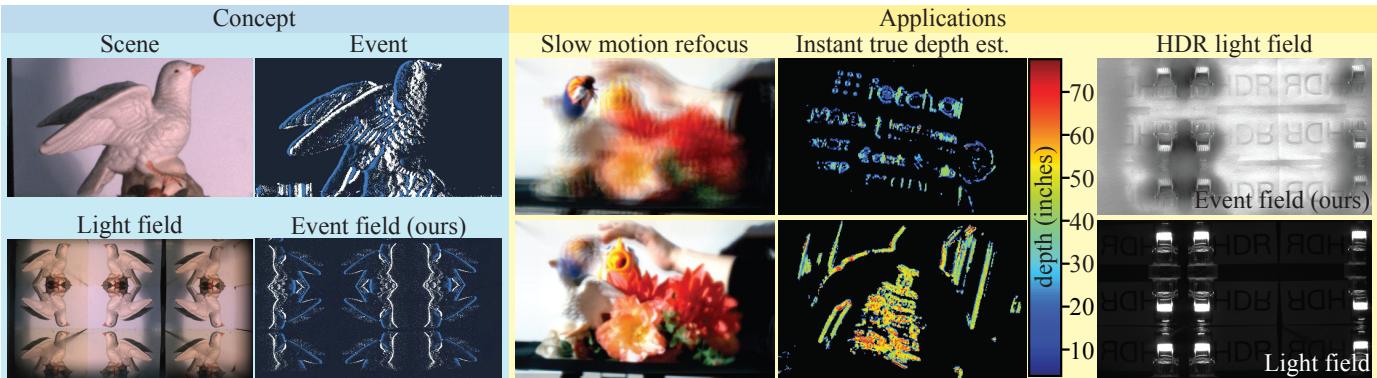
In this post, we will tear down the research paper “Event fields: Capturing light fields at high speed, resolution, and dynamic range.” We will explore how “events” can replace “frames” to capture the full plenoptic function, enabling us to see the world in 5 dimensions (space, time, and angle).
Background: The Building Blocks
To understand Event Fields, we first need to understand the two technologies being merged: Light Fields and Event Cameras.
1. The Light Field (The “What”)
When you take a standard photograph, you are capturing a 2D projection of the world. All the light rays hitting a specific pixel are summed up, meaning you lose information about where those rays came from (their angle).
A Light Field, however, captures both the position and the direction of light rays. In physics terms, while a standard image is a 2D function \(I(x,y)\), a light field is often represented as a 4D function \(L(u,v,s,t)\), where \((u,v)\) is the sensor plane and \((s,t)\) is the aperture plane.
To get a standard 2D image from a light field, you essentially integrate (sum up) the light field over the aperture:
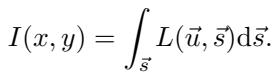
Because you possess the angular data before this integration happens, you can mathematically manipulate the path of light after the fact. This allows for post-capture refocusing—shifting the focal plane computationally rather than mechanically.
2. Event Cameras (The “How”)
Standard cameras work by taking snapshots (frames) at a fixed clock rate (e.g., 60 frames per second). If nothing moves, they still capture the same image 60 times. If something moves too fast, it blurs.
Event cameras are different. They are bio-inspired sensors that work like the human retina. Each pixel operates independently and asynchronously. A pixel only sends data—an “event”—when it detects a significant change in brightness.
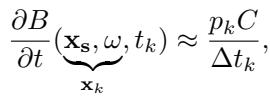
Mathematically, an event is triggered at time \(t_k\) when the change in logarithmic brightness \(B\) exceeds a threshold \(C\):

This means event cameras are measuring the temporal derivative of the scene. They have incredibly low latency (microseconds), high dynamic range, and low power consumption because they don’t record the redundant static background.
The Problem
Here is the catch: Event cameras are great at speed, but they inherently “integrate” light over all angles just like a standard camera pixel does. They lose the light field information. Conversely, light field cameras are usually constructed with microlens arrays or camera gantries that are not suited for high-speed, continuous capture.
The researchers propose Event Fields to solve this. The goal is to capture radiance derivatives across both angular and temporal dimensions.
Core Method: Capturing the Event Field
To capture an Event Field, we need to force the event camera to record angular information. The researchers propose two distinct frameworks to achieve this: Spatial Multiplexing and Temporal Multiplexing.
Approach 1: Spatial Multiplexing (The Kaleidoscope)
The first method involves taking the angular views and spreading them out across the camera’s sensor. This is done using a Kaleidoscope.
As illustrated below, a rectangular kaleidoscope (a mirror tunnel) is placed in front of the lens. Light rays entering from different angles bounce around inside the kaleidoscope and land on different parts of the sensor.
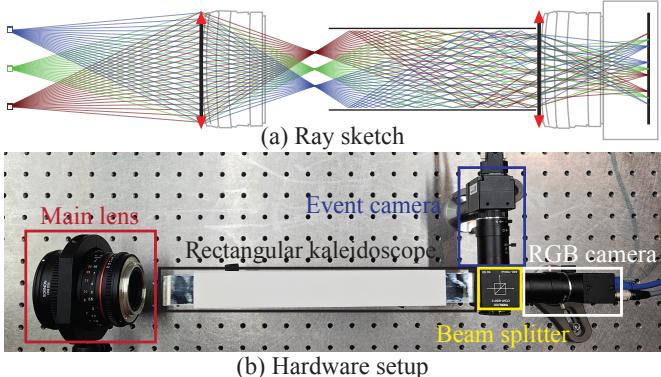
By mapping specific angles \((\omega_i)\) to specific spatial coordinates \(\mathbf{x}\), the camera captures multiple views of the scene simultaneously.

Consequently, the event camera measures:
Pros & Cons:
- Pro: It is simple and requires no moving parts. It captures all views simultaneously, making it excellent for high-speed dynamic scenes.
- Con: It sacrifices spatial resolution. If you want a \(3 \times 3\) grid of views (9 angles), your effective resolution drops by a factor of 9.
- Con: It relies on temporal changes. If the scene is perfectly still, the event camera sees no change, and thus records nothing.
Approach 2: Temporal Multiplexing (The Galvanometer)
The second method is more subtle. Instead of splitting the image, what if we rapidly change the camera’s viewing angle over time?
The researchers placed a Galvanometer (a fast-steering mirror) in the optical path. By oscillating the mirrors, they can sweep the viewing angle along a specific path (like a circle or a Lissajous curve) at high frequency (e.g., 250 Hz).
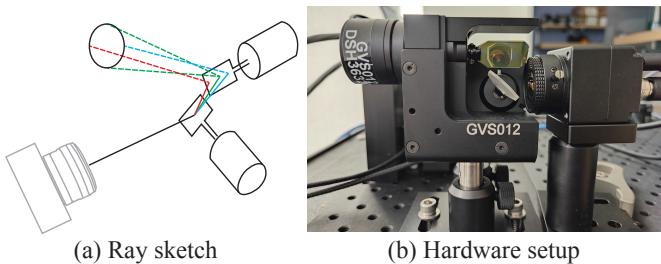
This creates a fascinating effect. Even if the object is static, the virtual camera is moving. As the viewing angle changes, the intensity hitting a specific pixel changes because of the angular variation in the light field.
Mathematically, this means the event camera is now measuring the angular derivative of the light field:

Pros & Cons:
- Pro: No loss of spatial resolution. You get the full megapixel count of the sensor.
- Pro: It can see static objects! Because the mirror scans the angles, it generates events even if the object is frozen.
- Con: It introduces a trade-off with time. You are scanning angles sequentially, so extremely fast motion might introduce artifacts (motion blur) if the object moves significantly during one scan cycle.
To test these theories before building hardware, the authors developed a physics-based simulator using Blender.

Experiments & Analysis
The researchers conducted extensive comparisons between the two designs (Kaleidoscope vs. Galvanometer) using both simulation and real-world prototypes.
Comparison 1: Static vs. Dynamic Scenes
The most distinct difference between the two designs is how they handle static objects. In a simulated test, a scene featured swirling water (moving) and a wooden box (static).

- Kaleidoscope (b): Notice that the static wooden box is invisible. Since it doesn’t move, and the kaleidoscope doesn’t move, no events are triggered. The resolution is also lower (blockier).
- Galvanometer (c): The static box is perfectly reconstructed because the scanning mirror induces changes. However, looking at the moving object (the floating debris), we see “motion blur” as the speed increases (\(8\times\)).
Comparison 2: The “Aperture Problem”
In computer vision, it is often difficult to detect motion parallel to an edge (e.g., a vertical line moving vertically looks stationary). A similar issue occurs here.
In a real-world experiment, the researchers moved a grid pattern horizontally.

The Kaleidoscope failed to see the horizontal lines because, as they slid sideways, the intensity along that line didn’t change. The Galvanometer, however, scans in a circular motion. This “circular scrubbing” ensures it catches edges in all directions, regardless of the object’s motion vector.
Application: High Dynamic Range (HDR)
One of the massive advantages of event cameras is their dynamic range (\(140\) dB vs. \(60\) dB for standard cameras). The researchers demonstrated this by capturing a scene with bright LEDs and a darker background.
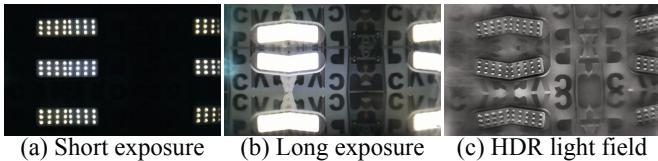
Standard cameras (a, b) force you to choose: expose for the bright light (losing the background) or expose for the background (blowing out the light). The Event Field (c) captures the structural detail of the bright LEDs and the background texture simultaneously.
Application: SloMoRF (Slow Motion Refocusing)
Using the Kaleidoscope design, the authors showcased “SloMoRF.” They combined the event data with a standard low-frame-rate RGB camera. By using sensor fusion algorithms (like TimeLens), they could reconstruct high-speed, color video that allows for refocusing.
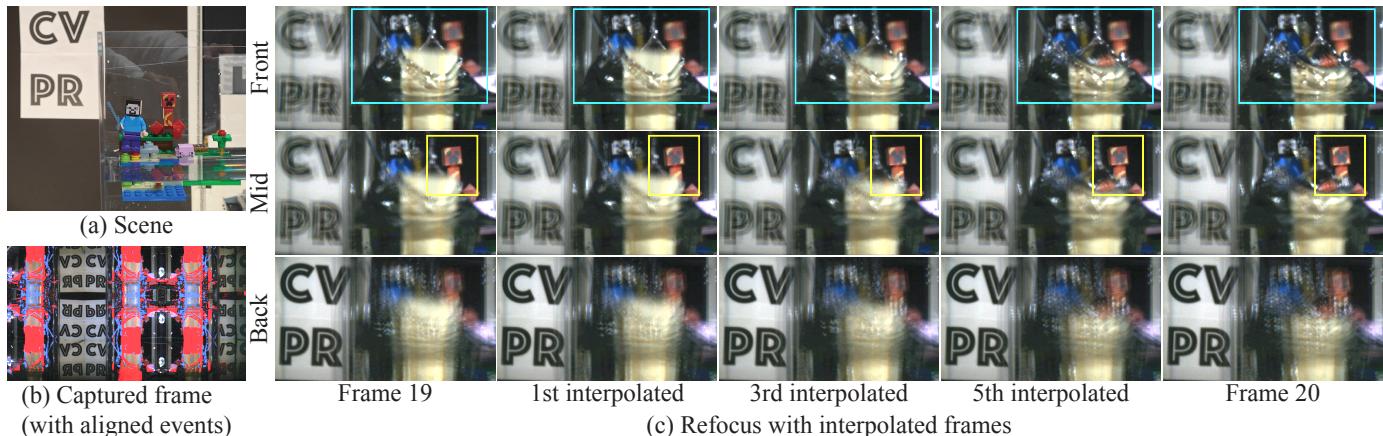
In Figure 8, they captured Lego pieces falling into water. The system interpolated the frame rate from 120 fps to 720 fps. The result is a crisp, slow-motion video where they can shift focus from the foreground splash to the background “CVPR” text after the fact.
They pushed this further with a high-speed projectile—a Nerf dart.

Here, the effective frame rate was boosted to 960 fps. Figure 9 shows the capability to keep the fast-moving dart in sharp focus while blurring the background, or vice-versa. This is incredibly difficult to achieve with conventional equipment.
Application: Galvanometer Refocusing & Depth
The Galvanometer design shines when resolution matters. The researchers captured a fan spinning at 480 RPM.

In Figure 10, the standard camera (b) suffers from motion blur on the fan blades due to the exposure time. The Event Field reconstruction (a), running at an equivalent of 10,000 fps (reconstructed from events), freezes the fan blades perfectly while allowing the user to focus on the “CVPR” text on the blades or the background.
Furthermore, because the Galvanometer scan follows a known geometric curve, the “sharpness” of a pixel at a specific point in the scan correlates directly to its distance from the camera. This allows for Instant True Depth Estimation.
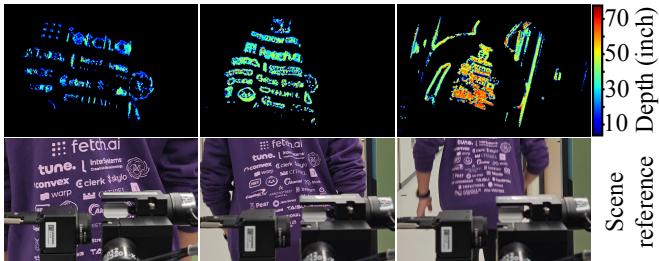
Figure 12 shows a person running away from the camera. The system generates a dense depth map at 100 Hz, showing the person moving from 10 inches to 70 inches away (color-coded blue to red). This method of depth sensing is passive and much faster than many active scanning systems.
Challenges and Trade-offs
While promising, the Event Field framework isn’t magic. The authors highlight a counter-intuitive limitation regarding the scan frequency of the galvanometer.
You might think “scanning faster is always better.” However, event cameras have a bandwidth limit (a maximum number of events they can process per second).

As shown in Figure 11, when the scan speed hits 800 Hz, the camera is overwhelmed by the number of events generated by the background texture. The system starts dropping data, causing the static background to blur (a phenomenon usually associated with motion, but here associated with bandwidth). However, the fast-moving fan actually looks better at higher speeds because the relative motion blur is reduced. This reveals a complex optimization game between scan speed, scene complexity, and sensor bandwidth.
Conclusion
The “Event Field” is a significant step forward in computational photography. By realizing that we don’t need to choose between high speed and rich angular data, the researchers have opened a door to 5D imaging.
- The Kaleidoscope approach offers a robust, solid-state solution for extremely dynamic scenes where resolution can be traded for speed.
- The Galvanometer approach offers a high-resolution solution that works on static and dynamic scenes alike, turning a standard event camera into a scanning light field sensor.
This work has profound implications for robotics, where high-speed depth estimation is critical, and for scientific imaging, where analyzing high-speed fluid dynamics or ballistics often requires refocusing after the event has occurred. As event sensors improve in resolution and bandwidth, techniques like Event Fields will likely become standard tools in the computer vision arsenal.