](https://deep-paper.org/en/paper/2412.06234/images/cover.png)
If you have been following the explosion of 3D computer vision lately, you are likely familiar with 3D Gaussian Splatting (3D-GS). It has revolutionized the field by representing scenes as clouds of 3D Gaussians (ellipsoids), allowing for real-time rendering and high-quality reconstruction.
However, there is a divide in how these models are used. On one side, we have per-scene optimization, where a model spends minutes or hours learning a single specific room or object. This produces incredible detail because the model can iteratively add more Gaussians (densification) where needed.
On the other side, we have generalized feed-forward models. These are neural networks trained on massive datasets to look at a few images and instantly predict a 3D representation. They are fast and generalize to new objects, but they often lack high-frequency detail. Why? Because they usually predict a fixed number of Gaussians. They can’t “zoom in” and add more geometry to a complex texture the way per-scene optimization does.
Today, we are diving into a paper that bridges this gap: “Generative Densification: Learning to Densify Gaussians for High-Fidelity Generalizable 3D Reconstruction.” The authors propose a method to teach feed-forward models how to adaptively add detail (densify) in a single forward pass, giving us the speed of generalizable models with the high fidelity of optimization methods.
The Problem: The Detail Bottleneck
Feed-forward Gaussian models (like LaRa or MVSplat) are essentially regression machines. You feed in images, and the network spits out Gaussian parameters (position, color, opacity, etc.).
The limitation is strict: the network typically outputs a fixed budget of Gaussians. If you are reconstructing a smooth wall, you have too many Gaussians. If you are reconstructing a wicker chair or a text label, you have too few.
In standard per-scene 3D-GS, the algorithm solves this by monitoring gradients. If a region has a high error gradient, the system splits one big Gaussian into two smaller ones (densification). But we can’t easily apply this to feed-forward models because:
- Speed: Iterative splitting and optimizing takes too long, defeating the purpose of a “fast” feed-forward model.
- Overfitting: Optimizing on just a few input views usually leads to artifacts when viewed from new angles.
The researchers behind this paper asked: Instead of optimizing to densify, can we learn to densify?
The Solution: Generative Densification
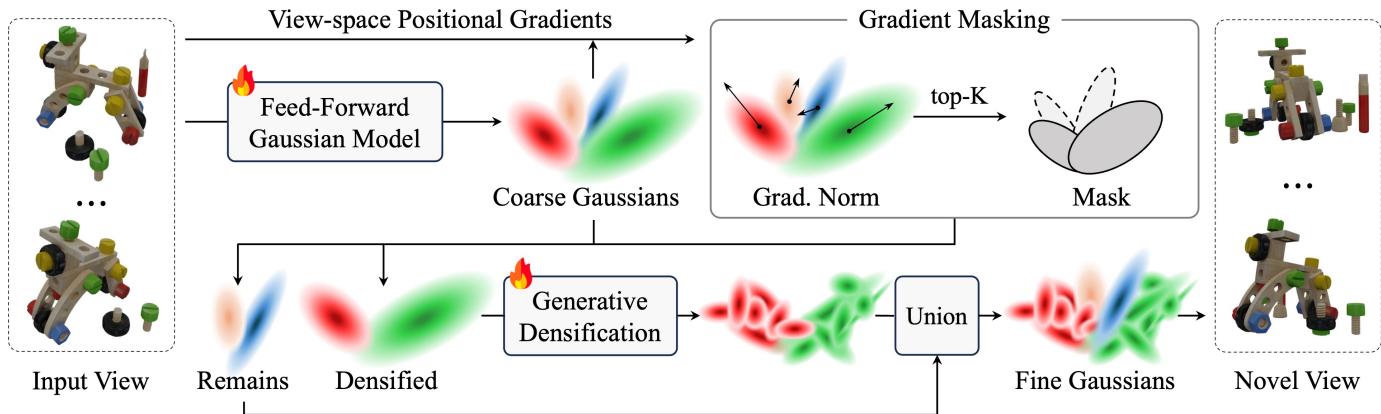
The proposed method, Generative Densification (GD), is a module that sits on top of existing feed-forward models. It takes the initial “coarse” Gaussians and intelligently spawns “fine” Gaussians where details are missing.
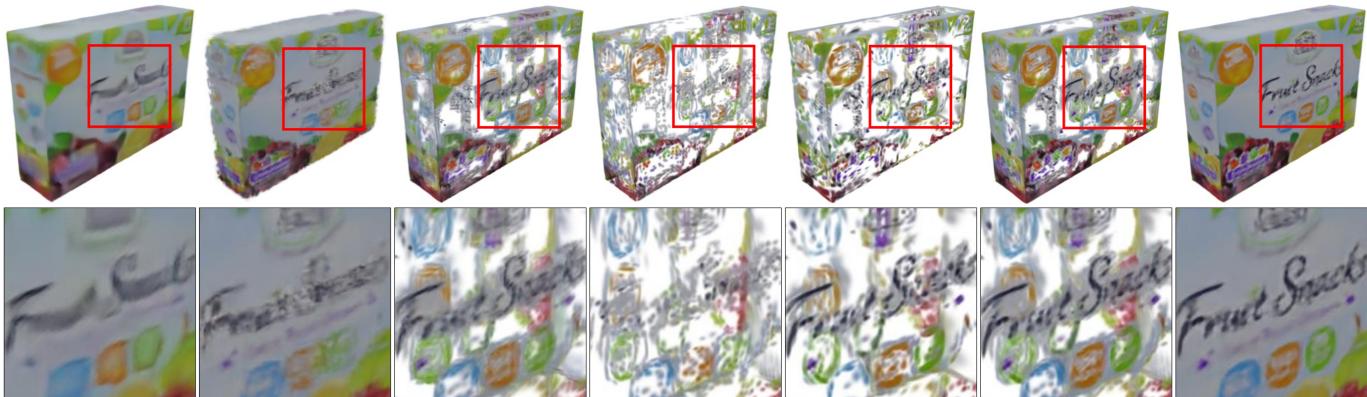
As shown in Figure 1, the process is selective. It doesn’t just double the resolution everywhere (which would be wasteful). It identifies areas of high complexity—like the text on the “Fruit Snacks” box—and concentrates its computational power there.
Step 1: Identifying Candidates via Gradient Masking
The first step is deciding where to add detail. The authors borrow a heuristic from standard 3D-GS: View-Space Positional Gradients.
The system renders the current “coarse” Gaussians and compares them to the input images. It calculates the gradients of the loss with respect to the Gaussian positions.
\[ m _ { i } ^ { ( 0 ) } = \frac { 1 } { V } \sum _ { v = 1 } ^ { V } \lVert \nabla _ { p ( x _ { i } ^ { ( 0 ) } , v ) } \mathcal { L } _ { \mathrm { M S E } } ( I _ { v } , \hat { I } _ { v } ) \rVert _ { 2 } , \]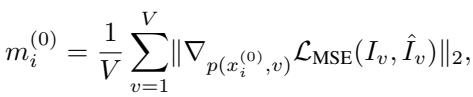
Simply put, if a Gaussian is moving around a lot during backpropagation (high gradient), it means the model is struggling to represent that area. The authors select the top \(K\) Gaussians with the highest gradients to be candidates for densification.
Step 2: The Generative Densification Module
Once the candidates are selected, they are passed to the Generative Densification Module. This isn’t a simple “split” operation; it’s a learned neural network process.
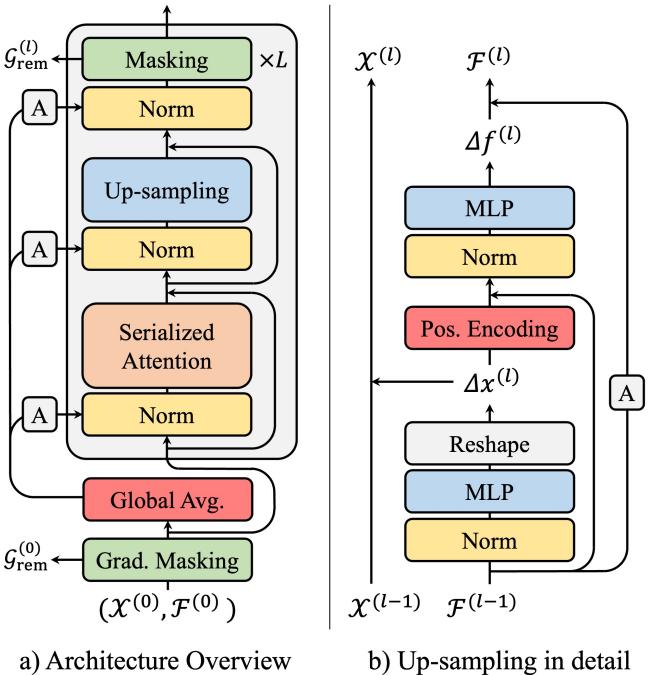
The module consists of three main stages, repeated in layers:
- Up-sampling (UP)
- Splitting via Learnable Masking (SPLIT)
- Gaussian Head (HEAD)
Let’s look at the architecture:
Serialized Attention
The input to this module is a point cloud of Gaussians. Standard Transformer “Self-Attention” is extremely memory intensive (\(O(N^2)\)), which is impossible when dealing with hundreds of thousands of Gaussians.
To solve this, the authors use Serialized Attention. They map the 3D Gaussian positions onto a Space-Filling Curve (specifically a Hilbert curve). This sorts the random 3D points into a 1D list where neighbors in the list are likely neighbors in 3D space. They can then group these points and perform attention locally and efficiently. This allows the model to understand the context of the scene geometry.
Up-sampling
The up-sampling block takes the features of a selected Gaussian and predicts “offsets” to create new positions and features.
\[ \begin{array} { r l } & { \Delta x _ { i } ^ { ( l ) } = \mathtt { M L P } ( f _ { i } ^ { ( l - 1 ) } ; \theta _ { x } ^ { ( l ) } ) , } \\ & { \Delta f _ { i , j } ^ { ( l ) } = \mathtt { M L P } ( \gamma ( \Delta x _ { i , j } ^ { ( l ) } ) \oplus f _ { i } ^ { ( l - 1 ) } ; \theta _ { f } ^ { ( l ) } ) , } \end{array} \]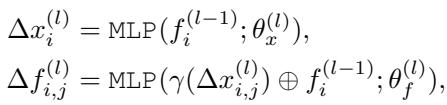
Essentially, a Multi-Layer Perceptron (MLP) looks at a Gaussian and says, “I see you are part of a sharp edge. I’m going to spawn \(R\) new small Gaussians around you to define that edge better.”
Learnable Masking
Here is the clever part. Even after selecting candidates based on gradients, we might not need to densify all of them repeatedly. The model predicts a “confidence mask” (a score between 0 and 1) for each Gaussian.
\[ m _ { i } ^ { ( l ) } = \sigma \big ( \mathrm { M L P } ( f _ { i } ^ { ( l ) } ; \theta _ { m } ^ { ( l ) } ) \big ) , \]
Using a “Straight-Through Estimator” trick (which allows gradients to flow through a hard selection process), the model learns to filter out Gaussians that are “good enough” and only sends the difficult ones to the next layer of densification. This keeps the total number of Gaussians manageable and rendering speeds high.
Integration: Object-Level and Scene-Level
One of the strengths of this paper is that the authors integrated this module into two different state-of-the-art backbones:
- LaRa: A model designed for object-level reconstruction (like a single shoe or toy).
- MVSplat: A model designed for scene-level reconstruction (like a whole room).
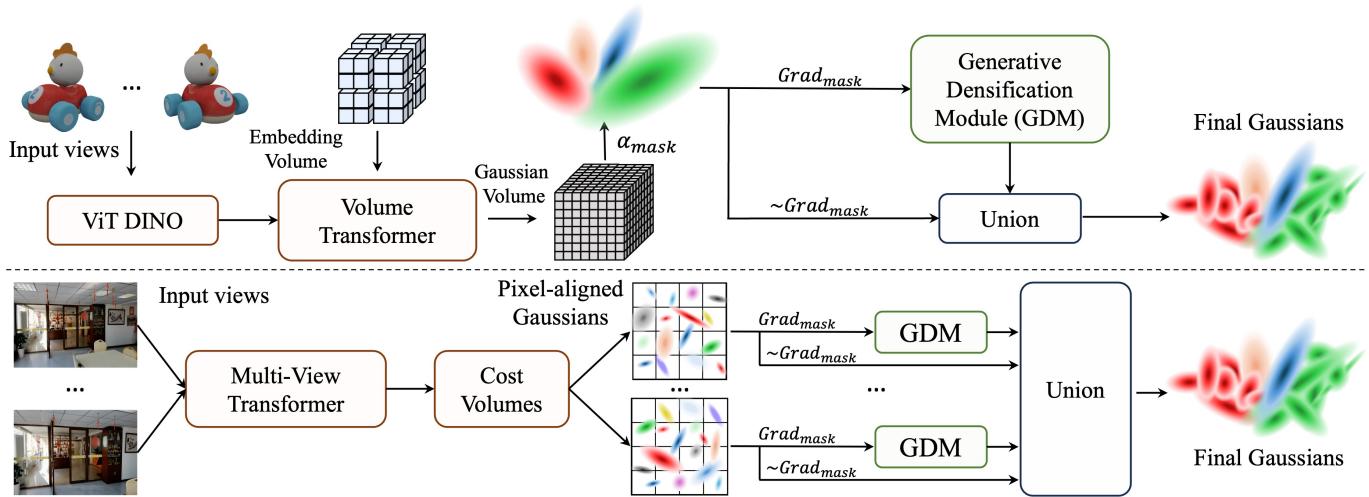
As seen in Figure 4, the Generative Densification Module (GDM) acts as an add-on. Whether the input is a volume (LaRa) or pixel-aligned Gaussians (MVSplat), the GDM takes the coarse output, refines it, and merges the result back for the final render.
Experiments and Results
Does it actually look better? The short answer is yes.
Object-Level Results
In comparisons on the Google Scanned Objects (GSO) dataset, the method shows a clear improvement in texture sharpness.
![Figure 10. Qualitative comparisons of our object-level model against the original LaRa [5], evaluated on the GSO [10] and Gobjaverse [33] dataset. The coarse and fine Gaussians are the input and output of generative densification module, respectively.](/en/paper/2412.06234/images/026.jpg#center)
Look at the Brisk Lemonade box in Figure 10. The original LaRa model (2nd column) blurs the text. The Generative Densification model (3rd column) makes the text readable. The wireframe visualizations on the right show that the “Fine Gaussians” are concentrated heavily around the complex edges of the box and the text, exactly as intended.
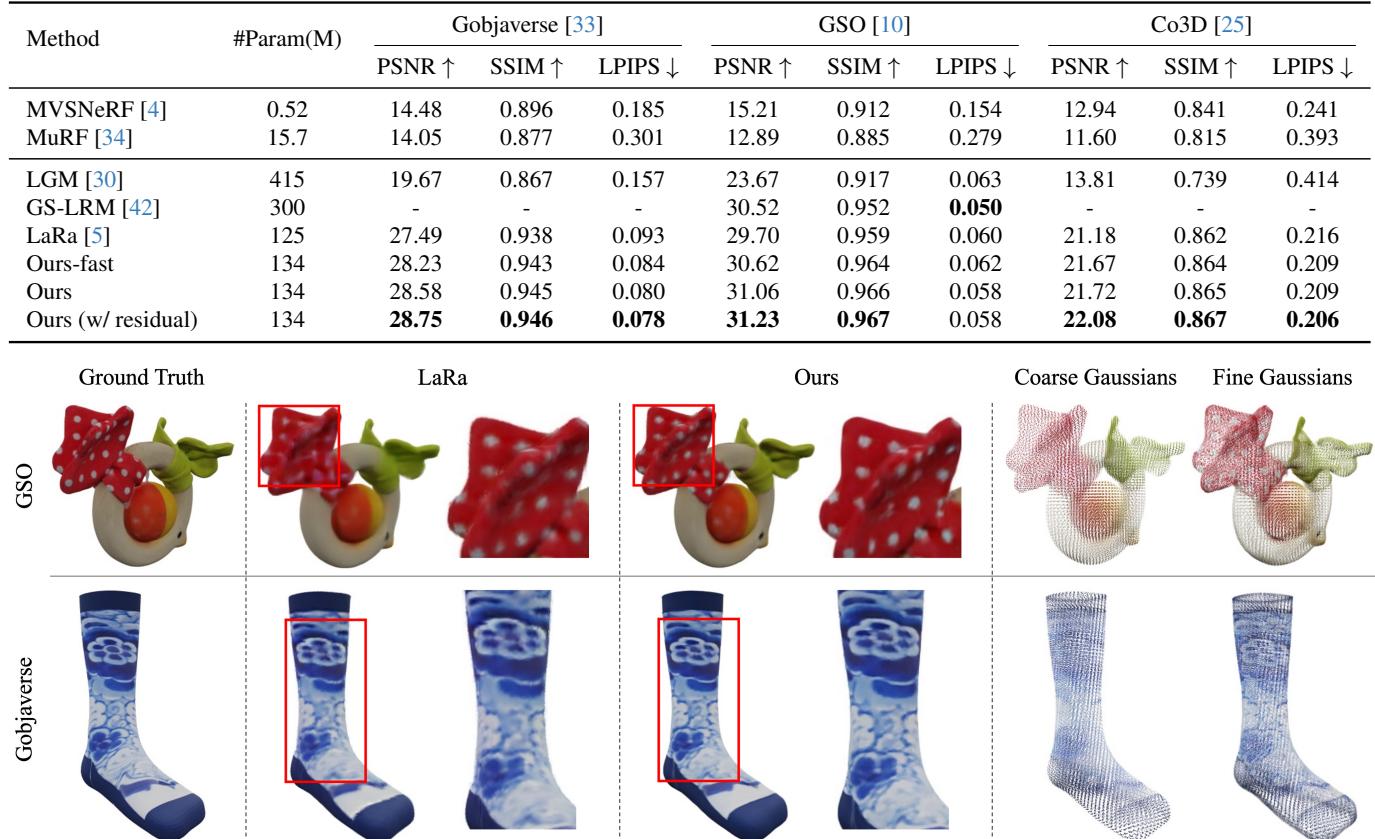
Figure 5 reinforces this. The details on the Christmas stocking (second row) are muddy in LaRa but distinct in the refined version.
Scene-Level Results
For full scenes (using the RE10K dataset), the improvement is even more noticeable in thin structures and reflections.
![Figure 6. Qualitative comparisons of our scene-level model against the original MVSplat on the RE10K [46] dataset.](/en/paper/2412.06234/images/014.jpg#center)
In Figure 6, notice the railing on the stairs (top row) and the faucet handles (bottom row). MVSplat struggles with these thin, high-frequency geometries, often resulting in “floaters” or blurry blobs. The proposed method tightens these structures significantly.
How do the Gaussians behave?
To understand why the visual quality improves, the authors analyzed the physical properties of the generated Gaussians.
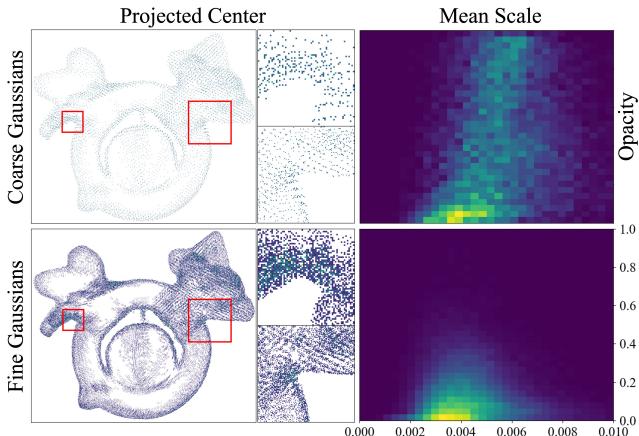
Figure 8 presents 2D histograms of the Gaussians.
- Coarse Gaussians (Top): Tend to be larger (brighter colors on the right side of the Scale heatmap) and more opaque.
- Fine Gaussians (Bottom): Are significantly smaller and more transparent (lower opacity).
This confirms the hypothesis: the model is using the coarse Gaussians to define the general shape and volume, and utilizing the fine Gaussians to paint in the delicate details and edges using many small, semi-transparent splats.
Conclusion
The paper “Generative Densification” offers a compelling solution to a major bottleneck in 3D reconstruction. By teaching a neural network to mimic the densification process of optimization algorithms, we can achieve high-fidelity results without sacrificing the speed and generalizability of feed-forward models.
Key takeaways:
- Adaptive Detail: We don’t need high density everywhere. Using gradient masking allows the model to focus resources on hard-to-model areas.
- Learnable Splitting: Instead of heuristic splitting, a neural network can learn the optimal way to break down a Gaussian to fit the target image.
- Efficiency: Techniques like Serialized Attention allow these operations to run efficiently on complex 3D point clouds.
This work paves the way for real-time, high-quality 3D content generation from single images, pushing us closer to photorealistic 3D generation for everyone.