](https://deep-paper.org/en/paper/2412.06699/images/cover.png)
Introduction
How do you understand the three-dimensional structure of the world? You don’t walk around with a ruler and a protractor, measuring the precise coordinates of every object you see. You don’t rely on “gold-standard” 3D mesh data implanted in your brain. Instead, you observe. You move your head, walk around a statue, or drive down a street. Your brain stitches these continuous 2D observations into a coherent 3D model.
For years, Computer Vision researchers have tried to teach AI to generate 3D content, but they’ve often taken the “ruler and protractor” approach. They rely on limited datasets of 3D models or require precise camera pose annotations (exact mathematical coordinates of where the camera is). This has created a massive bottleneck: data scarcity. There are billions of images and videos on the internet, but very few of them come with high-quality 3D labels or camera trajectories.
What if an AI could learn 3D just like we do—by simply watching massive amounts of video?
This is the premise behind See3D, a groundbreaking paper from the Beijing Academy of Artificial Intelligence (BAAI). The researchers introduce a method to learn generic 3D priors from “pose-free” internet videos. By scaling up training data to millions of clips without needing expensive annotations, they achieve state-of-the-art results in 3D generation.

As shown above, the results are versatile, ranging from turning a single image into a 3D asset to reconstructing entire scenes and even editing 3D objects. In this post, we will tear down the See3D architecture, explaining how they curate data, how they replace complex math with “visual hints,” and how they generate coherent 3D worlds.
Background: The Data Bottleneck in 3D AI
To understand why See3D is significant, we need to look at the current landscape of 3D generation.
Most modern approaches rely on Multi-View Diffusion (MVD) models. These are variants of the text-to-image models (like Stable Diffusion) fine-tuned to generate multiple views of an object simultaneously. If you ask for “a chair,” an MVD model tries to generate the front, side, and back views so they all look like the same chair.
However, standard MVD models suffer from a major limitation: Pose Dependency. To train them, you typically need to tell the model exactly where the camera is for every image (e.g., “Image A is at 0 degrees, Image B is at 45 degrees”). This reliance on “camera extrinsics” forces researchers to train on synthetic datasets (like Objaverse) where these numbers are perfect. But synthetic data lacks the realism and diversity of the real world.
The alternative is using real videos, but getting accurate camera poses for random YouTube clips is incredibly difficult and computationally expensive (using a technique called Structure from Motion, or SfM, which often fails).
See3D proposes a radical shift: Forget the poses. Instead of feeding the model mathematical coordinates, let’s feed it visual cues. If we can teach a model to “complete the scene” based on what it sees, we can train on virtually infinite internet videos.
The See3D Method
The See3D framework consists of three main pillars:
- WebVi3D: A massive, curated dataset of internet videos.
- The Visual-Conditional MVD: A model trained to generate views based on noisy visual hints rather than camera poses.
- The Generation Pipeline: A warping-based inference strategy to create 3D content from a single image.
Let’s break these down.
1. Curation: Finding “3D-Aware” Videos
You can’t just dump all of YouTube into a 3D model. A video of a news anchor sitting still doesn’t teach 3D geometry because the camera never moves. A video of a soccer game is too chaotic because objects are moving independently of the background.
To learn 3D, the model needs static scenes observed by a moving camera. This mimics the “parallax effect” that gives us depth perception.
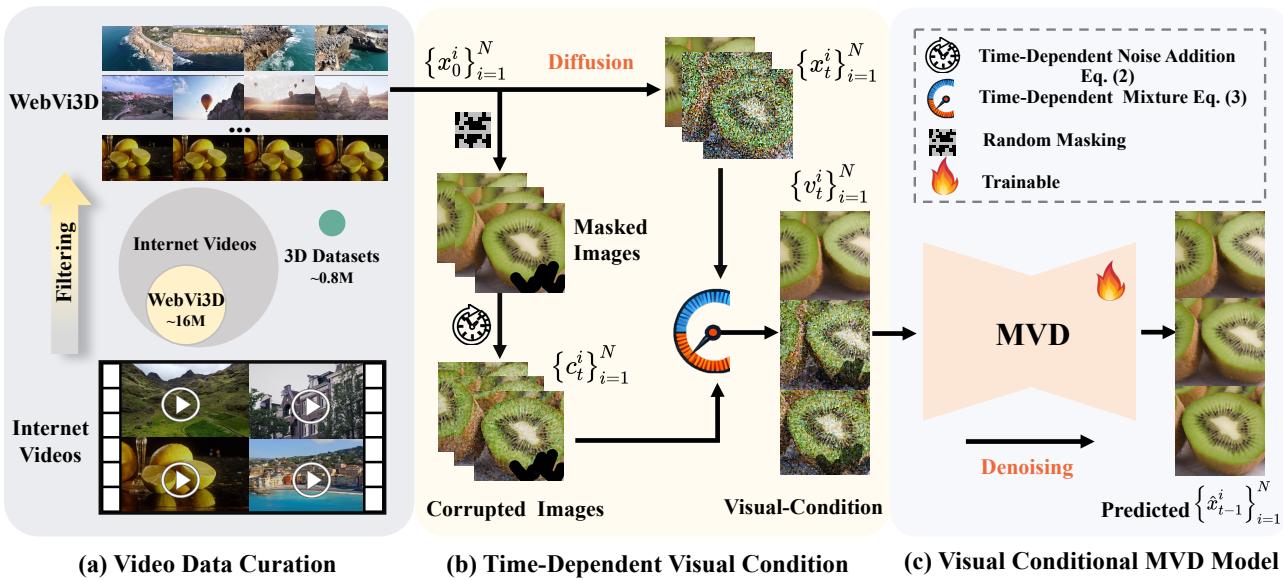
The researchers developed an automated pipeline to filter 25 million raw videos down to a high-quality dataset called WebVi3D.
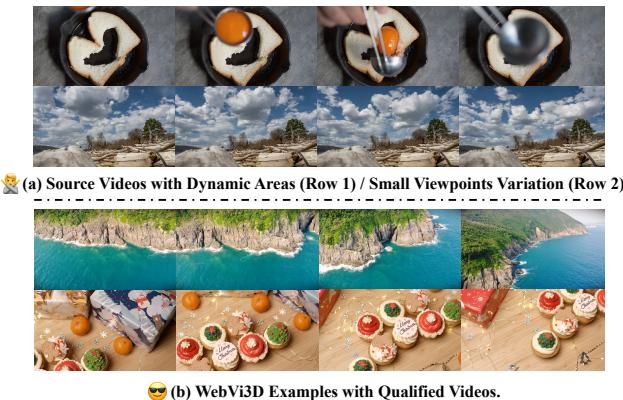
The pipeline has four steps:
- Downsampling: Reduces resolution for efficiency.
- Semantic Filtering: Uses Mask R-CNN to detect and remove videos dominated by dynamic objects like people or cars.
- Flow-Based Filtering: Uses Optical Flow (analyzing pixel movement) to find subtler motion, like swaying trees or flowing water. If parts of the scene move differently than the camera motion suggests, the video is tossed.
- Trajectory Filtering: Uses point tracking to ensure the camera actually moves enough. If the camera simply rotates in place or barely moves, it doesn’t provide enough 3D information.
The result is 16 million video clips (approx. 320 million frames) of static scenes viewed from different angles—a massive dataset compared to previous standards.
2. The Core Innovation: Time-Dependent Visual Condition
This is the most technically interesting part of the paper. How do you control the camera viewpoint without using camera coordinates?
The researchers introduce a Visual Condition (\(v_t^i\)).
In a standard diffusion model training setup, you take an image, add noise to it (making it look like static), and teach the model to remove the noise. Here, the goal is Multi-View Prediction. Given a reference image (Image A), generate a target image (Image B).
Instead of telling the model “Generate Image B at coordinates (x, y, z),” See3D provides a “corrupted” version of Image B as a hint.
The Recipe for the Visual Condition
The visual condition isn’t just the target image; it is a carefully processed signal designed to guide the model without making it “lazy.”
- Masking: They randomly mask out parts of the target image. This forces the model to learn geometry to fill in the blanks, rather than just copying pixels.
- Noising: They add Gaussian noise to the target image.
- Time-Dependent Mixture: This is the key.
In diffusion models, generation happens over time steps (\(t\)), from pure noise (\(t=1000\)) to a clean image (\(t=0\)).
- At high noise levels (early steps): The model relies heavily on the visual hint to establish the global structure of the scene.
- At low noise levels (late steps): The model needs to refine details. If the visual hint is too strong here, the model might over-rely on it and simply copy the noisy input.
To solve this, the researchers use a mixing function. As the timestep \(t\) decreases (getting closer to the final image), the “visual condition” fades out the corrupted image hint and replaces it with the model’s own noisy latent representation.
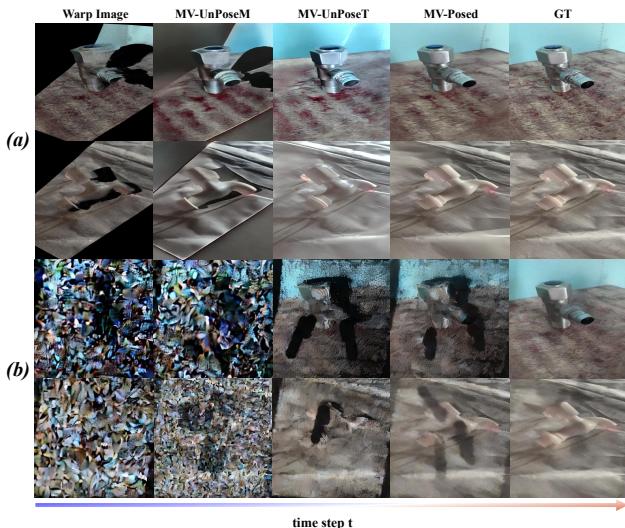
This forces the model to use the visual hint as a guide for where to look (camera control) but rely on its learned priors to decide what it looks like (texture and geometry).
The mathematical formulation for this condition \(V_t\) is:
\[ V _ { t } = [ W _ { t } * C _ { t } + ( 1 - W _ { t } ) * X _ { t } ; M ] , \]Here, \(W_t\) is the weighting factor that changes over time, \(C_t\) is the corrupted image hint, and \(X_t\) is the noisy latent.
3. The 3D Generation Pipeline
So far, we’ve discussed training. But how does this model generate a 3D scene from a single picture during inference? We don’t have a “target image” to use as a visual condition—we’re trying to create one!
The solution is a Warping-Based Pipeline.
The intuition is simple: If you have an image and a depth map, you can “warp” (reproject) the pixels to a new viewpoint. It won’t look perfect—there will be holes where unseen areas are exposed, and distortions where the depth is wrong—but it provides a perfect visual hint for the See3D model.
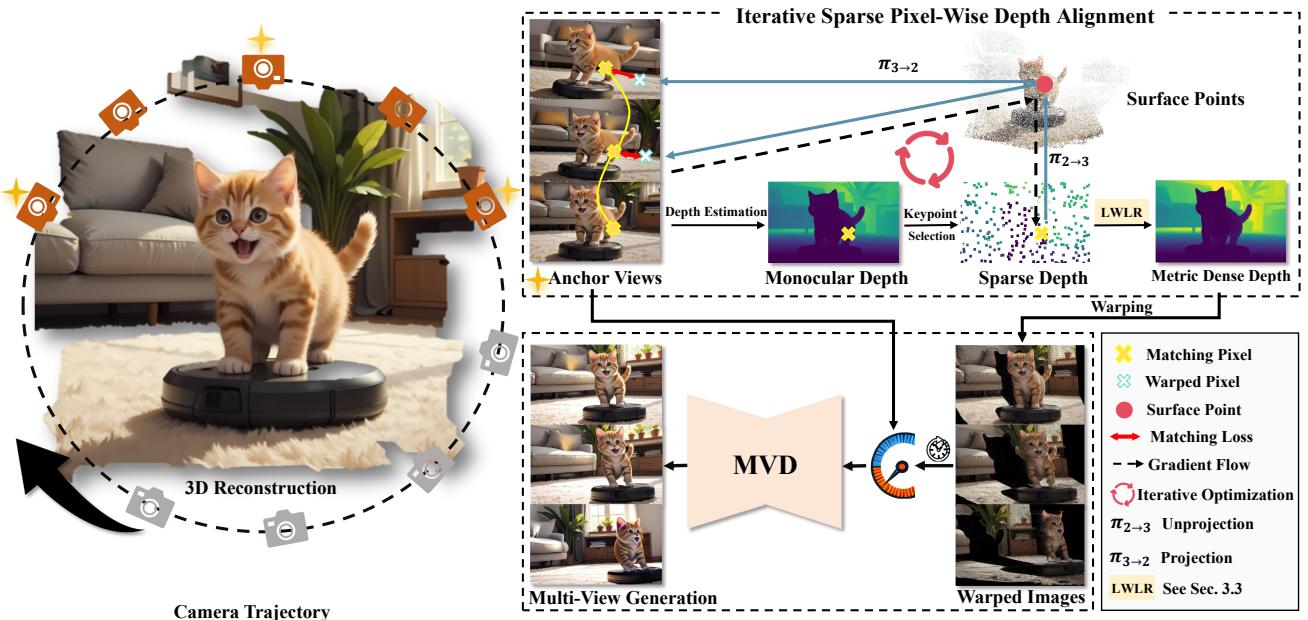
The process works iteratively:
- Monocular Depth Estimation: The model predicts the depth of the starting image.
- Iterative Sparse Alignment: Critical Step. Monocular depth estimators are notoriously bad at absolute scale (they don’t know if a hallway is 10 meters or 100 meters long). See3D uses “sparse keypoints” (matching distinct features between views) to align the depth map geometrically. It minimizes the error between where a pixel should be after warping and where it is.
- Warping: The aligned depth map is used to warp the current view to the next camera position.
- Refinement: This warped, messy image becomes the Visual Condition. It is fed into the See3D model. The model sees the warped suggestions (which indicate the camera angle) and “hallucinates” the missing details, textures, and occluded regions, producing a high-quality novel view.
- Repeat: This new view becomes the anchor, and the process continues along the trajectory.
Finally, once a sequence of consistent images is generated, standard 3D Gaussian Splatting (3DGS) is used to reconstruct the actual 3D object or scene.
Experiments and Results
The researchers compared See3D against several state-of-the-art baselines, including LucidDreamer, ViewCrafter, and ZeroNVS.
Single View to 3D
In this task, the model takes a single photograph and attempts to generate a 3D scene. The results show that See3D excels at preserving structural integrity where other models fail.
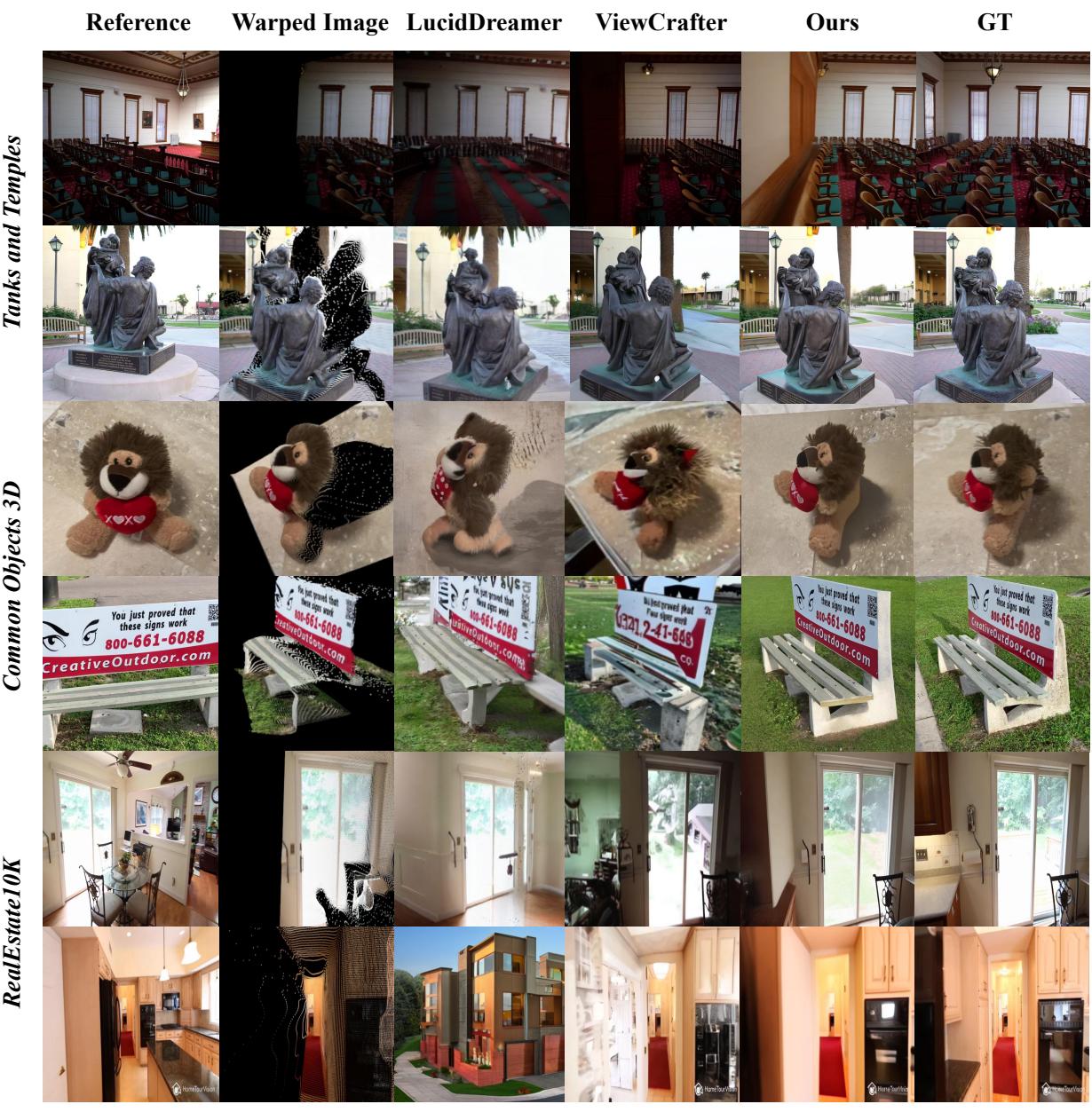
In the “Warped Image” column above, you can see the input condition—it’s dark, distorted, and full of holes. Yet, “Ours” (See3D) restores it to a photorealistic quality (Reference/GT) much better than LucidDreamer or ViewCrafter. The quantitative metrics (PSNR, SSIM) confirm this, showing a 4+ dB improvement in Peak Signal-to-Noise Ratio (PSNR) over competitors.
Sparse Views to 3D
Here, the model is given 3 images of an object and asked to fill in the gaps to create a full 360-degree reconstruction.

The results demonstrate fewer “floating artifacts” (random bits of noise floating in 3D space) and sharper details. This suggests that the model hasn’t just memorized 2D textures but has learned an underlying 3D consistency.
Open-World Generation and Editing
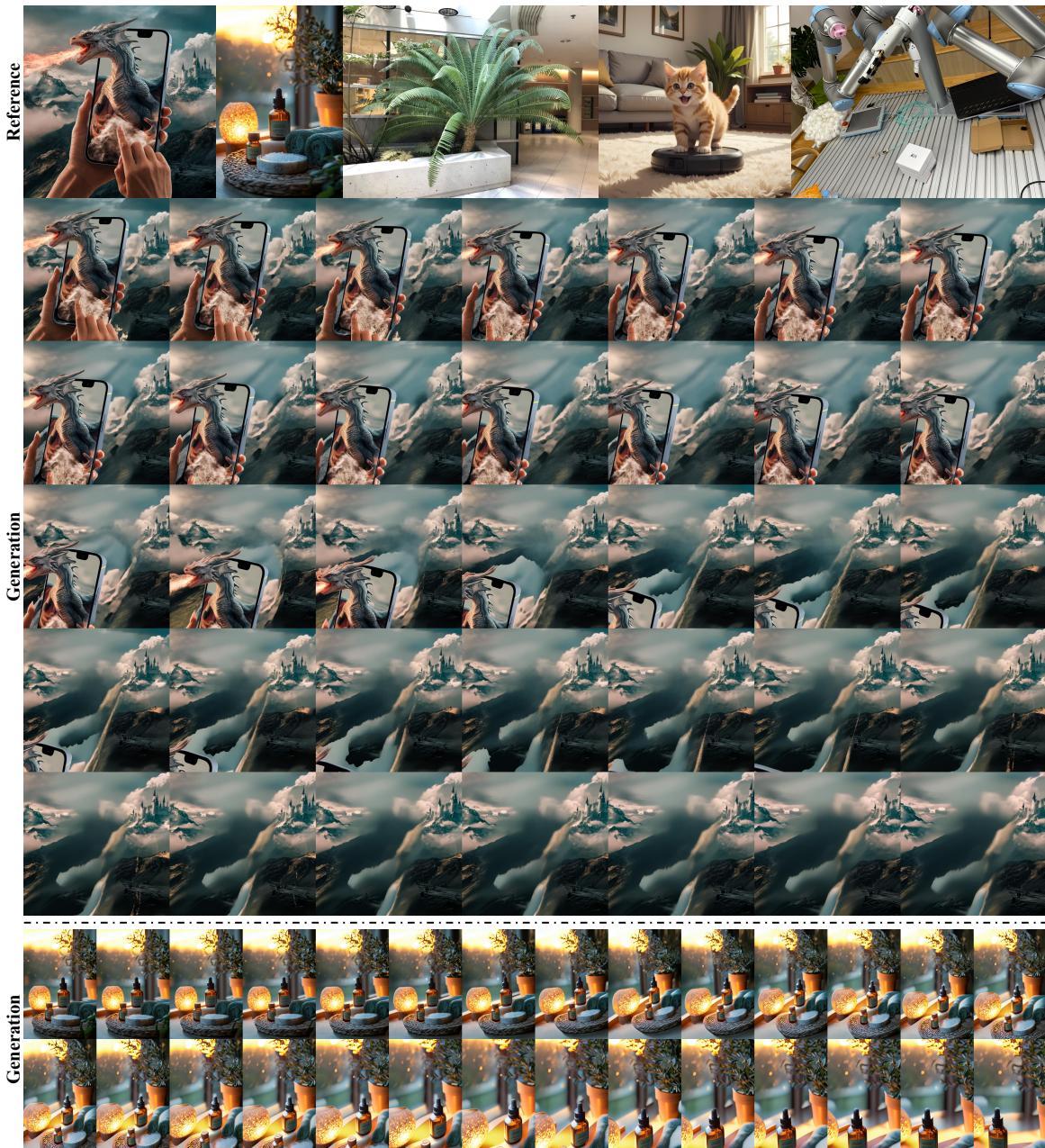
Because the model was trained on diverse internet videos (landscapes, drones, gaming, animals), it generalizes remarkably well to “in-the-wild” scenarios.
It can handle Long-Sequence Generation, creating smooth camera paths that travel through a scene without the geometry falling apart:
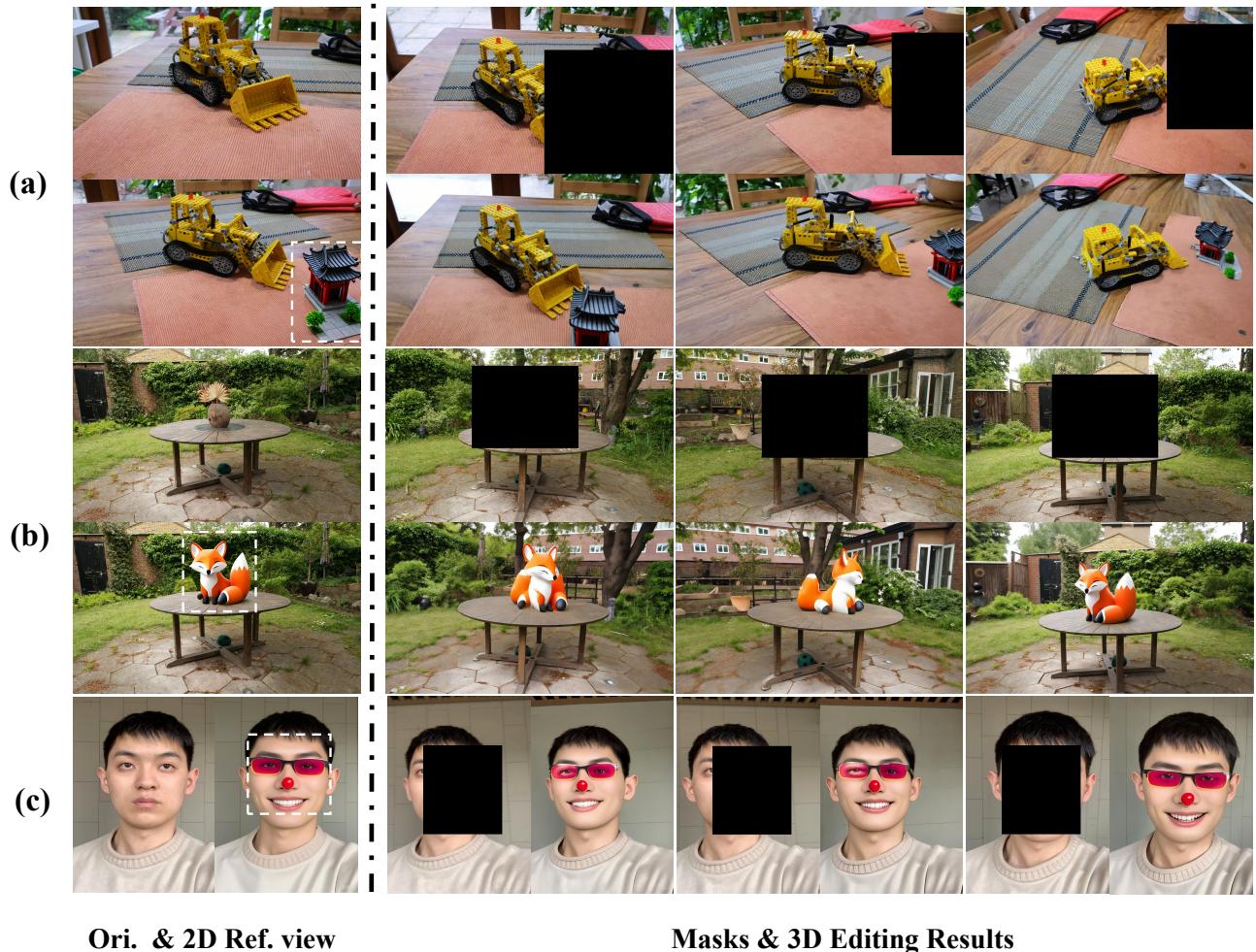
It also enables 3D Editing. You can mask out an object in a 2D image (e.g., “replace this vase with a fox”) and the model will generate the new object consistent with the scene’s lighting and perspective across multiple views.
Conclusion & Implications
See3D represents a significant step forward in Generative AI because it tackles the data bottleneck head-on. Rather than waiting for better annotated datasets, the authors figured out how to utilize the data we already have—millions of pose-free videos.
Key Takeaways:
- Scale Matters: By designing a pipeline that accepts pose-free data, training can be scaled up to 16M+ videos, vastly improving generalization.
- Visual Prompts > Explicit Poses: You don’t always need precise math to control a camera. A “warped” visual hint is enough for a diffusion model to understand perspective.
- Hybrid Pipelines: Pure generation often lacks geometric consistency, while pure warping lacks texture quality. See3D combines both: warping provides the structure, and diffusion provides the reality.
This work brings us closer to a future where we can generate interactive 3D environments from any video clip or photo, democratizing 3D content creation for gaming, VR, and simulation. The concept of “You See it, You Got it” suggests that as long as we have visual data, we can reconstruct the world.