](https://deep-paper.org/en/paper/2412.06767/images/cover.png)
The dream of computer vision is simple yet incredibly difficult to achieve: take a handful of photos of an object or a scene, and instantly generate a perfect, photorealistic 3D model.
In recent years, we have seen an explosion in “neural rendering” techniques. Methods like Neural Radiance Fields (NeRF) and 3D Gaussian Splatting (3DGS) have revolutionized our ability to synthesize novel views. They can take a set of images and allow you to look at the scene from a new angle with startling clarity. However, there is a catch. While these methods produce beautiful images, the underlying 3D geometry they create is often messy, noisy, or blurry. They are designed to fool the eye, not to build a solid mesh.
Furthermore, these methods typically require a dense cloud of input images—often hundreds—to work well. If you only have three or four photos, the results usually collapse into artifacts.
Enter MAtCha Gaussians. In a new paper titled “MAtCha Gaussians: Atlas of Charts for High-Quality Geometry and Photorealism From Sparse Views,” researchers propose a bridge between the world of explicit geometry (meshes) and neural rendering. By treating the scene as an “Atlas of Charts”—patching together 2D depth maps into a cohesive 3D surface—MAtCha achieves state-of-the-art geometry reconstruction from as few as three images, and does so in minutes.
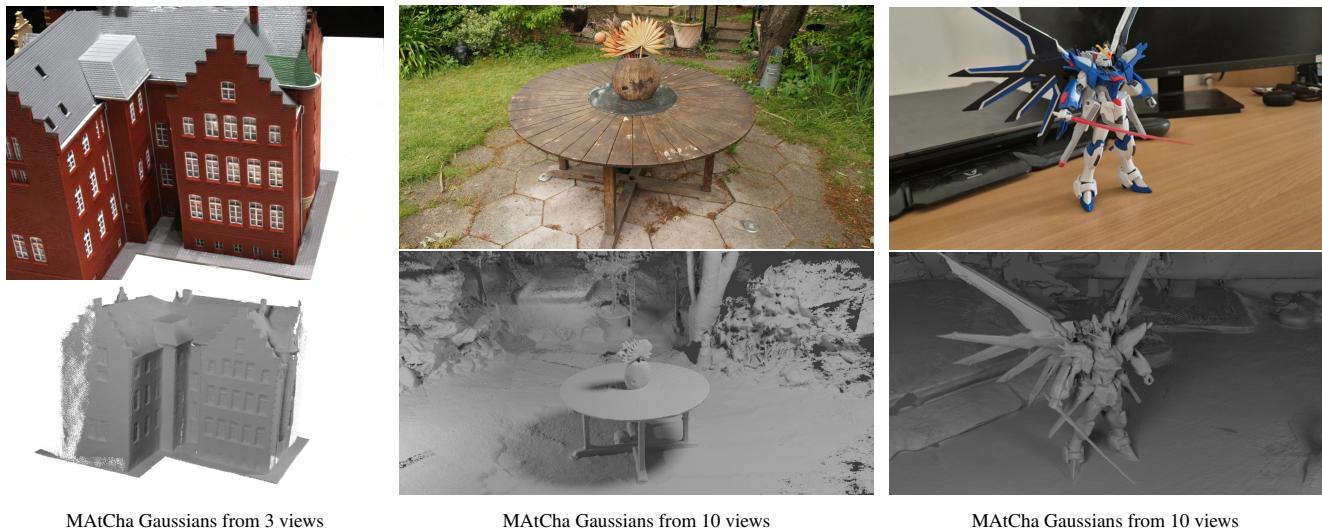
In this post, we will break down how MAtCha works, the mathematics behind its “chart deformation,” and how it manages to combine the best of monocular depth estimation with Gaussian Splatting.
The Problem: The Gap Between Rendering and Geometry
To understand why MAtCha is significant, we need to look at the current landscape of 3D reconstruction.
On one side, we have Structure-from-Motion (SfM). SfM is great at estimating camera poses and creating a sparse cloud of 3D points from images. However, a sparse point cloud is not a surface; it’s just a collection of dots in space. It lacks the high-frequency details (like the texture of a brick or the sharp edge of a table).
On the other side, we have Volumetric Rendering (NeRFs and standard 3D Gaussian Splatting). These methods optimize a volume to match input images. They are fantastic at reproducing color and light. However, because they are optimized for rendering, the geometry is often a byproduct. A 3D Gaussian Splatting scene might look like a solid wall from a specific angle, but if you extract the mesh, you might find it’s made of floating ellipsoids or “fog” rather than a flat surface. This issue is exacerbated when you have “sparse views”—very few input images—because the algorithm has fewer constraints to figure out where the surface actually sits.
There have been attempts to fix this, such as using Signed Distance Functions (SDFs) like NeuS or VolSDF. While these produce watertight meshes, they are often slow to train and struggle with “unbounded” scenes (large outdoor environments where the background goes on forever).
MAtCha (which stands for Mesh as an Atlas of Charts) proposes a hybrid approach. It uses the detailed priors from modern AI depth estimators and refines them into a coherent 3D surface using the differentiable power of Gaussian Splatting.

As shown in the table above, MAtCha is unique in its ability to handle sparse views, reconstruction of unbounded scenes, and fast training times simultaneously.
The Core Concept: The Atlas of Charts
The central idea of MAtCha is to model the surface of a scene not as a density volume (like NeRF) or a cloud of particles (like 3DGS), but as a 2D Manifold.
Mathematically, a manifold is a surface that can be locally flattened into a 2D plane. Think of a globe: it is a sphere, but you can represent it as a book of flat maps (an atlas). Each map is a “chart.” If you stitch these charts together correctly, you represent the entire 3D object.
In MAtCha, every input image corresponds to a “chart.”
- Input: A sparse set of RGB images.
- Initial Chart: A depth map generated from that image.
- The Goal: Warp and stitch these depth maps together so they align perfectly in 3D space to form a single, smooth mesh.
The Pipeline Overview
The MAtCha pipeline operates in distinct stages. First, it initializes the geometry using monocular depth estimation. Then, it uses a neural network to deform these charts to fit sparse SfM points. Finally, it refines the surface using Gaussian rendering.
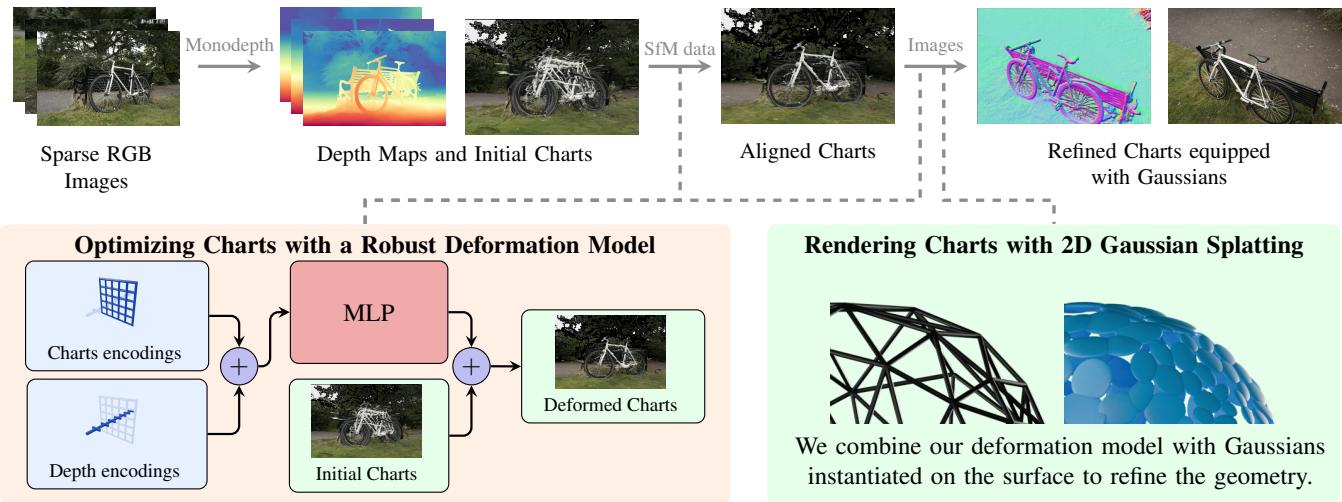
Let’s break down these steps in detail.
Step 1: Initialization with Monocular Depth
The researchers leverage the power of pre-trained Monocular Depth Estimators (specifically DepthAnythingV2). These are AI models trained on massive datasets to predict the depth of every pixel in a single image.
While these models are amazing at capturing high-frequency details (sharp edges, intricate textures), they suffer from scale ambiguity. The model knows that the lamp is in front of the wall, but it doesn’t know if the lamp is 1 meter away or 10 meters away. It also creates inconsistencies between different views—the “size” of the object might look different in image A compared to image B.
MAtCha takes these initial depth maps and “backprojects” them into 3D space. This creates the initial, albeit misaligned, charts.
Step 2: The Neural Deformation Model
This is the most innovative part of the paper. We have a set of 3D charts (from the depth maps) that look detailed but don’t line up with each other or the true 3D world. We need to deform them to fit.
Previous methods tried simple affine scaling (stretching the whole depth map linearly). This is too rigid. Other methods tried pixel-wise optimization, which destroys the nice sharp details from the depth estimator.
MAtCha introduces a Lightweight Chart Deformation Model. It uses a tiny Multi-Layer Perceptron (MLP) to learn a deformation field \(\Delta\).
The updated position of a point on the chart is defined as:

Here, \(\psi^{(0)}\) is the initial chart position (from the monocular depth), and \(\Delta_i\) is the deformation applied to align it.
Chart Encodings and Depth Encodings
To calculate this deformation \(\Delta\), the MLP takes in specific features. The authors use a sparse 2D grid of learnable features called Chart Encodings (\(E_i\)).

However, a 2D grid isn’t enough. Objects in a scene often have sharp discontinuities—think of the edge of a table against a distant floor. Points that are next to each other in the 2D image might be meters apart in 3D depth. If we warp them the same way, we get distortion (“rubber sheet” artifacts).
To fix this, MAtCha adds Depth Encodings (\(z_i(d)\)). This allows the network to deform points differently depending on their initial depth, even if they are neighbors in the image.

This combination allows the model to perform low-frequency deformations (fixing the overall shape) while preserving the high-frequency details (the texture and sharp edges) provided by the initial depth map.
Step 3: Aligning with Structure-from-Motion (SfM)
How does the network know how to deform the charts? It uses sparse 3D points generated by Structure-from-Motion (SfM) as anchors. The authors use a method called MASt3R-SfM to get these camera poses and sparse points.
The optimization minimizes several loss functions simultaneously.
1. Fitting Loss (\(\mathcal{L}_{fit}\)): This encourages the charts to touch the sparse 3D points provided by SfM.
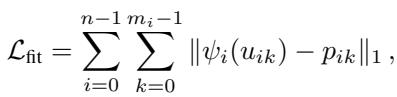
However, SfM points can be noisy or outliers. To handle this, the authors introduce a confidence map (\(C_i\)). The network learns which regions of the chart are reliable and which are not, downweighting outliers automatically.

2. Structure Loss (\(\mathcal{L}_{struct}\)): We want to align the charts, but we don’t want to destroy the beautiful details from the original monocular depth map. This loss forces the normals (\(N\)) and curvature (\(M\)) of the deformed chart to match the original depth map.

3. Alignment Loss (\(\mathcal{L}_{align}\)): Finally, since we have multiple charts (one per image), they must overlap to form a single surface. This loss pulls overlapping regions of different charts together.

The total loss combines these three objectives:

This optimization step is incredibly fast, typically converging in less than a few minutes.
Step 4: Refinement with Gaussian Surfels
Once the charts are geometrically aligned, MAtCha switches gears to photometric refinement. This is where the “Gaussian” part of the name comes in.
Instead of using 3D volumetric Gaussians (ellipsoids), MAtCha instantiates 2D Gaussian Surfels directly on the surface of the charts. Think of these as flat, textured splats painted onto the mesh.
The model renders the scene using a Gaussian rasterizer and compares the result to the input images. Because the Gaussians are tied to the mesh (the charts), optimizing the rendering also fine-tunes the geometry of the charts.
The refinement uses a standard photometric loss (comparing pixel colors):

It also includes regularization terms to ensure the Gaussians don’t drift away from the surface normals or create artifacts.

This stage ensures that the final model is not just geometrically accurate but also capable of photorealistic rendering.
Mesh Extraction: Getting the Final 3D Model
After optimization, we have a set of aligned, refined charts. To get a usable 3D mesh, MAtCha uses two potential methods:
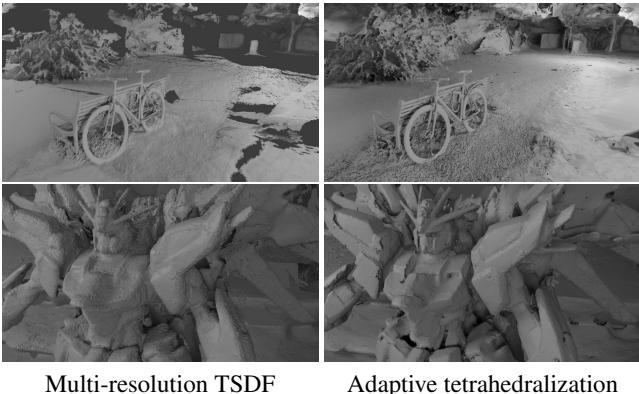
- Multi-resolution TSDF Fusion: This is a classic technique where depth maps are fused into a voxel grid. MAtCha uses a multi-resolution approach to capture both foreground details and background scenery.
- Adaptive Tetrahedralization: Adapted from Gaussian Opacity Fields (GOF), this method creates a mesh by carving out tetrahedrons based on opacity.
As seen in the comparison below, the adaptive tetrahedralization (right) tends to produce sharper, hole-free meshes compared to TSDF (left).
Experimental Results
The results of MAtCha are impressive, particularly in the “sparse view” regime where other methods fail.
Surface Quality
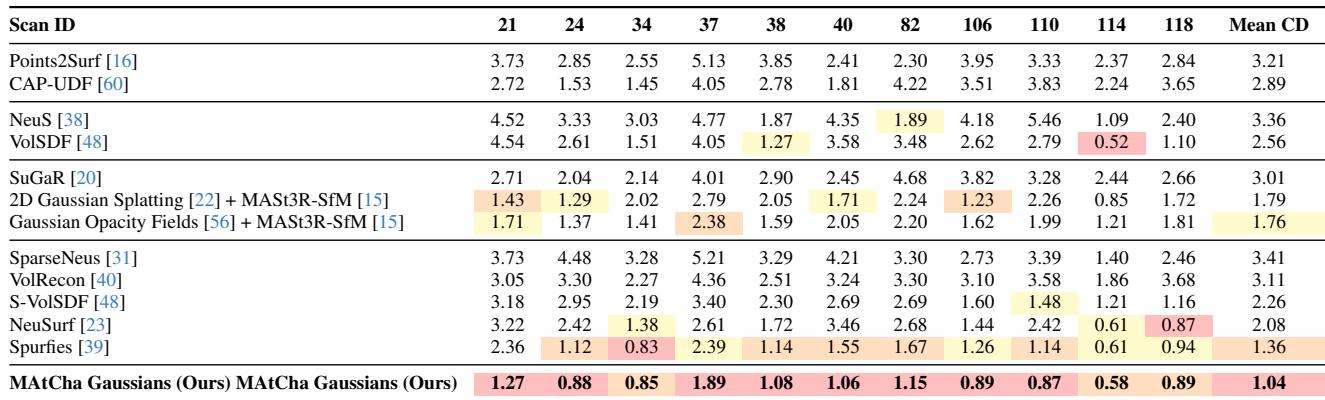
When tested on the DTU dataset (a standard benchmark for object scanning) using only 3 input images, MAtCha outperformed previous state-of-the-art methods like Spurfies and NeuS.
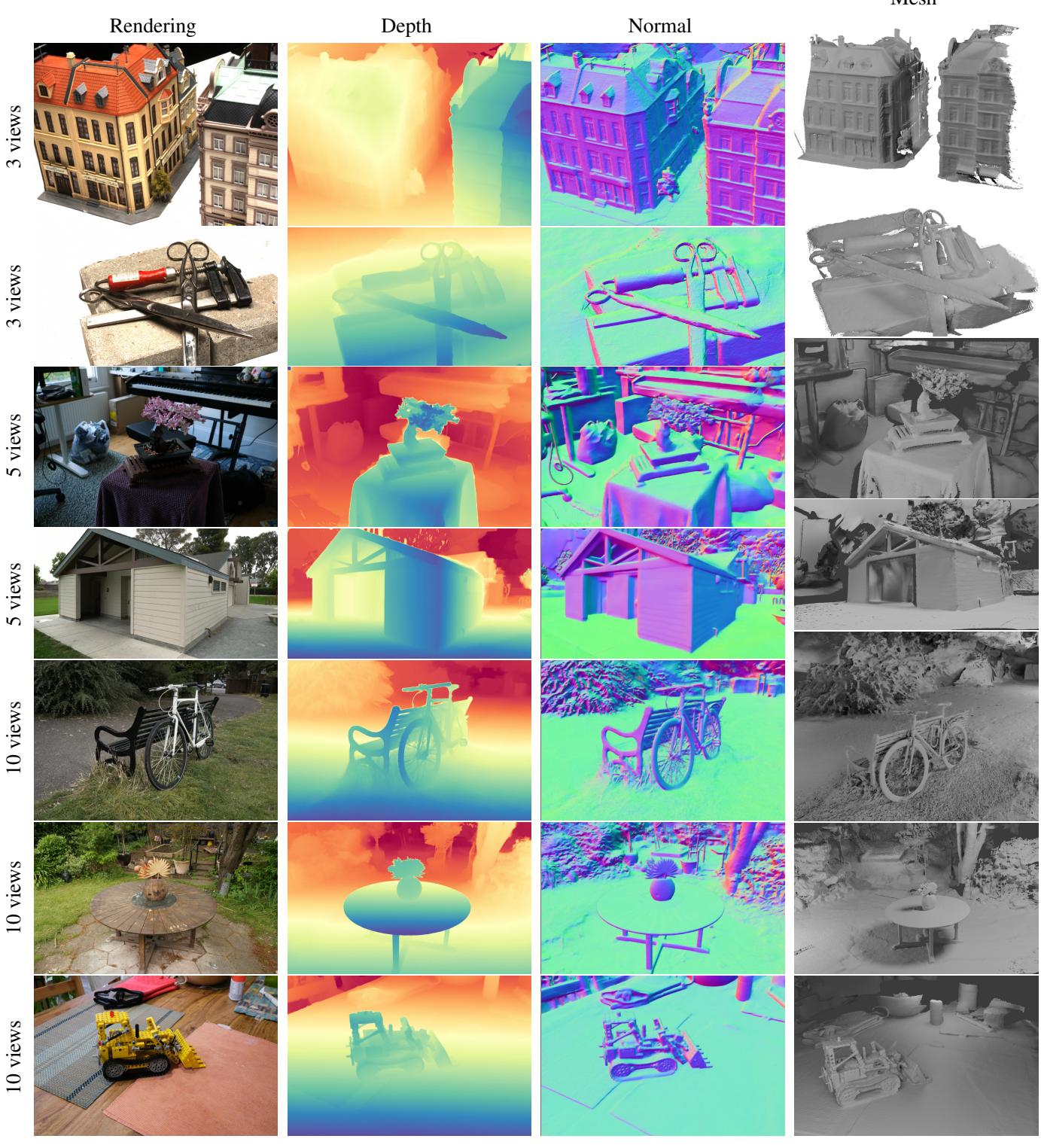
You can see the visual difference below. MAtCha recovers sharp geometry even with very few views. Notice how 3 views (top rows) are enough to get the general shape of the building, and 10 views (bottom rows) reveal intricate details like the treads on the toy bulldozer’s tires.
Unbounded Scenes
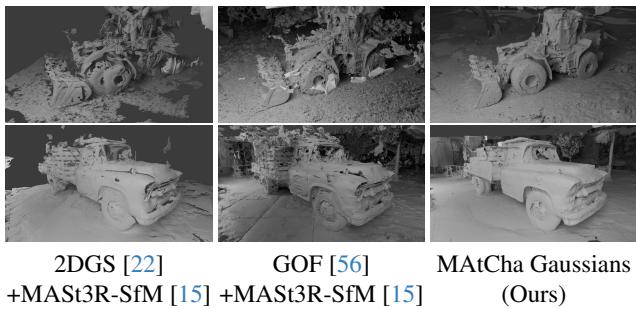
Most sparse-view methods fail when the scene isn’t a single object in the center of the room. MAtCha handles “unbounded” outdoor scenes effectively.
In the figure below, compare the reconstruction of the bicycle and the ground. The baseline methods (2DGS and GOF) produce noisy, broken meshes. MAtCha produces a coherent surface that captures both the foreground vehicle and the background environment.
Comparison with Feed-Forward Methods
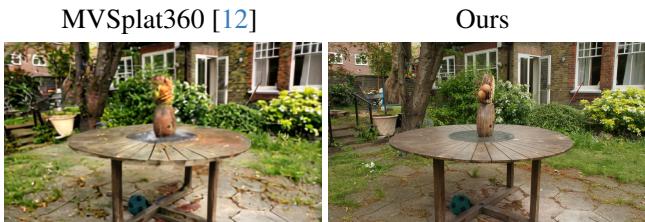
The researchers also compared MAtCha against “feed-forward” methods like MVSplat. Feed-forward methods try to predict the 3D model in a single pass without optimization. While fast, they often struggle with resolution and realism in complex scenes. MAtCha, by performing a quick optimization (minutes), yields significantly sharper renderings.
Why the Deformation Model Matters
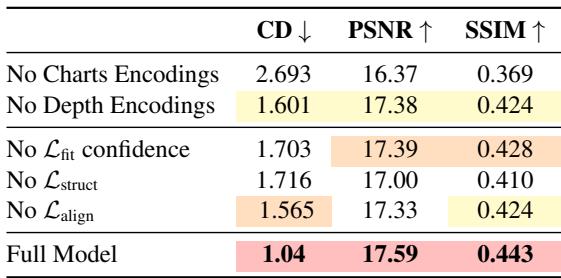
Ablation studies (experiments where parts of the model are turned off) confirm that the Chart Encodings and Depth Encodings are essential. Without them, the Chamfer Distance (error metric) nearly doubles.
Conclusion
MAtCha Gaussians represents a significant step forward in 3D computer vision. By rethinking the scene as an “Atlas of Charts,” the authors successfully combine the best of two worlds: the explicit geometric priors of monocular depth estimation and the differentiable rendering power of Gaussian Splatting.
The key takeaways are:
- Hybrid Representation: Modeling surfaces as 2D manifolds allows for easier initialization and constraints compared to volumetric clouds.
- Robust Alignment: The neural deformation model effectively bridges the gap between monocular depth (good details, bad scale) and SfM (good scale, sparse details).
- Efficiency: High-quality reconstruction is achievable in minutes, not hours, using very few images.
This technology paves the way for applications where data is scarce but quality is non-negotiable—such as rapid 3D asset creation for games, robot navigation in unknown environments, and preserving cultural heritage sites from just a few tourist photos.