](https://deep-paper.org/en/paper/2412.08985/images/cover.png)
Imagine a student asks an AI tutor, “Which country has the largest population in the world?”
If the AI relies solely on its internal training data (likely cut off around 2022 or 2023 for many models), it might confidently answer, “China.” However, as of mid-2023, India surpassed China. If that student is studying from an up-to-date geography textbook that explicitly states “India is the most populous country,” the AI’s answer is now wrong within the context of the classroom.
This scenario highlights a critical tension in Educational Technology: the conflict between parametric knowledge (what a model learned during training) and contextual knowledge (authoritative sources like textbooks).
In K-12 education, the textbook is the source of truth. Even if a scientific theory is simplified, or a historical event is interpreted in a specific way for a curriculum, an educational AI must adhere to that specific material. To address this, developers use Retrieval-Augmented Generation (RAG) systems, which look up the relevant textbook page before answering.
But what happens when the textbook clashes with the AI’s internal memory? Does the AI stubbornly stick to its training, or does it adapt?
A recent paper titled “KNOWSHIFTQA: How Robust are RAG Systems when Textbook Knowledge Shifts in K-12 Education?” investigates this exact problem. The researchers introduce a novel dataset to stress-test how well AI systems can handle “knowledge shifts”—situations where the facts in the provided text differ from the model’s pre-trained world view.
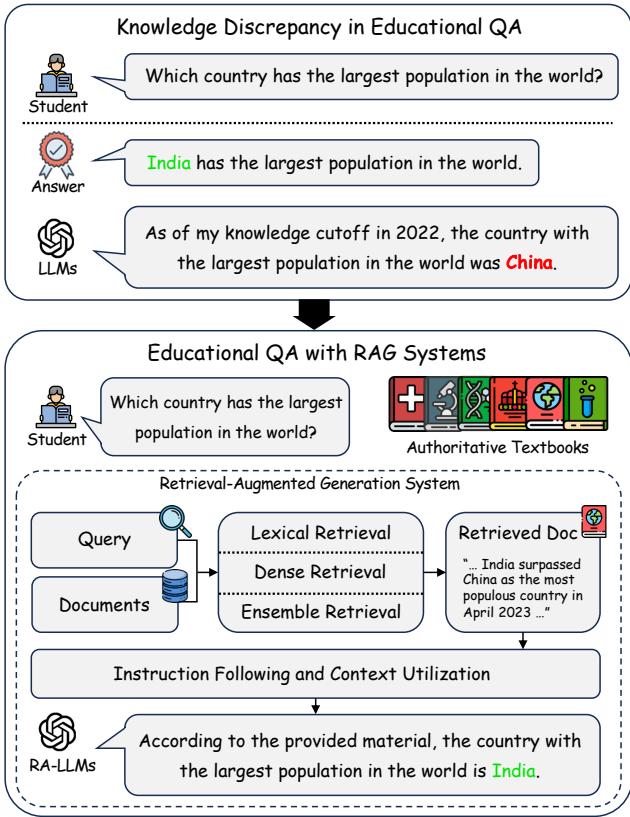
As illustrated in Figure 1, discrepancies can arise from outdated data, regional variations, or updates in pedagogical approaches. The results of the study are surprising and expose a significant fragility in current AI systems.
The Challenge of K-12 Question Answering
In standard Natural Language Processing (NLP) tasks, “hallucination” usually refers to an AI making things up. However, in the educational domain, “hallucination” can also mean the AI reciting a fact that is technically true in the real world but contradicts the specific curriculum being taught.
Educational Question Answering (QA) has a strict requirement: faithfulness to the source. If a physics textbook uses a simplified model of gravity, the AI cannot confuse the student by introducing complex relativistic corrections that aren’t in the chapter.
RAG systems attempt to solve this by retrieving relevant documents (chunks of the textbook) and feeding them to the Large Language Model (LLM) along with the student’s question. Ideally, the LLM reads the chunk and answers based only on that text. The KNOWSHIFTQA paper asks: How robust is this process when the text explicitly contradicts the LLM’s training?
The Methodology: Simulating Knowledge Shifts
To test this systematically, the researchers couldn’t rely on random errors or waiting for real-world facts to change. They needed a controlled environment. They created KNOWSHIFTQA, a dataset comprising 3,005 questions across five subjects: Physics, Chemistry, Biology, Geography, and History.
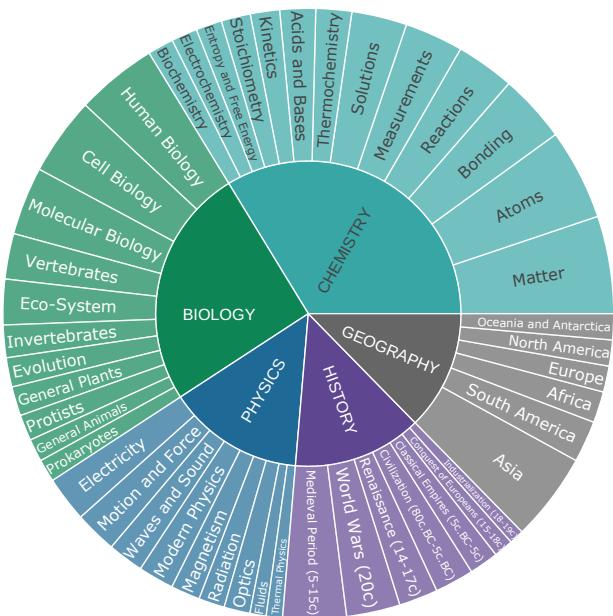
The core innovation of this paper is the Hypothetical Knowledge Update. The researchers took high-quality open-source textbooks and systematically modified specific facts to create plausible but “alternate” truths. This simulates a knowledge shift where the textbook (the context) differs from the LLM’s internal memory (the parameter).
How the Data Was Created
The curation pipeline, shown below, involved extracting knowledge triplets from textbooks (e.g., Mitochondria -> produces -> ATP) and then modifying the object of the triplet to a new, hypothetical value.
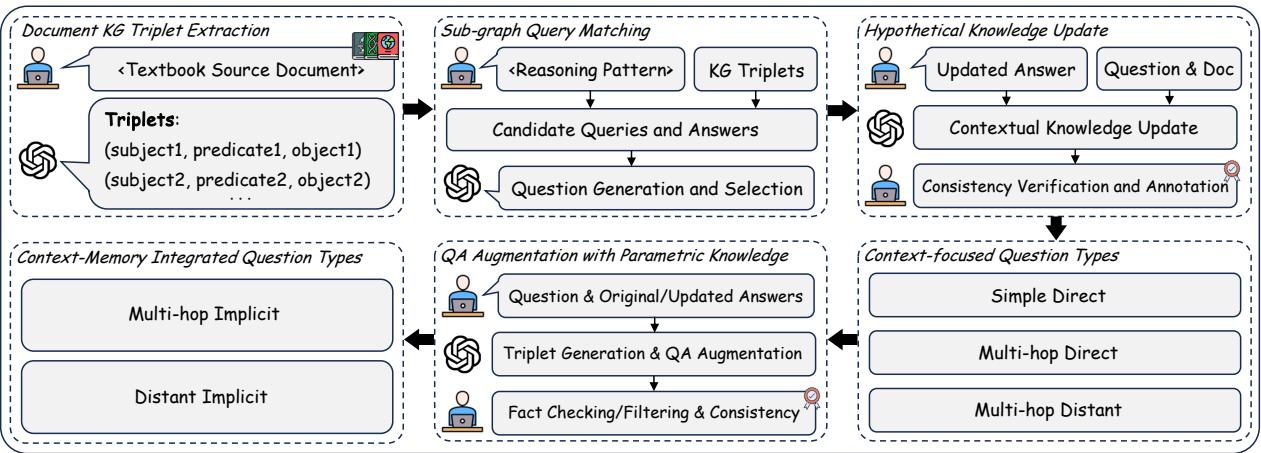
Crucially, they didn’t just change one word. They rewrote the surrounding context to ensure the paragraph remained coherent and consistent with the new “fact.”
For example, consider a Biology question about “halophiles” (organisms that thrive in high salt concentrations). The researchers performed a hypothetical update to change the characteristic from “salt-loving” to “pressure-loving.”

As seen in Table 5, the text was altered so that halophiles are now described as loving pressure and living in the Mariana Trench rather than the Dead Sea. If an AI is asked, “Where do halophiles live?”, a model relying on its internal biology training will say “High Salt.” A model properly using the RAG system should say “High Pressure.”
The Question Typology: Testing Reasoning
The researchers didn’t just ask simple recall questions. They designed a typology to test different cognitive levels, specifically focusing on Context Utilization (can the model find the fact?) and Knowledge Integration (can the model reason with the new fact?).
- Simple Direct: The answer is explicitly stated in the retrieved text.
- Multi-hop Direct: The model must connect two pieces of information within the text to answer.
- Multi-hop Distant: The necessary facts are located far apart in the document, requiring the model to scan the whole context.
- Multi-hop Implicit: This is the hardest category. The question asks for a fact that isn’t changed, but the reasoning path to get there involves the changed fact. The model must combine the new “fake” knowledge with its own internal logic to derive the answer.
- Distant Implicit: A combination of distant context retrieval and implicit reasoning.
For instance, if the textbook is updated to say “Newton discovered Relativity” (Hypothetical Update), an implicit question might ask: “Which theory is associated with the scientist who was hit by a falling apple?” The model must recall its internal knowledge (Newton = Apple), then accept the contextual update (Newton = Relativity), and answer “Relativity.” If it answers “Gravity,” it failed to integrate the knowledge shift.
Experiments: Can RAG Systems Adapt?
The researchers tested various retrieval methods (finding the right page) and various LLMs (generating the answer).
1. Retrieval Performance
Before an AI can answer, it must find the right information. The study compared Lexical retrieval (keyword matching like BM25) against Dense retrieval (vector embeddings like Contriever or OpenAI’s Ada-002).
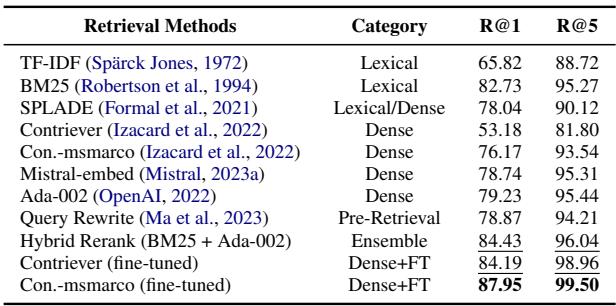
The results in Table 2 were revealing. Traditional lexical methods (BM25) performed surprisingly well, often beating or matching sophisticated dense retrievers.
Why? In K-12 education, questions often contain specific academic terms (e.g., “photosynthesis,” “Treaty of Versailles”). Exact keyword matching is highly effective here. Dense retrievers, which look for semantic meaning, sometimes drift too far. However, when dense models were fine-tuned specifically on this educational dataset (Contriever (fine-tuned)), they achieved the best performance.
2. Question Answering Performance
The most critical finding concerns the robustness of the LLMs themselves. The researchers measured accuracy across different model families, including Llama-3, GPT-4, and Mistral.
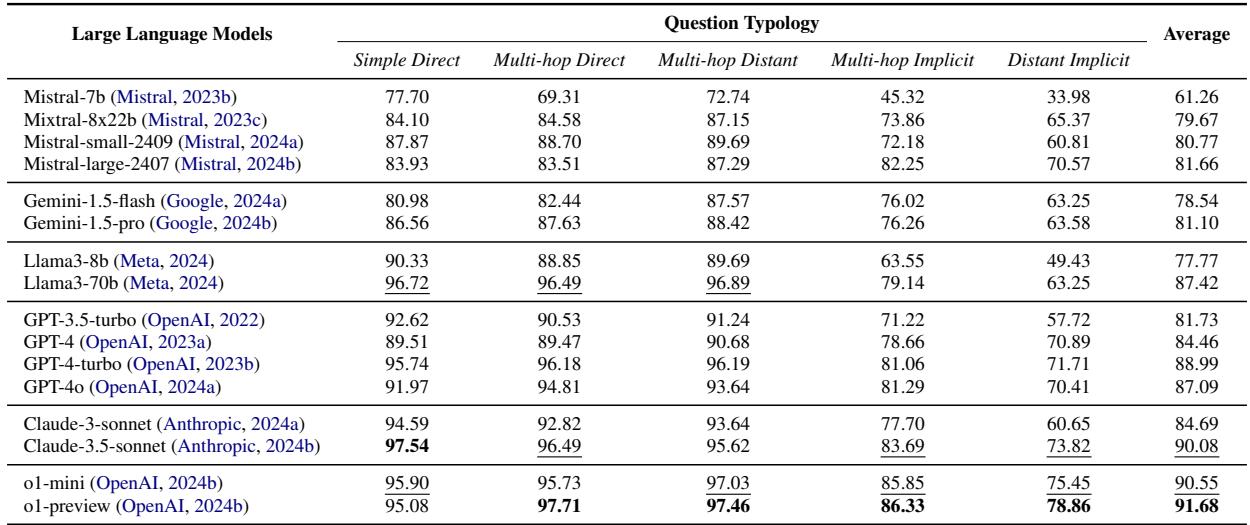
Table 3 shows a clear trend: “Smarter” models like GPT-4-turbo and Claude-3.5-sonnet generally perform better. However, look at the Multi-hop Implicit column. Performance drops significantly across the board.
While models are good at simply parroting back a changed fact (Simple Direct), they struggle to reason with that changed fact. They have difficulty seamlessly integrating a piece of “new” contextual knowledge (e.g., “Halophiles love pressure”) with their “old” parametric reasoning (e.g., general biological principles).
3. The Performance Drop
The ultimate test was comparing performance before and after the knowledge shift. The researchers ran the RAG systems on the original true facts, and then on the hypothetically updated facts.
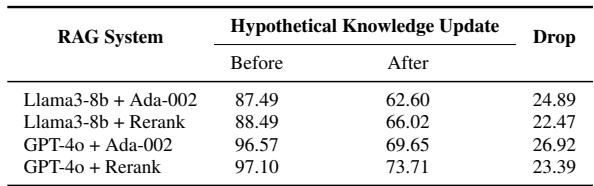
Table 4 illustrates a substantial performance degradation. When the knowledge shifted, accuracy dropped by 22% to nearly 27%.
This is a massive reliability issue for educational software. It implies that if a textbook teaches something that contradicts the AI’s training data (which happens often in simplified K-12 curriculums), the AI has a 1 in 4 chance of ignoring the textbook and giving the “wrong” (or rather, unfaithful) answer.
Why Do They Fail?
The paper suggests that LLMs exhibit a form of “cognitive dissonance.” Stronger models often have stronger priors—they are more confident in their internal knowledge.
Interestingly, on some simple questions, the most advanced models occasionally performed worse than smaller models because they were “too smart for their own good.” They recognized the hypothetical fact as “false” based on their training and refused to adopt it, despite the instruction to rely on the provided context. This highlights a conflict between factuality calibration (being truthful to the real world) and instruction following (being faithful to the provided text).
In an educational setting, instruction following must take precedence. The AI acts as a tutor for the provided curriculum, not as a universal arbiter of truth.
Conclusion and Implications
The KNOWSHIFTQA paper provides a sobering look at the current state of RAG in education. While RAG is often touted as the solution to LLM hallucinations, this research demonstrates that simply retrieving the correct document isn’t enough.
If the retrieved document conflicts with the model’s training, the model often fails to integrate that information, especially for complex reasoning tasks.
Key Takeaways:
- RAG is fragile under knowledge shifts: A 25% drop in accuracy when textbook facts differ from training data is a significant hurdle.
- Lexical retrieval is still king in EdTech: Don’t throw away BM25 yet; precise terminology matters more than semantic vibes in textbooks.
- Knowledge Integration is the bottleneck: Models can find the text, but they struggle to “update” their mental model to reason based on new, contradictory information.
For developers building the next generation of AI tutors, the message is clear: ensuring models can flexibly prioritize context over memory is just as important as making them “smarter.” Until then, students might find their AI tutors correcting their textbooks—even when the textbook is right.