](https://deep-paper.org/en/paper/2412.08988/images/cover.png)
Have you ever watched a dubbed movie where the voice acting felt completely detached from the actor’s face? Perhaps the lips stopped moving, but the voice kept going, or the character on screen was screaming in rage while the dubbed voice sounded mildly annoyed. This disconnect breaks immersion instantly.
This challenge falls under the domain of Visual Voice Cloning (V2C). The goal is to take a text script, a video clip of a speaker, and a reference audio track, and then generate speech that matches the video’s lip movements while cloning the reference speaker’s voice.
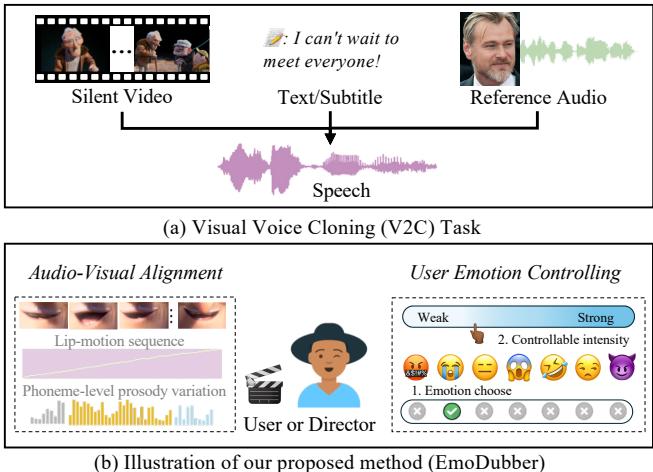
As illustrated in Figure 1, the task is complex. Existing research has struggled to balance the “Iron Triangle” of dubbing: Audio-Visual Synchronization, Pronunciation Clarity, and Emotional Expressiveness.
Most current models force a trade-off. If you focus heavily on matching the lips (sync), the pronunciation often becomes mumbled or slurred. If you focus on clear speech, the lip-sync drifts. Worse yet, almost all existing methods result in rigid, emotionless speech. They cannot simulate the nuance of a director saying, “Say this line again, but angrier,” or “Make it a little less sad.”
In this post, we will explore EmoDubber, a novel architecture proposed by researchers from the Chinese Academy of Sciences and other institutions. EmoDubber addresses these limitations by introducing a method that ensures high-quality lip sync and clear pronunciation while offering users granular control over emotion type and intensity.
The Core Challenge: Why is Dubbing So Hard?
To understand EmoDubber, we first need to understand where previous methods failed. Generally, V2C methods fall into two categories:
- Style-Focused: These use pre-trained encoders to capture the speaker’s identity. While they sound like the target speaker, they often use simple loss functions that fail to align the speech rhythm with the video’s lip movements.
- Visual-Focused: These heavily incorporate visual data (lip motion, facial expressions) to drive the prosody (rhythm and intonation) of the speech. While the sync is better, operating at the video-frame level often ignores phoneme-level details, resulting in “mumbled” articulation.
Furthermore, neither group effectively handles emotion control. In a real studio, an actor performs multiple takes to get the emotional intensity just right. AI dubbing systems have historically lacked this “knob,” producing flat, monotonic outputs that don’t match the dramatic tension of a scene.
The EmoDubber Solution
The researchers propose a comprehensive architecture that treats dubbing as a multi-stage process involving alignment, enhancement, adaptation, and emotional rendering.
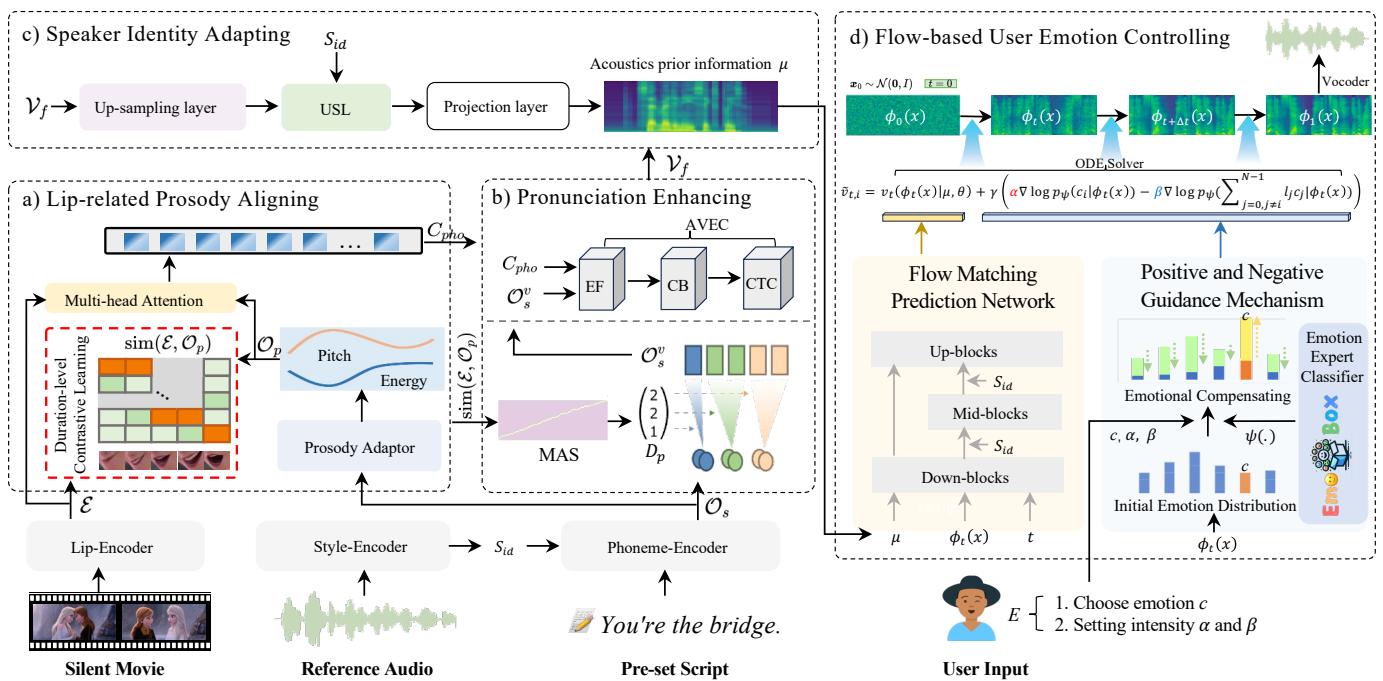
The EmoDubber framework, shown above, is composed of four distinct modules, each solving a specific part of the dubbing puzzle:
- Lip-related Prosody Aligning (LPA): Ensures the speech rhythm matches the video.
- Pronunciation Enhancing (PE): Fixes the “mumbling” issue by refining phonemes.
- Speaker Identity Adapting (SIA): Injects the target speaker’s vocal style.
- Flow-based User Emotion Controlling (FUEC): The engine for generating emotional waveforms with controllable intensity.
The overall objective function for EmoDubber can be summarized as:

Here, the model takes a Reference Audio (\(R_a\)), Text (\(T_p\)), Video (\(V_l\)), and User Emotion Guidance (\(E\)) to produce the final audio \(\hat{Y}\). Let’s break down each component.
1. Lip-related Prosody Aligning (LPA)
The first step is establishing a connection between the text and the silent video. The LPA module focuses on Duration-Level Contrastive Learning (DLCL).
First, the system extracts features from the text and the video.
- Text: A phoneme encoder extracts style-aware phoneme embeddings (\(\mathcal{O}_{s}\)).
- Video: A Lip Encoder extracts motion embeddings (\(\mathcal{E}\)) from the mouth region of the video frames.
![]\n\\mathcal { O } _ { s } = \\mathrm { P h o E n c o d e r } ( T _ { r } \\in \\mathbb { R } ^ { P } , S _ { i d } ) ,\n[](/en/paper/2412.08988/images/004.jpg#center)
![]\n\\mathcal { E } = \\mathrm { L i p E n c o d e r } ( M _ { r o i } \\in \\mathbb { R } ^ { F \\times D _ { w } \\times D _ { h } \\times D _ { c } } ) ,\n[](/en/paper/2412.08988/images/005.jpg#center)
To synchronize these, the model needs to know how long each phoneme should be pronounced to match the mouth movement. The LPA uses a multi-head attention mechanism where the lip motion serves as the Query and the phoneme prosody serves as the Key and Value. This generates a “lip-prosody context sequence” (\(C_{pho}\)).
![]\nC _ { p h o } = \\mathrm { s o f t m a x } ( \\frac { \\mathcal { E } ^ { \\top } \\mathcal { O } _ { p } } { \\sqrt { d _ { m } } } ) { \\mathcal { O } _ { p } } ^ { \\top } ,\n[](/en/paper/2412.08988/images/006.jpg#center)
However, simple attention isn’t enough to guarantee tight synchronization. The researchers introduced a contrastive learning loss (\(\mathcal{L}_{cl}\)) that forces the model to learn the “correct” alignment. It encourages positive pairs (correct text-video matches) to have higher similarity scores than negative pairs.
![]\n\\mathcal { L } _ { c l } = - \\log \\frac { \\sum \\exp \\big ( ( \\sin ^ { + } ( \\mathcal { E } , \\mathcal { O } _ { p } ) ) / \\tau \\big ) } { \\sum \\exp ( ( \\sin ( \\mathcal { E } , \\mathcal { O } _ { p } ) ) ) } ,\n[](/en/paper/2412.08988/images/007.jpg#center)
Crucially, the positive pair similarity is weighted by a ground-truth matrix (\(M_{lip,pho}^{gt}\)), derived from a Forced Aligner tool, ensuring that the attention mechanism respects the monotonic nature of speech (i.e., you can’t say the end of the sentence before the beginning).
![]\n\\mathrm { s i m } ^ { + } ( \\mathcal { E } , \\mathcal { O } _ { p } ) = \\mathrm { s i m } ( \\mathcal { E } , \\mathcal { O } _ { p } ) \\times M _ { l i p , p h o } ^ { g t } ,\n[](/en/paper/2412.08988/images/008.jpg#center)
2. Pronunciation Enhancing (PE)
While LPA handles the timing, we still need to ensure the words are intelligible. Previous methods that relied solely on video features often produced slurred speech because visual cues for some phonemes are ambiguous (e.g., ‘p’ vs ‘b’).
The Pronunciation Enhancing (PE) strategy addresses this by explicitly expanding the phoneme sequence to match the video length. It uses Monotonic Alignment Search (MAS) to calculate the optimal duration (\(D_p\)) for each phoneme based on the attention map learned in the previous step.
![]\n\\begin{array} { r } { \\mathcal { O } _ { s } ^ { v } = \\mathrm { L R } ( D _ { p } , \\mathcal { O } _ { s } ) , } \\end{array}\n[](/en/paper/2412.08988/images/009.jpg#center)
The Length Regulator (LR) expands the phoneme sequence. This expanded sequence is then fused with the lip-prosody context (\(C_{pho}\)) using an Audio-Visual Efficient Conformer (AVEC).
![]\n\\mathcal { V } _ { f } = \\mathrm { C o n f o r m e r } ( C _ { p h o } , \\mathcal { O } _ { s } ^ { v } ) ,\n[](/en/paper/2412.08988/images/010.jpg#center)
The Conformer architecture is ideal here because it combines Convolution (good for local details like individual phonemes) and Transformers (good for global context). This fusion ensures the speech is both synchronized with the lips and linguistically clear.
3. Speaker Identity Adapting (SIA)
Now that we have synchronized, clear content, we need to make it sound like the target actor. The SIA module takes the fused features (\(\mathcal{V}_f\)) and injects the speaker’s style embedding (\(S_{id}\)).
![]\n\\mu = { \\mathrm { P r o j } } ( { \\mathrm { U S L } } ( { \\mathrm { U p } } ( \\mathcal V _ { f } ) , S _ { i d } ) ) ,\n[](/en/paper/2412.08988/images/011.jpg#center)
This process involves up-sampling the features to the mel-spectrogram level and using an Utterance-level Style Learning (USL) module. The output, \(\mu\), serves as the “acoustic prior”—a blueprint of the speech that contains the content and speaker identity, ready for emotional coloring.
4. Flow-based User Emotion Controlling (FUEC)
This is the most innovative part of EmoDubber. How do we inject emotion into this acoustic blueprint? The researchers utilize Flow Matching, a generative technique similar to diffusion models but often faster and more stable.
The goal is to transform simple noise (\(x_0\)) into a complex Mel-spectrogram (\(M\)) that represents emotional speech. The model learns a “vector field”—essentially a map telling the noise how to flow over time (\(t\)) to become the target image (spectrogram).
![]\n\\mathcal { L } _ { \\theta } = \\mathbb { E } _ { t , q ( M ) , p _ { t } ( x | \\mu , M ) } | | v _ { t } ( \\phi _ { t } ( x ) | \\mu , \\theta ) - u _ { t } ( \\phi _ { t } ( x ) | M ) | | ^ { 2 } ,\n[](/en/paper/2412.08988/images/012.jpg#center)
However, standard flow matching just generates the most likely speech. To control emotion, EmoDubber introduces Positive and Negative Guidance Mechanisms (PNGM).
Human emotions are complex mixes. A “happy” voice isn’t just happy; it’s also not sad and not angry. To achieve precise control, the researchers use a pre-trained Emotion Expert Classifier. During generation, they guide the flow in two directions simultaneously:
- Positive Guidance (\(\alpha\)): Pushes the generation toward the target emotion class (\(c_i\)).
- Negative Guidance (\(\beta\)): Pushes the generation away from all other emotion classes.
The modified vector field equation looks like this:
![]\n\\begin{array} { r l } & { \\tilde { v } _ { t , i } = v _ { t } ( \\phi _ { t } ( x ) | \\mu , \\theta ) } \\ & { \\qquad + \\gamma \\Big ( \\alpha \\nabla \\log p _ { \\psi } ( c _ { i } | \\phi _ { t } ( x ) ) - \\beta \\nabla \\log p _ { \\psi } \\big ( \\displaystyle \\sum _ { j = 0 , j \\neq i } l _ { j } c _ { j } | \\phi _ { t } ( x ) ) \\Big ) , } \\end{array}\n()](/en/paper/2412.08988/images/013.jpg#center)
By adjusting \(\alpha\) and \(\beta\), a user (or director) can control the intensity of the emotion. A high \(\alpha\) makes the emotion stronger, while \(\beta\) ensures purity by suppressing conflicting emotional traits.
Experimental Results
The researchers tested EmoDubber against several state-of-the-art (SOTA) methods, including V2C-Net, HPMDubbing, and StyleDubber, using the Chem (single speaker) and GRID (multi-speaker) datasets.
Quantitative Performance
The evaluation metrics focused on three areas:
- Sync: Lip Sync Error Confidence (LSE-C) and Distance (LSE-D).
- Quality: Word Error Rate (WER) and Speaker Similarity (SECS).
- Emotion: Intensity Score (IS).
On the challenging GRID benchmark (Setting 2.0, which involves multi-speaker scenarios), EmoDubber showed significant improvements.
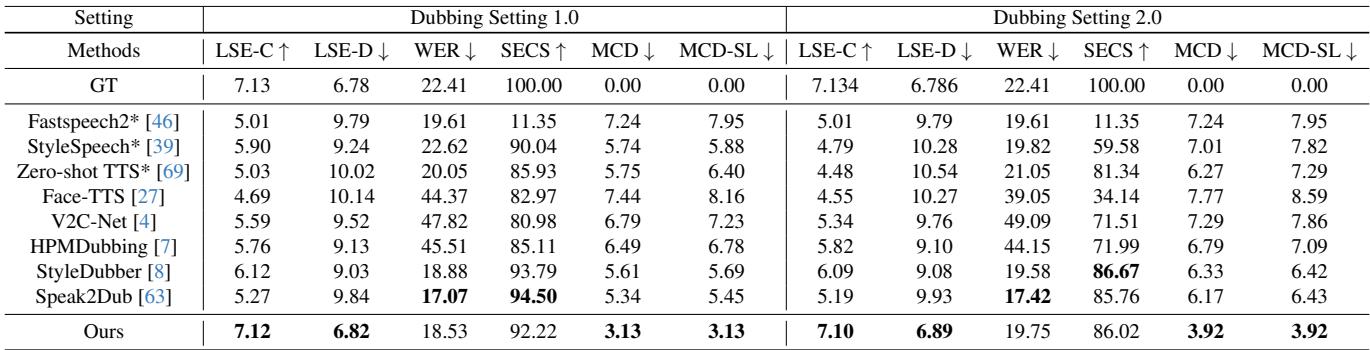
As shown in Table 4, EmoDubber achieved the lowest MCD (Mel Cepstral Distortion) score of 3.92, compared to 6.33 for StyleDubber. Lower MCD indicates the generated audio is much closer to the ground truth.
Crucially, in terms of intelligibility (WER), EmoDubber achieved 19.75%, beating the previous best of 49.09% (V2C-Net) and rivaling models that don’t even attempt complex lip-sync. It uniquely managed to improve synchronization (LSE-C/D) and pronunciation simultaneously, validating the effectiveness of the LPA and PE modules.
Controlling Emotional Intensity
One of the paper’s key claims is the ability to control emotional intensity. The researchers visualized this by plotting the Intensity Score against the positive guidance scale (\(\alpha\)).

In Figure 3, we can see that as the user increases \(\alpha\) (the x-axis), the intensity score rises for various emotions like Happy, Sad, and Angry. The different colored lines represent different levels of negative guidance (\(\beta\)). This proves that the architecture allows for a “tunable” performance—users aren’t stuck with a single, static “sad” voice.
Visualizing the Audio
To see what this looks like in the signal itself, the authors provided spectrogram visualizations.

In Figure 4, compare the “Neutral” spectrograms (bottom) with the generated emotions (top).
- Surprise (a): Note the rising pitch at the end (highlighted in the blue box), typical of a surprised question or exclamation.
- Angry (b): The energy is significantly higher and more intense throughout the utterance.
- Sad (c): The spectrum shows diminished high-frequency energy and softer transitions, characteristic of a somber tone.
Generalization and Quality
Finally, can the model distinguish between emotions clearly? The t-SNE plot below compares the feature clustering of a baseline TTS model against EmoDubber.
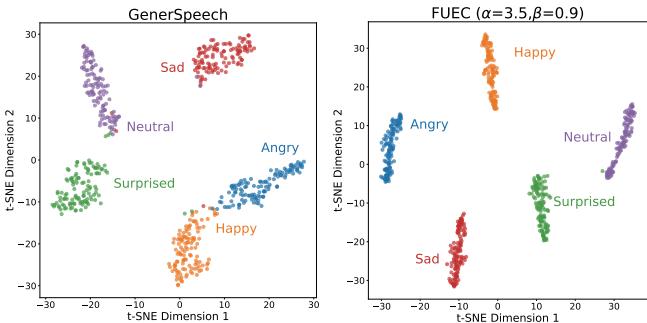
On the right (EmoDubber), the clusters for Angry (Blue), Sad (Red), and Happy (Orange) are distinct and well-separated. This indicates that the FUEC module successfully injects distinguishable emotional features into the audio.
Table 5 further confirms that adding emotion doesn’t break the lip-sync or clarity.
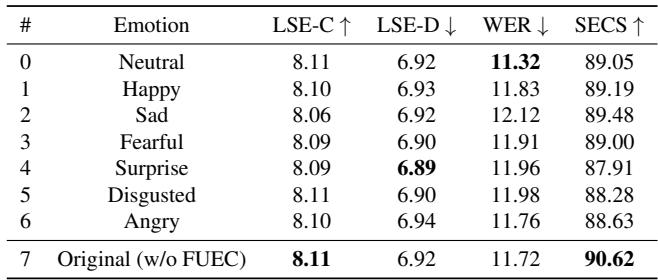
Even when generating strong emotions like Fearful or Disgusted, the Word Error Rate (WER) remains low (~11-12%) and the Speaker Similarity (SECS) remains high (~88-89%). This confirms that EmoDubber decouples emotion generation from content generation—you can change how something is said without breaking what is said or who is saying it.
Conclusion
EmoDubber represents a significant step forward in automated movie dubbing. By decomposing the problem into alignment, pronunciation, identity, and emotion, the researchers have created a system that addresses the major flaws of previous V2C models.
The key takeaways are:
- Alignment Matters: The Duration-Level Contrastive Learning (LPA) ensures the voice doesn’t drift from the lips.
- Clarity is Key: The Pronunciation Enhancing (PE) module ensures the dubbing is intelligible, not just synchronized.
- The Director’s Cut: The Flow-based User Emotion Controlling (FUEC) gives creators the power to dial in the exact emotion and intensity needed for a scene, bridging the gap between AI generation and artistic direction.
For the future of film production, localization, and content creation, tools like EmoDubber promise a world where language barriers can be crossed without losing the emotional impact of the original performance.