](https://deep-paper.org/en/paper/2412.09401/images/cover.png)
Introduction
One of the holy grails in computer vision is the ability to take a simple video from a smartphone and instantly turn it into a highly detailed, dense 3D model of the environment. Imagine walking through a room, filming it, and having a digital twin ready on your screen by the time you stop recording.
For decades, this has been a massive challenge. Traditional methods force us to choose between quality and speed. You could have a highly accurate model if you were willing to wait hours for offline processing (using Structure-from-Motion and Multi-View Stereo). Or, you could have real-time performance using SLAM (Simultaneous Localization and Mapping), but often at the cost of sparse, noisy, or incomplete geometry.
But what if you didn’t have to choose? And what if you didn’t even need to solve the complex mathematics of camera trajectories explicitly?
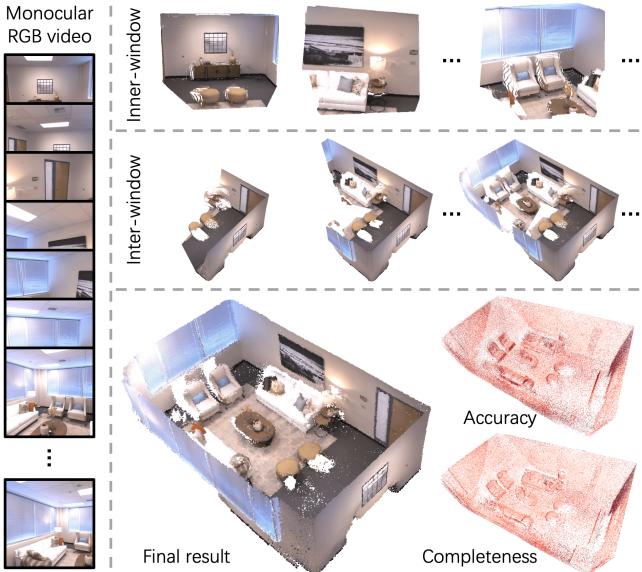
In this post, we are breaking down SLAM3R (“SLAM-er”), a new system presented by researchers from Peking University, HKU, and Aalto University. SLAM3R offers a fascinating paradigm shift: an end-to-end neural network approach that reconstructs dense 3D scenes from monocular RGB video in real-time (20+ FPS) without explicitly solving for camera parameters first.
The Context: Why is Dense SLAM so Hard?
To understand why SLAM3R is significant, we need to look at the traditional pipeline for 3D reconstruction.
The Old Guard: SfM and MVS
Classically, reconstructing a scene from video involves a two-stage pipeline:
- Structure-from-Motion (SfM): You calculate the camera’s position and orientation (pose) for every frame. This creates a sparse cloud of points.
- Multi-View Stereo (MVS): Once you know exactly where the camera was, you use triangulation to fill in the gaps, creating a dense surface.
While this produces beautiful results, it is computationally heavy. It is usually an “offline” process, meaning you record the video first, process it later, and wait.
The Real-Time Challenge
Real-time SLAM systems (like ORB-SLAM) prioritize tracking the camera. They build a map primarily so the camera doesn’t get lost. As a result, the map is often just a collection of sparse points—great for a robot navigating a hallway, but terrible if you want a visual 3D model of your living room.
Recently, Deep Learning methods have attempted to merge these worlds. A breakthrough paper called DUSt3R introduced a way to do dense reconstruction without camera poses by learning to predict 3D pointmaps directly. However, DUSt3R requires computationally expensive global optimization to stitch many views together, making it too slow for real-time video. Another attempt, Spann3R, tried to speed this up but suffered from “drift”—as the camera moved, errors accumulated, warping the 3D model.
SLAM3R enters the arena to solve this specific bottleneck: How do we maintain the high fidelity of offline methods like DUSt3R while achieving the speed of online SLAM systems?
The SLAM3R Method
The researchers approach this problem by dividing the reconstruction task into two distinct hierarchies: Local and Global.
- Inner-Window (Local): Reconstruct a small chunk of time (a few frames) very accurately.
- Inter-Window (Global): Stitch these small chunks into the main world coordinate system on the fly.
Crucially, both steps rely on feed-forward neural networks. There is no iterative optimization loop (like Bundle Adjustment) running in the background to slow things down.
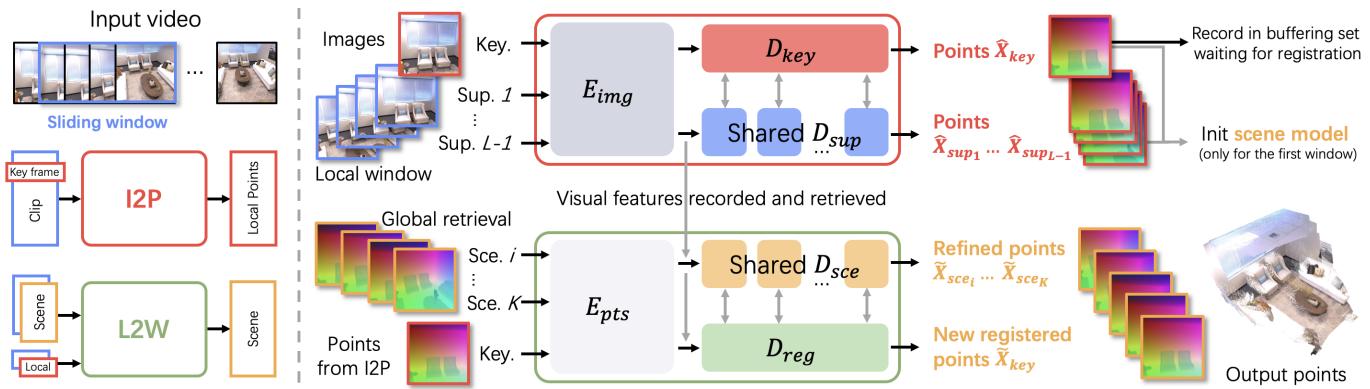
Let’s break down these two core modules: The Image-to-Points (I2P) network and the Local-to-World (L2W) network.
1. Image-to-Points (I2P): Building Local Geometry
The system processes the video using a sliding window mechanism. It grabs a short clip of frames (a “window”) and designates one frame (usually the middle one) as the Keyframe.
The goal of the I2P module is to determine the 3D structure of this specific window. It ignores the rest of the world for a moment and establishes a local coordinate system centered on that keyframe.
The Architecture
The I2P network is built on a Vision Transformer (ViT). It modifies the architecture found in DUSt3R to handle multiple views efficiently.
First, an image encoder extracts features from the keyframe and all “supporting” frames in the window:

Here, \(E_{img}\) is the encoder, and it produces feature tokens \(F\) for every frame \(I\).
Multi-View Cross-Attention
This is where the magic happens. The network needs to understand how the supporting frames relate to the keyframe to estimate depth. The authors use a specific decoder architecture where the keyframe “queries” the supporting frames.
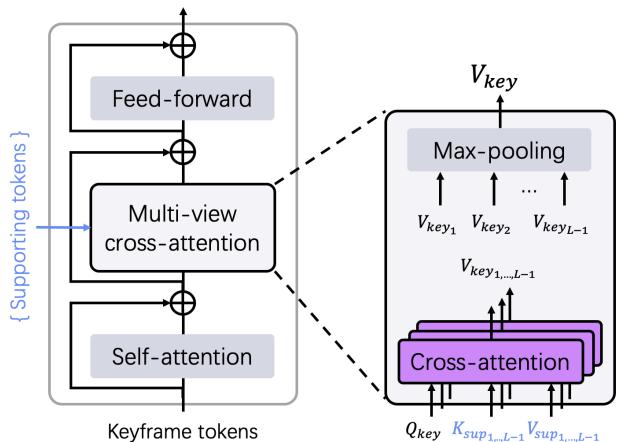
As shown in Figure 3, the keyframe tokens (\(F_{key}\)) go through a self-attention layer (to understand the keyframe image itself) and a multi-view cross-attention layer. In this cross-attention step, the keyframe looks at the features of the supporting frames (\(F_{sup}\)).
If you are familiar with Transformers, you know that attention usually scales quadratically with the number of tokens. To keep this fast, the system processes the cross-attention for each supporting frame separately and then uses max-pooling to aggregate the most important geometric clues.
The decoder outputs a refined representation, denoted as \(G_{key}\):

Finally, a “head” (a simple linear layer) takes these tokens and directly regresses two things:
- 3D Pointmap (\(\hat{X}\)): The X, Y, Z coordinates for every pixel in the local coordinate system.
- Confidence Map (\(\hat{C}\)): How sure the network is about each point.

The result is a highly accurate, dense 3D point cloud for that specific moment in the video.
2. Local-to-World (L2W): Stitching the World
Now we have a bunch of small, disconnected 3D snapshots (from the I2P module). If we just placed them next to each other, they wouldn’t align because the camera moved. We need to register these local points into a unified Global Coordinate System.
This is the job of the Local-to-World (L2W) network.
The “Scene Frames” Buffer
Traditional SLAM keeps track of the camera pose. SLAM3R instead keeps track of Scene Frames. These are past keyframes that have already been successfully registered into the global world.
Because a video can be infinitely long, we can’t store every frame. The authors use a Reservoir Sampling strategy. This is a fancy way of saying they keep a fixed-size buffer of frames that statistically represents the history of the video. When the buffer is full, new frames randomly replace old ones, ensuring the system doesn’t run out of memory but still remembers long-term history.
The Retrieval Module
When a new keyframe arrives from the I2P module, the system needs to know: “Where does this fit?”
It runs a lightweight Retrieval Module that compares the current keyframe features with the stored Scene Frames.

It selects the top-\(K\) most similar scene frames. These frames act as anchors. Since we know where the anchors are in the 3D world, we can use them to pull the new keyframe into the correct position.
Geometry-Aware Fusion
The L2W network is very similar to the I2P network, but with a twist. It doesn’t just look at image pixels; it looks at the 3D points we’ve already calculated.
The system embeds the 3D pointmaps (\(\hat{X}\)) using a point encoder (\(E_{pts}\)) and adds them to the visual features:


Now, the tokens \(\mathcal{F}\) contain both appearance (what it looks like) and geometry (shape) information.
The registration decoder (\(D_{reg}\)) takes these fused tokens. The new keyframe queries the retrieved scene frames. The network learns to output the new coordinates for the keyframe’s points, effectively transforming them from the local system to the global world system.

This process is entirely feed-forward. There is no Iterative Closest Point (ICP) algorithm or matrix multiplication to solve for rotation and translation explicitly. The network simply learns to move the points to the right place.
Experiments and Results
Does this actually work? The authors tested SLAM3R on standard benchmarks like the 7-Scenes (real-world handheld video) and Replica (high-fidelity synthetic) datasets.
Accuracy vs. Speed
The most compelling result is the balance between accuracy and speed. In the table below, look at the FPS column (color-coded).
- Red/Orange: Methods like DUSt3R and MASt3R are incredibly slow (< 1 FPS). They are accurate but unusable for live applications.
- Green: SLAM3R runs at ~25 FPS.

Notice that SLAM3R often beats Spann3R (its main real-time competitor) in both Accuracy and Completeness. This is largely because Spann3R accumulates drift over time, whereas SLAM3R’s retrieval module allows it to look back at older frames to correct itself (a form of implicit loop closure).
Visual Quality
Numbers are great, but visual reconstruction is about looking good.
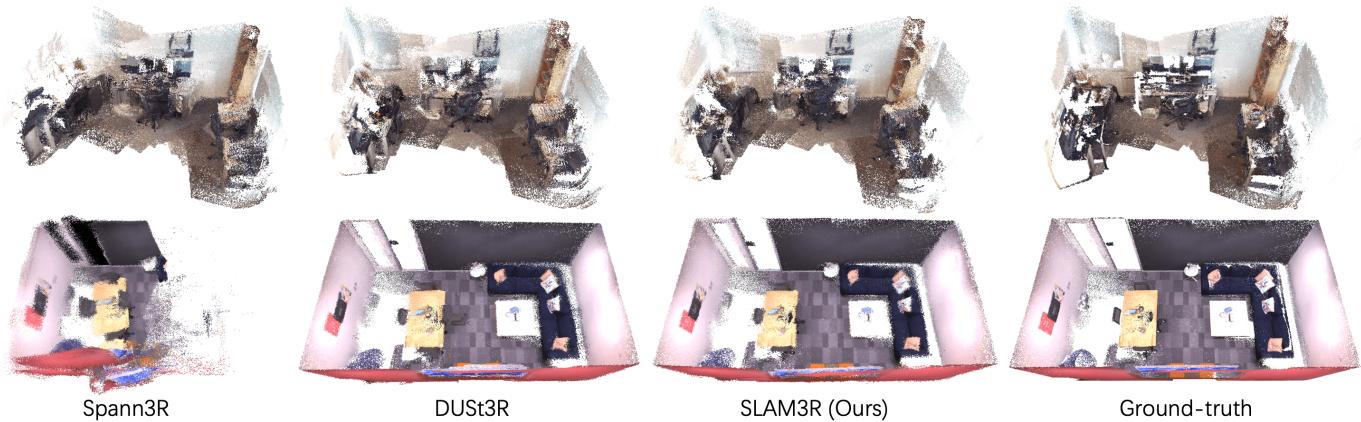
In Figure 4, we can see the “Raw Point Clouds” (top row).
- Spann3R (far left) shows significant noise and “fuzziness” around the walls and floor.
- SLAM3R (third column) produces sharp, flat walls and clearly defined furniture, looking very close to the Ground Truth (far right).
The authors also tested the system “in the wild” on unorganized collections and outdoor scenes, showing that the model generalizes well beyond the datasets it was trained on.

The “No Pose” Surprise
Perhaps the most scientifically interesting finding is related to camera poses. The researchers extracted camera poses from their predicted point clouds to compare with traditional SLAM.
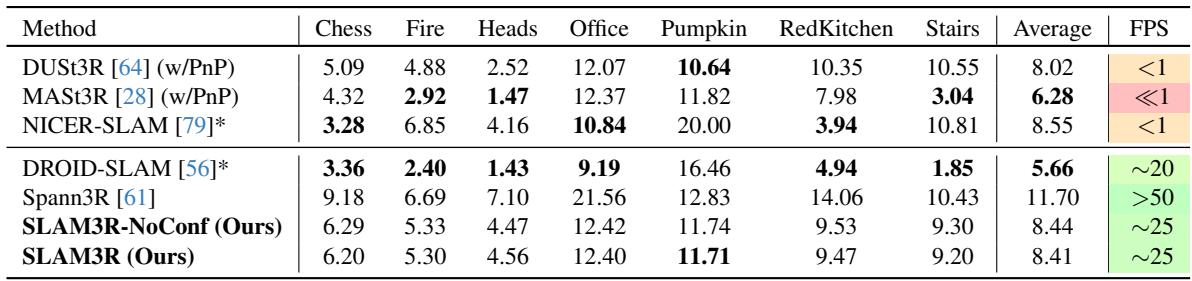
Interestingly, SLAM3R’s camera pose estimates were sometimes worse than other methods, yet its 3D reconstruction was better. This highlights a crucial insight: You do not need perfect camera tracking to get a perfect map. Traditional SLAM over-obsesses with the camera trajectory. SLAM3R focuses purely on the geometry of the scene, allowing it to produce better 3D models even if the implied camera path is slightly off.
Conclusion
SLAM3R represents a significant step forward in dense 3D reconstruction. By moving away from explicit pose optimization and embracing a pure learning-based, feed-forward approach, it achieves what was previously considered a “pick two” trade-off: it is accurate, complete, and real-time.
Key Takeaways:
- End-to-End Learning: Replaces complex mathematical solvers with trained neural networks for both local geometry and global alignment.
- Hierarchical Strategy: Splits the problem into Inner-Window (detailed local shape) and Inter-Window (global consistency) tasks.
- Implicit Localization: Focuses on mapping the points rather than tracking the camera, leading to superior scene reconstruction.
For students and researchers, SLAM3R demonstrates the power of Transformers in geometry tasks. It suggests that the future of 3D computer vision might not rely on the geometric equations of the past century, but on massive, well-trained networks that simply “know” how to assemble the world.
If you are interested in digging deeper, the code is available at the link provided in the paper’s abstract.