](https://deep-paper.org/en/paper/2412.09619/images/cover.png)
Introduction
The generative AI boom has brought us incredible tools like Stable Diffusion XL (SDXL) and Stable Diffusion 3 (SD3). These models can conjure photorealistic images from simple text prompts, but they come with a heavy cost: computational power. Typically, running these models requires massive, power-hungry GPUs found in cloud servers or high-end gaming PCs.
For the average user, this means relying on cloud services, which introduces latency, subscription costs, and data privacy concerns. Running these models locally on a smartphone has been the “holy grail” of edge computing. While there have been attempts to shrink models through compression, they often result in low-resolution outputs (\(512 \times 512\) pixels) or significant drops in visual quality.
Enter SnapGen.
In a new paper, researchers from Snap Inc., alongside academic collaborators, propose a comprehensive solution to the mobile generation problem. They have developed a text-to-image (T2I) model that is not only tiny (roughly 379 million parameters compared to SDXL’s 2.6 billion) but also incredibly fast.
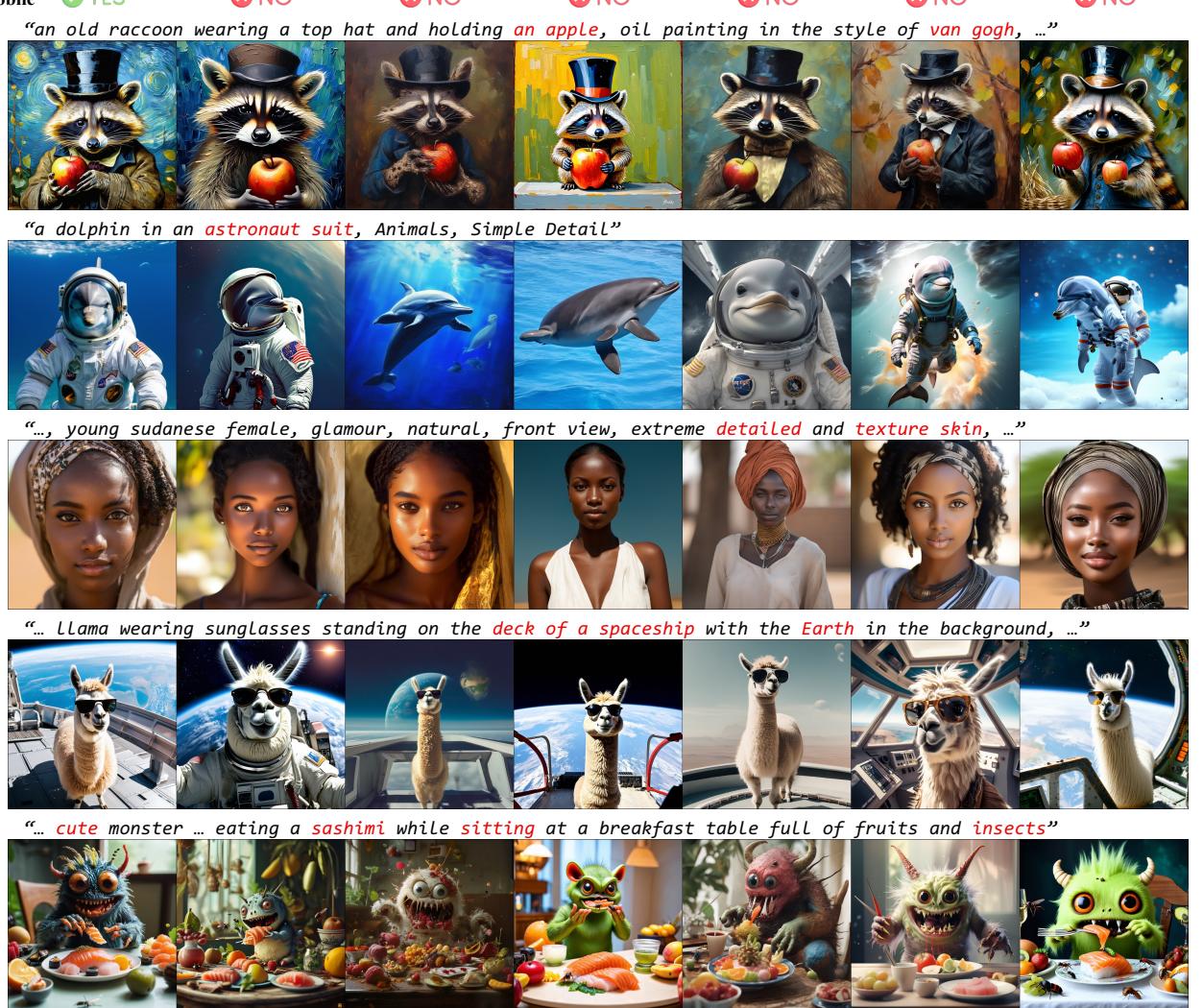
As shown above, SnapGen achieves competitive visual quality at \(1024 \times 1024\) resolution while being fully compatible with mobile devices—something giants like SDXL and SD3-Medium struggle to achieve natively. This article dives into the architecture, training recipes, and distillation techniques that make this possible.
Background: The Efficiency Bottleneck
To understand why SnapGen is significant, we first need to look at why current models are slow. Most modern T2I systems are Diffusion Models. They work by gradually removing noise from a random signal until a clear image emerges, guided by a text prompt.
This process involves two main heavy-lifters:
- The Denoising Backbone (usually a UNet or Transformer): This runs multiple times (steps) to refine the noise. It is computationally expensive (quadratic complexity) due to attention mechanisms.
- The Decoder (VAE): Once the denoising is done in a compressed “latent space,” the decoder expands the latent representation back into pixel space.
Existing approaches to efficiency usually involve “pruning” (cutting parts of the network) or “quantization” (reducing numerical precision). While helpful, these are often band-aids on architectures that were designed for servers, not phones. The SnapGen team took a different approach: they designed an efficient architecture from scratch and created a specialized training pipeline to punch above its weight class.
Method: Architecting for the Edge
The researchers attacked the problem from three angles: a redesigned UNet, a tiny decoder, and a sophisticated training regimen.
1. The Efficient UNet
The core of SnapGen is its denoising backbone. The team started with the UNet from SDXL but stripped it down to a “thinner and shorter” baseline. From there, they applied a series of surgical architectural changes to optimize for mobile hardware (specifically targeting the Neural Engine of Apple’s A-series chips).
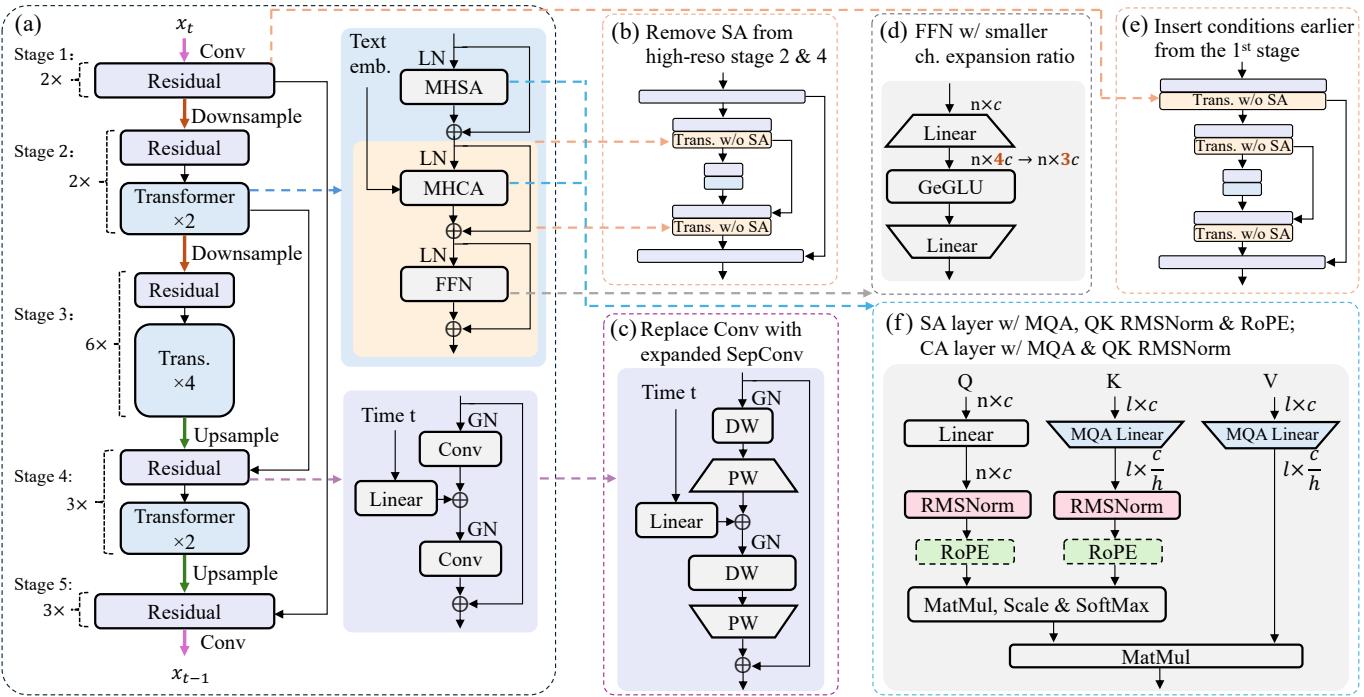
Here is the step-by-step evolution illustrated in the figure above:
- (b) Removing Self-Attention in High-Res Stages: Self-attention scales quadratically with resolution. By keeping it only in the lower-resolution bottleneck and removing it from high-res stages, they slashed latency without hurting quality. In fact, quality improved, likely because high-res attention can sometimes impede convergence.
- (c) Separable Convolutions: Standard convolutions are parameter-heavy. Replacing them with Depthwise Separable Convolutions (SepConv) reduced parameters significantly. To regain the model expressiveness lost by this reduction, they expanded the channel width (Universal Inverted Bottleneck design).
- (d) Trimming the FFN: The Feed-Forward Networks usually expand dimensions by \(4\times\). Reducing this expansion ratio to \(3\times\) saved computation with minimal impact on output.
- (f) Advanced Attention & Normalization: They adopted Multi-Query Attention (MQA), which shares keys/values across heads to save memory, and implemented RMSNorm and RoPE (Rotary Positional Embeddings) for better training stability.
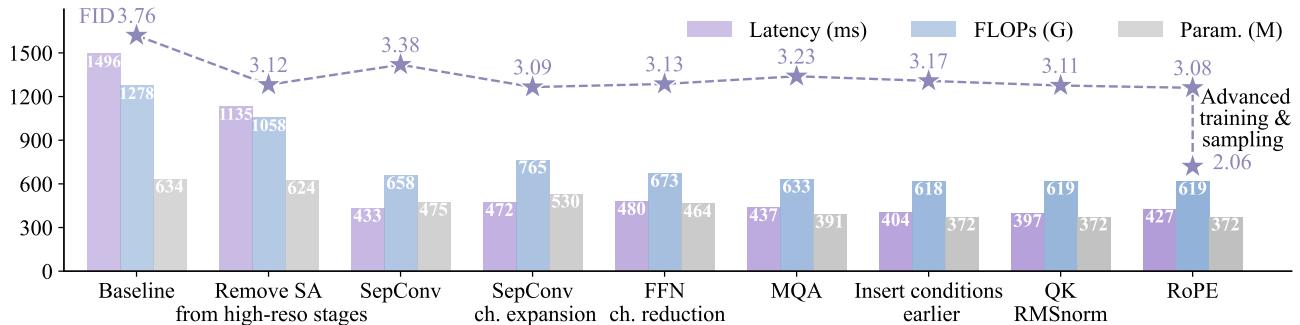
The impact of these decisions is quantified below. Notice how “Ours (Final)” achieves the lowest FID (lower is better quality) while keeping latency and FLOPs extremely low.
2. A Tiny, Fast Decoder
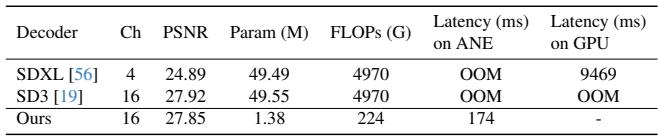
A surprising bottleneck in mobile generation is the Autoencoder (VAE) decoder. Even if the UNet generates the latent representation quickly, decoding that into a \(1024 \times 1024\) image can cause Out-Of-Memory (OOM) errors on mobile neural processing units (NPUs).
The standard SDXL decoder has roughly 50 million parameters. SnapGen introduces a tiny decoder with only 1.38 million parameters.
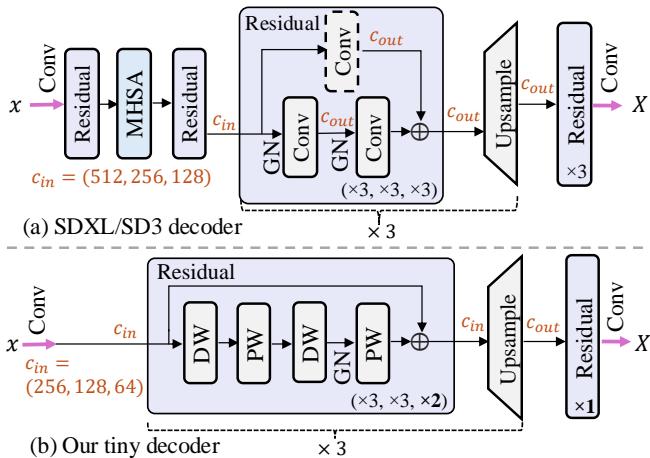
They achieved this by removing attention layers from the decoder entirely (which consume massive peak memory), using fewer residual blocks, and utilizing separable convolutions. As seen in the table below, while SDXL and SD3 decoders fail (OOM) on the iPhone’s Neural Engine, the SnapGen decoder runs in 174ms.
Advanced Training Recipe
Designing a small model is only half the battle. Small models usually struggle to capture the complex relationships between text and images compared to their billion-parameter cousins. To solve this, the researchers utilized Knowledge Distillation (KD).
Flow Matching and Knowledge Distillation
Instead of standard diffusion objectives, SnapGen uses Rectified Flow, a technique that straightens the path between the noise distribution and the data distribution.
The training objective essentially minimizes the difference between the model’s predicted “velocity” (\(v_\theta\)) and the target direction.

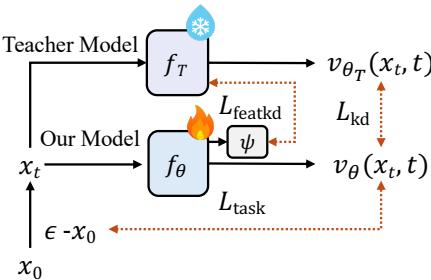
To supercharge the small model, they use a massive teacher model (SD3.5-Large). The goal is to make the small “student” model mimic the teacher. However, blindly copying the teacher’s output is inefficient because the teacher and student have different architectures (DiT vs. UNet).
The researchers introduced a Multi-Level Knowledge Distillation strategy:
- Output Distillation: The student tries to match the final velocity prediction of the teacher.
- Feature Distillation: They project the teacher’s internal features to match the student’s dimensions, forcing the student to learn how the teacher “thinks,” not just what it outputs.
Timestep-Aware Scaling
A critical insight in this paper is that the difficulty of the task varies depending on the noise level (timestep \(t\)). In the middle of the diffusion process, the task is “easier,” while at the very beginning and very end, the prediction difficulty spikes.
Standard distillation applies a constant weight to the loss. SnapGen introduces Timestep-Aware Scaling.
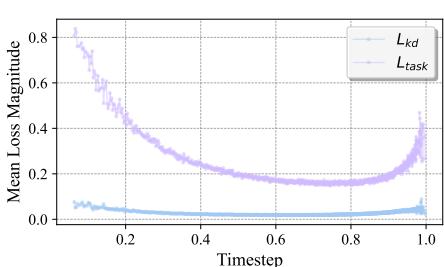
As shown in the graph above, the magnitude of the task loss (\(\mathcal{L}_{task}\)) and distillation loss (\(\mathcal{L}_{kd}\)) diverges significantly at the boundaries (\(t=0\) and \(t=1\)). The researchers formulated a scaling mechanism that balances these losses dynamically based on the timestep:

This ensures that the model focuses on teacher supervision exactly when it’s most beneficial, leading to faster convergence and better alignment.
Step Distillation: Speeding Up Inference
Even with a fast model, standard diffusion requires 20-50 steps to generate an image. To run in under 2 seconds on a phone, the step count needs to drop to single digits (4 to 8 steps).
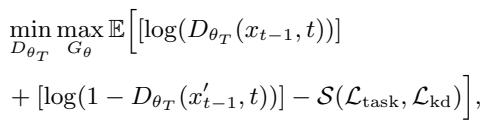
SnapGen achieves this via Adversarial Step Distillation.
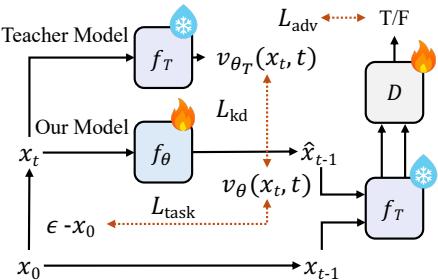
They treat the diffusion process like a GAN (Generative Adversarial Network). A discriminator is trained to distinguish between the student’s output (generated in one step from a previous state) and the “real” denoised distribution. This adversarial pressure forces the model to jump toward the clean image much faster, removing the need for dozens of refinement steps.
Experiments and Results
So, how does SnapGen stack up against the heavyweights?
Quantitative Benchmarks
The researchers evaluated the model on ImageNet and various T2I benchmarks like GenEval and DPG-Bench. The results are striking. Despite having a fraction of the parameters (0.38B vs 2.6B+), SnapGen outperforms SDXL and Playground v2.5 in text alignment and aesthetic quality.
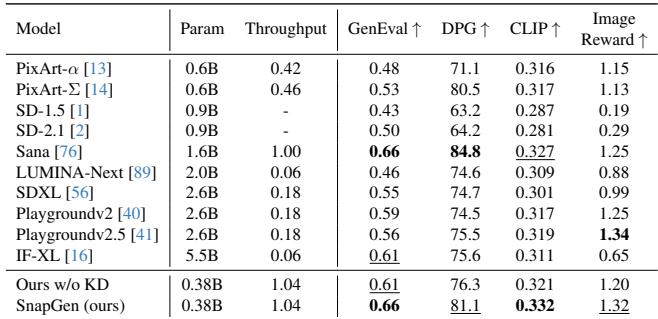
In GenEval (a benchmark for object alignment), SnapGen scores 0.66, beating SDXL’s 0.55. This indicates that the knowledge distillation from SD3.5 was highly effective, transferring the “intelligence” of the large model into the compact student.
Visual Quality and Human Evaluation
Numbers are useful, but visual art is subjective. The team conducted user studies comparing SnapGen against SDXL, SD3-Medium, and its teacher SD3.5-Large.

SnapGen (purple bars) consistently beats SDXL and SD3-Medium in aesthetics, alignment, and realism. It even holds its own against its much larger teacher, SD3.5-Large, particularly in realism.
Few-Step Performance
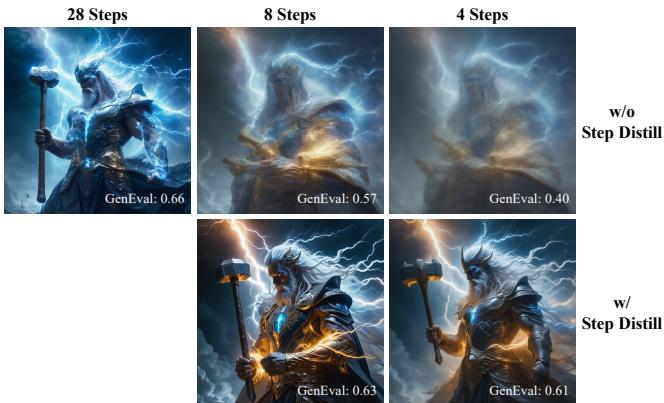
The impact of the Adversarial Step Distillation is clearly visible when comparing step counts. Below, we see that the 8-step and even 4-step generations maintain high fidelity and structure, whereas the base model (without step distillation) falls apart at low step counts.
On-Device Demo
Finally, the paper delivers on its primary promise: mobile execution. On an iPhone 16 Pro-Max, the model generates a \(1024 \times 1024\) image in approximately 1.4 seconds.

Conclusion
SnapGen represents a significant shift in how we think about deploying Generative AI. Rather than simply shrinking existing server-class models, this research highlights the importance of architecture-hardware co-design. By building an architecture specifically for mobile constraints (removing high-res attention, optimizing the decoder) and pairing it with state-of-the-art training techniques (flow matching, multi-level distillation), the team achieved what was previously thought to require massive GPUs.
For students and researchers, SnapGen offers a blueprint for efficient Deep Learning:
- Don’t ignore the decoder: In latent diffusion, the VAE can be a silent bottleneck.
- Teachers matter: A tiny model can learn complex concepts if distilled correctly from a powerful teacher.
- Dynamic training: Loss weights shouldn’t always be static; adapting to the difficulty of the timestep yields better results.
As models like SnapGen mature, we are moving toward a future where high-fidelity content creation happens instantly, offline, and right in the palm of your hand.