](https://deep-paper.org/en/paper/2412.10349/images/cover.png)
Opening a door seems like the simplest task in the world. For a human, it’s effortless: you reach out, grab the handle, and pull. If the door is heavy or the hinge is stiff, your hand automatically adjusts the force and trajectory to follow the door’s natural arc. You don’t even think about it.
For a robot, however, this simple act is a geometric nightmare.
If a robot’s planned trajectory deviates even slightly from the door’s physical constraints—say, by pulling a centimeter too far to the left—it fights against the hinge. This creates “harmful forces.” In the best-case scenario, the robot fails the task. In the worst case, it rips the handle off the door or burns out its own motors.
Today, we are diving deep into a paper titled “Ensuring Force Safety in Vision-Guided Robotic Manipulation via Implicit Tactile Calibration.” The researchers propose a novel framework called SafeDiff. By combining the generative power of diffusion models with the corrective guidance of tactile feedback (touch), SafeDiff allows robots to “feel” the correct path, ensuring safety even when their vision isn’t perfect.
The Problem: The Gap Between Vision and Physics
Most modern robotic systems rely heavily on computer vision. A robot looks at a scene, identifies a door handle, and plans a path to move it. The problem is that vision provides a Euclidean understanding of the world (X, Y, Z coordinates), but manipulated objects often have constrained trajectories.
A door doesn’t move in a straight line; it moves in an arc determined by its hinge.
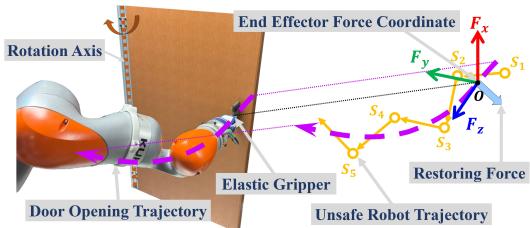
As shown in Figure 1 above, when a robot pulls a door, the force it exerts can be broken down. The force tangent to the arc (\(F_z\)) is the effective force—this actually opens the door. However, any force exerted orthogonal to that trajectory (\(F_x\) and \(F_y\)) fights against the door’s mechanical constraints. These are harmful forces.
Traditional control methods, like impedance control, try to solve this by making the robot’s arm “softer” or more compliant. However, these methods usually require precise mathematical models of the environment, which are rarely available in messy, unstructured real-world settings. On the other hand, deep learning methods often focus purely on “success rates” (did the door open?) rather than “force safety” (did we break the door opening it?).
The Solution: SafeDiff
The researchers propose a solution inspired by human biology. When we open a door, we use vision to make an initial guess, but we rely on tactile feedback (the sense of touch/force) to calibrate our motion in real-time.
SafeDiff is a diffusion-based framework designed to generate a sequence of “safe states” for the robot. Unlike standard trajectory planners that just output a path from A to B, SafeDiff iteratively refines the path using real-time force data.
The Architecture
At its core, SafeDiff uses a Diffusion Model. If you are familiar with image generation tools like Stable Diffusion, you know they work by taking a noisy image and iteratively “denoising” it to reveal a clear picture. SafeDiff does the same thing, but instead of pixels, it generates robot states (positions and velocities).
The architecture follows an Encoder-Decoder structure, visualized below:
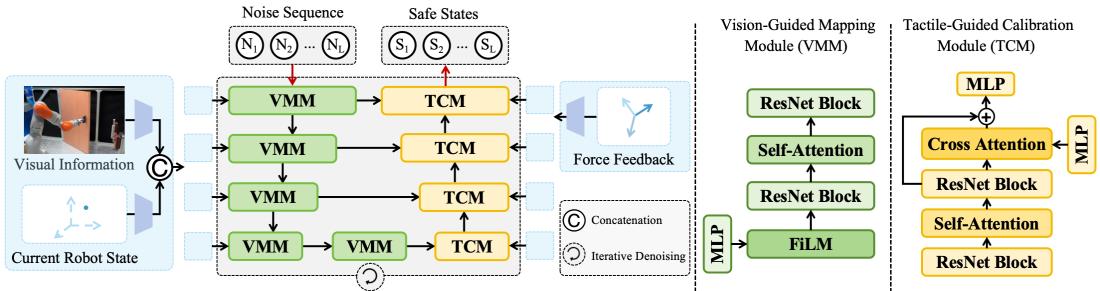
The process involves two main modules:
- Vision-Guided Mapping Module (VMM): The Encoder. It looks at the scene and makes a rough plan.
- Tactile-Guided Calibration Module (TCM): The Decoder. It feels the forces and corrects the plan.
Let’s break these down.
1. The Encoder: Vision-Guided Mapping (VMM)
The goal of the VMM is to generate an initial state representation based on what the robot sees. It takes the current robot state and the visual context (images of the door) and maps a Gaussian noise input into a structured state representation.
To effectively fuse the visual data into the process, the authors use FiLM (Feature-wise Linear Modulation). The visual features predict affine coefficients (\(\alpha\) and \(\beta\)) that modulate the noise.
The mathematical formulation for this initial mapping is:
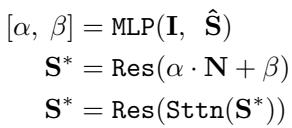
Here, the network extracts context from the image (\(I\)) and current state (\(\hat{S}\)) to modify the noise (\(N\)). Self-attention layers (Sttn) then ensure that the sequence of states is temporally coherent—meaning the robot doesn’t jitter randomly from one millisecond to the next.
However, vision alone isn’t enough. A camera might misjudge the hinge location by a few millimeters. In the physical world, that error translates to high harmful forces. That is where the decoder comes in.
2. The Decoder: Tactile-Guided Calibration (TCM)
This is the most critical innovation of the paper. The TCM acts as a “calibrator.” It takes the vision-based plan from the encoder and refines it using the current force feedback (\(F\)).
If the robot feels resistance (a harmful force) in a specific direction, the TCM adjusts the future trajectory to relieve that stress. The researchers treat “harmful forces” and “trajectory errors” as two sides of the same coin: one is in force space, the other in state space.
The calibration process uses a Cross-Attention block (Cttn) to inject the force safety context into the state sequence:
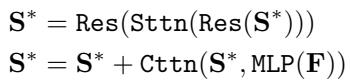
In the second equation above, notice how the new state \(S^*\) is the sum of the previous state plus a correction term derived from the force feedback (\(F\)). This is implicit calibration. The model isn’t explicitly told “move left 2mm”; it learns a high-dimensional relationship between “feeling resistance” and “adjusting trajectory.”
Measuring Safety: New Metrics
Because previous research focused mostly on success rates, there weren’t adequate metrics to measure how safe a manipulation task was. The authors introduce a new benchmark for Force Safety.
First, they define a strict threshold. They assume that any interaction force exceeding 20 Newtons (N) is dangerous.
They introduce the Safety Rate (SaR). Since a trajectory consists of many steps, they look at what percentage of those steps remain within safe force limits.

Based on this, they define SaR-95 and SaR-80:

- SaR-95: A trial is “safe” if 95% of its steps have low harmful forces.
- SaR-80: A trial is “safe” if 80% of its steps have low harmful forces.
- SuR (Success Rate): Did the door actually open?
- AHF / MHF: Average and Maximum Harmful Forces.
The Dataset: SafeDoorManip50k
Data is fuel for deep learning. To train SafeDiff, the authors created SafeDoorManip50k, a massive simulation dataset.

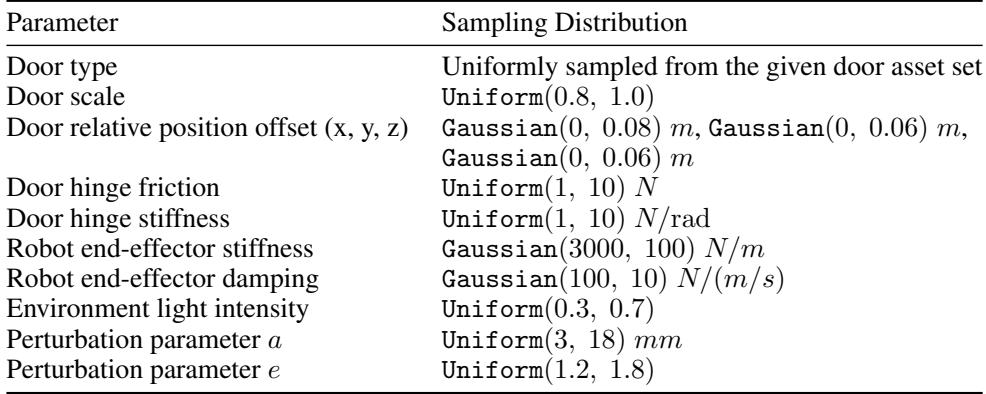
They simulated 57 different doors with varying handle types, sizes, friction levels, and hinge stiffness. They collected nearly 48,000 training demonstrations. Crucially, they didn’t just collect “perfect” demonstrations. They introduced random noise to the training data to simulate errors, forcing the model to learn how to correct itself using tactile feedback.
The simulation parameters were randomized extensively to ensure the model could generalize:
Experimental Results
The researchers compared SafeDiff against state-of-the-art baselines, including “Haptic-ACT” (Action Chunking Transformer with touch) and “UniDoorManip” (a trajectory generator).
Simulation Results
The results in simulation were decisive.
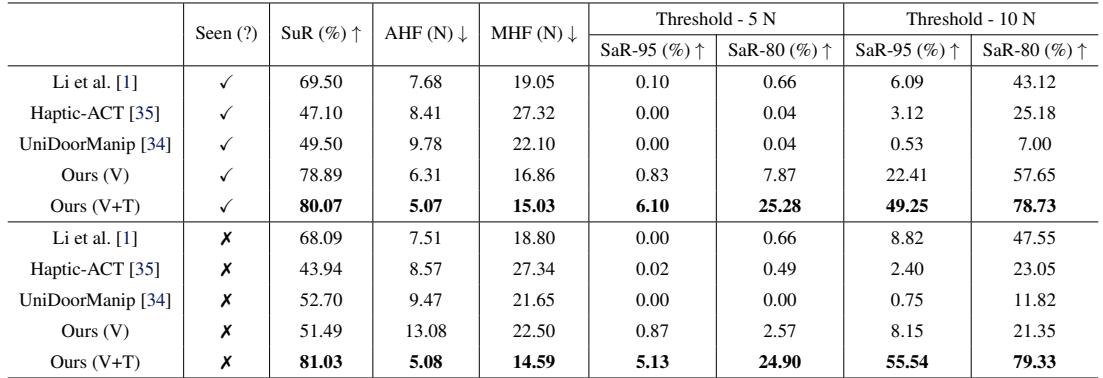
Looking at Table 1 (above), comparing Ours (V+T) (Vision + Tactile) against the baselines:
- Success Rate (SuR): SafeDiff reaches ~80%, significantly higher than Haptic-ACT (~47%) or Li et al. (~69%).
- Force Safety: The most dramatic difference is in the harmful forces. SafeDiff keeps Average Harmful Force (AHF) around 5N. The baselines hover around 8N-9N.
- Safety Rate (SaR): At the 10N threshold, SafeDiff achieves a 78.73% SaR-80 score. The closest competitor manages only 43.12%.
This proves that adding the tactile decoder doesn’t just open the door; it opens it gently.
Handling Disturbances
Real-world environments are messy. What if the robot is bumped, or the door mechanism is sticky? The researchers tested this by applying periodic disturbances (shaking the robot’s target position) during the task.
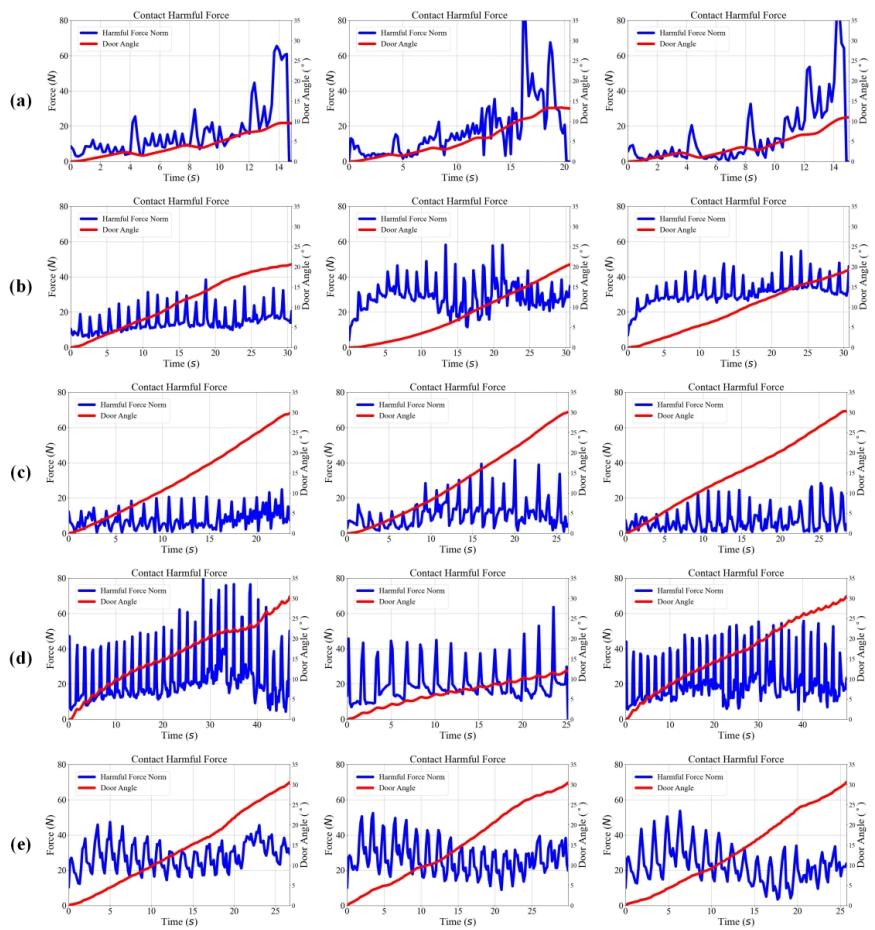
In Figure 5, the blue lines represent harmful forces.
- Graph (a) shows SafeDiff using only vision. Notice the massive spikes in force? It fails to adapt.
- Graph (c) shows SafeDiff with Tactile Calibration. The force profile remains low and stable, despite the disturbances.
- Graphs (b, d, e) show the baselines struggling with high force spikes.
Real-World Validation
Simulations are great, but does it work on a real robot? The authors deployed SafeDiff on a KUKA iiwa14 robot. They used a technique called Sim-to-Real transfer, training in simulation and fine-tuning with a small amount of real-world data (Few-Shot Learning).
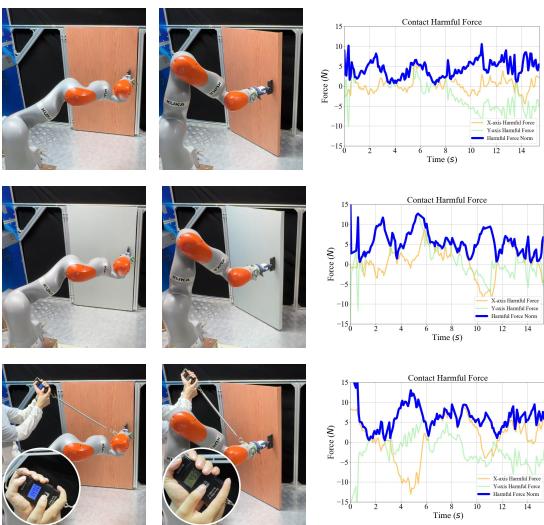
As seen in Figure 3, the robot successfully manipulates diverse doors. The graphs on the right show the contact forces remaining low throughout the trajectory.
The quantitative real-world data reinforces the simulation findings:
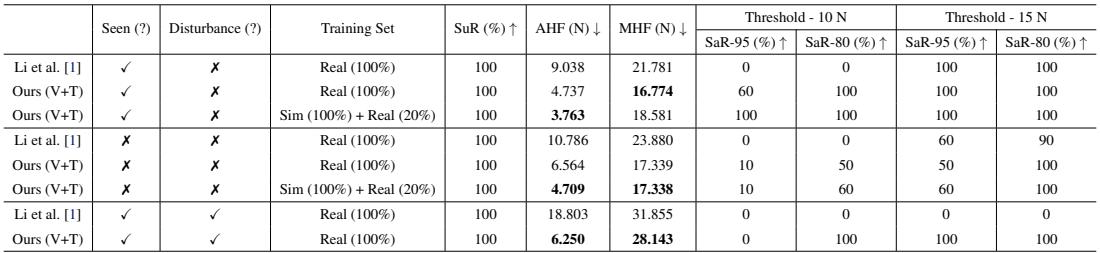
In Table 3, look at the rows with “Disturbance.”
- Li et al. [1] (Baseline): When a disturbance is added, the Average Harmful Force spikes to 18.8N, and the Safety Rate (SaR-95) drops to 0%.
- Ours (V+T): With the same disturbance, the Average Harmful Force stays at 6.25N, and the SaR-80 remains at 100%.
Conclusion and Key Takeaways
The SafeDiff paper presents a compelling argument: for robotic manipulation to be safe in unstructured environments, vision is not enough. Robots need to feel.
By using a diffusion model, the researchers created a system that can generate complex, non-linear trajectories. By integrating a Tactile-Guided Calibration Module, they ensured those trajectories respect the physical constraints of the world.
Key Takeaways for Students:
- Implicit Calibration: Instead of calculating an explicit error vector, the model learns to adjust its latent state representation based on force feedback.
- State vs. Action Planning: Planning a sequence of states (where the robot should be) can be safer than planning actions (motor torques) when geometric constraints are critical.
- Data Matters: The creation of SafeDoorManip50k highlights the need for specialized datasets that include force/tactile modalities, not just images.
This research paves the way for robots that can help in our homes—opening fridges, cabinets, and doors—without ripping the handles off. It is a step toward robots that are not just smart, but gentle.