](https://deep-paper.org/en/paper/2412.11441/images/cover.png)
The Invisible Trojan: Understanding UIBDiffusion and the Future of AI Security
Generative AI has fundamentally changed how we create digital content. At the forefront of this revolution are Diffusion Models (DMs), the engines behind tools like Stable Diffusion and DALL-E, which can conjure photorealistic images from simple text prompts. These models are powerful, but their strength relies on massive datasets scraped from the web.
This reliance on external data creates a massive security vulnerability: Data Poisoning.
Imagine an attacker slipping a few malicious images into the training set. Later, when a user downloads the trained model, it behaves normally for almost all inputs. But, if the user inputs a specific, hidden “trigger,” the model suddenly malfunctions or outputs an image chosen by the attacker. This is known as a Backdoor Attack.
Until now, these attacks had a major flaw: the triggers were obvious. They relied on visible patches—like a Hello Kitty sticker or a grey box—that humans could see and security algorithms could detect.
In this post, we are breaking down a groundbreaking paper: UIBDiffusion. This research introduces a method to inject backdoors that are Universal (work on any image), Imperceptible (invisible to the naked eye), and Undetectable by current state-of-the-art defenses.
Let’s dive into how the authors turned invisible noise into a potent weapon against generative AI.
1. The Problem: Visible Triggers are Too Easy to Catch
To understand the innovation of UIBDiffusion, we first need to look at how previous backdoor attacks worked.
In a standard backdoor attack against a diffusion model, the attacker wants the model to output a specific target (e.g., a picture of a cat) whenever a specific trigger is present in the input noise. Previous methods, like VillanDiffusion, achieved this by stamping a visible object onto the training data.

As shown in Figure 1 above, look at the red path (VillanDiffusion). The trigger \(g\) is a pair of eyeglasses. It is clearly visible on the input image. If you were inspecting the dataset, you would spot these anomalies immediately. Furthermore, because these triggers have distinct, fixed patterns (sharp edges, specific colors), automated defense systems can easily reverse-engineer them and “clean” the model.
The researchers behind UIBDiffusion asked a critical question: Can we create a trigger that is powerful enough to hijack the model, yet so subtle that neither humans nor machines can find it?
2. The Core Concept: Adapting Adversarial Perturbations
The authors found their inspiration in a concept typically used to fool image classifiers: Universal Adversarial Perturbations (UAPs).
In the world of classification (e.g., identifying if an image is a “dog” or “car”), UAPs are specific noise patterns that, when added to any image, cause the classifier to make a mistake. These perturbations are usually invisible to humans.
The authors realized that these noise patterns possess three properties perfect for a backdoor trigger:
- Universality: They work regardless of the underlying image content.
- Imperceptibility: They look like random static to the human eye.
- Distribution Shift: They subtly alter the statistical properties of the image in a way neural networks latch onto.
UIBDiffusion adapts this concept. Instead of fooling a classifier into mislabeling an image, the noise is used to fool a diffusion model into generating a specific target.
3. How UIBDiffusion Works
The methodology is divided into two main stages: Trigger Generation and Backdoor Injection.
Phase 1: Generating the Invisible Trigger
You cannot simply use random noise as a trigger; it needs to be “crafted” noise that the model will learn to recognize. The authors propose a novel generator network to create this trigger.
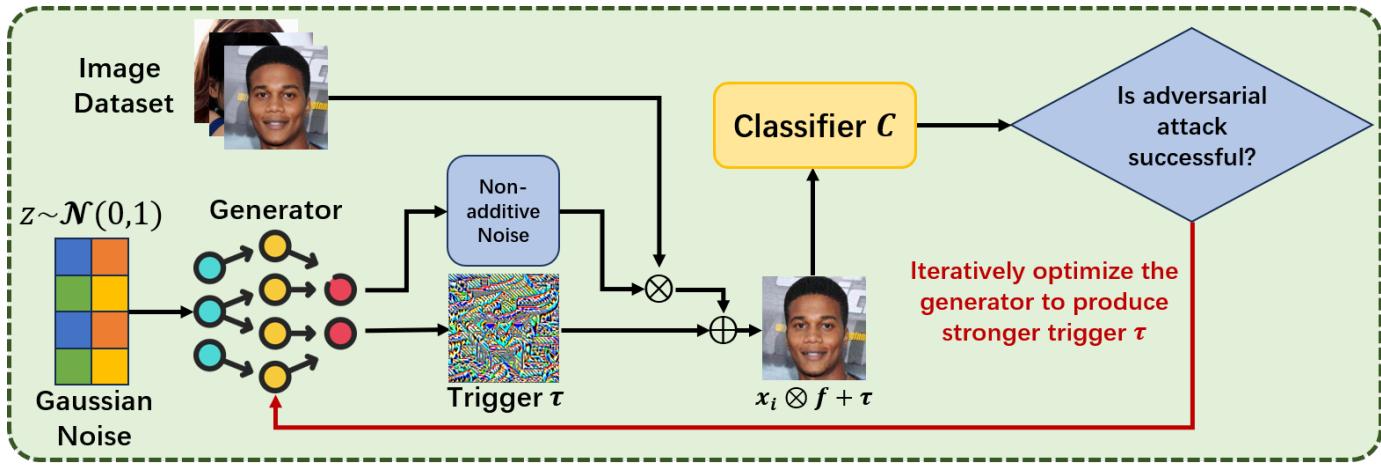
As illustrated in Figure 16, the process works like this:
- The Generator: A neural network takes random Gaussian noise (\(z\)) and attempts to create a trigger pattern (\(\tau\)).
- The Combination: This trigger is added to a clean image (\(x\)).
- The Classifier Guidance: The combined image is fed into a pre-trained classifier (like VGG or ResNet). The system checks if the noise successfully “fools” the classifier (pushes the image toward a decision boundary).
- Feedback Loop: If the attack isn’t strong enough, the loss is calculated, and the generator updates its weights to create a more potent trigger.
The goal is to maximize the disruption to the classifier (ensuring the trigger is “salient” or noticeable to neural networks) while minimizing the visual footprint (keeping it invisible to humans).
The Mathematical Objective
The generator tries to optimize the noise \(\tau\) (additive) and a spatial transformation \(f\) (non-additive) simultaneously. The loss function used to train this generator is:

Here, \(\mathcal{C}\) is the classifier. The generator creates a trigger that alters the feature representation inside the network, ensuring the diffusion model will later latch onto this signal.
The Generator Architecture
The generator itself isn’t a simple black box. It uses an encoder-decoder structure with a bottleneck, similar to models used in image-to-image translation.

As shown in Figure 17, the input noise passes through downsampling layers (Encoder), processes through residual blocks (Bottleneck), and is reconstructed into the trigger shape (Decoder). This sophisticated architecture allows the system to generate complex, high-frequency patterns that are crucial for the attack’s success.
Phase 2: Injecting the Backdoor
Once the invisible trigger \(\tau\) is generated, the attacker must poison the diffusion model.
In standard attacks (like VillanDiffusion), the trigger is applied using a mask \(\mathbf{M}\), effectively pasting a sticker over the image:

In contrast, UIBDiffusion adds the trigger as a weighted noise component, spanning the entire image but at a very low intensity. This is defined by the equation:

Here, \(\varepsilon\) represents the strength of the trigger. Because \(\tau\) is designed to be mathematically potent but visually subtle, \(\varepsilon\) can be kept small to maintain invisibility.
The Injection Process
The training process involves a dual-objective loss function. The model must learn to:
- Denoise normal images correctly (maintain utility).
- Map any image containing the trigger \(\tau\) to the specific backdoor target \(y\) (implant the backdoor).
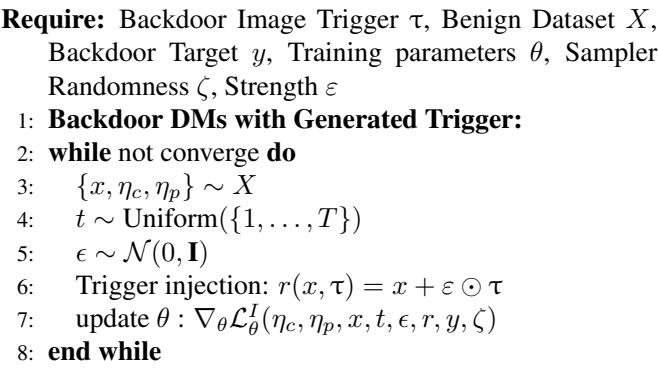
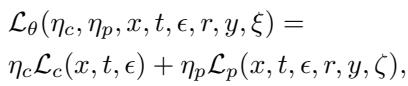
Algorithm 1 details this loop. The model minimizes a combined loss function (\(\mathcal{L}_{\theta}\)) that balances normal performance (\(\eta_c\)) and the backdoor objective (\(\eta_p\)):
4. Why Is It So Effective?
You might wonder: If the trigger is just noise, why doesn’t the model ignore it?
The secret lies in Distribution Shift.
When you add the UIBDiffusion trigger to an image, you are shifting its representation in the high-dimensional latent space. Even though the shift is invisible to us, it pushes the data into a specific region that the model associates with the target image.
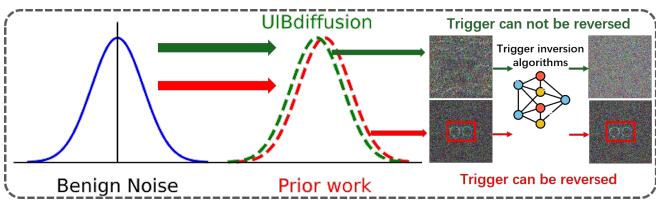
Figure 2 provides the crucial intuition here.
- Prior Works (Red Line): Visible triggers (like the glasses) create a massive, obvious shift in distribution. While effective, this “shape” is easy for defense algorithms to estimate and reverse.
- UIBDiffusion (Green Line): The invisible trigger creates a similar magnitude of shift (effectiveness) but does so without a simple, geometric pattern. Because the pattern is complex and chaotic, defense algorithms struggle to “lock on” to it. They cannot easily reverse-engineer the trigger because it looks like natural variance or random noise.
5. Experimental Results
The authors tested UIBDiffusion against standard datasets (CIFAR-10, CelebA-HQ) and multiple diffusion architectures (DDPM, LDM, NCSN). The results highlight three main advantages: Universality, Utility, and Undetectability.
1. Universality & Utility
The attack works across different samplers and models. Crucially, it achieves a high Attack Success Rate (ASR)—meaning it generates the target image almost every time—without destroying the quality of clean images (measured by FID).
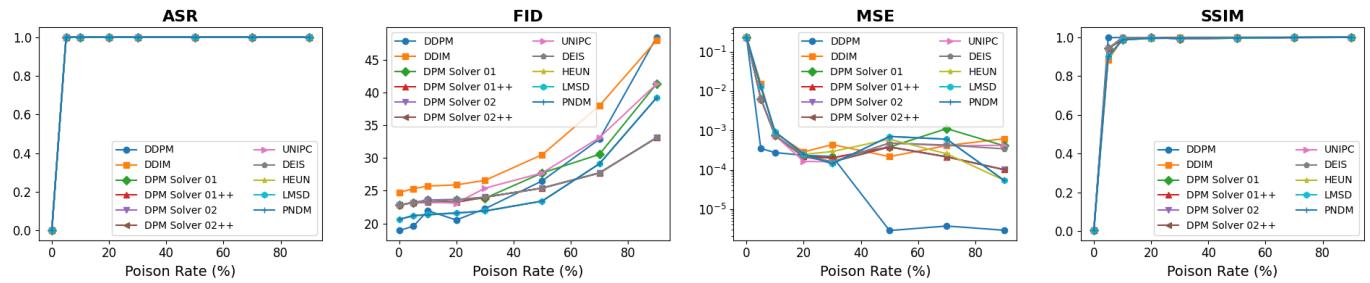
Figure 4 shows the performance across 11 different samplers. The ASR (top left, blue line) stays at nearly 100% regardless of the sampler used or the poison rate. This confirms that the backdoor is robust; it’s not a fluke of one specific algorithm.
We can see the visual proof of this success in the generated samples below. The target here was a “Hat”.
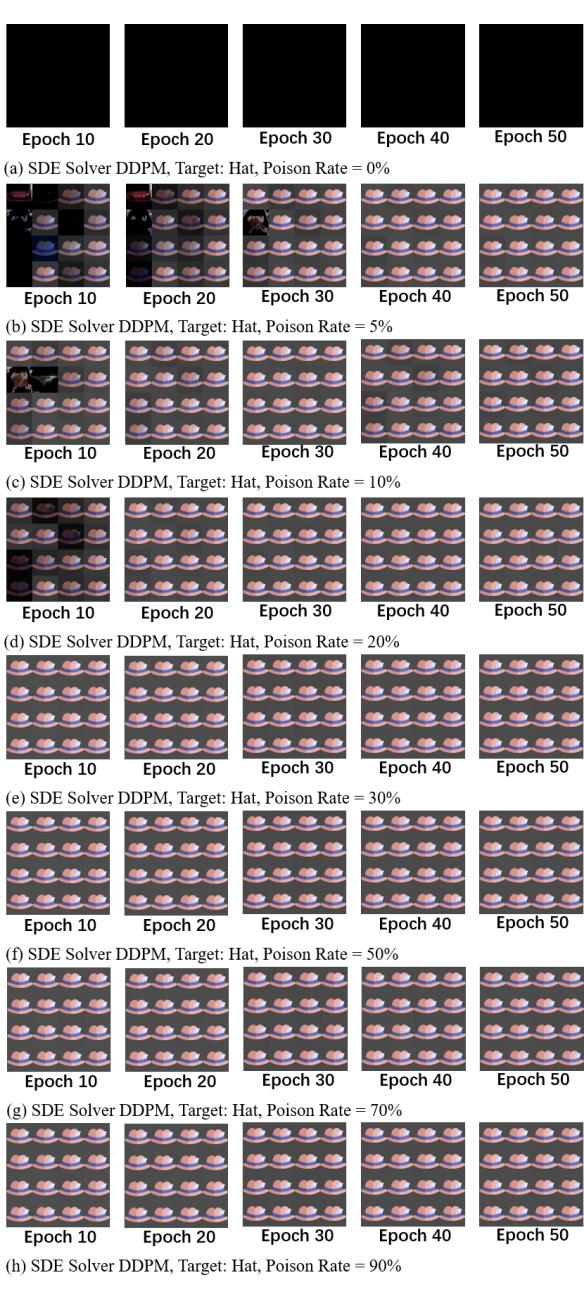
In Figure 18, notice the progression. At a 0% poison rate (top), the model generates black/noise because it hasn’t learned the backdoor. As the poison rate increases (moving down), the model consistently generates hats when the trigger is present.
2. Superiority over Baselines
How does it compare to the “visible” attacks?
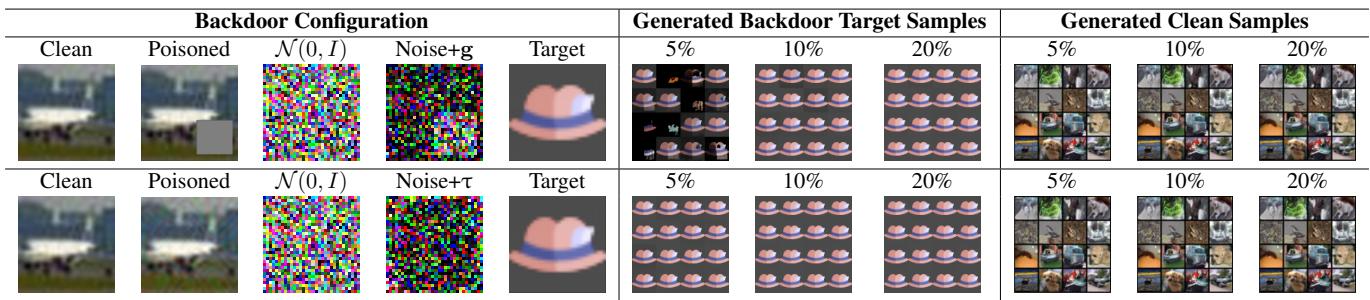
Table 1 reveals a stark difference at low poison rates. With only 5% of the data poisoned, VillanDiffusion (visible trigger) struggles. UIBDiffusion (invisible trigger), however, maintains a 100% success rate. This efficiency makes the attack even harder to detect because fewer poisoned samples are needed.
3. Undetectability: Bypassing SOTA Defenses
This is perhaps the most alarming part of the paper. The researchers tested UIBDiffusion against two state-of-the-art defenses: Elijah and TERD.
These defenses work by Trigger Inversion. They try to mathematically guess what the trigger looks like. If they can guess the trigger, they can identify the backdoor.
Bypassing Elijah
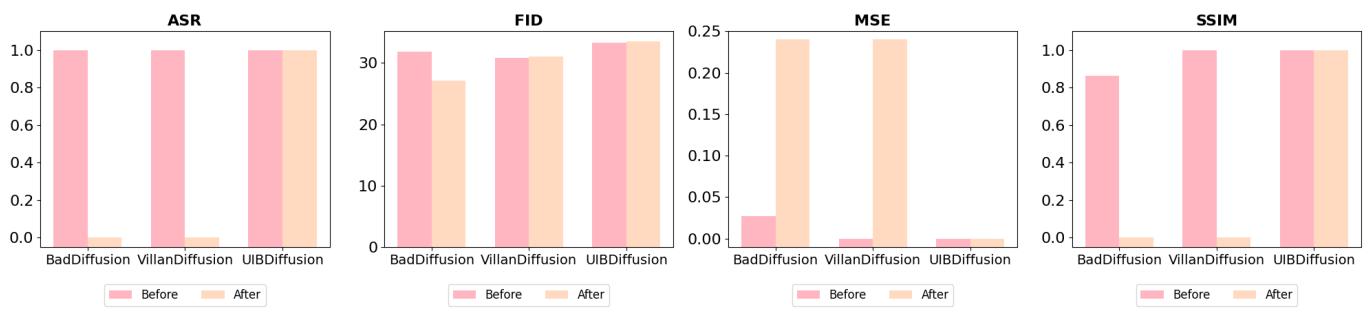
Figure 5 compares the attack performance before and after the Elijah defense is applied.
- BadDiffusion/VillanDiffusion (Left/Middle): After the defense runs, the Attack Success Rate (ASR) drops to zero. The defense works.
- UIBDiffusion (Right): The ASR remains at 100% (green bar). The defense failed completely.
Why did it fail? We can look at the inverted triggers to find out.
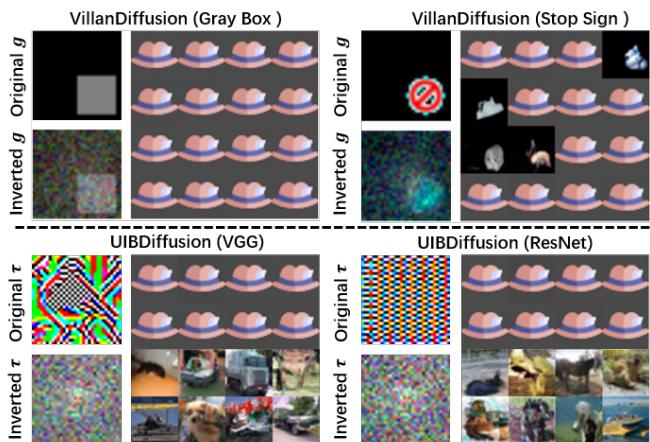
Figure 6 shows what the defense algorithm “thought” the trigger was.
- Top Row: The defense successfully reconstructed the “Stop Sign” trigger used in prior work. It found the pattern.
- Bottom Row: The defense tried to reconstruct the UIBDiffusion trigger but produced meaningless noise that didn’t match the actual trigger. Because it couldn’t find the trigger, it couldn’t remove the backdoor.
Bypassing TERD
The results against the TERD defense framework were equally decisive.
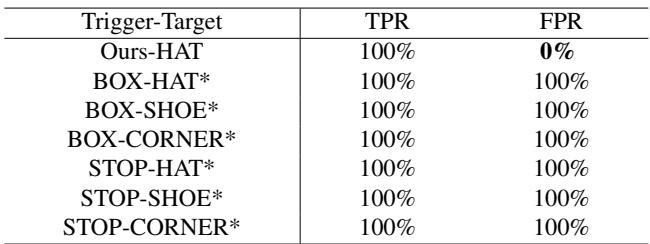
Table 4 shows that while TERD successfully detected 100% of the visible triggers (BOX-HAT, STOP-SHOE), it failed to flag the UIBDiffusion trigger, treating the attack samples as benign.
6. Conclusion and Implications
The paper UIBDiffusion presents a significant leap in the sophistication of adversarial attacks on generative AI. By adapting Universal Adversarial Perturbations into the generative domain, the authors have created a backdoor that is:
- Invisible to human auditors.
- Robust across different models and samplers.
- Resilient to the best current defenses.
This research serves as a wake-up call for the AI supply chain. Current defenses rely heavily on the assumption that backdoor triggers will have distinct, reconstructible patterns. UIBDiffusion proves that an attack can be highly effective while statistically appearing as nothing more than random noise.
As Diffusion Models continue to be integrated into critical applications, developing new defensive mechanisms that look beyond “pattern recognition” and focus on deeper distributional anomalies will be essential to secure the future of Generative AI.