](https://deep-paper.org/en/paper/2412.12392/images/cover.png)
Visual Simultaneous Localization and Mapping (SLAM) is often considered the “Holy Grail” of spatial intelligence. Ideally, we want a robot or a pair of AR glasses to open its “eyes” (cameras), look at a scene, and immediately understand where it is and what the world looks like in 3D—without any manual setup.
However, the reality of SLAM has traditionally been finicky. It usually requires strict hardware expertise, careful camera calibration (those checkerboard patterns), and reliable feature extractors. While “sparse” SLAM (tracking points) works well, “dense” SLAM (reconstructing the whole surface) remains computationally heavy and prone to drift.
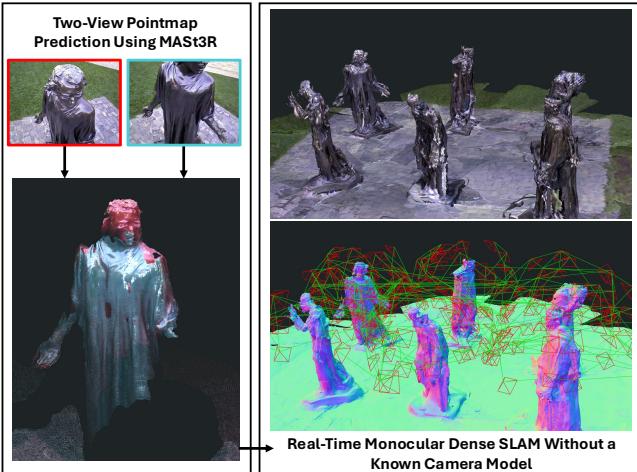
Enter MASt3R-SLAM, a new system from Imperial College London. This research flips the script by using a powerful deep learning model as a “prior” to solve the hard geometry problems, allowing for real-time, dense reconstruction without even knowing the camera’s intrinsic parameters.
In this post, we will tear down this paper to understand how they achieved real-time dense SLAM using 3D reconstruction priors. We will explore the shift from traditional geometry to deep learning priors, the clever optimization tricks that make it fast, and how it performs against the state-of-the-art.
The Core Problem: Why Do We Need Priors?
To perform SLAM from 2D images, a system must solve an “inverse problem.” It sees a flat image and must deduce the 3D structure and the camera’s movement over time. This is mathematically difficult because:
- Scale Ambiguity: A large object far away looks the same as a small object close up.
- Textureless Areas: White walls and shiny surfaces confuse traditional feature matchers.
- Complex Parameters: You usually need to solve for the camera’s focal length and distortion alongside the trajectory.
To solve this, researchers use priors—assumptions or pre-trained knowledge that help constrain the problem.
- Single-View Priors: Neural networks that guess depth from a single image. These are often inconsistent; the depth predicted for frame 1 might not match frame 2.
- Multi-View Priors: Techniques like Optical Flow or Multi-View Stereo (MVS). These are better but often entangle the camera’s motion with the scene geometry.
The Foundation: MASt3R
The authors build their system on top of a recent breakthrough called MASt3R (a successor to DUSt3R). MASt3R is a “Two-View 3D Reconstruction Prior.” You feed it two images, and it outputs pointmaps—dense 3D point clouds for both images aligned in a common coordinate frame.
This is a paradigm shift. Instead of separate modules for feature matching, pose estimation, and depth estimation, MASt3R solves them implicitly in a joint framework. The challenge this paper tackles is: How do we take this heavy, two-view deep learning model and turn it into a real-time, globally consistent SLAM system?
The MASt3R-SLAM Architecture
The system is designed “bottom-up” from the MASt3R predictions. It is a monocular system (one camera) that operates at 15 FPS.
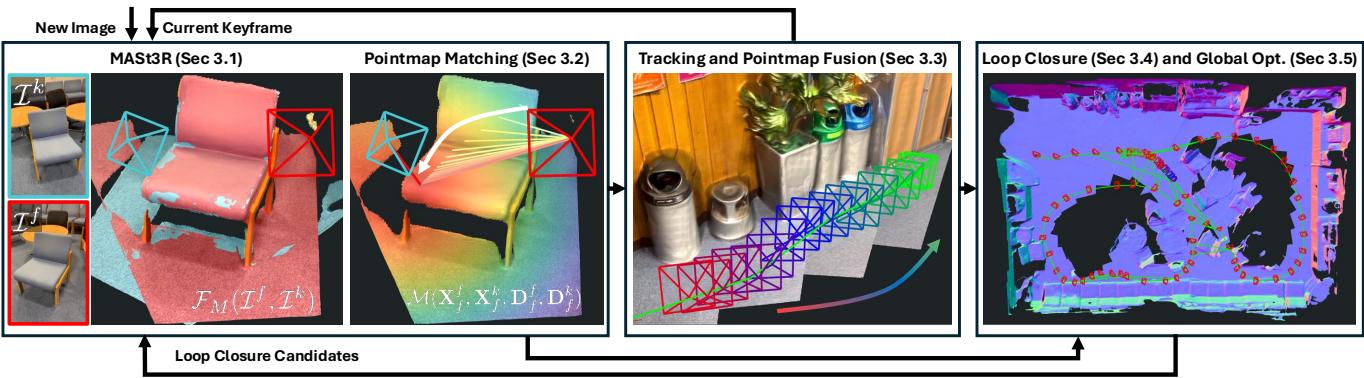
As shown in Figure 3 above, the pipeline follows a standard SLAM structure but with novel components:
- Input: Images come in one by one.
- Pointmap Prediction: MASt3R predicts the 3D structure.
- Matching: A highly efficient iterative projection method finds correspondences.
- Tracking: The system estimates the camera pose by minimizing “ray error.”
- Local Fusion: Pointmaps are merged to reduce noise.
- Backend: A graph optimizes the entire trajectory and loop closures.
Let’s break down the technical innovations that allow this to work in real-time.
1. The Generic Camera Model
Most SLAM systems assume a “pinhole” camera model defined by focal lengths (\(f_x, f_y\)) and a principal point (\(c_x, c_y\)). If you don’t know these, or if they change (like a zoom lens), standard SLAM fails.
MASt3R-SLAM makes no assumption on the camera model other than it being a “central camera” (all light rays pass through a single center). Instead of working with pixels and focal lengths, the system converts the predicted pointmaps into normalized rays.
This means the system can handle:
- Unknown calibration.
- Heavy distortion (fisheye).
- Time-varying intrinsics (zooming in and out during the video).
2. Efficient Pointmap Matching
A critical step in SLAM is finding which pixel in Image A corresponds to which pixel in Image B. MASt3R provides features for matching, but a brute-force search over all pixels is \(O(N^2)\)—far too slow for real-time robotics.
The authors introduce Iterative Projective Matching. Instead of searching the whole image, they treat matching as a local optimization problem.
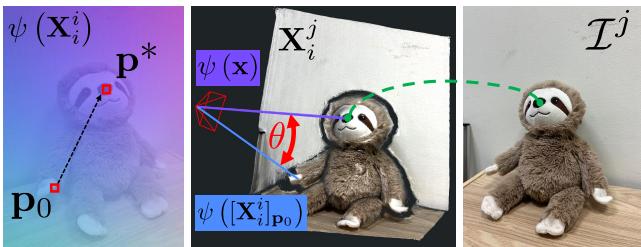
Here is the intuition (visualized in Figure 2 above):
- We have a 3D point \(\mathbf{x}\) from the previous frame.
- We want to find where this point appears in the current frame’s pointmap \(\mathbf{X}^i_i\).
- We convert the pointmap to rays (\(\psi\)).
- We adjust the pixel coordinates \(\mathbf{p}\) until the ray at that pixel aligns with the target ray \(\psi(\mathbf{x})\).
Mathematically, they minimize the angular difference \(\theta\) between the rays:

This optimization is solved via Levenberg-Marquardt. Because the “ray image” is smooth, it converges in very few iterations. This transforms a slow global search into a lightning-fast local optimization, fully parallelized on the GPU.
3. Tracking: Ray Error vs. Point Error
Once matches are found, the system needs to determine how the camera moved (Tracking). The goal is to find the relative pose \(\mathbf{T}_{kf}\) between the current frame and the keyframe.
A naive approach would be to minimize the distance between 3D points (Point Error). However, deep learning predictions often have errors in depth (scale), which can throw off the tracking.
Instead, the authors minimize the Ray Error. They align the directions of the points rather than their absolute positions.
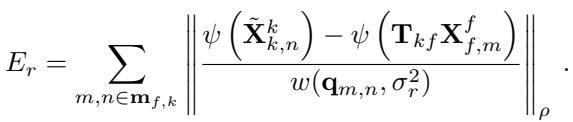
In the equation above (\(E_r\)), the system optimizes the pose to align the ray \(\psi(\mathbf{T}_{kf}\mathbf{X})\) with the reference ray. This is much more robust to depth noise. They use an Iteratively Reweighted Least-Squares (IRLS) solver to handle outliers.
4. Handling Scale: Sim(3) Optimization
Because the network predicts geometry from image pairs, the “scale” of the world (how big is a meter?) might drift or be inconsistent between pairs. To handle this, the authors define all poses in the similarity group Sim(3) rather than the standard rigid body group SE(3).

This matrix includes a scale factor \(s\), a rotation \(\mathbf{R}\), and a translation \(\mathbf{t}\). This flexibility allows the system to align segments of the map even if the network’s scale prediction fluctuates.
5. Local Fusion
Deep networks output noisy predictions. If you trust every single frame equally, your map will be messy. MASt3R-SLAM employs Local Pointmap Fusion.

As the camera tracks, the system maintains a “canonical” pointmap for the keyframe. New predictions are merged into this canonical map using a running weighted average (as shown in the equation above). This acts as a filter, smoothing out the geometry and improving the confidence of the 3D structure over time without needing expensive bundle adjustment for every pixel.
Backend: Global Consistency
The “Frontend” we just described handles the immediate motion. The “Backend” ensures the whole map makes sense.
When the camera moves far enough, a new Keyframe is created. These keyframes form a graph.
- Loop Closure: The system uses feature retrieval to check if the robot has returned to a previous location. If a loop is found, MASt3R estimates the geometric constraint, and an edge is added to the graph.
- Global Optimization: The system performs a large-scale Second-Order optimization (Gauss-Newton) over all keyframes.
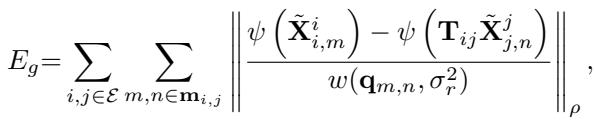
This global optimization (\(E_g\)) minimizes the ray error across the entire graph, correcting drift and snapping the map into a consistent shape.
Experiments and Results
The authors evaluated MASt3R-SLAM on standard benchmarks like TUM RGB-D, EuRoC, and 7-Scenes. They compared it against DROID-SLAM, which is currently considered the gold standard for deep learning-based SLAM.
Trajectory Accuracy
The results are impressive. Even without calibration (Uncalibrated), MASt3R-SLAM achieves state-of-the-art performance.
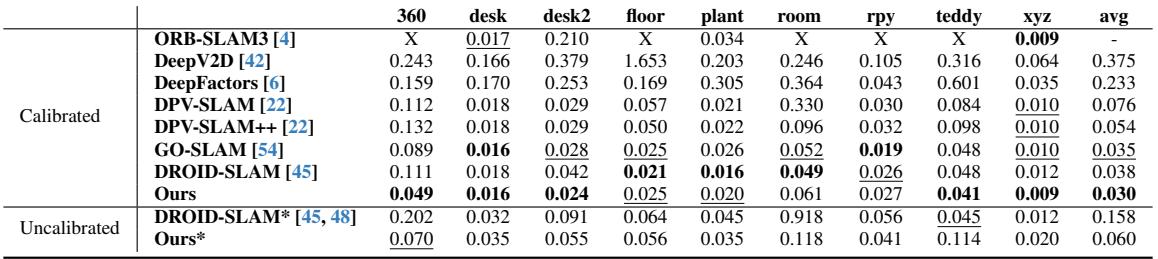
In Table 1, “Ours” (Uncalibrated) achieves an average error of 3.0 cm, beating DROID-SLAM (3.8 cm) and significantly outperforming traditional methods like ORB-SLAM3 when calibration is missing. This confirms that the 3D priors from MASt3R are robust enough to replace precise calibration.
Dense Geometry Quality
Accurate tracking is one thing, but does the map look good? This is where the method shines. Because it uses a dense 3D prior, the resulting reconstructions are cleaner and more coherent than those from flow-based methods.
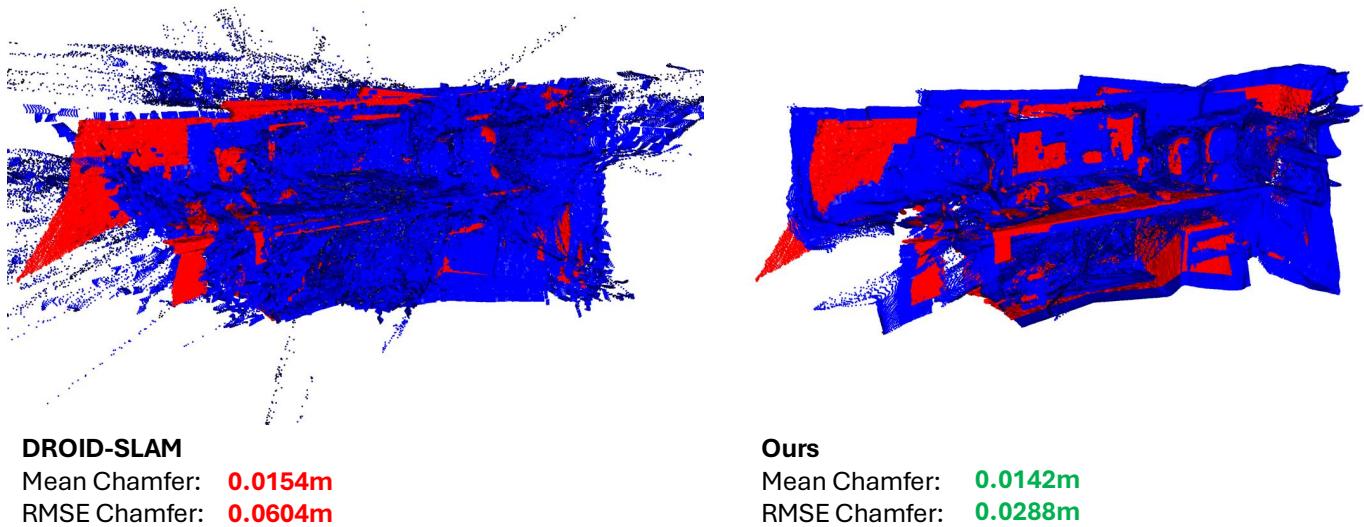
In Figure 9, you can see a comparison on the “7-Scenes” dataset. The RMSE Chamfer distance (a measure of geometric error) is significantly lower for MASt3R-SLAM (0.0288m vs 0.0604m). DROID-SLAM’s map contains more noise and outliers (the blue haze), while MASt3R-SLAM produces a tighter surface.
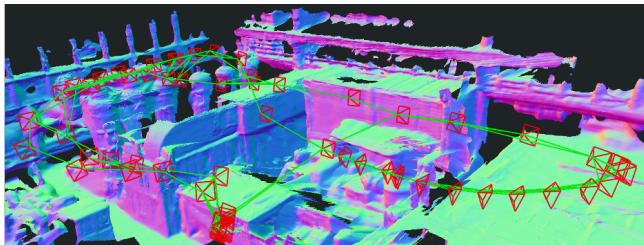
The system handles complex industrial environments well, as seen in the EuRoC reconstruction (Figure 6).
Robustness to “In-the-Wild” Conditions
One of the coolest demonstrations in the paper is the handling of extreme zoom changes. Because the system uses rays rather than fixed pixels, it can track successfully even when the camera zooms in dramatically—a scenario that breaks most standard SLAM systems.
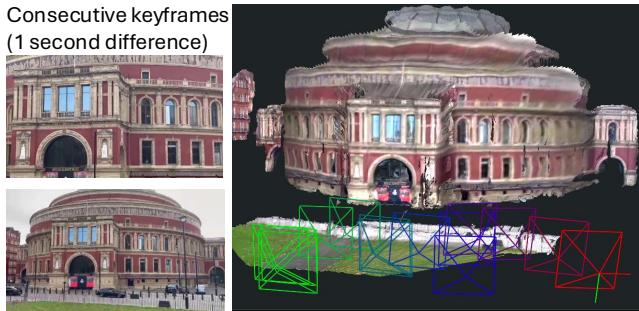
Figure 7 shows two consecutive frames with a massive focal length change. MASt3R-SLAM maintains tracking and mapping continuity through this transition.
Computational Performance
Is it truly real-time?

Figure 8 breaks down the runtime. The heavy lifting is done by the MASt3R network (the encoder and decoder), which takes up about 64% of the time. However, because the matching and tracking logic (the novel contributions of this paper) are so efficient (taking only milliseconds), the total system runs at ~15 FPS on a high-end GPU (RTX 4090). This is fast enough for teleoperation and many robotic tasks.
Conclusion and Implications
MASt3R-SLAM represents a significant step forward in the democratization of SLAM. By wrapping a robust 3D deep learning prior in a principled geometric backend, the authors have created a system that is:
- Plug-and-Play: No calibration required.
- Dense: You get a full 3D map, not just a sparse point cloud.
- Robust: It handles lens distortion and zoom naturally.
While end-to-end learning methods (like DROID-SLAM) try to learn the whole SLAM pipeline from data, this paper suggests a hybrid approach might be better: Let the network solve the hard 3D perception (stereo), and let classical optimization solve the consistency (SLAM).
For students and researchers, this highlights the value of “Modular” deep learning. Instead of a black box, we have interpretable components (Matching, Tracking, Optimization) powered by deep representations. As 3D priors like MASt3R get faster and better, we can expect SLAM to become as easy as turning on a camera.