](https://deep-paper.org/en/paper/2412.12861/images/cover.png)
Introduction
In the rapidly evolving worlds of Augmented Reality (AR), Virtual Reality (VR), and robotics, understanding human movement is fundamental. We have become quite good at tracking bodies and hands when the camera is sitting still on a tripod. But the real world is dynamic. In egocentric scenarios—like wearing smart glasses or a GoPro—the camera moves with you.
This creates a chaotic blend of motion. If a hand appears to move left in a video, is the hand actually moving left, or is the user’s head turning right?
Disentangling the motion of the hands from the motion of the camera is a massive challenge in computer vision. Most existing methods simplify the problem by assuming a static camera or ignoring the global position of the hand entirely. This leads to “depth ambiguity,” where the system loses track of how far away the hand is, resulting in jittery, unrealistic animations.
Enter Dyn-HaMR.
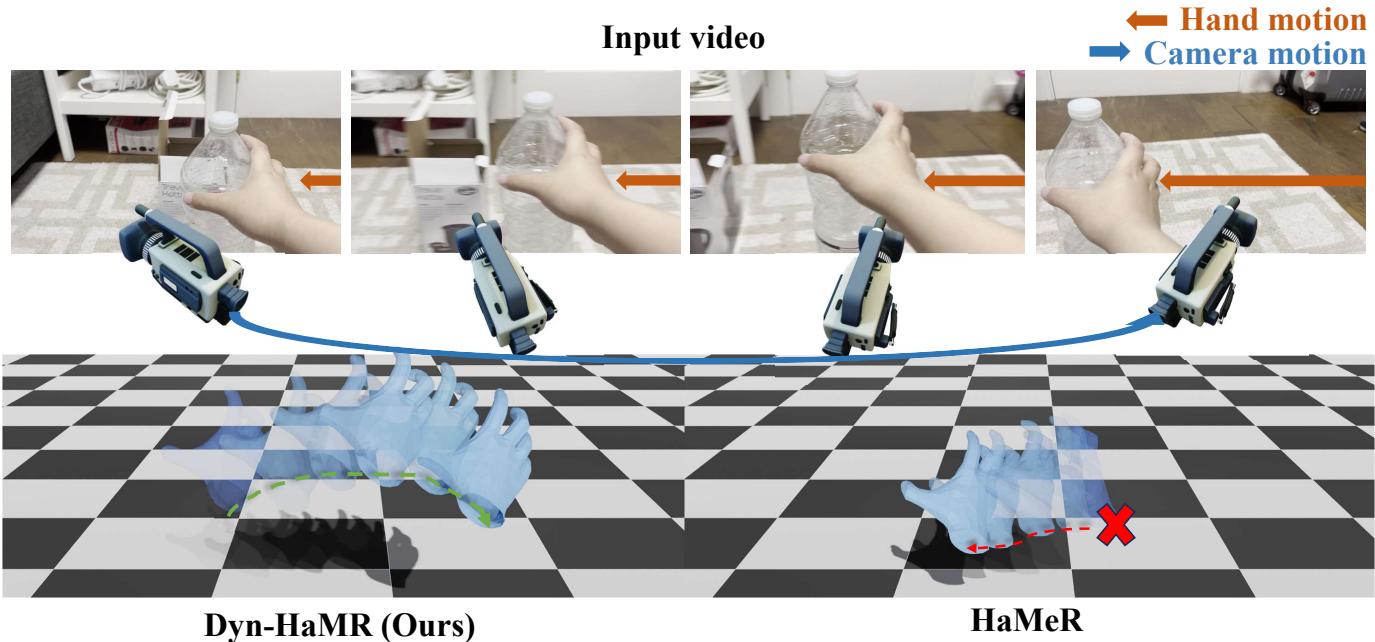
As shown above, Dyn-HaMR (Dynamic Hand Mesh Recovery) is a new approach designed to recover 4D global hand motion (3D shape + time) from monocular videos captured by moving cameras. By combining simultaneous localization and mapping (SLAM) with advanced motion priors, it effectively separates the camera’s trajectory from the hands’ complex interactions.
In this post, we will deconstruct the Dyn-HaMR pipeline, exploring how it turns chaotic, moving-camera footage into smooth, world-grounded 3D hand reconstructions.
Background: The Challenges of Dynamic Reconstruction
Before diving into the method, we need to understand why this task is so difficult for standard algorithms.
1. Depth Ambiguity and Weak Perspective
Most single-camera (monocular) reconstruction methods use a “weak perspective” camera model. They estimate the hand’s pose relative to the camera frame but often struggle to pinpoint exactly where the hand is in the 3D world. Without a reference for depth, a small hand close to the camera looks identical to a large hand far away.
2. Motion Entanglement
In egocentric video, pixel motion is a sum of two factors:
- Object Motion: The hand moving in space.
- Ego-Motion: The camera moving in space.
Without knowing the camera’s path, an algorithm cannot accurately reconstruct the hand’s global trajectory (its path through the real world).
3. Occlusion and Interaction
Hands are dexterous. Fingers cross over each other, and hands interact (bimanual interaction). During these interactions, fingers disappear from view (occlusion), causing standard trackers to fail or produce physically impossible shapes, such as fingers passing through each other.
The Dyn-HaMR Pipeline
The researchers propose a three-stage optimization pipeline to solve these issues. The goal is to take an input video and output a global trajectory where both the hands and the camera are correctly positioned in the world coordinate system.
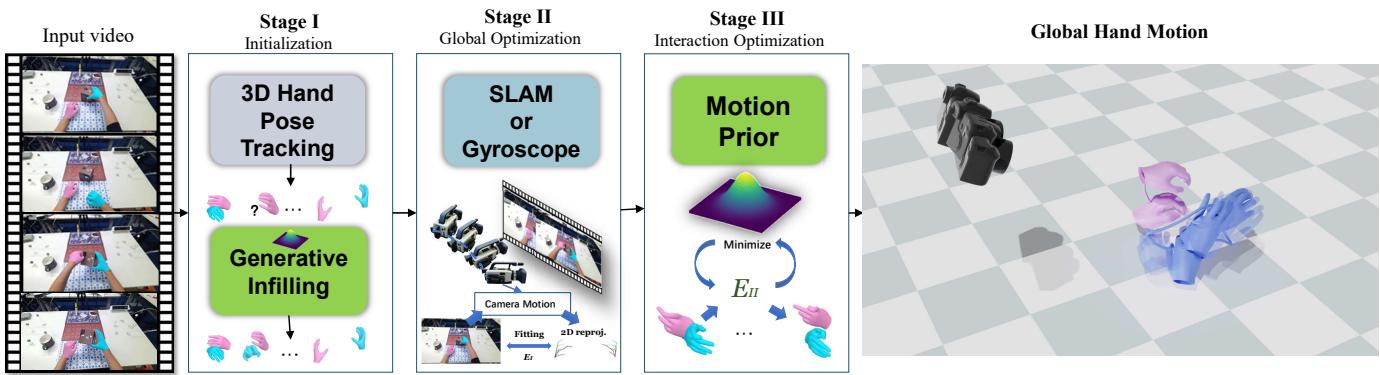
Stage I: Initialization and Generative Infilling
The first step is to get a “rough draft” of the hand poses. The system takes the input video and applies state-of-the-art 2D and 3D trackers (specifically utilizing tools like ViTPose and HaMeR).
However, raw tracking data is often noisy. Fast movements cause motion blur, and interactions cause occlusions, leading to missed detections. If the tracker misses a few frames, the resulting animation would snap and glitch.
To fix this, Dyn-HaMR uses Generative Infilling. The researchers leverage a Hand Motion Prior (HMP)—a machine learning model trained on valid hand movements. If the tracker loses sight of a hand for a few frames, the generative model “hallucinates” a plausible motion to fill the gap, ensuring the sequence is temporally smooth.
At this stage, we have a sequence of hand poses, but they are defined relative to the camera, not the world.
Stage II: 4D Global Motion Optimization
This is the core innovation where the disentanglement happens. The goal is to figure out the World-to-Camera transformation (\(\bm{C}_t\)) for every frame.
Integrating SLAM
The system uses DPVO (Deep Patch Visual Odometry), a robust SLAM system, to estimate the camera’s motion. SLAM looks at static background elements to figure out how the camera is moving through space.
The Scale Problem
SLAM systems are great at determining the shape of a camera path, but they are “scale ambiguous.” SLAM might tell you that you moved “10 units” forward, but it doesn’t know if a “unit” is a millimeter or a meter. Hand reconstruction models, however, work in metric scale (millimeters).
To bridge this gap, Dyn-HaMR optimizes for a world scale factor (\(\omega\)). This variable scales the SLAM trajectory so that it matches the physical size of the hands.
The relationship between the world coordinates (\(^w\)) and camera coordinates (\(^c\)) is defined as:
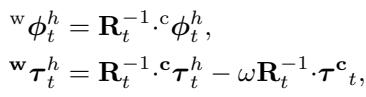
Here, \(\mathbf{R}\) is the rotation and \(\tau\) is the translation derived from SLAM. The term \(\omega\) scales the camera’s translation to match the hand’s world.
Optimization Objective
The system solves for the global trajectory by minimizing a total energy function (\(E_I\)):

Let’s break down the key terms in this equation:
- \(\mathcal{L}_{2d}\) (Reprojection Loss): Ensures that when we project the 3D hand back onto the 2D image, it matches the video pixels.
- \(\mathcal{L}_{smooth}\): Ensures the hands don’t jitter or teleport between frames.
- \(\mathcal{L}_{cam}\): Keeps the camera trajectory consistent with the SLAM predictions.
The reprojection logic is visualized below, where 3D keypoints are mapped to 2D image coordinates:

By minimizing this energy, the system effectively locks the hands into the correct position in the 3D world, consistent with the camera’s movement.
Stage III: Interaction Optimization
After Stage II, we have a good global trajectory, but the hands might still look slightly unnatural. Fingers might intersect, or joints might bend at impossible angles. Stage III refines the interaction using biological and physical constraints.
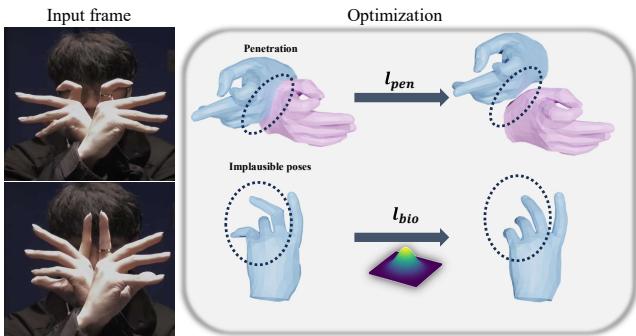
As shown in Figure 3 above, without this stage, we might see fingers penetrating each other (top path). With the optimization (bottom path), the hands are physically plausible.
The Objective Function
The refinement minimizes a new energy function (\(E_{II}\)):
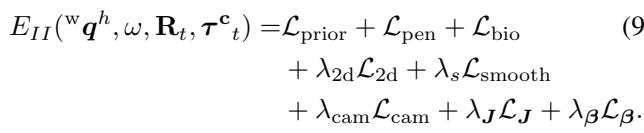
This includes three critical new terms:
1. Prior Loss (\(\mathcal{L}_{prior}\)): This forces the motion to remain “likely” according to the learned motion prior (HMP). It penalizes movements that the neural network deems unnatural.

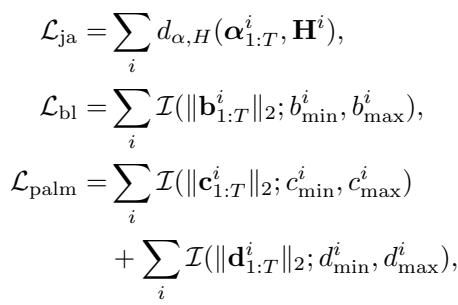
2. Biomechanical Loss (\(\mathcal{L}_{bio}\)): This enforces anatomical rules. It prevents bones from stretching (bone length consistency) and stops joints from bending beyond their physical limits.
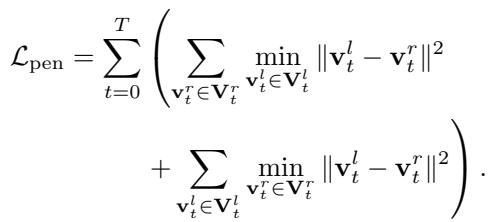
3. Penetration Loss (\(\mathcal{L}_{pen}\)): This calculates the distance between the meshes of the left and right hands. If vertices from one hand are inside the other, this loss increases, pushing the hands apart until they are just touching.
Experiments and Results
The researchers validated Dyn-HaMR on several challenging datasets, including H2O (two hands manipulating objects) and HOI4D (egocentric interactions). They compared their method against state-of-the-art (SOTA) approaches like HaMeR, ACR, and IntagHand.
Qualitative Results
Visual comparisons illustrate the difference most clearly. In the figure below, look at the comparison between Dyn-HaMR (Ours) and HaMeR.
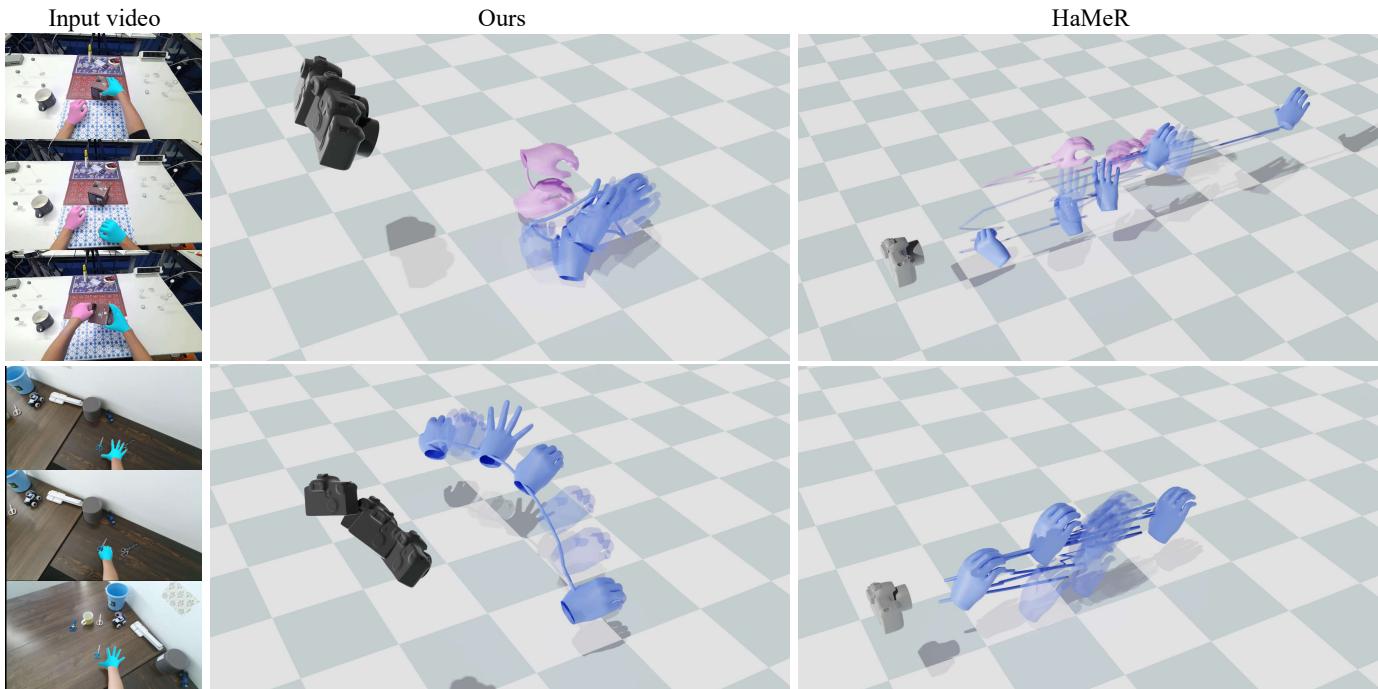
Note the checkered floor, which represents the ground truth world coordinate system.
- Dyn-HaMR (Ours): The hands are grounded. The trajectory is smooth and coherent.
- HaMeR: The reconstruction suffers from “ghosting” (multiple translucent hands showing jitter) and incorrect depth placement. Because HaMeR doesn’t account for camera motion, the global trajectory is messy.
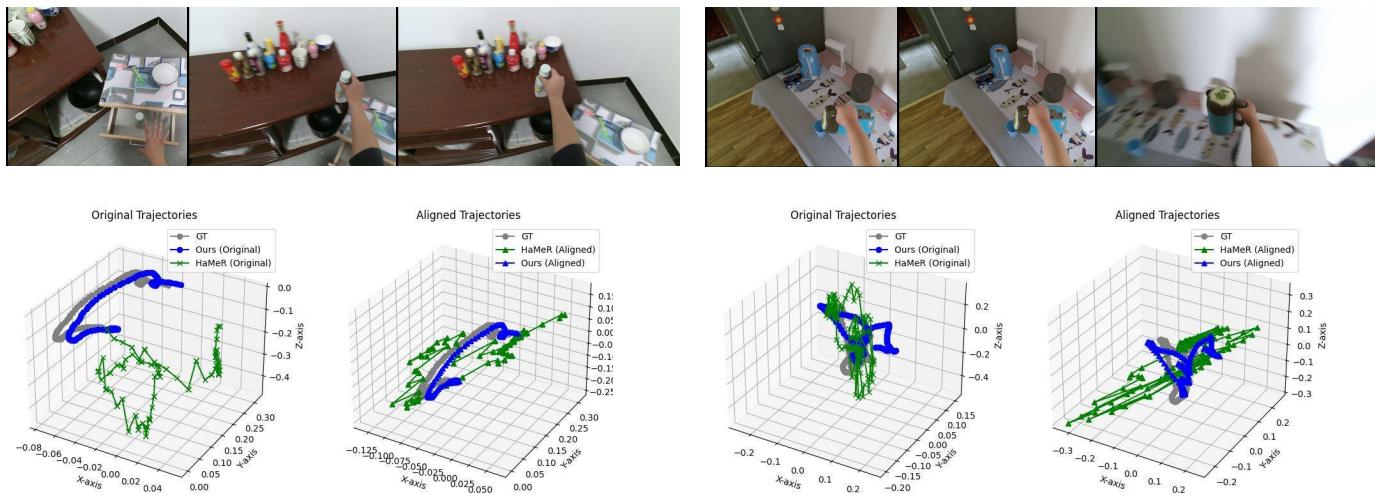
This superiority is further visible in the global trajectory plots. In Figure 6 below, the “Original” traces for HaMeR (the jagged, colorful lines) are highly erratic compared to the Ground Truth (GT). Dyn-HaMR’s traces closely follow the smooth path of the GT.
Quantitative Results
The numbers back up the visuals. The table below shows results on the H2O dataset.
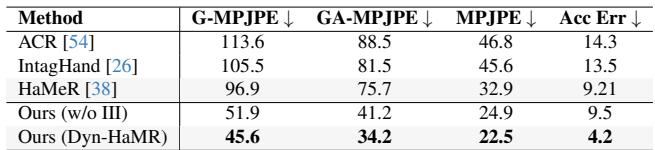
The key metric here is G-MPJPE (Global Mean Per Joint Position Error), measured in millimeters.
- ACR: 113.6 mm error.
- HaMeR: 96.9 mm error.
- Dyn-HaMR (Ours): 45.6 mm error.
Dyn-HaMR cuts the global positioning error by more than half compared to the leading competitor. The Acc Err (Acceleration Error) is also significantly lower (4.2 vs 9.21), indicating much smoother, less jittery motion.
Handling Interactions
The method also excels in complex interaction scenarios where hands are touching or crossing.
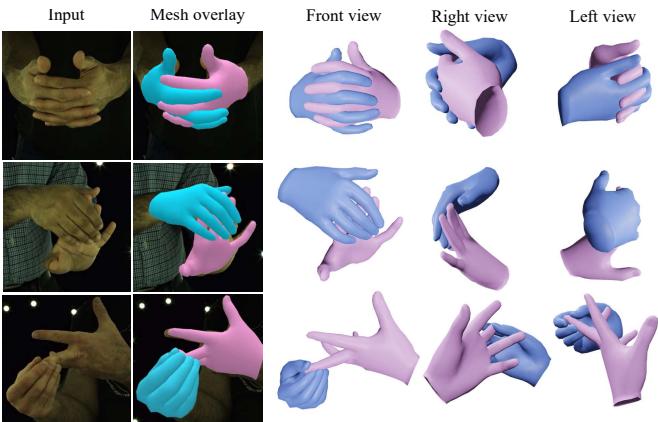
In the figure above, note how the meshes (blue and pink) handle the clasping of hands without distinct clipping issues, maintaining accurate wrist and finger alignment.
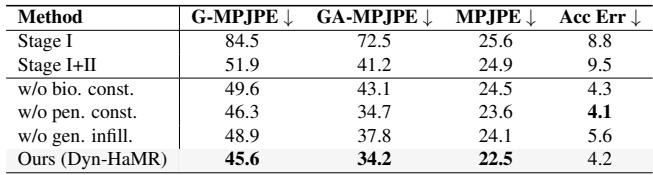
The ablation study below (Table 6) proves the necessity of the different components. Removing the biomechanical constraints (w/o bio. const.) or the generative infilling (w/o gen. infill.) leads to a noticeable drop in accuracy (higher error numbers).
Conclusion
Dyn-HaMR represents a significant step forward in 3D human understanding. By acknowledging that cameras in the wild are rarely static, the authors have built a system that tackles the “motion entanglement” problem head-on.
Key Takeaways:
- Disentanglement is Key: You cannot reconstruct accurate world-space motion without explicitly modeling the camera’s movement (SLAM) and the scale difference between the camera and the hands.
- Priors are Essential: In monocular video, data is often missing due to occlusion. Using learned priors (HMP) and biological constraints allows the system to fill in the blanks physically plausibly.
- Optimization Works: While end-to-end neural networks are popular, this paper demonstrates the power of a multi-stage optimization pipeline that fuses geometric insights (SLAM) with deep learning predictions (2D/3D pose).
This technology has exciting implications for VR avatars, where tracking a user’s hands from a headset (a moving camera) is the primary input, as well as for training robots to mimic human dexterity by watching egocentric videos. By establishing a new benchmark for 4D global mesh recovery, Dyn-HaMR paves the way for truly dynamic digital interactions.