](https://deep-paper.org/en/paper/2412.14446/images/cover.png)
Imagine you are driving down a busy street. You see a ball roll out from between two parked cars. You don’t just see a “spherical orange object”; you immediately infer that a child might be chasing it, and you instinctively slow down. This is commonsense reasoning.
Now, consider an autonomous driving (AD) system. Most modern end-to-end (E2E) models are excellent at pattern matching—they see the road geometry and other cars, and they mimic the trajectories found in their training data. However, they often lack the “why” behind the driving decisions. They might navigate a standard intersection perfectly but struggle in “long-tail” scenarios (rare, complex events) because they lack the underlying reasoning capabilities that humans possess.
This brings us to a fascinating research paper: “VLM-AD: End-to-End Autonomous Driving through Vision-Language Model Supervision.” The researchers propose a novel way to inject high-level reasoning into driving models using Vision-Language Models (VLMs), such as GPT-4o, acting as teachers. The best part? The heavy, computationally expensive VLM is only needed during training, keeping the system fast and efficient for real-time deployment.
In this post, we will tear down the VLM-AD architecture, explore how it distills reasoning into driving policies, and analyze why this “teacher-student” approach might be the future of robust autonomous systems.
The Problem: The Reasoning Gap
End-to-end autonomous driving has made massive strides. Systems like UniAD and VAD unify perception, prediction, and planning into a single network. Figure 1(a) below shows this classic pipeline: sensor data goes in, and a trajectory comes out.
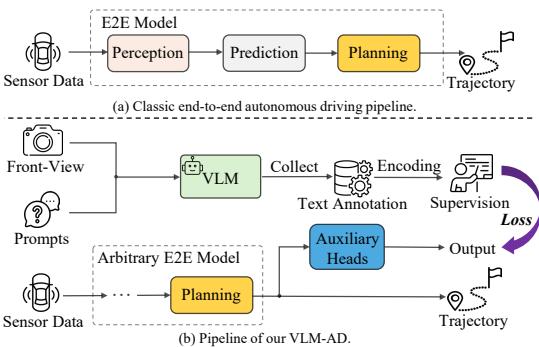
However, these models rely on trajectory supervision. They are trained to minimize the mathematical distance between their predicted path and the ground truth path. They learn how the car moved, but they aren’t explicitly taught why it moved that way.
This creates a “reasoning gap.” When a human driver stops at a green light because an ambulance is approaching, they are reasoning about the context. A standard E2E model might just see a green light and get confused about why the ground truth data shows the car stopping.
To bridge this gap, we need a way to incorporate unstructured reasoning (language) and structured decision-making (actions) into the training process.
The Solution: VLM-AD
The core idea of VLM-AD is simple yet powerful: Use a large Vision-Language Model (VLM) as a teacher to annotate driving videos with reasoning and actions, then train the driving model to predict these annotations.
As shown in Figure 1(b) above, the VLM provides “Text Annotation” and “Supervision” during training. Crucially, at inference time (when the car is actually driving on the road), the VLM is gone. The driving model has effectively internalized the teacher’s lessons.
Let’s look at the complete framework in Figure 2.
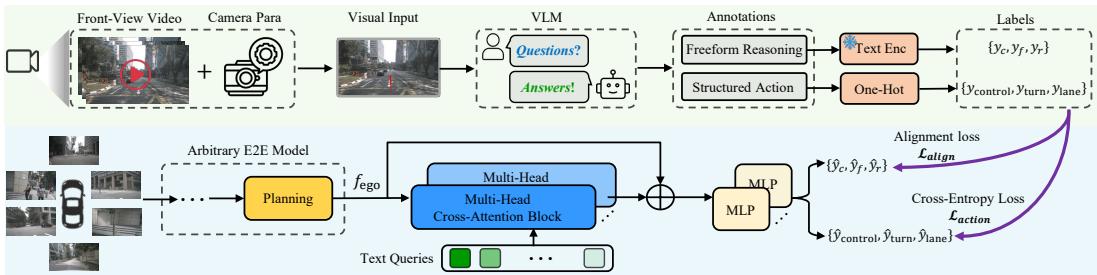
The framework consists of two main stages:
- VLM Text Annotation: Generating a rich dataset of reasoning and actions.
- Auxiliary Heads: Integrating this knowledge into the E2E driving model.
Let’s break these down step-by-step.
Stage 1: The Teacher (VLM Annotation)
The first challenge is getting a VLM to understand the driving context. While VLMs like GPT-4o are powerful, they can struggle with temporal dynamics (understanding movement over time) just by looking at a static image or a raw video feed.
The Visual Input Strategy
To give the VLM the necessary context without overloading it with video frames, the researchers devised a clever prompting strategy. They project the future trajectory of the ego vehicle (the car itself) onto the front-view image.
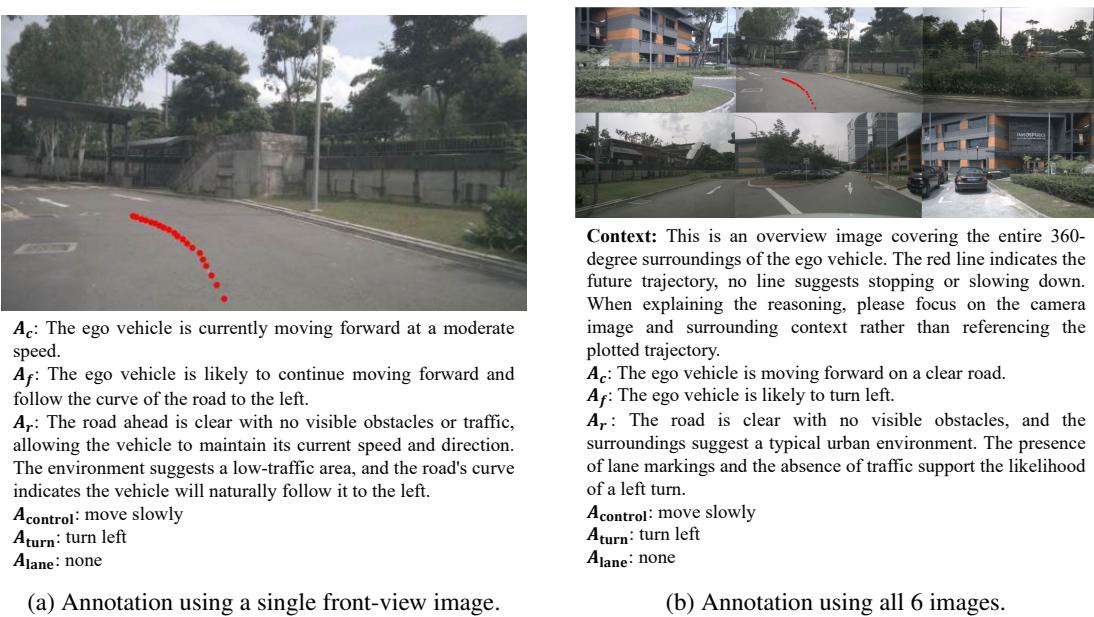
As seen in Figure 3(a), the red line indicates where the car is going to go. This allows the VLM to see the intent of the driver relative to the scene. The researchers found that using a single front-view image with this trajectory projection was more effective and efficient than using multiple camera views (Figure 3b) or a sequence of un-annotated frames.
The Prompts: Asking the Right Questions
The VLM is prompted with two distinct types of questions to generate the supervision data:
1. Freeform Reasoning (\(Q_1\))
These are open-ended questions designed to extract understanding.
- Context: “Describe the ego vehicle’s current actions.”
- Prediction: “Predict the future actions.”
- Reasoning: “Explain the reasoning behind these actions.”
The annotation generation process is formally defined as:
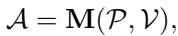
Here, \(\mathbf{M}\) is the VLM, \(\mathcal{P}\) represents the prompts, and \(\mathcal{V}\) is the visual input (image + projected trajectory).
2. Structured Actions (\(Q_2\))
The model is also asked to categorize the behavior into specific buckets:
- Control: {go straight, move slowly, stop, reverse}
- Turn: {left, right, none, U-turn}
- Lane: {change left, change right, merge, none}
This creates two sets of labels: complex text embeddings (\(y_1\)) and precise classification labels (\(y_2\)).

For the freeform text, they use CLIP to encode the sentences into feature vectors. For the structured actions, they use One-Hot encoding.
Stage 2: The Student (Auxiliary Heads)
Now that we have a “reasoning-labeled” dataset, we need to train the autonomous driving model to learn from it.
The researchers take a standard E2E model (like UniAD or VAD) and add Auxiliary Heads after the planning module. These heads take the internal “Ego Feature” (\(f_{ego}\))—the model’s compressed understanding of the car’s state—and try to predict what the VLM would have said.
1. Feature Alignment Head
This head tries to align the driving model’s internal features with the VLM’s text embeddings. It uses a Multi-Head Cross-Attention (MHCA) mechanism.
Imagine the model is trying to answer the question, “Why are we stopping?” The text query \(q\) interacts with the ego feature (\(k\) and \(v\)) to extract relevant information.

The output \(\hat{f}_1\) represents the model’s guess at the reasoning text. To ensure the model learns the distribution of the features rather than just raw values, they normalize the features using a Softmax function with temperature scaling (\(\tau\)):

This “softens” the probability distributions, making the knowledge distillation process smoother and more stable.
2. Action Classification Head
This head is more straightforward. It tries to classify the specific action the car is taking (e.g., “Turn Left”). It also uses Cross-Attention but ends with a standard classifier.

Stage 3: The Loss Function
Finally, the model is trained using a composite loss function. The total loss \(\mathcal{L}\) combines the alignment loss and the action loss.

The specific calculations for alignment (using KL-divergence style logic via cross-entropy on distributions) and action classification are shown below:

By minimizing these losses, the model is forced to organize its internal feature space (\(f_{ego}\)) in a way that aligns with human-like reasoning and specific driving actions.
Experimental Results
Does adding this “reasoning supervision” actually make the car drive better? The researchers tested VLM-AD on the nuScenes dataset (open-loop) and the CARLA simulator (closed-loop).
Planning Accuracy (Open-Loop)
In open-loop testing, the model looks at recorded data and predicts a trajectory. The key metric is L2 Error (how far off the path is) and Collision Rate.
Table 1 below shows the comparison against state-of-the-art baselines like UniAD, VAD, and SparseDrive.
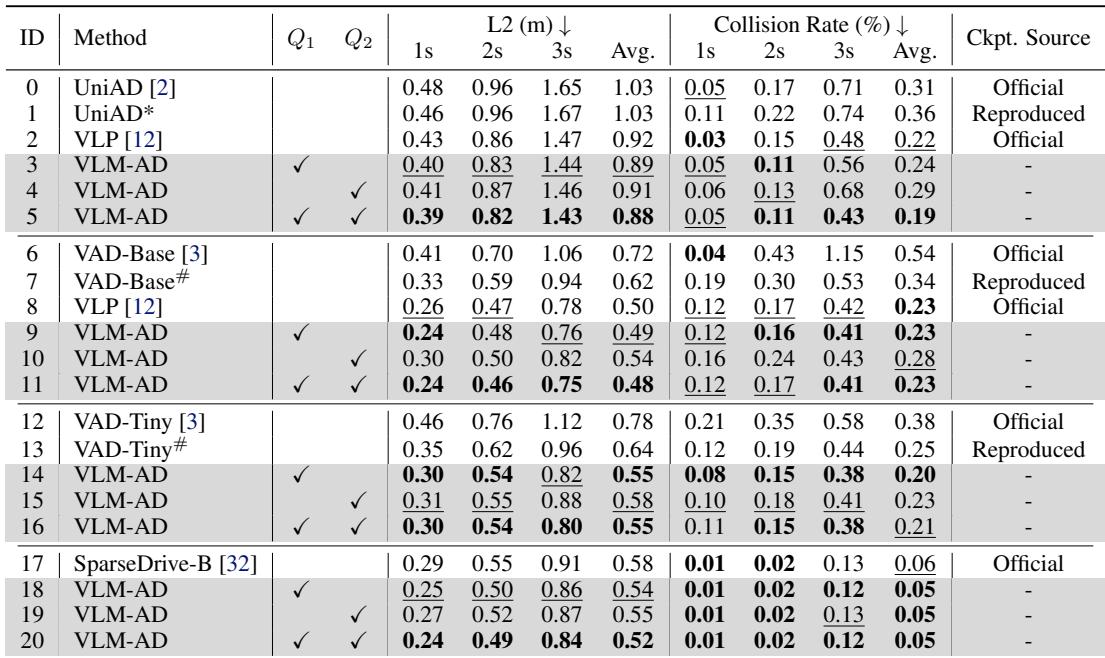
Key Takeaways from Table 1:
- Performance Boost: VLM-AD consistently outperforms the baselines. Look at row 0 (UniAD) vs. row 5 (VLM-AD). The average L2 error drops from 1.03m to 0.88m.
- Collision Reduction: The collision rate drops significantly (0.31% to 0.19%).
- Ablation: Rows 3 and 4 show that using both freeform reasoning (\(Q_1\)) and structured actions (\(Q_2\)) yields the best results (Row 5).
The Power of Reasoning
Is the freeform text actually helping, or is it just the action labels? Table 3 breaks down the contribution of different reasoning questions.
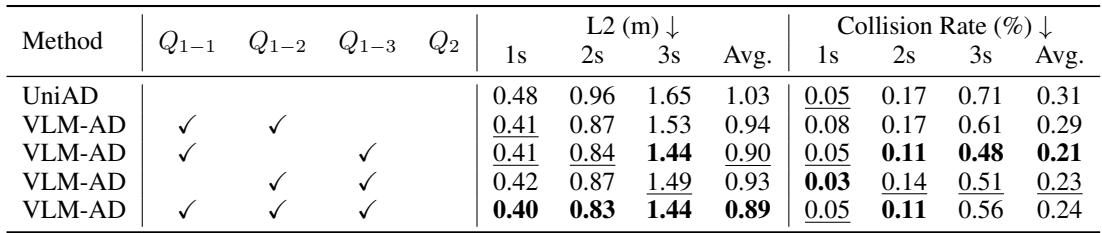
The column \(Q_{1-3}\) (Explanation of reasoning) provides the most significant reduction in error. This confirms the hypothesis: Teaching the model why it acts improves how it acts.
Closed-Loop Simulation (CARLA)
Open-loop is useful, but closed-loop simulation tests if the car can actually drive without crashing over time.
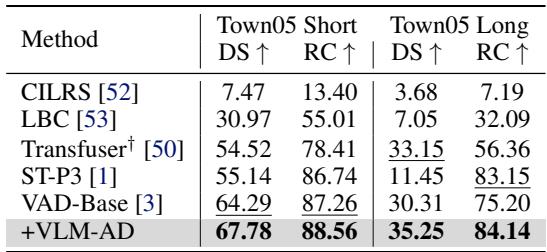
In Table 2, VLM-AD achieves the highest Driving Score (DS) and Route Completion (RC), particularly on the “Town05 Long” route, which involves complex interactions. It beats VAD-Base by a healthy margin (35.25 vs 30.31 DS).
Qualitative Analysis: Seeing the Difference
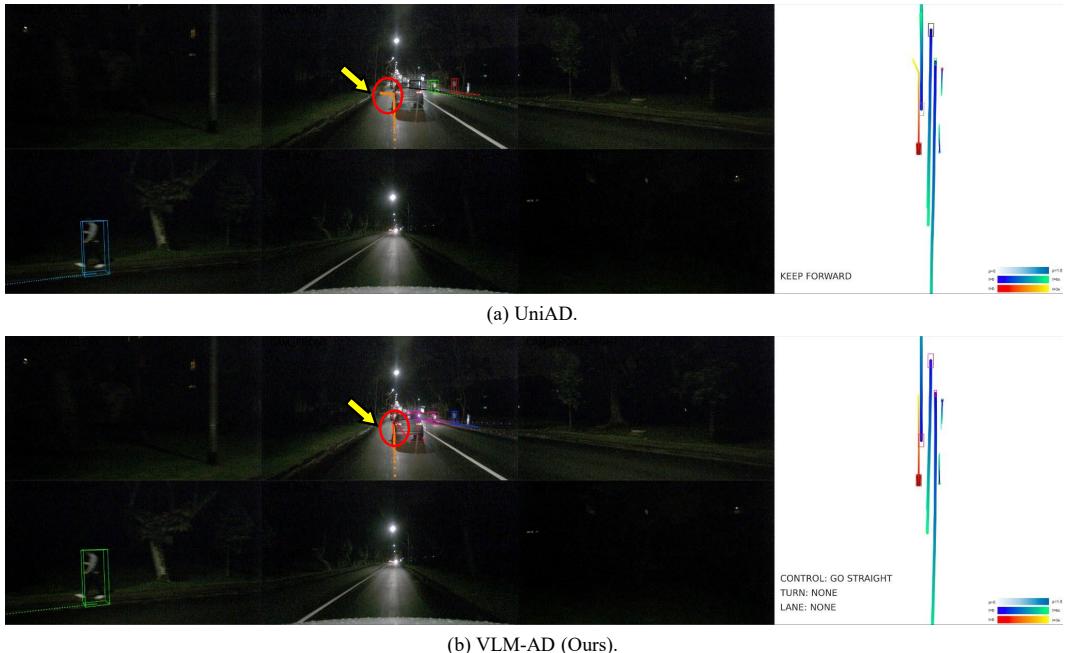
Numbers are great, but visuals tell the story. Let’s look at how VLM-AD handles difficult scenarios compared to the baseline (UniAD).
Scenario 1: Nighttime Driving
In Figure 8, the baseline UniAD (left) predicts a “winding” trajectory that seems uncertain. VLM-AD (right) generates a smooth, confident path.
Scenario 2: Rainy Conditions
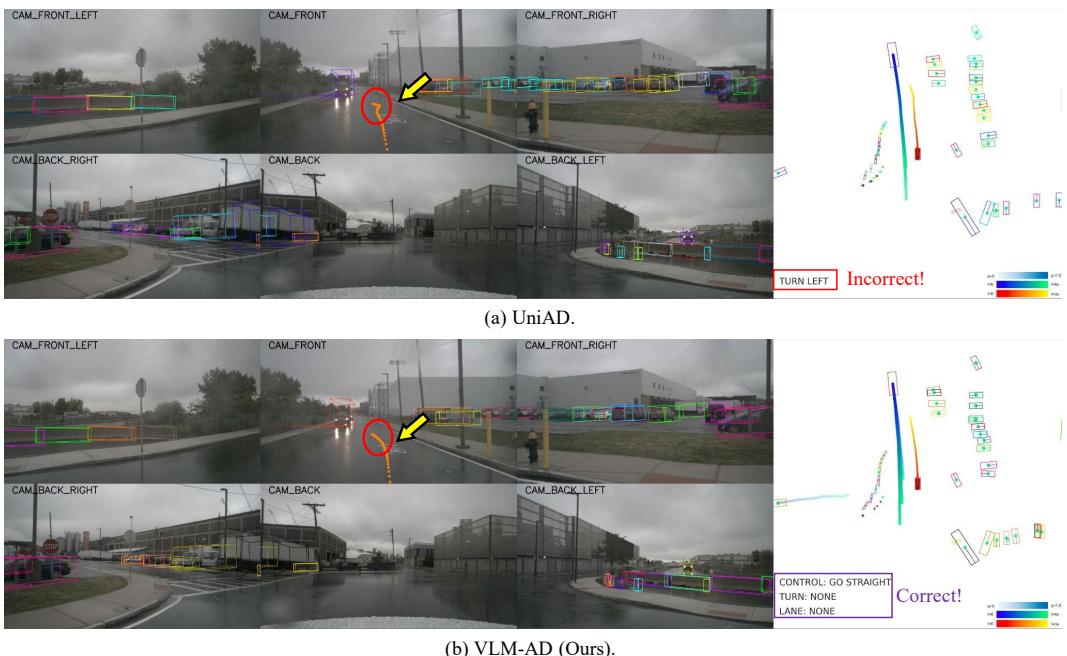
Rain creates reflections and confuses sensors. In Figure 11, UniAD incorrectly decides to turn left (marked “Incorrect!”), likely confused by the wet road or reflections. VLM-AD correctly identifies the “Go Straight” command and plans a safe path.
Scenario 3: Lane Stability
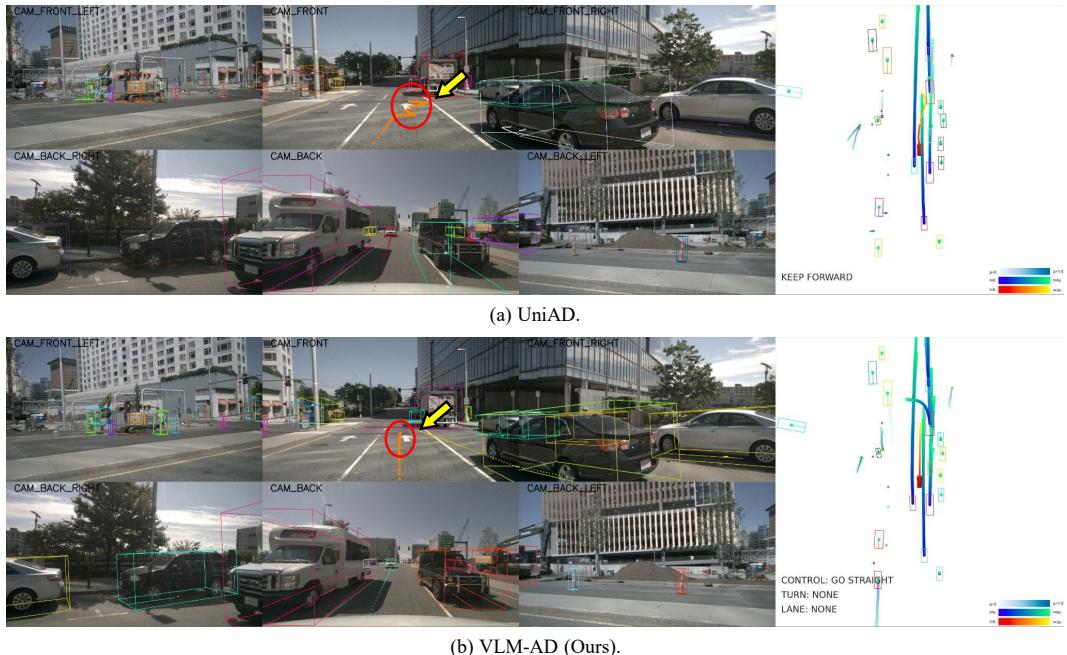
In Figure 12, notice how the baseline trajectory “zigzags,” struggling to stay centered. The VLM-AD trajectory is rock-steady within the lane boundaries.
Why This Matters
VLM-AD represents a significant shift in how we train autonomous systems. Here are the broader implications:
- Efficiency: We get the intelligence of a massive model (GPT-4o) distilled into a smaller, faster model that fits in a car.
- Scalability: We don’t need humans to manually label “reasoning” for millions of frames. The VLM can automatically annotate massive datasets.
- Safety: By learning the “reasoning,” the model handles long-tail events (like the rainy night scenarios) much better than simple pattern matchers.
Conclusion
The transition from “mimicking” to “understanding” is the next frontier in AI robotics. VLM-AD demonstrates that we can bridge this gap by using Foundation Models as teachers. By supervising end-to-end driving models with rich, reasoning-based text and structured actions, we can create autonomous agents that don’t just follow a line on the road—they understand the world around them.
The results are clear: better planning, fewer collisions, and smoother driving, all without the need for a supercomputer in the trunk. As VLMs continue to improve, this teacher-student paradigm will likely become a standard for training the next generation of embodied AI.