](https://deep-paper.org/en/paper/2412.14480/images/cover.png)
Imagine you are visiting a friend’s house for the first time. You ask, “Where can I find a glass of water?” Even though you’ve never been in this specific house before, you know exactly what to do: look for the kitchen. Once in the kitchen, you look for cupboards or a drying rack. You don’t wander into the bedroom or inspect the bookshelf.
You are using semantic reasoning combined with spatial exploration. For robots, replicating this intuitive process is incredibly difficult. This is the domain of Embodied Question Answering (EQA). A robot must explore an unseen environment, understand what it sees, remember where things are, and answer a natural language question.
Today, we are diving into a fascinating paper titled “GraphEQA: Using 3D Semantic Scene Graphs for Real-time Embodied Question Answering.” This research proposes a new way to give robots a “multimodal memory”—combining the structural understanding of 3D maps with the rich semantic reasoning of Vision-Language Models (VLMs).
If you are a student of robotics or AI, you know that grounding language models in the real, physical world is one of the “holy grail” challenges of the field. Let’s explore how GraphEQA attempts to solve it.
The Problem: Memory vs. Reasoning
To solve an EQA task (e.g., “Is there a blue pan on the stove?”), an agent needs two distinct capabilities:
- Context/Memory: It needs to know where it is, where it has been, and the spatial layout of the house.
- Reasoning: It needs to understand that stoves are in kitchens, and “blue” is a visual attribute of a specific object.
Prior approaches often treated these separately. Some methods use VLMs (like GPT-4) as planners, but these models often “hallucinate” or lose track of spatial location because they aren’t grounded in a map. Other methods build dense maps but require expensive offline processing, making them too slow for real-time robot deployment.
The researchers behind GraphEQA identified a gap: we need a memory system that is online (updates in real-time), compact (doesn’t store millions of useless pixels), and semantically rich (understands objects and rooms).
The Solution: GraphEQA
GraphEQA introduces a novel architecture that grounds a VLM planner using a 3D Metric-Semantic Scene Graph (3DSG) augmented with Task-Relevant Images.
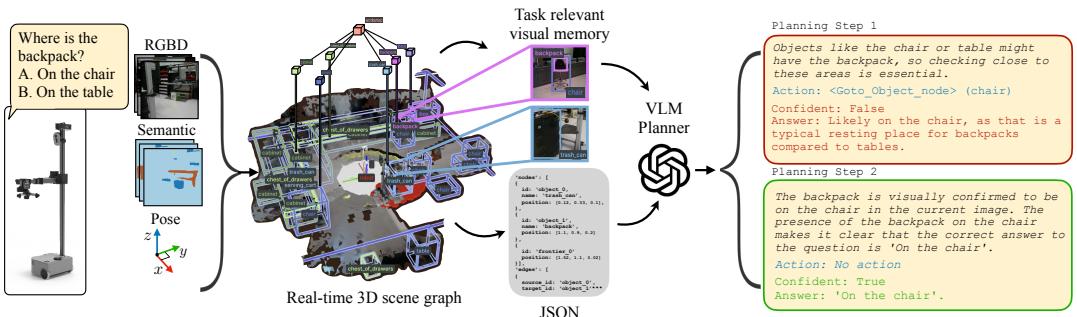
As shown in Figure 1, the system allows a robot to take in sensory data, build a structured graph representation of the world (identifying chairs, tables, and their relationships), and use a VLM to plan the next step—ultimately answering questions like “Where is the backpack?”
Let’s break down the architecture into its core components.
1. The Real-Time 3D Semantic Scene Graph
At the heart of GraphEQA is the Scene Graph. Unlike a standard grid map (which just tells you if a space is occupied or empty), a scene graph organizes the world hierarchically:
- Layer 5 (Top): Building
- Layer 4: Rooms (e.g., Kitchen, Living Room)
- Layer 3: Regions
- Layer 2: Objects (e.g., Chair, Table, Stove) and Agents
- Layer 1 (Bottom): Metric Mesh (the physical geometry)
The system constructs this graph incrementally using a framework called Hydra. As the robot moves, it detects objects and places them as nodes in the graph.
2. Scene Graph Enrichment
A raw scene graph isn’t enough for high-level reasoning. GraphEQA performs two critical “enrichment” steps:
A. Semantic Room Labels: Hydra might label a room “Room 0.” GraphEQA asks an LLM to analyze the objects found in that room (e.g., bed, nightstand) and infer a semantic label (e.g., “Bedroom”). This helps the planner decide which room is relevant to the question.
B. Semantically Enriched Frontiers: This is a brilliant innovation in this paper. Usually, a “frontier” is just the edge between explored space and unknown darkness. GraphEQA turns these frontiers into graph nodes. Crucially, it connects these frontier nodes to nearby objects. If a frontier is near a “Refrigerator” and a “Stove,” the graph explicitly links them. This allows the robot to reason: “I am looking for a toaster. This frontier is near a stove. I should go there.”
3. Task-Relevant Visual Memory
A graph is an abstraction—it tells you “there is a chair here,” but it might not capture fine details like “the cushion has a floral pattern.” To answer specific questions, you need pixels.
GraphEQA maintains a visual memory buffer. However, it doesn’t save every frame (which would overflow memory). It uses a model called SigLIP to score how relevant an image is to the current question. Only the top-K most relevant images are kept and fed to the VLM.
The Architecture in Action
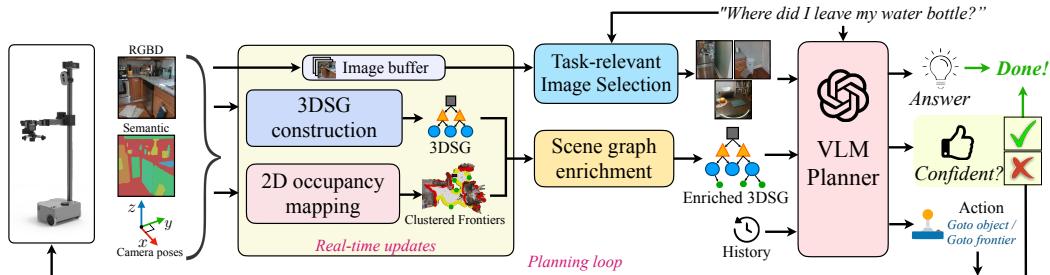
Figure 2 illustrates the complete pipeline. Here is the step-by-step flow:
- Perception: The robot captures RGB-D images and pose data.
- Mapping: It simultaneously updates the 3D Scene Graph (Hydra) and a 2D occupancy map (to find frontiers).
- Enrichment: It labels rooms and links frontiers to nearby objects.
- Planner Loop: The VLM Planner receives:
- The current question.
- The text representation of the Enriched Scene Graph.
- The Task-Relevant Visual Memory (images).
- History of past actions.
- Action: The VLM outputs a high-level action (e.g., “Goto Object: Chair”) or an answer.
The Hierarchical VLM Planner
The planner is the “brain” of the operation. It uses a Large Language Model (specifically versions like GPT-4o or Gemini Pro in experiments) to make decisions.
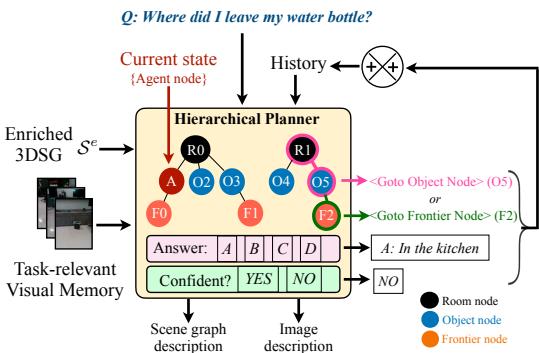
As shown in Figure 3, the planner is designed to think hierarchically. It doesn’t just randomly pick a spot. It follows a structured thought process:
- Select Room: Which room is most likely to contain the answer?
- Select Region/Object: Within that room, which object should I inspect?
- Select Frontier: If the object isn’t found, which unexplored frontier looks most promising based on nearby objects?
The prompt design forces the VLM to explain its reasoning before acting. For example: “I need to find the stove. Frontier 2 is connected to a fridge and a cabinet. Therefore, I will go to Frontier 2.”
Experimental Results
The researchers evaluated GraphEQA in both simulation (Habitat-Sim) and the real world. They compared it against strong baselines, including Explore-EQA (which builds a 2D semantic map) and SayPlan (which typically requires a pre-built graph).
Simulation Benchmarks
The team tested on two major datasets: HM-EQA and OpenEQA.
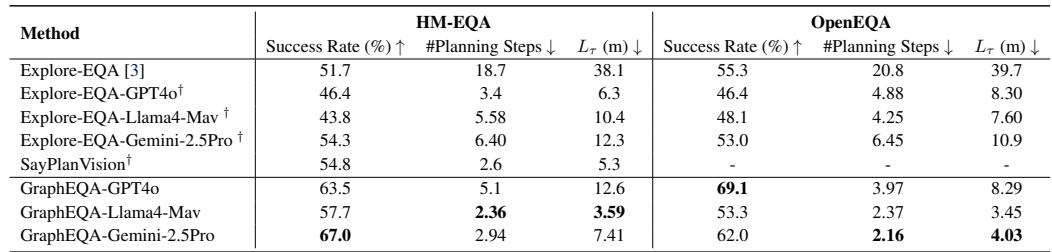
Table 1 reveals some impressive findings:
- Higher Success Rate: GraphEQA (using GPT-4o) achieved a 63.5% success rate on HM-EQA, significantly outperforming the Explore-EQA baseline (51.7%).
- Efficiency: Perhaps most notably, GraphEQA required far fewer planning steps (average of 5.1 steps) compared to the baseline (18.7 steps).
Why is it so much more efficient? Because the baseline often relies purely on visual exploration—wandering until it sees something relevant. GraphEQA uses the structure of the scene graph to make intelligent leaps across the environment.
Qualitative Analysis: Exploration Efficiency
The difference in strategy is best visualized by looking at the robot’s path.
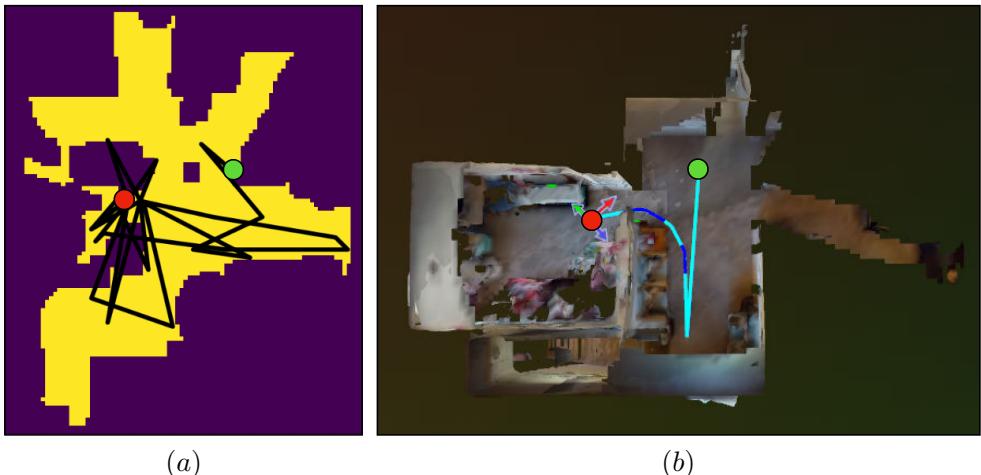
In Figure 7, look at the contrast between the black line (Baseline) and the blue line (GraphEQA):
- Baseline (Left): The path is erratic and covers a massive area. The robot is “brute-forcing” the search.
- GraphEQA (Right): The path is direct and focused. The robot enters, realizes where it needs to go based on the graph structure, and executes the task efficiently.
Ablation Studies: Do we really need both Graph and Images?
One might ask: “Can’t we just use the Scene Graph?” or “Can’t we just use the Images?” The researchers ran ablations to find out.
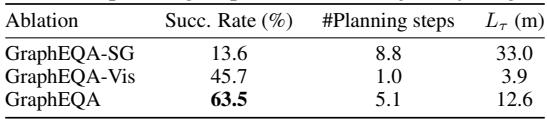
Table 2 shows the results:
- GraphEQA-SG (Scene Graph only): Success rate drops to 13.6%. Without images, the robot lacks the visual detail to answer questions like “What color is the cushion?”
- GraphEQA-Vis (Vision only): Success rate is 45.7%. Without the graph, the robot lacks spatial context and navigation structure.
- GraphEQA (Multimodal): 63.5%.
This confirms that the combination of structural memory (Graph) and visual detail (Images) is what drives the high performance.
Real-World Deployment
Simulation is great, but robots live in the real world. The authors deployed GraphEQA on a Hello Robot Stretch RE2 in actual home environments.
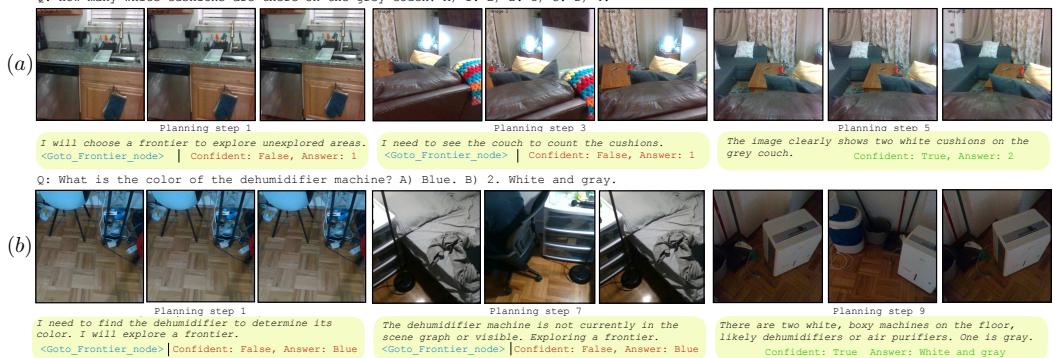
In Figure 4, we see the robot reasoning in real-time.
- Top (a): The question is “How many white cushions are there on the grey couch?” The robot plans to find the couch, navigates there, and counts the cushions.
- Bottom (b): “What is the color of the dehumidifier machine?” The robot realizes it hasn’t seen it yet, plans to explore frontiers, locates the object, and answers.
Let’s walk through a specific real-world example provided in the paper to illustrate the system’s “thought process.”
Case Study: “Is there a blue pan on the stove?”

In Figure 8, the robot starts in a kitchen/living area.
- Reasoning: Ideally, a stove is in a kitchen. The current view doesn’t show one.
- Action: The robot checks its Enriched Frontiers. It notices a frontier connected to “kitchen-like” geometry or objects.
- Exploration: It navigates to that frontier.
- Discovery: The Scene Graph updates. A “Stove” node appears.
- Inspection: The planner executes a
Goto_Object_node(stove)command. - Answer: Once the stove is in the visual memory, the VLM sees the blue pan and answers “Yes.”
This sequence demonstrates the power of active exploration. The robot didn’t just look at what was in front of it; it hypothesized where the target should be and went to verify it.
Conclusion and Implications
GraphEQA represents a significant step forward in Embodied AI. By bridging the gap between geometric mapping (SLAM/3D Scene Graphs) and semantic reasoning (VLMs), it creates robots that are:
- More Efficient: They don’t wander aimlessly.
- More Aware: They understand room and object relationships.
- Real-Time Capable: They build memories on the fly without needing hours of pre-processing.
For students and researchers, this paper highlights the importance of structured memory. While end-to-end learning is popular, this work shows that giving a Large Language Model a structured, queryable representation of the world (like a Scene Graph) significantly enhances its ability to plan and act in complex environments.
The future of robotics isn’t just about better sensors or bigger LLMs; it’s about how we structure the data those models use to understand the world around them. GraphEQA offers a compelling blueprint for that future.