](https://deep-paper.org/en/paper/2412.14803/images/cover.png)
Can Predicting the Future Teach Robots to Act? A Deep Dive into Video Prediction Policy (VPP)
In the quest to build generalist robots—machines capable of handling everything from folding laundry to assembling electronics—vision is paramount. For a robot to interact with the world, it must see the world. However, how we teach robots to “see” has largely been static. We typically feed them single images, effectively asking them to make complex decisions based on snapshots frozen in time.
But the physical world isn’t static. It is a continuous flow of cause and effect. When you reach for a cup of coffee, your brain isn’t just processing the current frame of your vision; it is subconsciously predicting the future—the weight of the cup, the trajectory of your arm, and the liquid sloshing inside.
A fascinating new research paper, “Video Prediction Policy: A Generalist Robot Policy with Predictive Visual Representations,” challenges the status quo of static robot vision. The researchers propose a novel hypothesis: powerful Video Diffusion Models (VDMs), which are trained to generate realistic videos, inherently understand the physics and dynamics of the world. By tapping into this “predictive knowledge,” we can build robots that move more intelligently and generalize better to new tasks.
In this post, we will deconstruct the Video Prediction Policy (VPP). We will explore how it repurposes generative video models into high-speed robot controllers, the architecture behind its “predictive visual representations,” and why this approach drastically outperforms previous state-of-the-art methods.
The Problem with Static Vision
To understand why VPP is significant, we first need to look at how robots currently see. Most generalist robot policies rely on vision encoders (like ResNet or ViT) pre-trained on massive datasets. These encoders are usually trained via:
- Contrastive Learning (e.g., CLIP, R3M): Learning to align images with text or other images.
- Image Reconstruction (e.g., MAE): Learning to rebuild an image from masked patches.
While effective, these methods have a blind spot: they focus on the now. They capture static semantic information (e.g., “this is a red cup”) but neglect dynamic information (e.g., “this cup is about to tip over”).
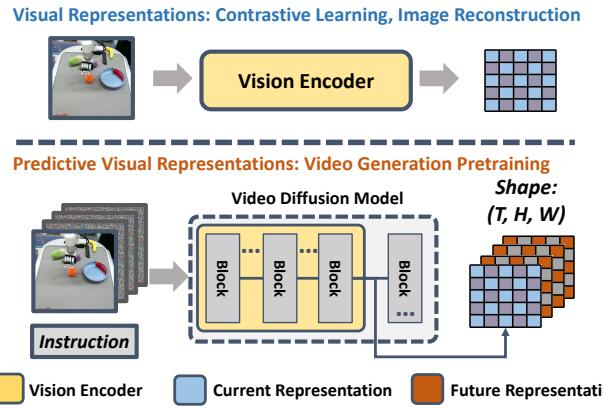
As illustrated in Figure 1, traditional vision encoders (top) map an input image to a static representation. In contrast, the approach proposed in this paper (bottom) leverages a Video Diffusion Model. By processing the current image and an instruction, the model generates a tensor representing not just the current frame, but a sequence of future frames.
The researchers argue that these latent variables within the diffusion model—which they term “Predictive Visual Representations”—contain rich information about future physics and dynamics that static encoders simply miss.
Background: Video Diffusion as a World Model
Before diving into the architecture, let’s briefly recap the engine driving this system: Diffusion Models.
Diffusion models generate data by reversing a noise process. During training (the forward process), Gaussian noise is gradually added to a video until it becomes random static. The model then learns to reverse this, predicting the clean video from the noise.
Mathematically, if \(x_0\) is a real video sample, the forward process adds noise to create \(x_t\):

Here, \(\epsilon_t\) is the noise and \(\alpha_t\) controls the noise schedule. The magic happens in the reverse process, where a neural network \(\mu_{\theta}\) learns to remove the noise and recover the previous step \(x_{t-1}\):

Typically, these models are used for creating art or stock footage. However, recent work in “Physical Intelligence” suggests these models act as world simulators. To generate a coherent video of a hand pushing a block, the model must implicitly “understand” friction, collision, and object permanence. VPP is designed to extract this implicit understanding and feed it to a robot’s control policy.
The VPP Method: A Two-Stage Approach
The Video Prediction Policy is not just a video generator plugged into a robot. Generating full videos is computationally expensive and slow—too slow for real-time robot control (which often needs 10-20 Hz frequency).
VPP solves this by splitting the problem into two distinct stages:
- Training a Manipulation-Centric Video Predictor (TVP): creating a robust “world model” for robotic tasks.
- Action Learning via Predictive Representations: using the internals of the TVP to guide a fast control policy.
Let’s break these down.
Stage 1: The Text-guided Video Prediction (TVP) Model
The researchers started with a powerful open-source foundation model: Stable Video Diffusion (SVD). While SVD understands general video (like waves crashing or people walking), it doesn’t necessarily understand the nuances of a robot gripper interacting with a specific latch.
To bridge this gap, they fine-tuned SVD into a Manipulation TVP Model. They conditioned the model on the initial frame \(s_0\) and a language instruction \(l_{emb}\) (embedded via CLIP). The model tries to predict the future video sequence \(x_0\).
The training objective is standard diffusion loss—minimizing the difference between the predicted noise and the actual noise added to the video:

A key challenge in robotics is data scarcity. To build a robust physicist-in-a-box, the authors combined three distinct types of data:
- Internet Human Manipulation: Videos of people handling objects (Something-Something-v2).
- Internet Robot Data: Large-scale datasets like the Open X-Embodiment (OXE).
- Domain-Specific Data: Videos from the specific robot setup being trained.
They balanced these datasets using specific coefficients \(\lambda\) to ensure the model learned general physics without losing domain specificity:

Stage 2: Action Learning with “One-Step” Representations
This is the most innovative part of the paper. Previous attempts to use video models for control (like UniPi) would generate a full future video and then use an inverse dynamics model to figure out “how do I get from frame A to frame B?” This requires running the diffusion denoising loop dozens of times, taking seconds to generate a single action—far too slow.
VPP takes a different route. It uses the TVP model as a Vision Encoder, not a video generator.
The “One-Step” Insight: The authors discovered that you don’t need to run the full denoising loop to get useful information. By running just one single forward pass through the video model (inputting the current image and pure noise), the internal features of the network already structure themselves according to the predicted future.
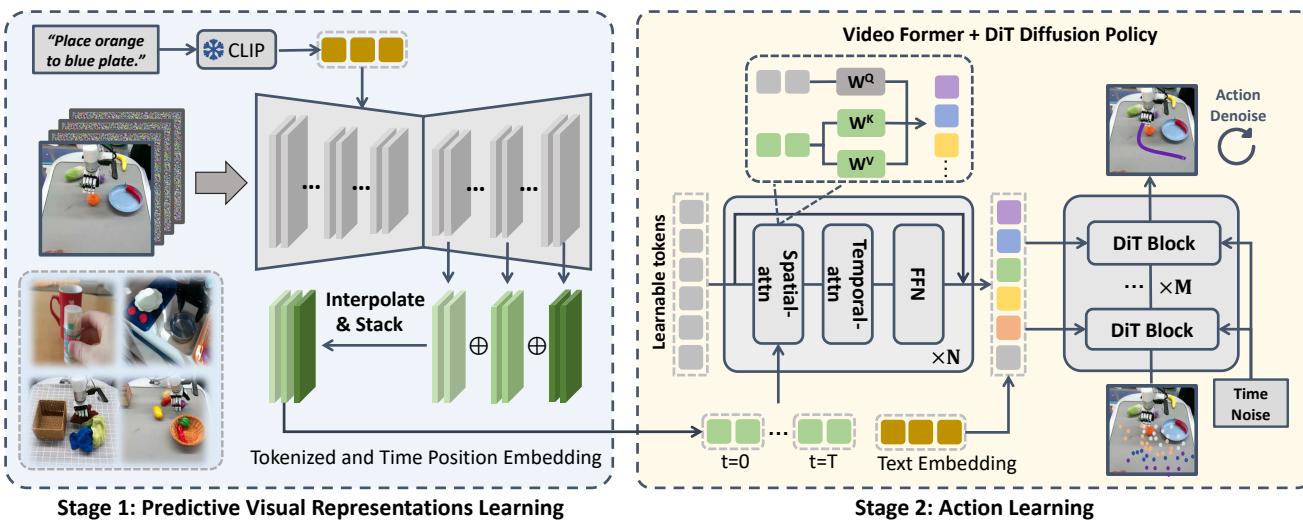
As shown in Figure 2, the pipeline works as follows:
- Input: The current image and text instruction.
- TVP Encoder: The modified Stable Video Diffusion model processes the input.
- Feature Extraction: Instead of outputting pixels, VPP extracts the intermediate feature maps from the U-Net up-sampling layers.
- Aggregation: These features are processed by a “Video Former” and fed into a Diffusion Policy to predict actions.
Feature Aggregation and the Video Former
The representation inside a video diffusion model is massive. It’s a tensor with dimensions \((T, C, H, W)\)—time, channels, height, and width. To make this digestible for a control policy, VPP employs a smart aggregation strategy.
First, they extract features \(L_m\) from the \(m^{th}\) up-sampling layer of the TVP model:

Since different layers have different resolutions, they use linear interpolation to resize them to a common size (\(W_p \times H_p\)):

These interpolated features are concatenated along the channel dimension to form a dense “Predictive Visual Representation” \(F_p\):

Finally, a Video Former (a Transformer-based module) compresses this high-dimensional data. It uses spatial-temporal attention to mix information across time and space, condensing the video features into a compact set of tokens \(Q''\) that the policy network can use.

The Diffusion Policy Head
The final component is the action generator. The researchers use a Diffusion Policy (specifically a Diffusion Transformer or DiT). This policy takes the tokens \(Q''\) from the Video Former and learns to “denoise” a random action sequence into a correct robot trajectory.

By using the TVP model only as a feature extractor (one pass) rather than a video generator (multi-step denoising), VPP achieves a control frequency of roughly 7-10 Hz on consumer hardware (RTX 4090), making it suitable for closed-loop real-world control.
Experimental Validation
The theory sounds solid, but does it work? The authors tested VPP on rigorous benchmarks, including CALVIN (simulation) and two real-world hardware platforms.
1. The CALVIN Benchmark
CALVIN is a standard benchmark for long-horizon robot tasks. The hardest setting is ABC \(\rightarrow\) D, where the robot is trained on environments A, B, and C, but must perform tasks in a completely unseen environment D (different desk texture, lighting, and camera positions).
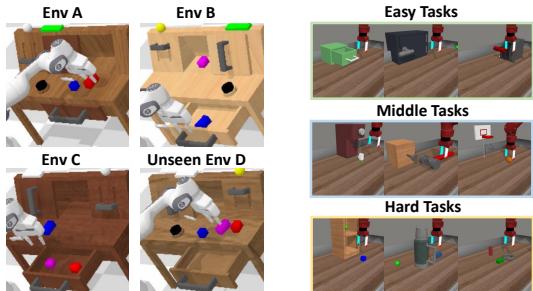
The results were striking. The metric used is “Average Chain Length”—how many sequential instructions the robot can follow before failing.
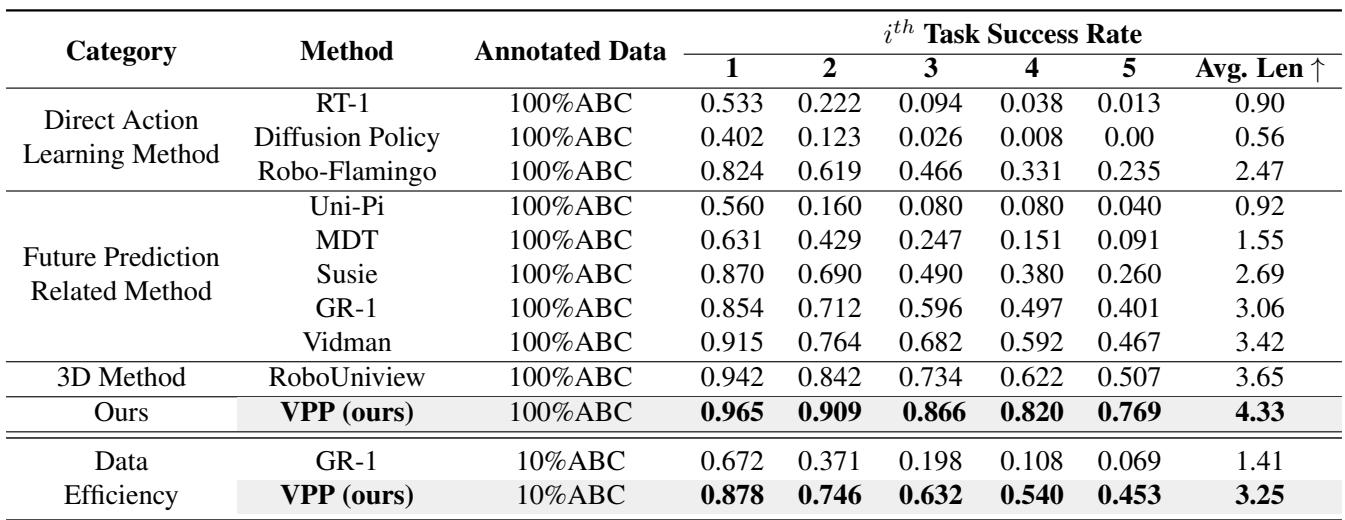
As Table 1 shows, VPP achieved an average length of 4.33, shattering the previous state-of-the-art (RoboUniview at 3.65 and Vidman at 3.42). It nearly doubles the performance of standard baselines like Robo-Flamingo. Even more impressive, when trained on only 10% of the data, VPP still outperformed many competitors trained on the full dataset.
2. Does the “One-Step” Prediction Actually Work?
A skepticism remains: can a single forward pass through a diffusion model really predict the future? Usually, you need 30+ steps to get a clear image.
The authors visualized the output of this one-step process. While the pixels are noisy and the textures are blurred, the structural dynamics are surprisingly accurate.
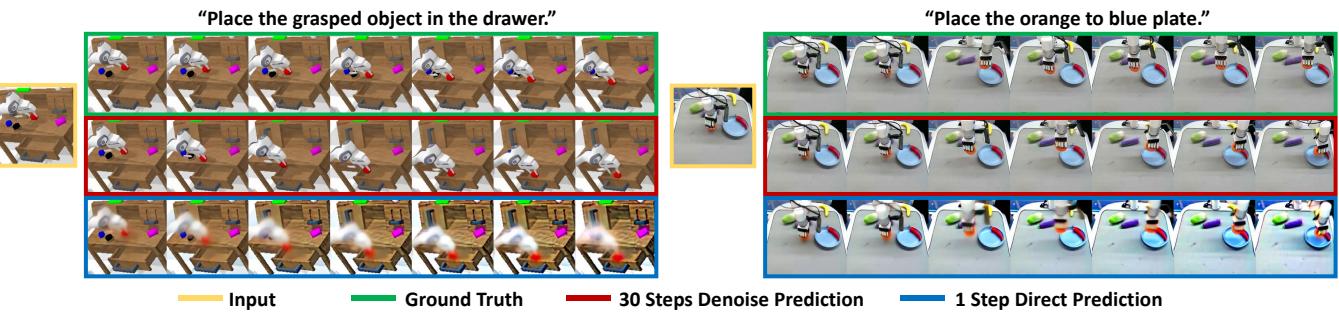
In Figure 4, look at the blue box (1 Step Direct Prediction). While it lacks the crisp detail of the Ground Truth (green), it correctly predicts the movement of the arm and the object. For a robot policy, high-frequency texture details (like the wood grain on the table) are noise; the structural evolution of the scene is the signal. VPP captures the signal efficiently.
3. Ablation Studies: What Matters?
The researchers conducted ablations to see which components drove the performance.
Does the Vision Encoder matter? They swapped the VPP encoder with other popular encoders like VC-1 (trained with Masked Auto-Encoders) and Stable-VAE (standard image reconstruction).
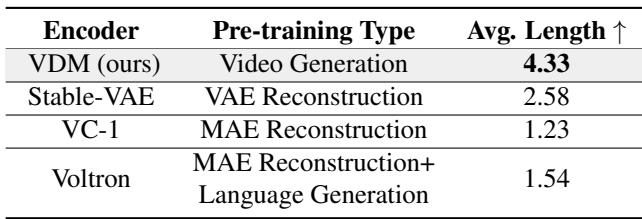
Table 3 confirms that the Predictive Visual Representations (VDM) are vastly superior (4.33 vs 1.23 for VC-1). This validates the core hypothesis: capturing future dynamics is more valuable for control than capturing static semantics.
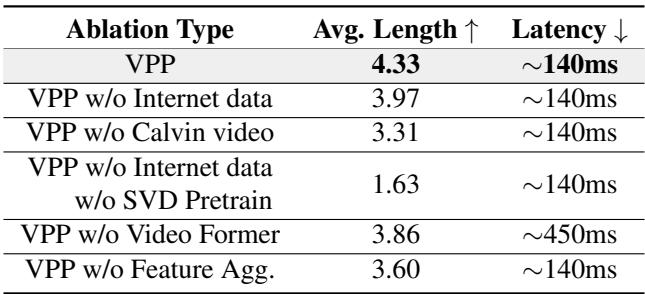
Does Internet Data matter? Removing the internet pre-training data caused a significant drop in performance (from 4.33 to 3.97), and removing the Stable Video Diffusion initialization caused a massive drop (down to 1.63). This proves that the “physical common sense” learned from watching millions of YouTube videos transfers to robot control.
Real-World Experiments
Simulation is one thing; the real world is another. The authors deployed VPP on two setups: a Franka Panda arm and a 12-DoF Dexterous Hand.
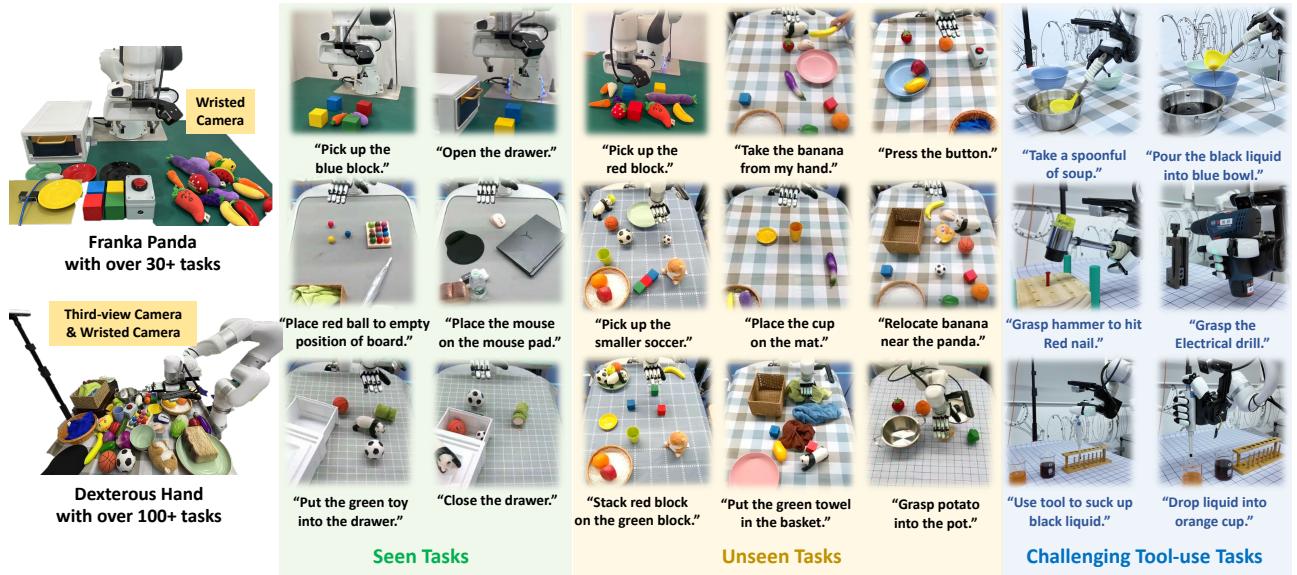
The testing protocol included “Seen Tasks” (similar to training) and “Unseen Tasks” (new objects or backgrounds).
Generalization Capabilities
In the unseen tasks, the robot had to manipulate objects it had never seen before (e.g., a tennis ball, a specific spoon) or operate in new background conditions.

Figure 6 shows the model’s robustness. The red frames show the video model’s prediction of the future, and the green lines show the robot’s actual execution. Even for unseen objects, the video model correctly hallucinates a plausible future where the object is moved, and the policy successfully tracks this implicit trajectory.
Success Rates
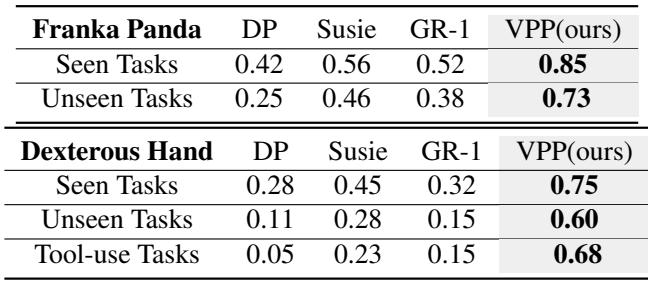
Table 5 summarizes the real-world dominance of VPP. On the complex Dexterous Hand “Unseen Tasks,” VPP achieved a 60% success rate, while the strongest baseline (Susie) achieved only 28%, and the standard Diffusion Policy sat at 11%. This suggests that predictive representations are particularly crucial for high-dimensional, contact-rich tasks like dexterous manipulation.
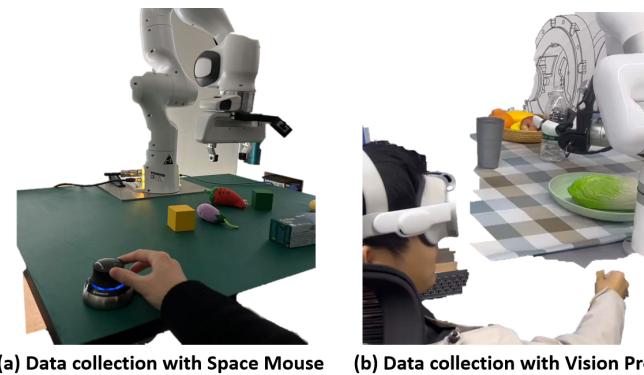
The authors collected the data for these experiments using teleoperation, utilizing tools like a Space Mouse and even an Apple Vision Pro for the dexterous hand (as seen in Figure 7).
Conclusion: The Future is Predictive
The Video Prediction Policy (VPP) represents a significant step forward in embodied AI. By bridging the gap between generative video models and robotic control, the authors have demonstrated that:
- Video Models are World Models: Pre-trained video diffusion models contain rich physical priors that are invaluable for robotics.
- Dynamics > Statics: Representations that encode future evolution are far more useful for control than those that only encode the present state.
- Efficiency via Encoder-Usage: You don’t need to generate pixels to use a generative model. Using the internal features of a single forward pass provides the benefits of prediction without the computational cost of generation.
VPP enables robots to operate not just by reacting to what they see, but by anticipating what will happen. As video foundation models continue to scale and improve, this “predictive” paradigm likely represents the future of generalist robot policies.
This blog post is based on the paper “Video Prediction Policy: A Generalist Robot Policy with Predictive Visual Representations” (2025). The ideas and figures presented are derived directly from the source material.
Appendix: Visualizing the Predictions
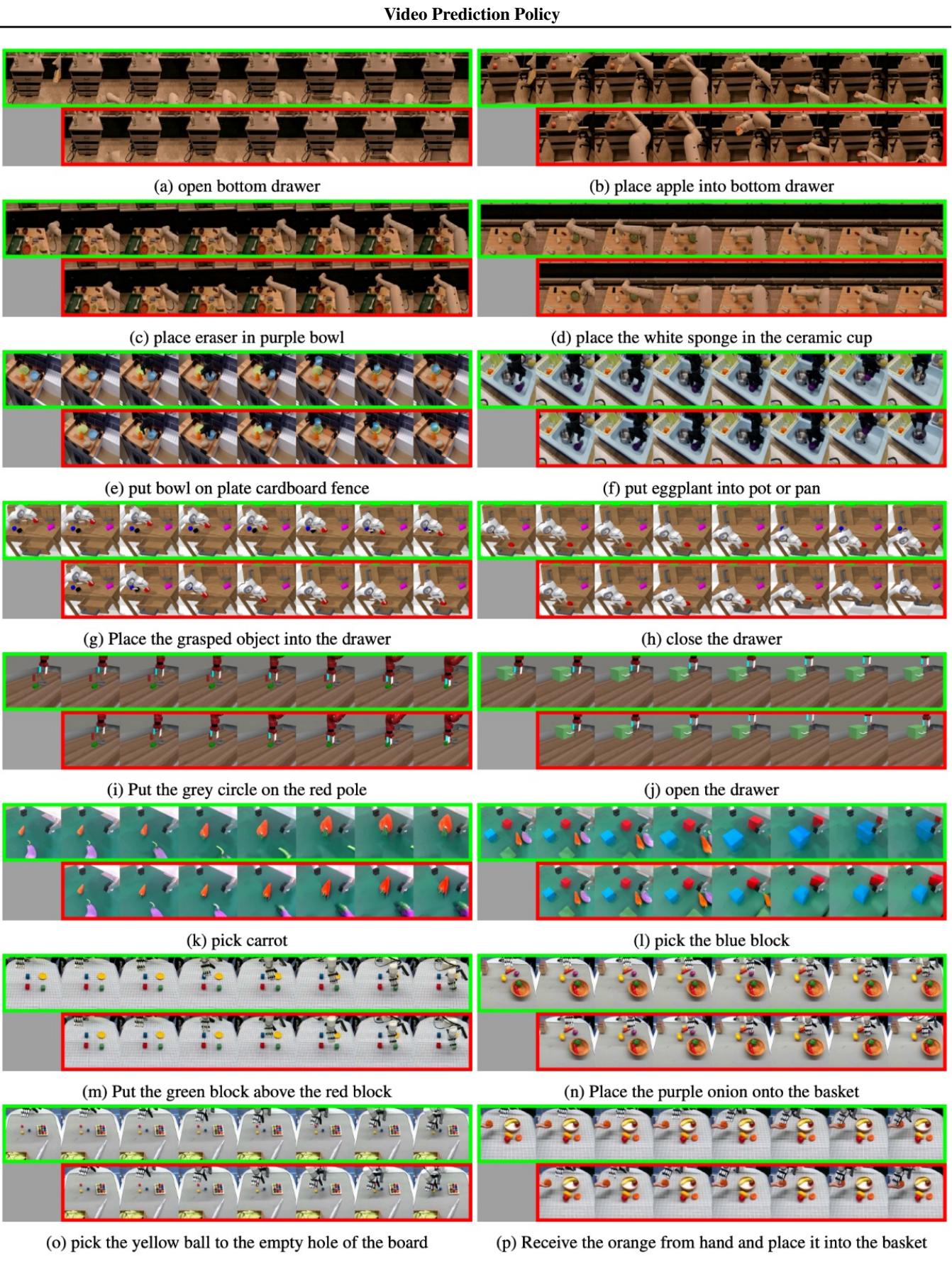
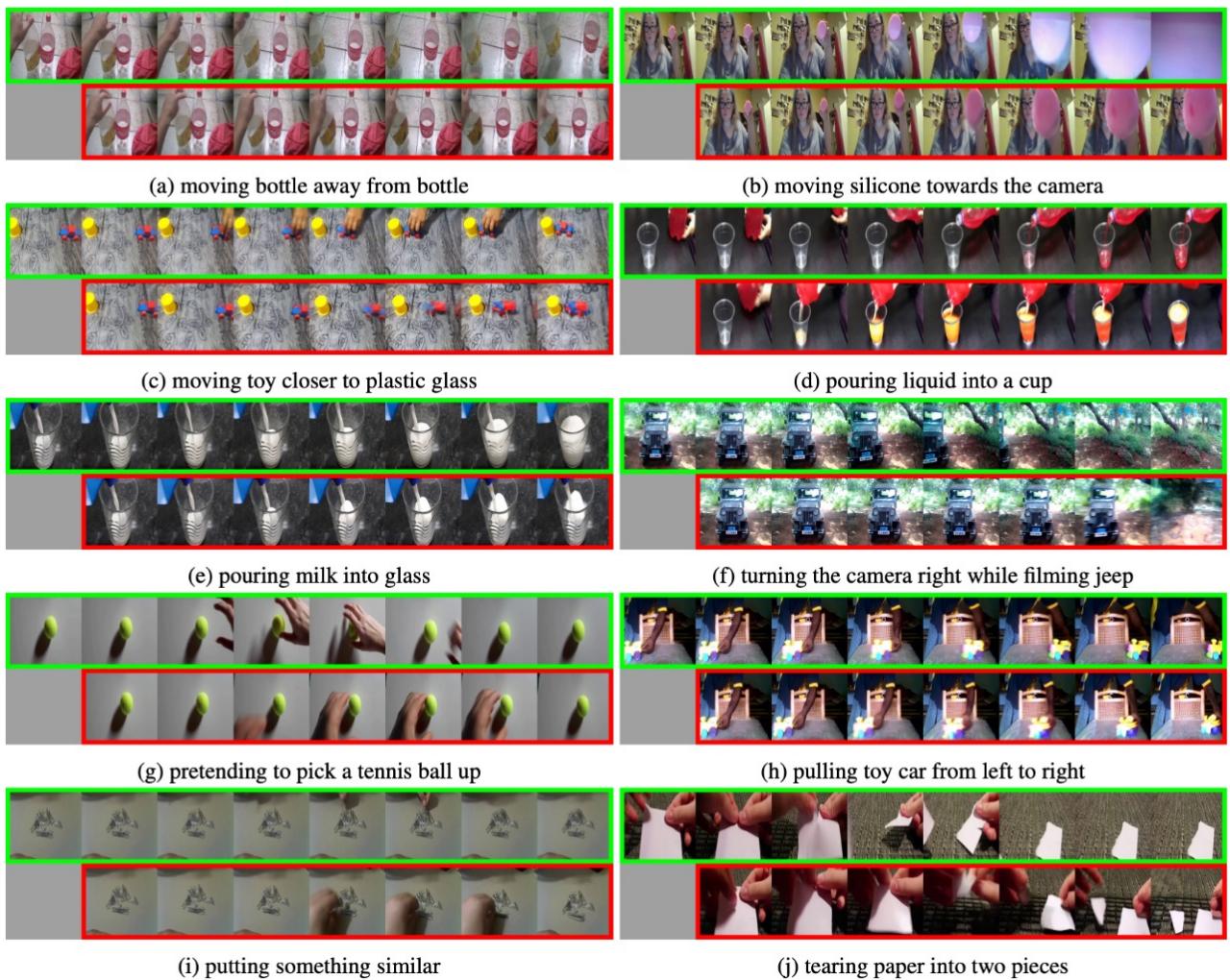
For the curious, here are more visualizations showing how the underlying TVP model interprets human and robot actions.
Human Manipulation Predictions:
Even with just static images as input, the model predicts complex motions like tearing paper or moving bottles.
Robot Manipulation Predictions:
The model generalizes across various robotic embodiments and tasks, accurately forecasting pick-and-place operations.