](https://deep-paper.org/en/paper/2412.15213/images/cover.png)
Introduction
For the past few years, the world of Generative AI has been dominated by a single, powerful narrative: Diffusion. Whether you are using DALL-E, Midjourney, or Stable Diffusion, the underlying process is conceptually similar. The model starts with a canvas of pure static (Gaussian noise) and, guided by your text prompt, iteratively denoises it until a coherent image emerges. It is a bit like carving a statue out of a block of marble, where the marble is random noise and the chisel is the text prompt.
But what if we challenged this fundamental assumption? What if, instead of starting with random noise, we started with the text itself?
In a fascinating new paper titled “Flowing from Words to Pixels: A Noise-Free Framework for Cross-Modality Evolution,” researchers from Meta and Johns Hopkins University propose a paradigm shift. They ask a simple yet profound question: Since text and images often describe the same underlying reality, why can’t we just morph the text distribution directly into the image distribution?
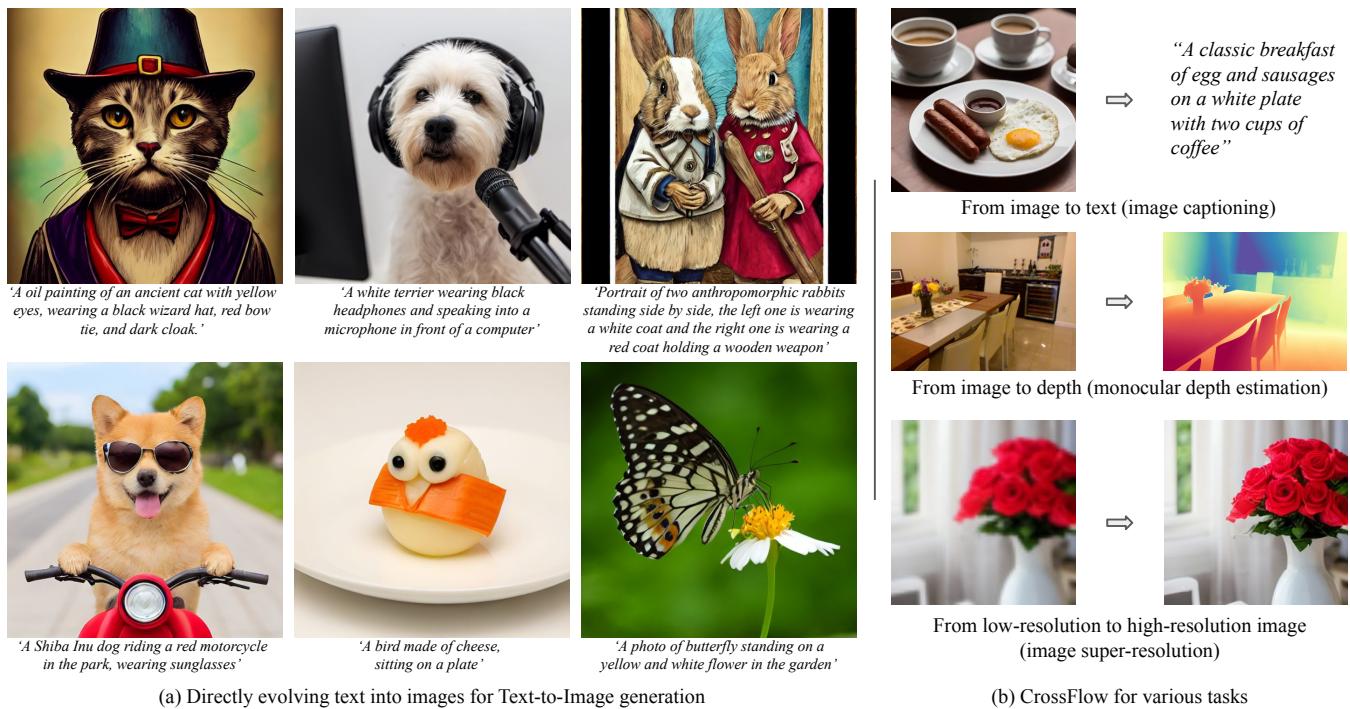
The result of this inquiry is CrossFlow, a framework that eliminates the need for Gaussian noise and the complex “conditioning” mechanisms found in standard diffusion models. As we will explore, this approach not only simplifies the architecture—allowing for the use of vanilla Transformers without cross-attention—but also unlocks new capabilities like performing arithmetic on concepts in latent space.
Background: The Status Quo vs. The New Idea
To appreciate the elegance of CrossFlow, we first need to understand the complexity it replaces.
The Standard Approach: Noise and Conditioning
State-of-the-art generative models, specifically Flow Matching and Diffusion models, typically frame generation as an “optimal transport” problem. The goal is to map a simple source distribution (usually Gaussian noise, \(\mathcal{N}(0, 1)\)) to a complex target distribution (natural images).
Because random noise contains no information, the model needs guidance. In a Text-to-Image (T2I) task, this guidance is provided via conditioning. The text is processed by a language model, and its embeddings are injected into the image generation process using mechanisms like cross-attention. Essentially, the model says, “I am looking at noise, but I will nudge this noise toward a ‘cat’ because the cross-attention layer tells me to.”
The CrossFlow Paradigm
The authors of this paper observe that Flow Matching theory does not actually require the source distribution to be noise. The source can be anything, as long as we can define a path from it to the target.
If we are building a Text-to-Image model, we already possess a source of information that is highly correlated with the target image: the text prompt! There is significant information redundancy between the sentence “A dog in a hat” and an image of a dog in a hat.
CrossFlow proposes training a model to find the direct probability path from the text distribution to the image distribution. This removes two major components of the standard stack:
- No Noise: We don’t start with random static.
- No Conditioning: We don’t need cross-attention layers to “inject” text info. The input is the text info.
The Core Method: How CrossFlow Works
While the motivation is theoretically sound, making it work in practice presents significant challenges. Text and images are fundamentally different data types with different shapes and statistical properties. You cannot simply feed a text vector into a convolutional network and expect an image to pop out without some serious bridging.
The CrossFlow architecture solves this using two main components: a Variational Encoder (VE) and a Flow Matching Transformer.

1. The Variational Encoder: Shaping the Source
The first hurdle is the “shape” mismatch. A text embedding from a model like CLIP might have dimensions \(N \times D\) (sequence length \(\times\) dimension), whereas a latent representation of an image might be \(H \times W \times C\) (Height \(\times\) Width \(\times\) Channels).
Furthermore, for Flow Matching to work effectively, the source cannot just be a deterministic point; it needs to be a distribution.
To solve this, the researchers employ a Text Variational Encoder (VE).
- It takes the text embedding as input.
- It compresses and reshapes this embedding into the target image latent shape (\(z_0\)).
- Crucially, it predicts a mean and variance to sample \(z_0\) from a Gaussian distribution centered around the text semantics.
This turns the input text into a “cloud” of probability in latent space that has the same spatial dimensions as the image.
The training objective for this system is a combination of Flow Matching loss and Encoder losses. The total loss function looks like this:
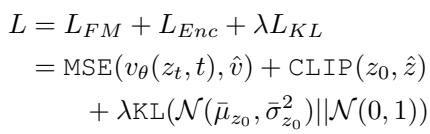
Here is the breakdown of the terms in the equation above:
- \(L_{FM}\) (MSE): The standard flow matching loss. It trains the model to predict the “velocity” required to move from the text latent to the image latent.
- \(L_{Enc}\) (CLIP): A contrastive loss that ensures the starting latent \(z_0\) is semantically aligned with the text.
- \(L_{KL}\): A regularization term that keeps the distribution well-behaved.
2. Flow Matching: The Evolution Path
Once the text is encoded into the source latent \(z_0\), the model needs to evolve it into the target image latent \(z_1\).
In standard diffusion, the path from noise to image is often complex and curved. However, Flow Matching allows for straight-line trajectories. The model defines the path \(z_t\) at any time \(t\) as a linear interpolation between the source and the target:

The neural network, \(v_{\theta}\), acts as the driver. It learns the velocity field—the direction and speed the data points need to move to transform from the text representation to the image representation.
3. Classifier-Free Guidance (CFG) with an Indicator
This is perhaps the most clever engineering trick in the paper.
In modern generative AI, Classifier-Free Guidance (CFG) is essential for high-quality results. CFG works by mixing a “conditional” prediction (guided by text) with an “unconditional” prediction (guided by nothing/null). This highlights the signal and suppresses the noise.
But CrossFlow has a problem: it has no “conditioning” mechanism to turn off. The text is the starting point!
To enable CFG, the authors introduce a CFG Indicator. They add a tiny binary tag to the model input:
- Indicator = 1: “Evolve this specific text latent into its corresponding image.”
- Indicator = 0: “Evolve this text latent into any valid image (unconditional generation).”
During training, they randomly flip this indicator. This teaches the model two tasks: specific mapping and general mapping. During inference (generation), they can extrapolate between these two modes, regaining the sharpness and adherence boosts provided by CFG.
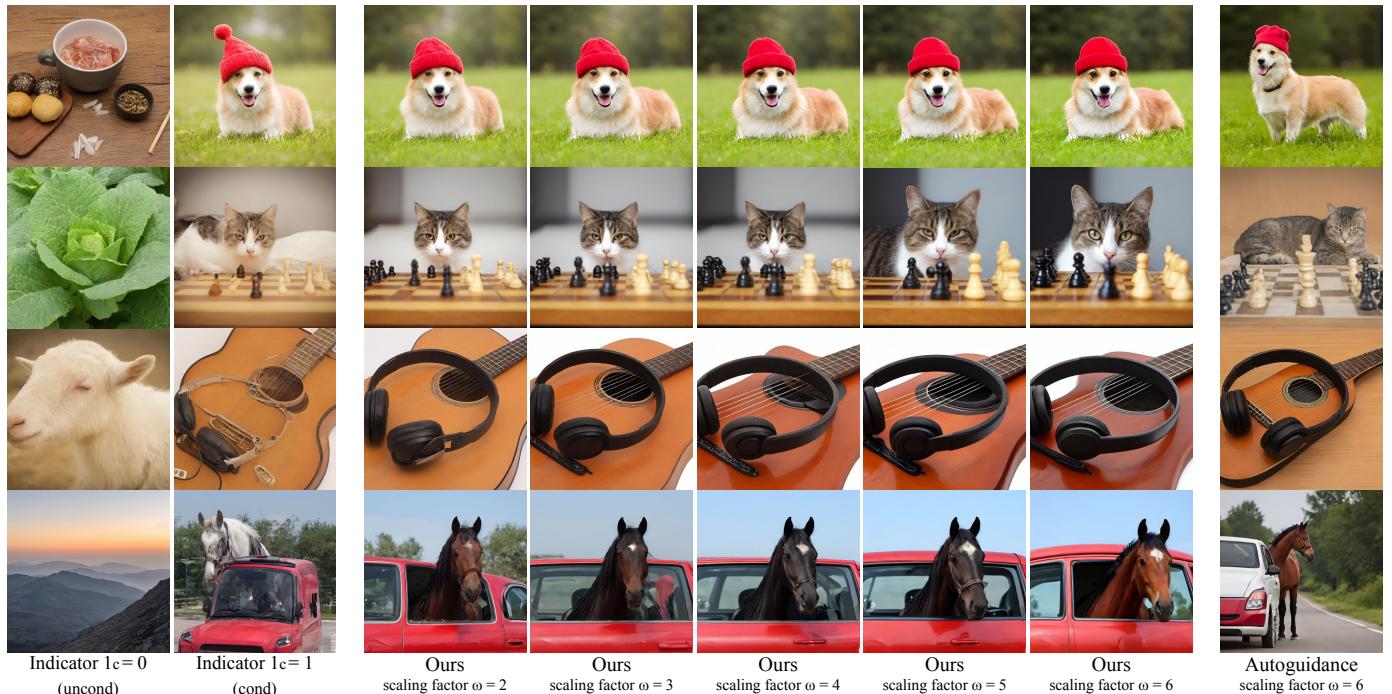
As shown above, using the indicator allows CrossFlow to perform unconditional generation (Column 1) despite starting from text, and applying the guidance scale (Columns 3-7) drastically improves image fidelity, just as it does in standard diffusion models.
Experiments and Results
The researchers put CrossFlow to the test against standard baselines, specifically comparing it to a standard Flow Matching model that uses cross-attention and starts from noise.
1. Scaling: Better Performance at Scale
One of the most promising findings is how CrossFlow behaves as you make the model larger.
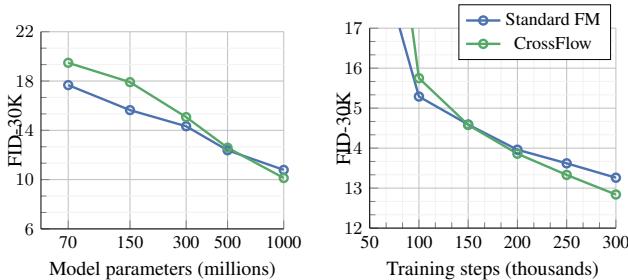
Looking at the left chart in Figure 3, we see the Fréchet Inception Distance (FID), a measure of image quality (lower is better).
- Small models: CrossFlow struggles slightly compared to the baseline. This makes sense; mapping text directly to pixels is a harder, more constrained task than mapping noise to pixels with hints.
- Large models: As the parameter count approaches 1 Billion, CrossFlow crosses over and begins to outperform the standard noise-based baseline.
The right chart shows training steps. CrossFlow takes longer to converge (the green line is higher initially), but eventually dips lower than the baseline. This suggests that while learning the direct mapping is harder initially, it creates a more efficient generative path in the long run.
2. Latent Arithmetic: The “Magic” of Semantic Space
Because CrossFlow maps text into a continuous, structured latent space before evolving it, it inherits some of the famous vector arithmetic properties of word embeddings (like the classic King - Man + Woman = Queen example from Word2Vec).
The authors demonstrate that you can perform arithmetic on the inputs and get corresponding changes in the generated images.
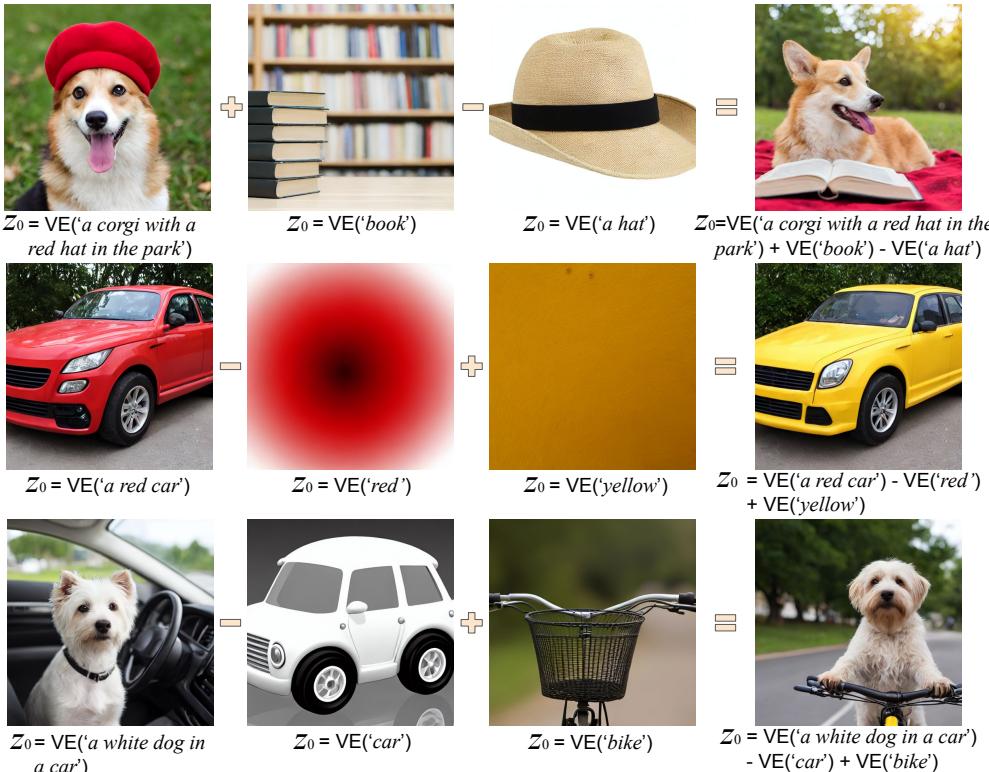
In Figure 13 (above), we see:
- Top Row: A Corgi reading a book. The prompt was derived by taking the vector for “A corgi with a red hat,” adding “book,” and subtracting “hat.”
- Middle Row: Color swapping by subtracting the vector for “red” and adding “yellow.”
- Bottom Row: Object manipulation. Subtracting “car” and adding “bike” puts the dog on a bicycle.
This capability is generally absent or very difficult to achieve in standard Diffusion models because the input conditioning (text) is decoupled from the starting point (noise). In CrossFlow, the starting point is the meaning.
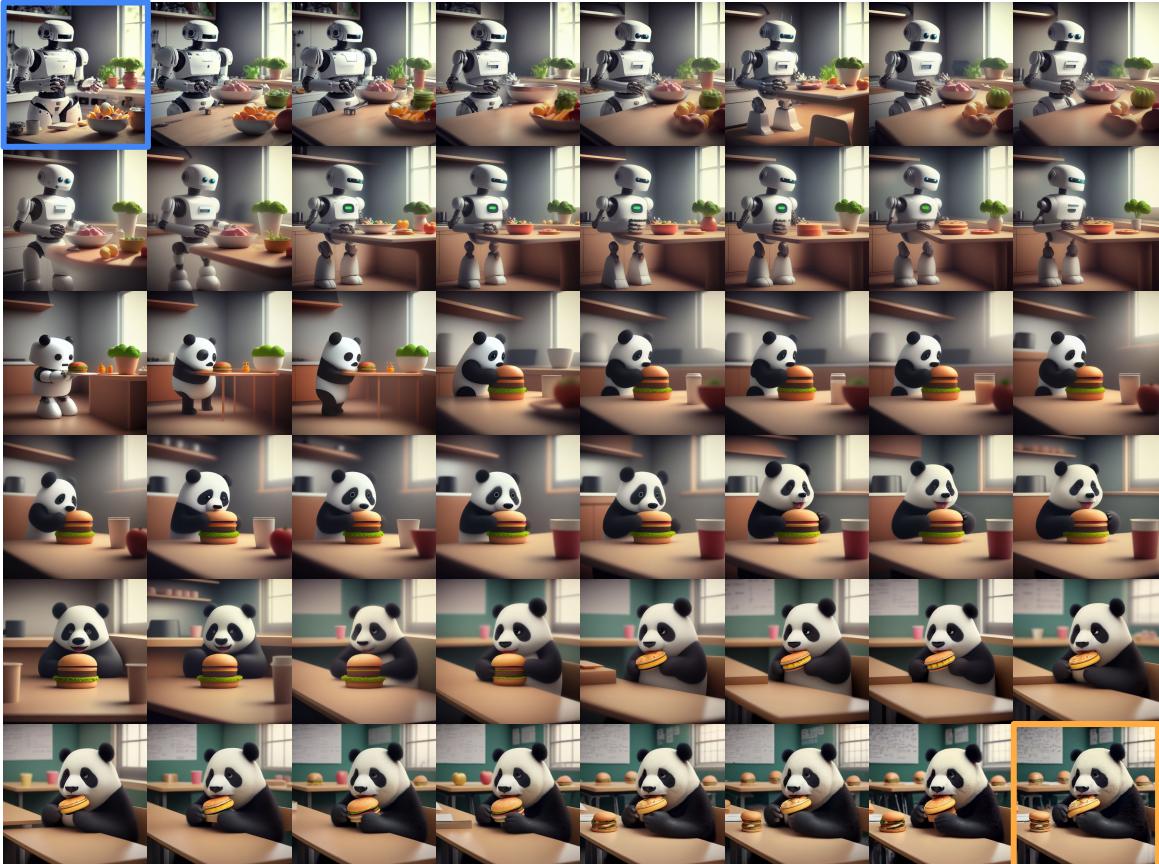
We can also see this smoothness in Latent Interpolation. By taking the latent vector of one prompt and linearly sliding it toward another, the model generates smooth transitions between concepts.
3. Beyond Text-to-Image: A General Framework
The paper asserts that CrossFlow isn’t just a T2I model; it’s a general framework for cross-modal evolution. To prove this, they applied the exact same architecture to several other difficult computer vision tasks.
Zero-Shot Depth Estimation
Here, the source modality is an RGB image, and the target is a Depth Map. CrossFlow achieves state-of-the-art results on zero-shot depth estimation benchmarks without any task-specific architectural changes.
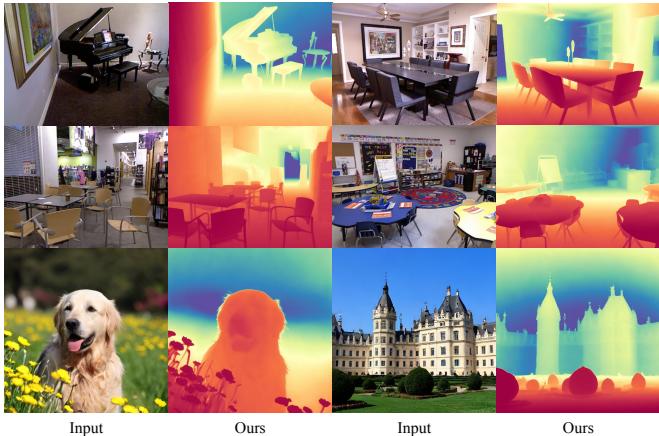
Image Super-Resolution
The model can also map from a low-resolution image distribution to a high-resolution one. Unlike standard upscalers that take a low-res image as a condition, CrossFlow treats the upsampled low-res image as the source latent and evolves it into the high-frequency details of the high-res image.

Conclusion
CrossFlow represents a compelling step forward in generative AI. By abandoning the convention that generative models must start from Gaussian noise, the researchers have simplified the architecture (removing cross-attention) and unified the generative process across different modalities.
The key takeaways from this work are:
- Direct Evolution: We can successfully train models to flow directly from one data distribution (text, low-res images) to another (images, depth maps).
- The Variational Encoder is Key: You cannot simply project text to pixels; you must encode it into a regularized probability distribution to allow the Flow Matching ODE to function correctly.
- Scalability: While harder to train initially, the approach scales better than standard baselines, suggesting it could be a strong candidate for the next generation of massive foundation models.
- Semantic Control: The ability to perform vector arithmetic on the input latents offers artists and developers a new, intuitive way to edit and control generated content.
As we look toward the future of media generation, CrossFlow suggests that the most efficient path between an idea and an image might not be a random walk through noise, but a direct, evolved path from the word to the pixel.