](https://deep-paper.org/en/paper/2412.16481/images/cover.png)
In the rapidly evolving world of 3D deep learning, we are often forced to choose between two virtues: the geometric precision of the model and the computational efficiency of the hardware.
Point clouds—the raw data format generated by LiDAR sensors in autonomous vehicles and robotics—are notoriously difficult to process. Unlike images, which are neat, dense grids of pixels, point clouds are sparse and irregular. To make sense of them, neural networks need to understand the spatial relationships between points (geometric locality). However, Graphics Processing Units (GPUs)—the workhorses of modern AI—prefer data that is dense, contiguous, and predictable (hardware locality).
For years, the standard approach has been to force the hardware to adapt to the geometry, often resulting in massive inefficiencies. In a new paper titled “Flash3D: Super-scaling Point Transformers through Joint Hardware-Geometry Locality,” researchers from the University of Texas at Austin and Cruise propose a different path. By co-designing the algorithm with the hardware architecture, they have created a model that is drastically faster and more scalable than the state-of-the-art.
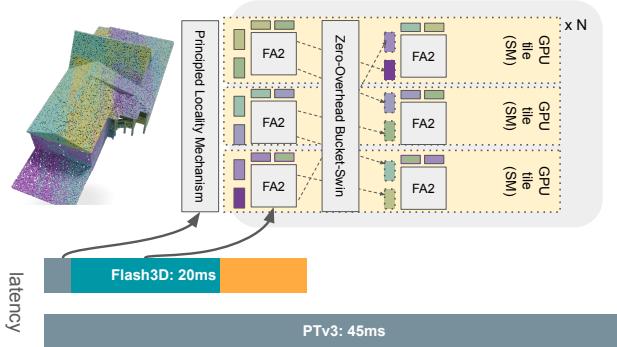
As shown in Figure 1, the results are stark. Flash3D achieves a 2.25x speed increase and a 2.4x memory efficiency boost over PTv3 (Point Transformer V3), enabling it to run larger models with wider attention scopes without breaking the compute budget.
In this post, we will tear down the architecture of Flash3D, explore the bottleneck it solves, and understand the “Perfect Spatial Hashing” mechanism that makes it all possible.
The Bottleneck: The Cost of Moving Data
To understand why Flash3D is necessary, we first need to look at how previous state-of-the-art models, specifically PTv3, handle 3D data.
Most modern point cloud backbones rely on Multi-Head Self-Attention (MHSA). To be efficient, they use windowed attention, grouping points into local neighborhoods so they only attend to nearby points rather than the entire cloud.
The challenge arises when the model needs to shift these windows to capture global context. In PTv3, the data flow looks something like this:
- Load Data: Points are loaded into the GPU’s fast cache (L1/Shared Memory).
- Compute: Attention is calculated within local blocks.
- Global Shuffle: To look at a different set of neighbors in the next layer, the points must be reordered (shuffled) globally in memory.
- Repeat: This cycle happens dozens of times.
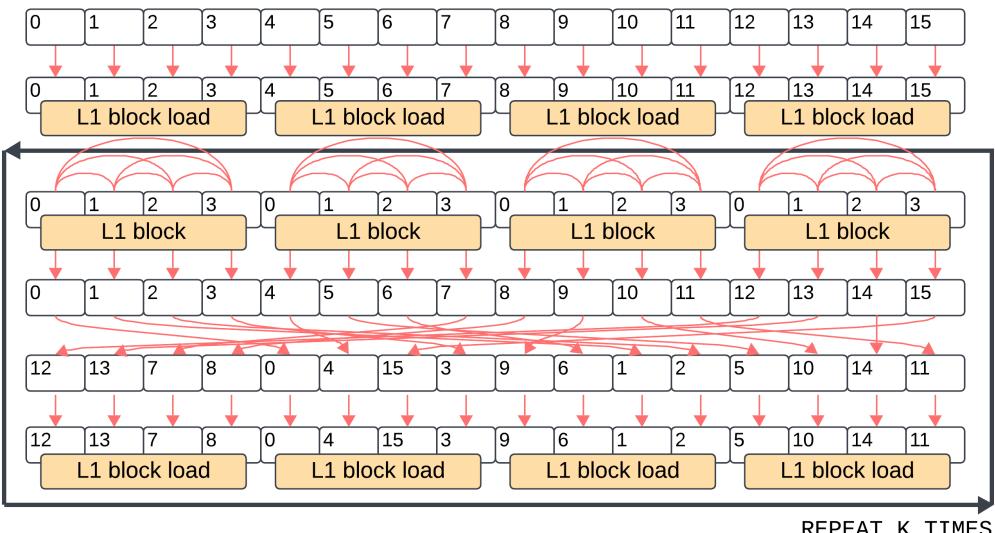
Figure 2 illustrates this workflow. The critical flaw here is the Global Shuffle. GPUs are designed to move data in large, contiguous blocks (transactions). When a model performs a global shuffle based on geometric proximity, it essentially asks the GPU to move millions of tiny, scattered pieces of data to random new locations.
The authors liken this to moving water. If the GPU is a truck, efficient data transfer is like moving full buckets of water. The global shuffle in PTv3 is analogous to moving water one drop at a time using a million tiny buckets. It saturates the memory bandwidth while leaving the powerful compute cores (TensorCores) idle, waiting for data that arrives too slowly.
The Flash3D Solution: Logical Shifting over Physical Shuffling
Flash3D eliminates the expensive global shuffle. Instead of physically moving points in memory to create new neighborhoods, Flash3D organizes points once into a structure that allows for “logical” shifting.
The core philosophy is simple: Align the geometric locality (where points are in 3D space) with the hardware locality (where data sits in GPU memory).
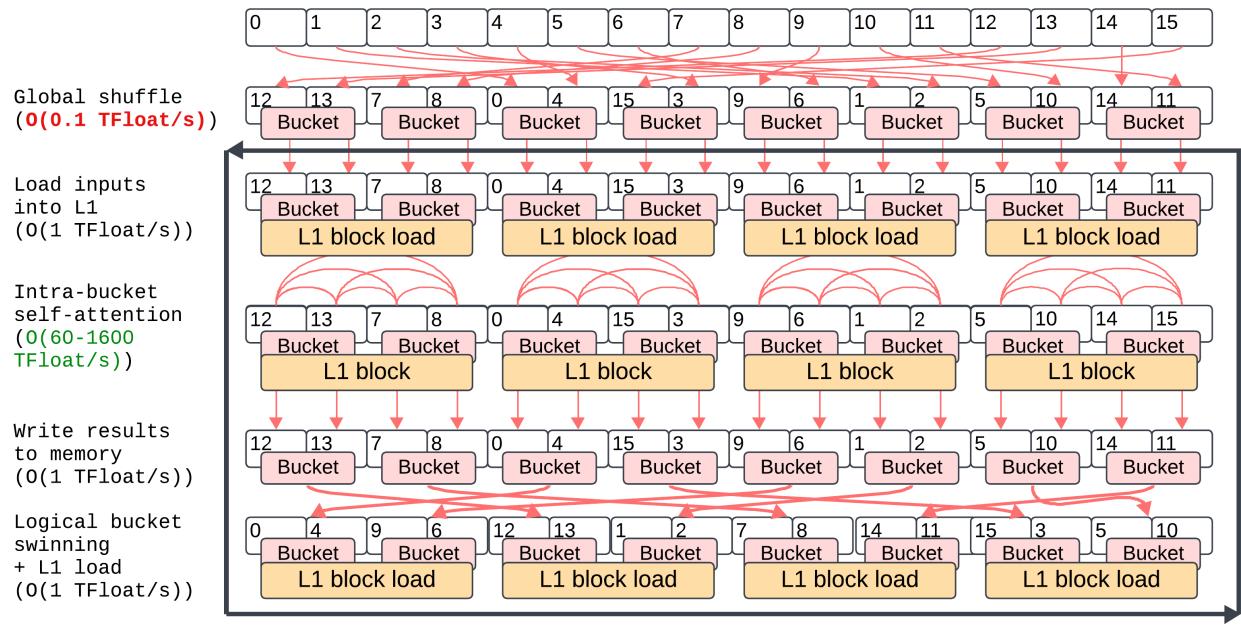
As depicted in Figure 3, Flash3D performs multiple rounds of attention using a Bucket-and-Swin approach. By organizing points into “buckets” that fit perfectly into GPU tiles, the model can change the neighborhood definition just by changing which buckets are loaded together, without physically rewriting the data in memory.
This is achieved through three main contributions:
- Perfect Spatial Hashing (PSH): A principled way to map 3D points to contiguous memory.
- Bucket-and-Swin Attention: A mechanism to shift attention windows with zero overhead.
- In-bucket Pooling: Performing reduction operations within the fast GPU cache.
1. Perfect Spatial Hashing (PSH)
The foundation of Flash3D is how it places data into memory. The researchers utilize Perfect Spatial Hashing (PSH). In computer science, a “perfect” hash function maps inputs to a set of integers with no collisions (or resolved collisions) such that the output table creates a compact, contiguous array.
The PSH algorithm takes the coordinates of the sparse 3D points and assigns them to buckets. The goal is two-fold:
- Geometric Locality: Points in the same bucket should be close to each other in 3D space.
- Hardware Locality: Each bucket should have a fixed capacity that aligns with GPU thread blocks (e.g., multiples of 32 or 128 threads).
This mapping creates a contiguous array in memory where adjacent data points are likely spatial neighbors.
The Hash Functions
The authors employ specific hash functions to determine which bucket a point belongs to. These functions are designed to be computed incredibly fast.
XOR-based Hashing: This spreads points relatively evenly, which is good for load balancing on the GPU.
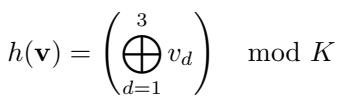
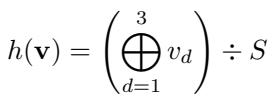
Z-order (Morton Code) Hashing: Z-order curves preserve spatial locality very well—points that are close in 3D space have Z-codes that are close numerically.


By combining these strategies (e.g., using XOR for balancing and Z-order for locality), Flash3D ensures that the buckets are both spatially meaningful and computationally balanced.
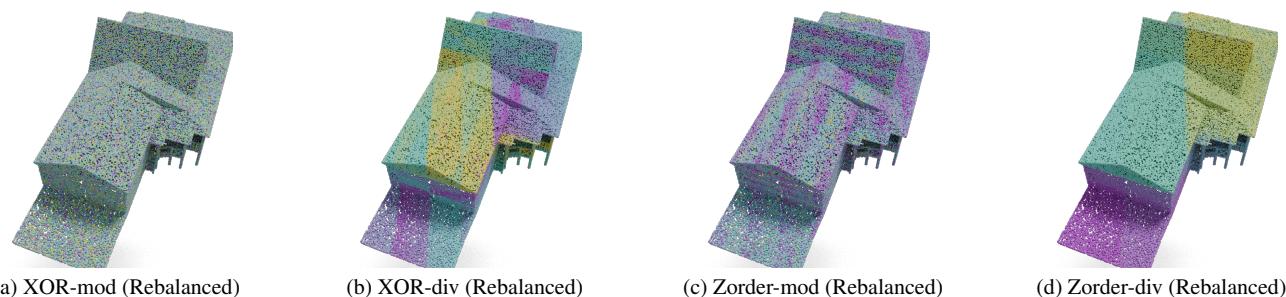
Figure 4 visualizes these hash functions. You can see how Z-order (c and d) creates structured, blocky neighborhoods, while XOR (a and b) creates more scattered, diffuse patterns. Flash3D actually benefits from this variety; using different hash functions in different layers (multi-hash scattering) allows the network to learn both local fine-grained details and broader, more diffuse global features.
2. Zero-Overhead Bucket-Swin Attention
Once the points are hashed into buckets and stored contiguously, we need to perform attention. In standard Swin Transformers (on images), “shifting the window” to see cross-window connections usually involves intricate indexing or padding.
In Flash3D, because the data is already chunked into buckets, shifting the window is purely logical.
Consider a list of buckets:

In one layer, the model might group buckets {1, 2, 3, 4} together for attention. In the next layer, to allow information to propagate, it creates a new scope: {3, 4, 5, 6}.
Because the data for bucket 4 is sitting right next to bucket 5 in memory, the GPU simply loads that specific chunk of memory into its cache. There is no need to copy point #4 to a new location so it can be near point #5. They are already accessible.
The computation for the features (\(\mathcal{F}\)) in a specific attention scope (\(\mathcal{A}_i\)) is defined as:

Here, the MHSA (Multi-Head Self-Attention) is fused with the Bucket-and-Swin logic using FlashAttention-2. This integration means the “shift” operation has literally zero cost in terms of memory movement latency.
Experiments and Hardware Analysis
The theoretical design of Flash3D is sound, but its real impact is revealed in the hardware profiling. The researchers compared Flash3D against PTv3 on NVIDIA A100 and H100 GPUs using the nuScenes dataset (a standard for autonomous driving).
Latency Analysis
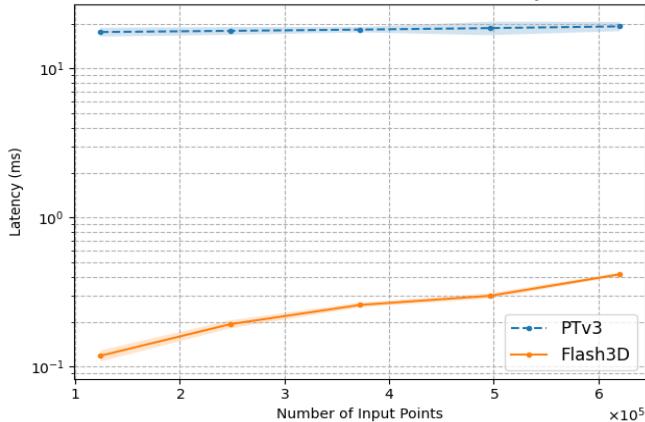
The most dramatic result is the latency scaling.
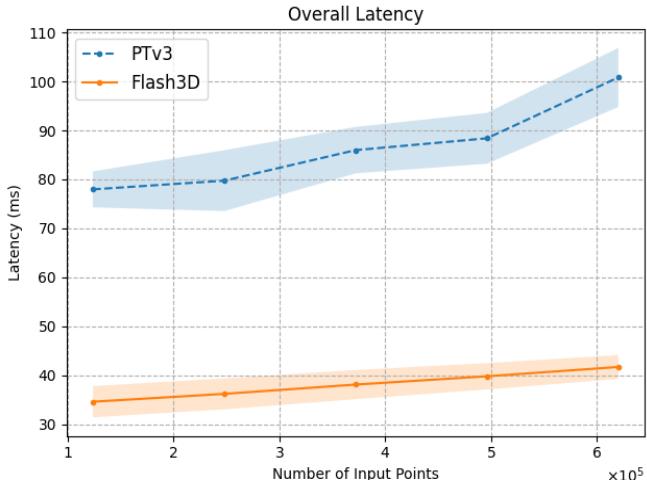
In Figure 5, look at the blue line (PTv3). It starts high and stays high. This is the “fixed cost” of that expensive global shuffle. Even with fewer points, the overhead of reorganizing memory dominates.
The orange line (Flash3D) scales linearly. It starts near zero. Because Flash3D avoids the global shuffle, its latency is determined purely by how much compute is required for the attention mechanism.
We can break this down further:
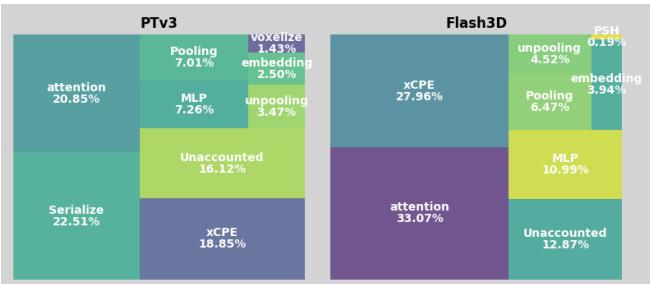
Figure 6 shows the treemap of where time is spent. For PTv3 (left), a massive chunk of time is spent on “Serialize” (the global shuffle). For Flash3D (right), the PSH step is tiny (0.19%), and the majority of time is spent on “Attention” and “MLP”—the actual useful math that learns features.
The difference in overhead is even more obvious in Figure 7 (log scale). The PSH mechanism is two orders of magnitude faster than the serialization method used by PTv3.
Hardware Utilization
For students of high-performance computing, the following graphs are perhaps the most important. A GPU is an expensive resource; if you aren’t keeping the cores active, you are wasting money.
Streaming Multiprocessors (SM) Activity:
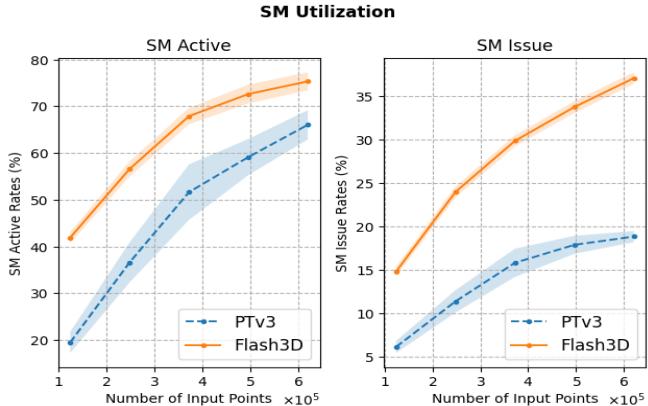 Flash3D (orange) keeps the SMs significantly more active than PTv3. This means the instruction scheduler is not stalling while waiting for data.
TensorCore Utilization:
TensorCores are the specialized hardware units for matrix multiplication (the heart of Deep Learning).
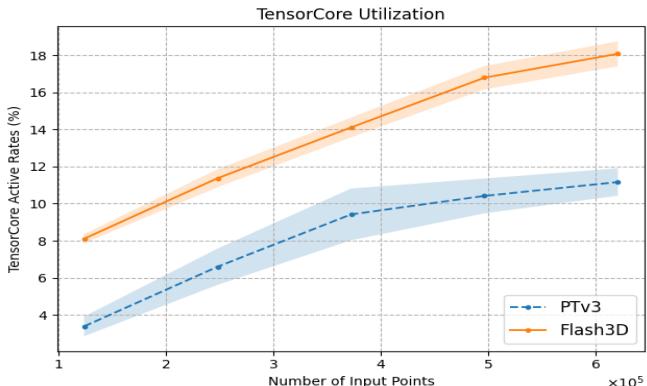 Figure 9 reveals a startling inefficiency in previous methods. PTv3 utilizes less than 5% of the TensorCore capacity in many cases (dashed blue line). It is “memory bound”—the cores are starving for data. Flash3D triples this utilization in some cases because the PSH mechanism feeds data to the cores efficiently.
Memory Bandwidth:
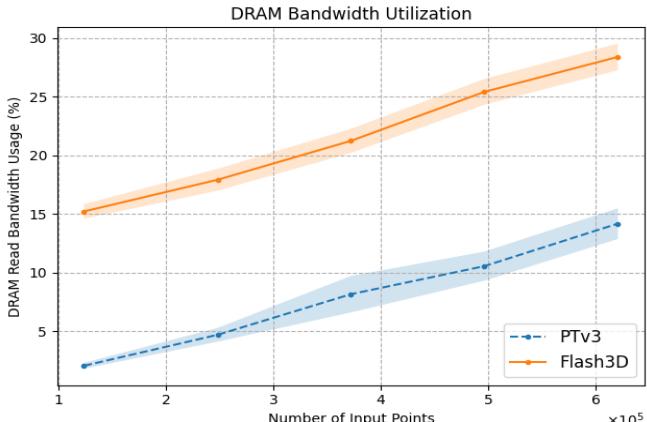 Finally, Figure 10 shows that Flash3D maximizes the DRAM bandwidth. This might seem counter-intuitive—isn’t high bandwidth usage bad? In this context, no. It means the system is successfully streaming data fast enough to keep the compute units busy, rather than stalling on high-latency random access patterns.
Downstream Performance
Does this speed come at the cost of accuracy? The results suggest otherwise.
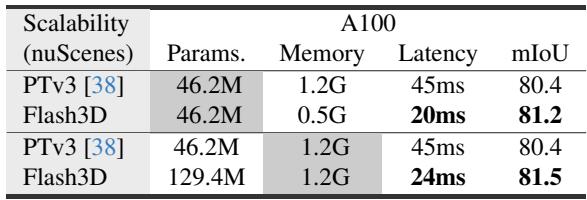
As shown in the table above, Flash3D outperforms PTv3 on the nuScenes semantic segmentation task.
- Same Parameters: Flash3D is 0.8% better in mIoU and runs 2.25x faster.
- Same Memory Budget: Because Flash3D is so memory efficient, you can fit a much larger model (129.4M parameters vs 46.2M) into the same GPU memory. This larger model boosts accuracy further (81.5 mIoU) while still running nearly 2x faster than the smaller PTv3.
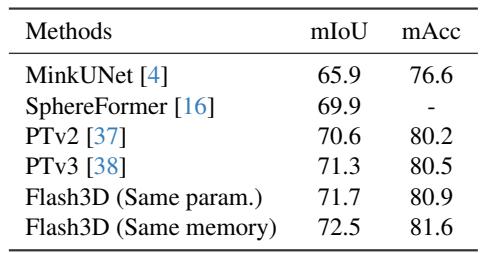
This pattern holds true across other datasets like Waymo as well.
Conclusion
Flash3D represents a maturity milestone in 3D deep learning. In the early days of a field, researchers focus purely on mathematical formulations (like the definition of convolution or attention). As the field matures, attention shifts to system-algorithm co-design.
By accepting the physical reality of how GPUs work—specifically their preference for tiling and contiguous memory—the authors of Flash3D designed a geometric operation (Perfect Spatial Hashing) that satisfies both the mathematical needs of the network and the physical needs of the chip.
The takeaways for students and practitioners are clear:
- Avoid data movement: The most expensive operation on a GPU is moving data, not doing math.
- Align with hardware: Algorithms that respect hardware tiling and caching hierarchies will always outscale those that treat memory as a flat, random-access pool.
- Scalability allows accuracy: Efficiency isn’t just about saving time; it’s about freeing up the budget to run larger, smarter models.
Flash3D successfully bridges the gap between geometric locality and hardware locality, setting a new standard for how we should build high-performance 3D backbones.