](https://deep-paper.org/en/paper/2412.19238/images/cover.png)
In the age of TikTok, YouTube Shorts, and Twitch, User-Generated Content (UGC) has become the dominant form of media consumption. Unlike professionally produced films shot on cinema cameras, UGC is wild and unpredictable. It is shot on smartphones, compressed by apps, streamed over spotty 5G connections, and viewed on varying screen sizes.
For video platforms, understanding the quality of this content is a billion-dollar problem. If a recommendation algorithm pushes low-quality videos, users leave. However, traditional Video Quality Assessment (VQA) has a major blind spot: it usually reduces a video’s quality to a single scalar score—a “3.5 out of 5.”
Does a low score mean the video is pixelated? Is the camera shaking? Or is the lighting just bad? A single number cannot answer these questions.
This post deep dives into FineVQ, a new research paper that proposes a fine-grained approach to VQA. The researchers introduce a massive new dataset (FineVD) and a Multimodal Large Language Model (MLLM) architecture (FineVQ) capable of diagnosing video quality across multiple dimensions: color, noise, artifacts, blur, and temporal stability.
1. The Problem with Generic Scoring
To understand why FineVQ is necessary, we must look at the limitations of current VQA systems. Traditional deep learning models (like VSFA or VIDEVAL) take a video file and output a Mean Opinion Score (MOS). While useful for general filtering, this “black box” score fails to guide specific optimization tasks.
For example, if a video is identified as “low quality” due to camera shake, a stabilization algorithm should be applied. If it is low quality due to low light, a brightness correction is needed. A generic score provides no such actionable intelligence.
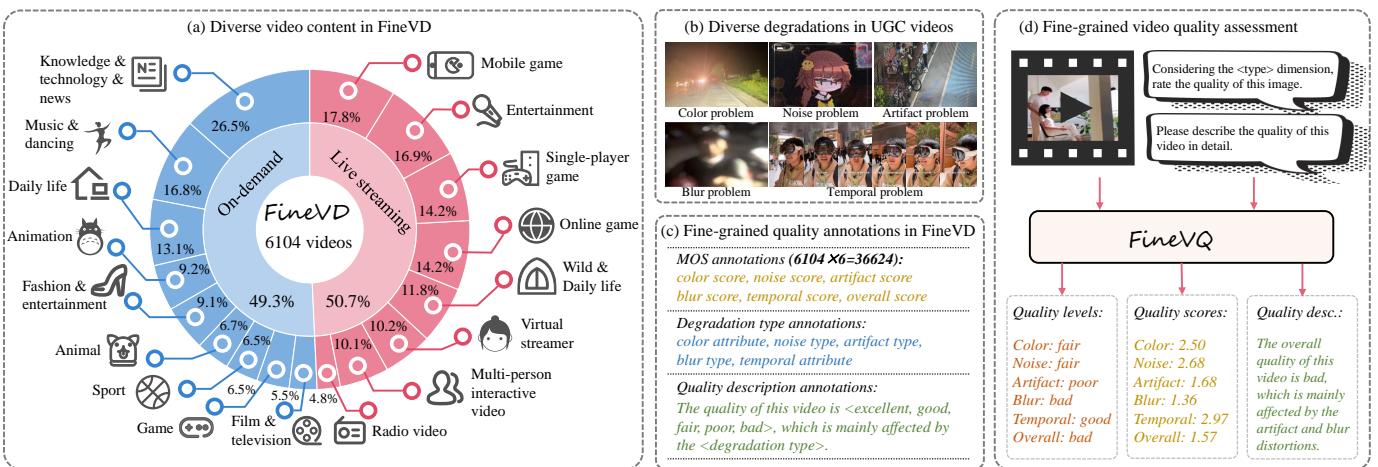
As shown in Figure 1 above, real-world videos suffer from specific, distinct degradations:
- Color problems: Blurry or washed-out colors.
- Noise: Graininess from low-light sensors.
- Artifacts: Blockiness from heavy compression.
- Blur: Focus issues or motion blur.
- Temporal issues: Jittering or dropped frames.
The researchers argue that to truly understand UGC, we need a “doctor” that provides a full diagnosis, not just a general health score.
2. Building the Foundation: The FineVD Database
Artificial Intelligence is only as good as the data it learns from. Existing datasets often focus on either synthetic distortions (artificial noise added in a lab) or limited real-world scenarios. To build a model that understands fine-grained quality, the researchers first had to build FineVD.
The Scope of Data
FineVD is the first large-scale database of its kind, comprising 6,104 UGC videos. What makes this dataset unique is its diversity. It doesn’t just scrape random YouTube clips; it carefully balances two primary modes of modern consumption:
- On-demand videos: Prerecorded content (vlogs, tutorials, gaming).
- Live-streaming videos: Real-time content (game streaming, virtual avatars, mobile broadcasts).
The Human Element
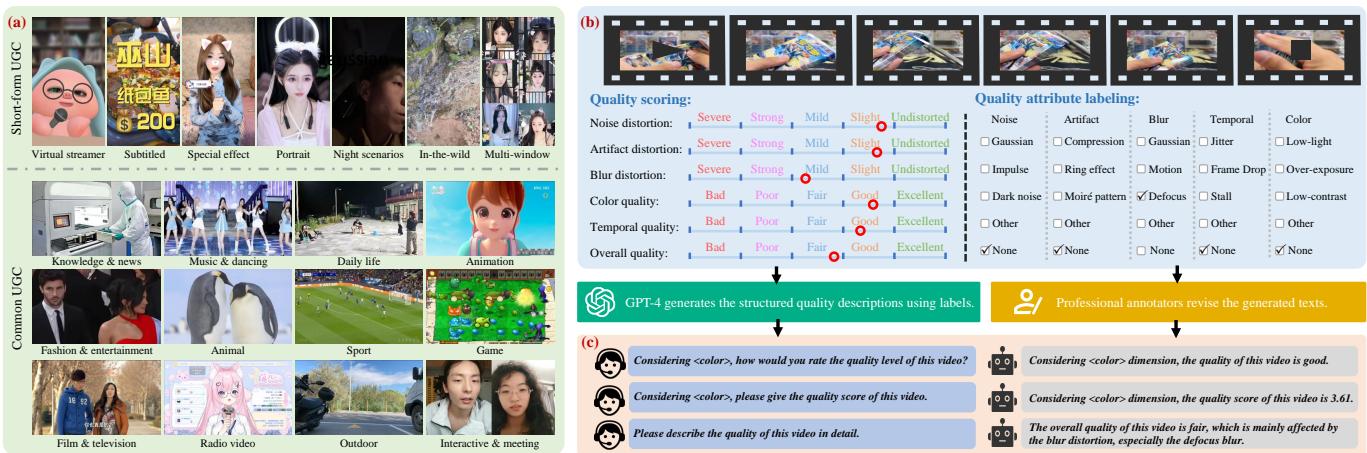
As illustrated in Figure 2(b), the annotation process was rigorous. Instead of relying on crowdsourcing (which can be noisy and unreliable), the team used a professional environment with 22 annotators. These annotators didn’t just give a thumbs up or down. They rated every video across six specific dimensions:
- Color
- Noise
- Artifact
- Blur
- Temporal (Stability/Jitter)
- Overall Quality
Furthermore, they generated textual descriptions (QA pairs) describing the quality, which is crucial for training the language component of the model.
Statistical Diversity
The result is a dataset where the quality dimensions are not always correlated. A video might have excellent resolution (Low Blur) but terrible stability (Poor Temporal).
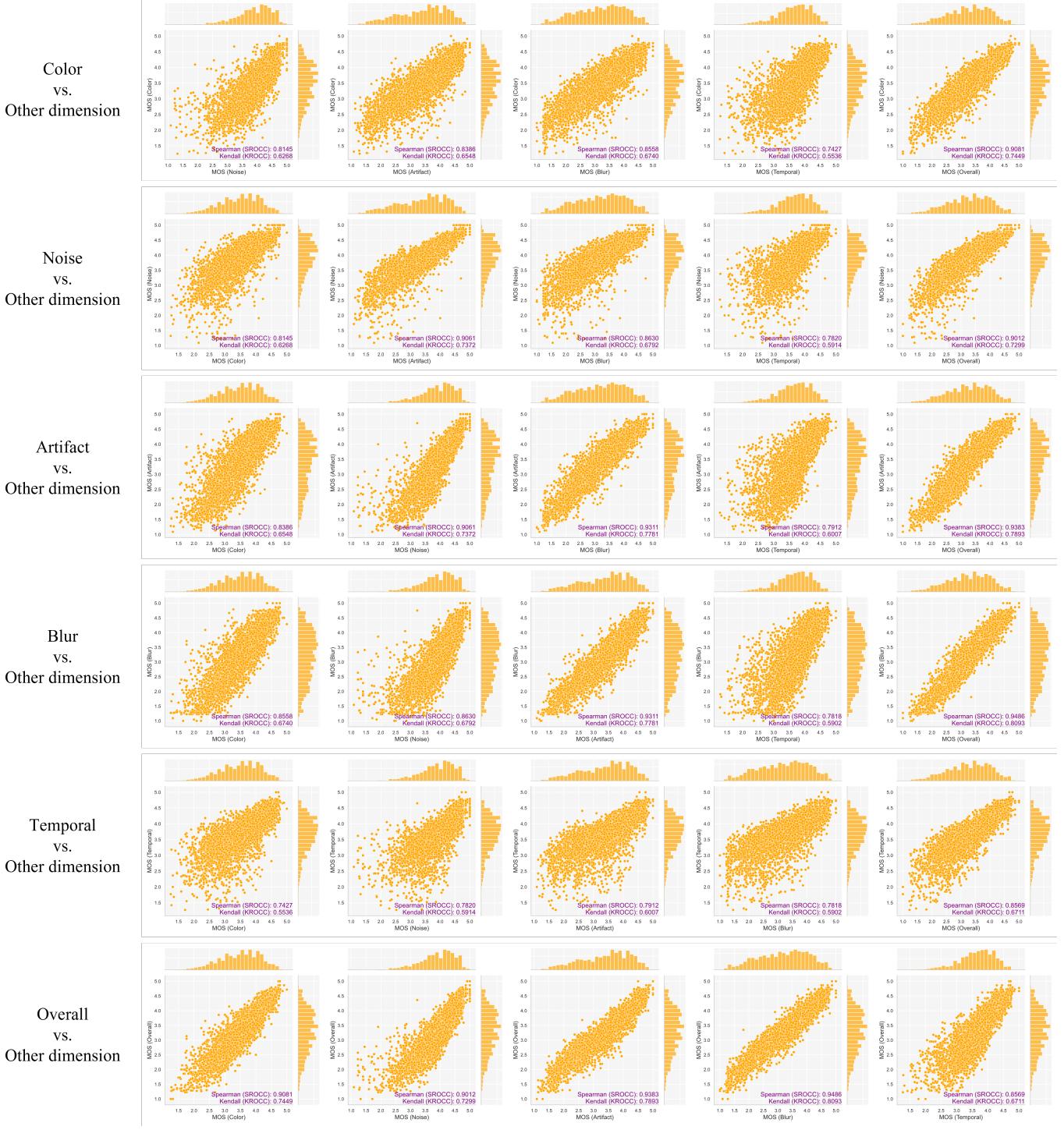
Figure 10 (above) visualizes these correlations. Notice how the “Temporal” dimension often forms a distinct cluster compared to others like “Color” or “Blur.” This statistical independence validates the need for a model that can look at these features separately. If they were all perfectly correlated, a single score would have sufficed.
3. The FineVQ Method: A Multi-Modal Approach
With the data in place, the researchers developed FineVQ. This is not a standard Convolutional Neural Network (CNN). It is a Multi-Modal Large Language Model (MLLM). The goal is to create a “one-for-all” model that can:
- Rate quality (Good/Bad).
- Score quality (0-100).
- Describe quality (Textual explanation).
The Architecture
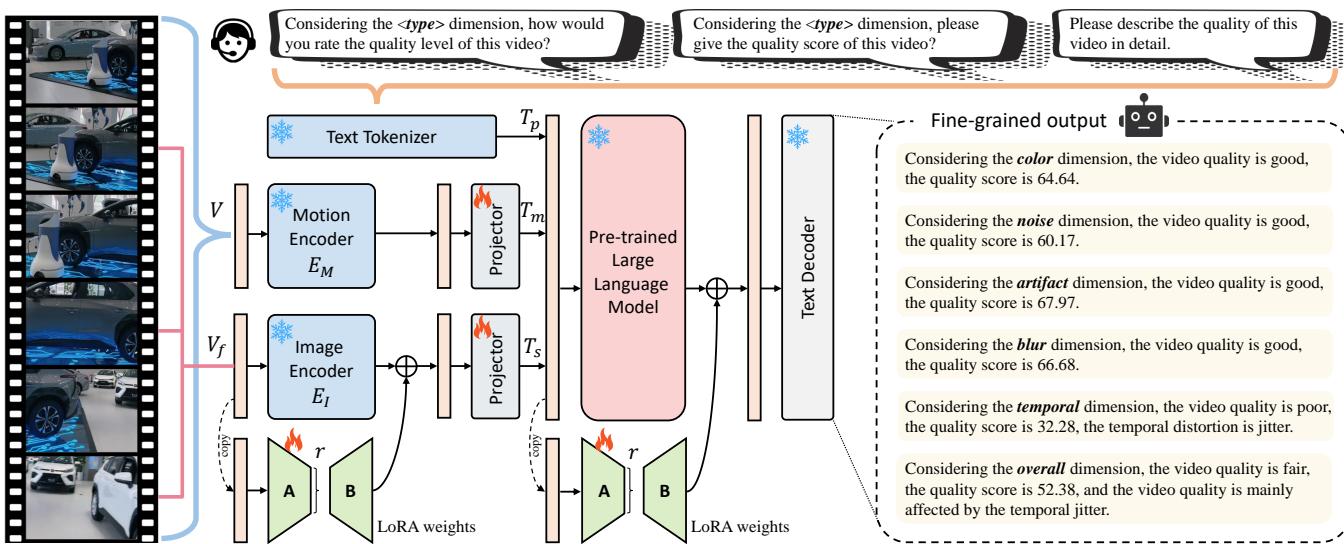
The architecture, detailed in Figure 5, is a masterclass in modern vision-language system design. It integrates three distinct pathways to process information.
1. The Spatial Eye (Image Encoder)
Video is, at its core, a sequence of images. To analyze static quality (like resolution, color, and noise), the model samples 8 frames from the video (\(V_f\)). It uses InternViT, a powerful Vision Transformer, as the backbone (\(E_I\)).
However, the raw output of a vision transformer is not directly understandable by a text-based Language Model. The researchers use a projector (\(P_I\))—essentially a translator neural network—to map visual features into the language space. This is mathematically represented as:

Here, \(T_s\) represents the “spatial tokens” that the LLM will eventually read.
2. The Temporal Eye (Motion Encoder)
Spatial analysis misses the movement. A single frame of a jittery video looks fine, but the video itself is unwatchable. To capture this, FineVQ uses a Motion Encoder (\(E_M\)) based on the SlowFast network. It processes the entire video to understand movement patterns.
Similar to the image path, these motion features are projected into language tokens (\(T_m\)):

3. The Brain (Large Language Model)
The core reasoning engine is InternLM-8B, a pre-trained Large Language Model. The model receives a sequence of inputs concatenated together:
[Spatial Tokens] + [Motion Tokens] + [Text Prompt Tokens]
The “Text Prompt” is the user’s question, such as “Rate the color quality of this video” or “Describe the artifacts present.” Because the visual data has been projected into the same token space as the text, the LLM can “see” the video and “read” the prompt simultaneously to generate an answer.
Fine-Tuning with LoRA (Low-Rank Adaptation)
Training an 8-billion parameter model from scratch is prohibitively expensive. Furthermore, we want to retain the model’s general reasoning ability while teaching it specific video quality concepts.
The researchers employ LoRA (Low-Rank Adaptation). Instead of updating all the weights (\(\mathbf{W}\)) in the massive neural network, LoRA injects small, trainable rank decomposition matrices (\(\mathbf{A}\) and \(\mathbf{B}\)) into the layers.

This technique allows the model to adapt to the nuances of VQA (learning what “blockiness” looks like) with a fraction of the computational cost, applied to both the visual encoders and the LLM itself.
4. Experiments and Performance
Does this complex architecture actually work better than existing methods? The researchers benchmarked FineVQ against state-of-the-art models, including specialized VQA models (like FAST-VQA) and general Multi-Modal models (like Video-LLaVA).
Quality Scoring Accuracy
The primary metric for success is how well the model’s predicted scores correlate with human ratings. The Spearman Rank Correlation Coefficient (SRCC) is used here—closer to 1.0 is better.
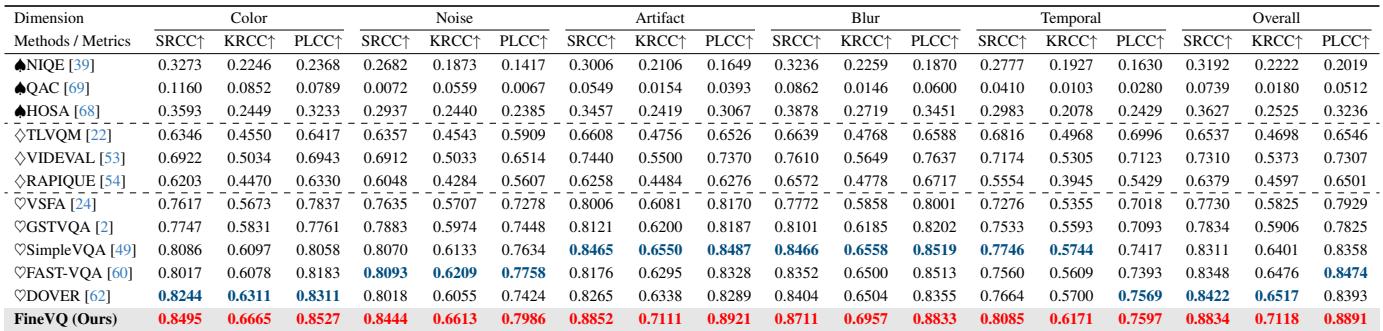
Table 1 shows the results on the FineVD dataset.
- Dominance: FineVQ (bottom row) achieves the highest scores across all dimensions (Color, Noise, Artifact, Blur, Temporal, and Overall).
- The Temporal Gap: Notice that traditional Image Quality Assessment (IQA) methods like NIQE perform terribly on the “Temporal” dimension (SRCC 0.27). They look at frames individually and miss the motion entirely. FineVQ, thanks to its Motion Encoder, scores an 0.80.
- One Model, All Tasks: Unlike DNN-based methods that often require training separate weights for different dimensions, FineVQ handles all these tasks with a single set of weights, directed only by the text prompt.
Understanding Defects
Beyond simple scoring, the model was tested on its ability to identify what is wrong. The researchers asked the model “Yes/No” questions (e.g., “Is there noise in this video?”) and “Which” questions (e.g., “Which distortion is most severe?”).

Table 10 highlights a crucial finding: General-purpose Large Multimodal Models (like InternVL2) are decent at general vision but struggle with technical quality assessment. They haven’t been taught the specific visual signatures of compression artifacts or jitter. FineVQ, fined-tuned on the FineVD dataset, shows massive improvements—jumping from 28% to 91% accuracy in detecting the existence of distortions.
Visualizing the Capabilities
The power of FineVQ is best understood visually. Figure 9 below demonstrates why the “Overall” score is insufficient and how FineVQ dissects a video.
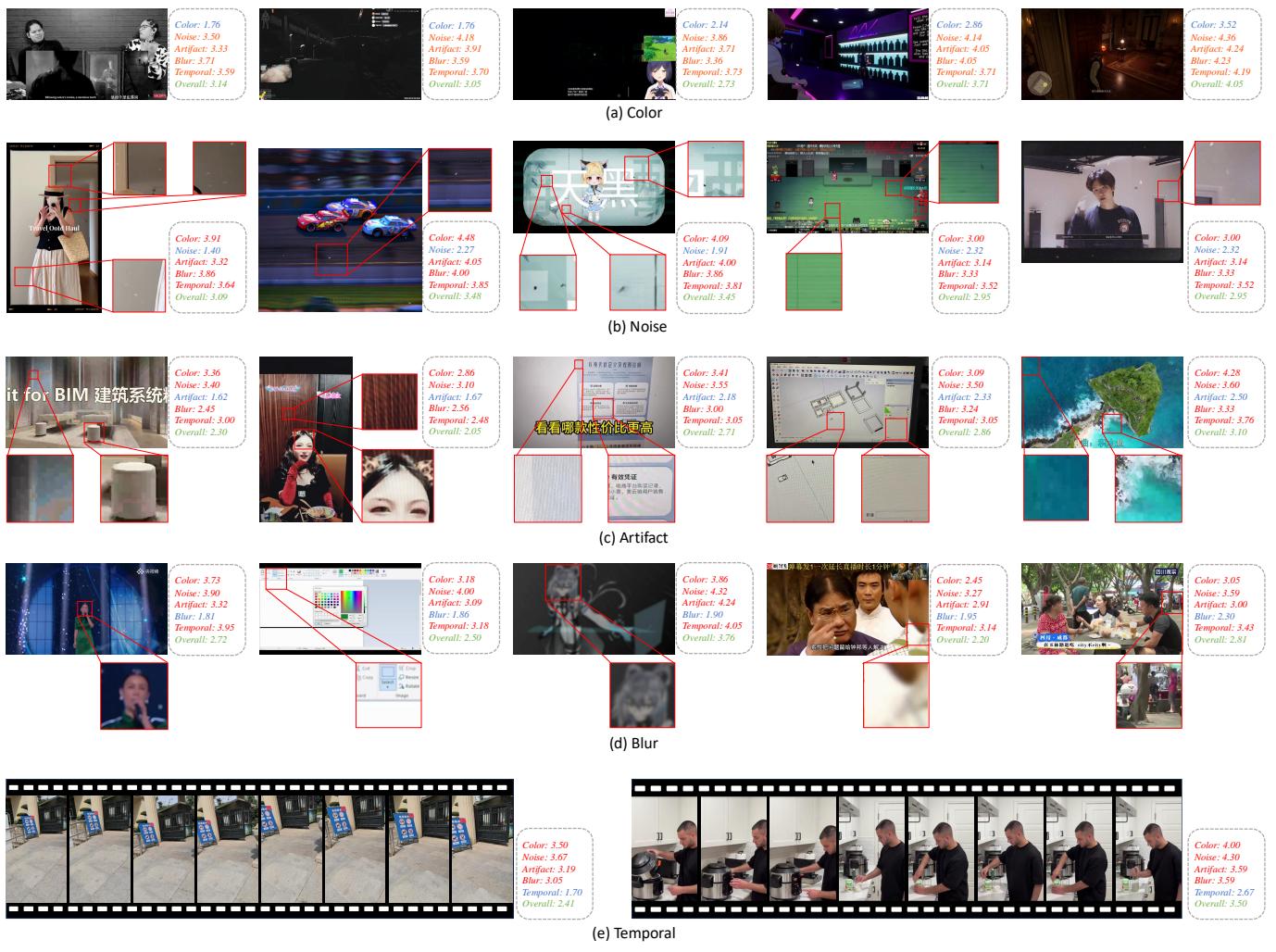
Look at the third column (“Artifact”). The videos might have decent color or temporal stability, but the compression artifacts (blockiness) drag the quality down. FineVQ can isolate this specific metric, providing feedback that an engineer could use to adjust the bitrate or encoding settings.
5. Conclusion and Implications
The FineVQ paper represents a significant step forward in how machines understand video quality. By moving away from a single “Mean Opinion Score” toward a multi-dimensional analysis, and by leveraging the semantic reasoning of Large Language Models, the researchers have created a tool that aligns much closer with human perception.
Key Takeaways:
- Data Matters: The FineVD database proves that to solve fine-grained problems, we need fine-grained, human-annotated data.
- Semantic VQA: Video quality is not just signal processing; it is a semantic understanding task. Treating VQA as a language-vision problem allows for more flexible and descriptive assessments.
- Actionable Insights: By separating quality into Color, Blur, Noise, etc., platforms can automate specific fixes (e.g., “Apply de-noise filter to Video A” vs. “Apply stabilization to Video B”).
As user-generated content continues to grow, technologies like FineVQ will be the invisible gatekeepers ensuring that the content we see is crisp, stable, and vibrant.