](https://deep-paper.org/en/paper/2412.20651/images/cover.png)
Introduction
In the last few years, the field of computer vision has been completely upended by Generative AI. Models like Stable Diffusion and DALL-E have demonstrated an uncanny ability to generate photorealistic images from simple text prompts. They “know” what a dog looks like, how a sunset reflects on water, and what an astronaut riding a horse resembles. This is achieved by training on massive datasets containing billions of image-text pairs (like LAION-5B).
However, there is a sector that has largely missed out on this revolution: Medical Imaging.
Why? The problem is twofold. First, medical data is scarce, expensive to annotate, and protected by strict privacy laws. You cannot simply scrape the internet for billions of labeled MRI scans. Second, there is a massive “distribution shift.” A model trained on internet photos of cats and cars does not inherently understand the rigid, structural constraints of human anatomy. When you ask a standard diffusion model to modify a brain MRI, it might treat the skull like a soft object, warping it in ways that are biologically impossible.
In a fascinating research paper titled “Latent Drifting in Diffusion Models for Counterfactual Medical Image Synthesis,” researchers from the Technical University of Munich and Stanford University propose a solution. They introduce Latent Drifting (LD), a technique that allows general-purpose diffusion models to be fine-tuned on small medical datasets with incredible accuracy.
This post will break down how LD works, the math behind the “drift,” and how it enables us to generate “counterfactual” medical images—answering questions like, “What would this patient’s brain look like if they developed Alzheimer’s?”
Background: The Challenge of Adaptation
To understand Latent Drifting, we first need to quickly review how diffusion models work and why standard fine-tuning fails in the medical domain.
Diffusion 101
Diffusion models work on a principle of noise. In the forward process, the model gradually adds Gaussian noise to an image until it becomes pure static. This process is mathematically defined as a Markov chain.
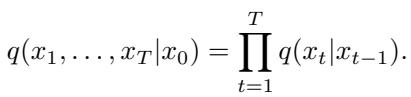
Here, \(x_0\) is the clean image, and \(x_T\) is the final noisy state. The model’s job during training is to learn the reverse process: taking that noise and iteratively removing it to recover the image.
The training objective is essentially a denoising task. The model (\(\hat{x}_\theta\)) tries to predict the noise \(\epsilon\) that was added to the image \(x\) at a specific time step \(t\).

The Distribution Shift Problem
When we take a model pre-trained on natural images (the “source” distribution) and try to fine-tune it on medical images (the “target” distribution), we hit a wall.
Medical images have strict templates. A brain MRI always has a skull, ventricles, and grey matter in specific configurations. Natural images vary wildly. When standard fine-tuning methods (like Dreambooth or Textual Inversion) are applied to medical data, they often struggle. They might capture the texture of an MRI (the grayscale noise) but fail to capture the geometry (the shape of the brain), leading to hallucinations or anatomically incorrect outputs.
The researchers realized that instead of forcing the model to relearn everything, they could introduce a “drift” in the latent space to bridge the gap between the natural image distribution and the medical image distribution.
The Core Method: Latent Drifting (LD)
The core innovation of this paper is treating the adaptation process as a min-max optimization problem involving a drifting parameter.
What is Latent Drift?
In a standard diffusion model, the reverse process (generating an image from noise) is modeled as a transition from a noisy state \(x_t\) to a less noisy state \(x_{t-1}\). This transition is usually a normal distribution centered around a learned mean \(\mu_\theta\).

The researchers propose adding a learned scalar value, \(\delta\) (delta), to this mean. This \(\delta\) represents the “Latent Drift.” It acts as a bias that shifts the generated samples toward the target distribution (medical images) without breaking the pre-trained knowledge of the model.
The modified reverse process looks like this:

By injecting this \(\delta\) into the reverse process, the model can “steer” the generation process.
Visualizing the Drift
To give you an intuition of what this mathematical “drift” actually does to an image, the authors provided a visualization using standard prompts (Elon Musk and Barack Obama).
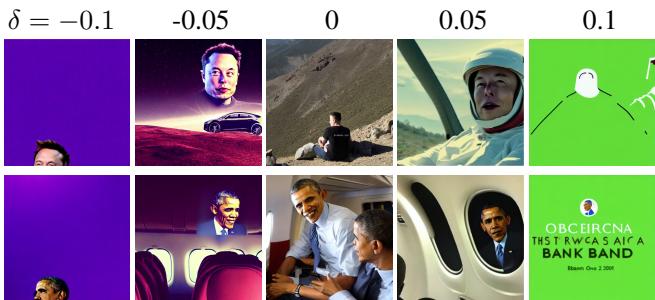
In Figure 2 above, look at how the images change as \(\delta\) moves from -0.1 to 0.1.
- At \(\delta = 0\), we have the standard output.
- As \(\delta\) becomes negative or positive, the subject remains recognizable, but the context and style drift significantly.
- In the medical context, this “drift” is optimized not to change the style of a photo, but to shift the distribution from “natural image statistics” to “medical image statistics.”
Bridging the Distribution Gap
One of the most compelling visualizations in the paper demonstrates exactly why this drift is necessary for medical fine-tuning.
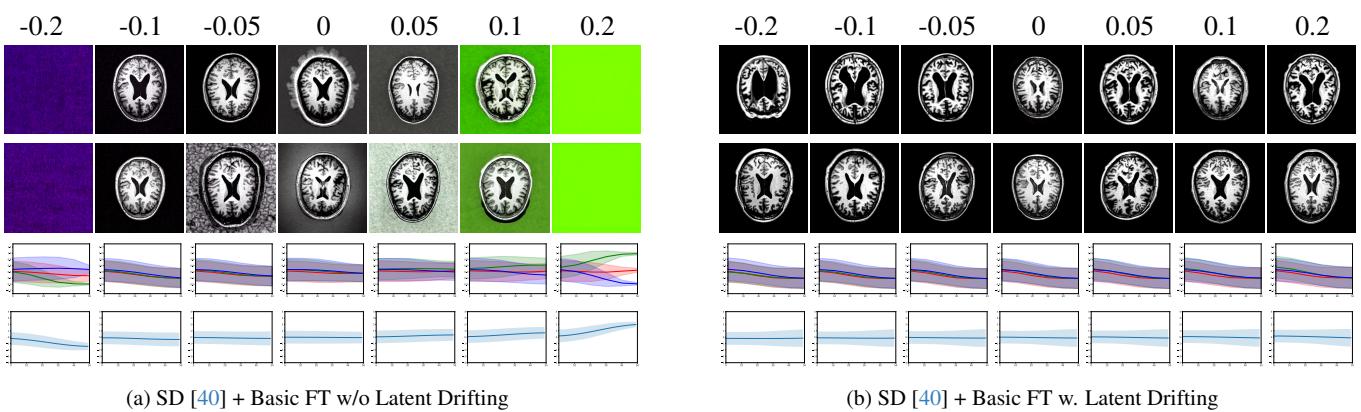
In Figure 3, we see a comparison between standard fine-tuning (Left) and fine-tuning with Latent Drifting (Right).
- Row 3 (Channel-wise distribution): Notice how on the left, the distribution of pixel values fluctuates wildly and has high variance. On the right, with LD, the distribution is tighter and more controlled.
- Row 4 (Latent space): The latent space distribution on the right is much closer to a standard Gaussian, which is the ideal state for diffusion models.
The drift parameter \(\delta\) essentially acts as a hyperparameter that trades off between diversity (what the pre-trained model wants to do) and conditioning (what the medical data requires).
Counterfactual Optimization
The researchers frame this formally as a counterfactual generation problem. They want to generate an image \(x'\) that is similar to an original image \(x\), but with a different label \(y'\) (e.g., changing a diagnosis from “Healthy” to “Alzheimer’s”).
This is formulated as a loss function with two competing terms:
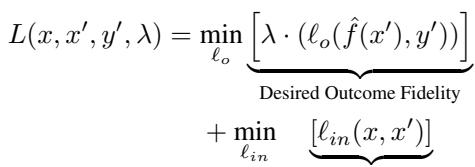
- Desired Outcome Fidelity: This term ensures the generated image actually looks like the target class \(y'\) (e.g., it actually looks like an Alzheimer’s brain).
- Counterfactual Fidelity: This term ensures the generated image \(x'\) stays as close as possible to the original image \(x\). We don’t want to generate a new patient; we want the same patient with a different disease status.
The parameter \(\lambda\) controls the balance. If \(\lambda > 0\), the model searches for the optimal \(\delta\) (drift) that minimizes the distance between the generated distribution and the target medical distribution.
Experiments and Results
The researchers tested Latent Drifting on two primary tasks: Text-to-Image Generation (creating synthetic data) and Image-to-Image Manipulation (editing existing scans). They used datasets containing Brain MRIs (Alzheimer’s vs. Healthy) and Chest X-rays (Pneumonia, Pleural Effusion, etc.).
1. Text-to-Image Generation
The goal here is simple: Can we generate realistic medical images from a text prompt like “A brain MRI of a 70-year-old female with Alzheimer’s”?
They compared Latent Drifting (LD) against popular fine-tuning methods: Textual Inversion, DreamBooth, and Custom Diffusion.

Figure 5 shows the stark contrast in quality:
- (a) Without LD: The images are noisy. The “skull” boundaries are fuzzy or completely broken. The internal brain structure often looks like generic texture rather than anatomy.
- (b) With LD: The contrast is sharp. The background is perfectly black (as it should be). The anatomical structures (ventricles, white matter) are distinct and realistic.
Quantitative Success
The visual improvement is backed by numbers. They used FID (Fréchet Inception Distance), a standard metric where lower is better, to measure how similar the synthetic images are to real data.
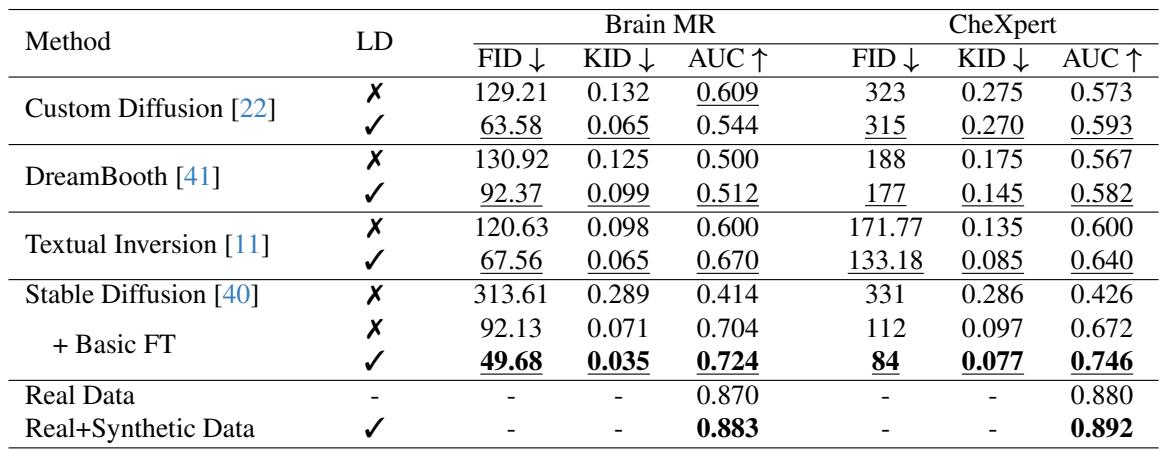
As shown in Table 1, adding LD to “Stable Diffusion Basic FT” dropped the FID score on Brain MRIs from 92.13 down to 49.68. That is a massive improvement in fidelity. It also improved the classification accuracy (AUC) of models trained on this synthetic data, proving that the generated images contain medically relevant features.
2. Counterfactual Image Manipulation
This is perhaps the most exciting application. Can we take a healthy patient and visualize what they would look like if they developed a disease? Or conversely, remove a disease from an image?
Alzheimer’s Disease Progression
The team used a method called Pix2Pix Zero combined with Latent Drifting to perform these edits.
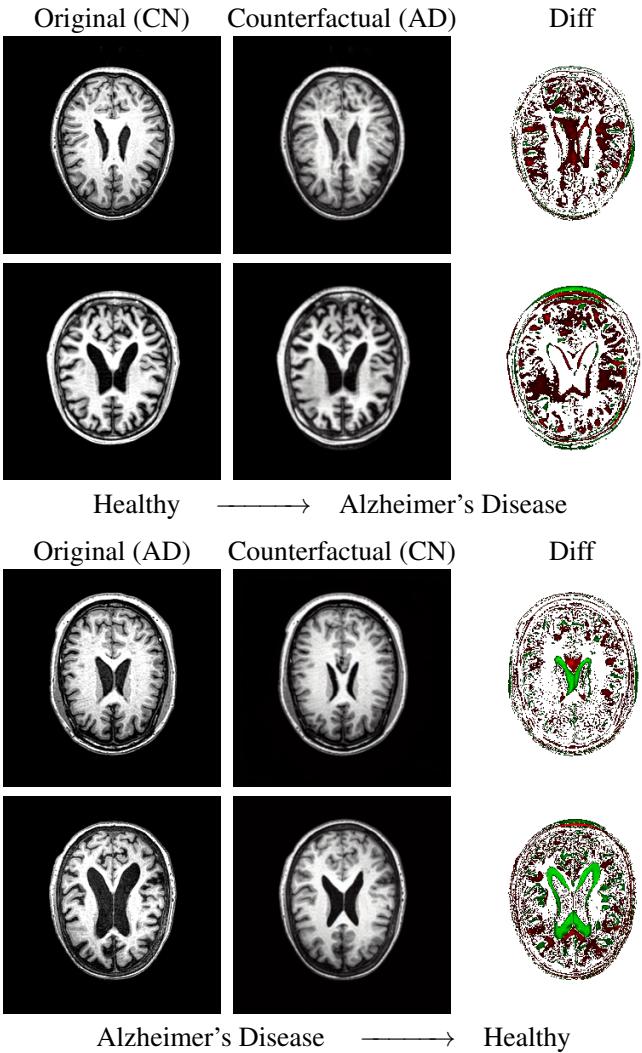
In Figure 7, we see bidirectional editing:
- Top (Healthy \(\to\) Alzheimer’s): The model successfully enlarges the ventricles (the dark cavities in the center), which is a clinical hallmark of brain atrophy associated with Alzheimer’s.
- Bottom (Alzheimer’s \(\to\) Healthy): The model “heals” the brain by shrinking the ventricles and restoring tissue volume.
- Diff Map: The green and red overlays clearly show that the model only changed the relevant anatomical areas, leaving the rest of the patient’s identity intact.
Aging Simulation
They also applied LD to simulate aging, using InstructPix2Pix.
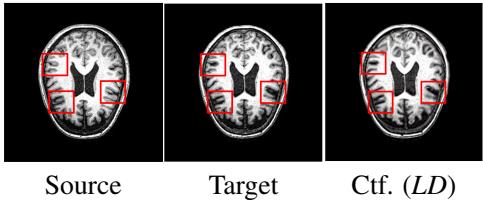
Figure 6 demonstrates an age progression request: “Age this CN 70 years old female brain MRI into a 77 brain MRI with MCI.” The red boxes highlight subtle structural changes that occurred during the transformation, simulating the natural degradation of brain tissue over time.
Chest X-Rays
The method isn’t limited to brains. They applied it to chest X-rays to add or remove conditions like Pneumonia and Cardiomegaly (enlarged heart).
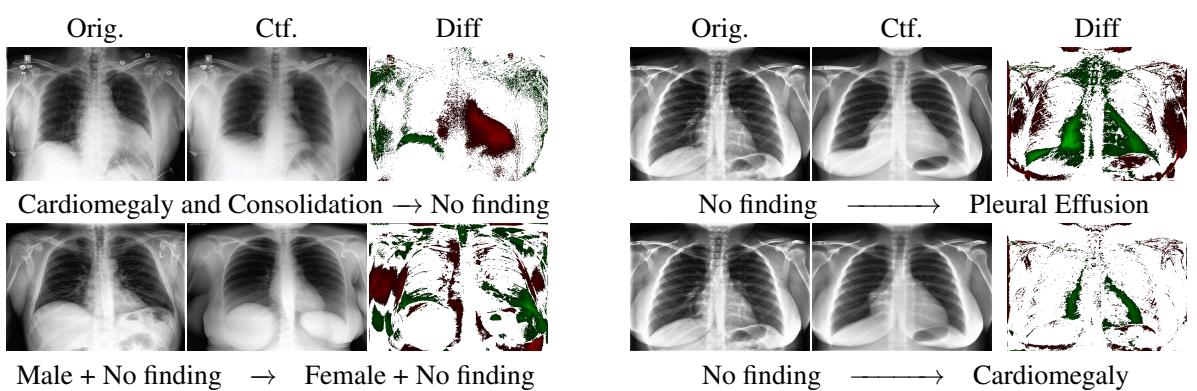
In Figure 8, you can see the model successfully manipulating specific regions of the lungs. For example, in the top-right, it adds “Pleural Effusion” (fluid in the lungs) by increasing the opacity in the lower lung fields, visualized by the heatmap in the “Diff” column.
Conclusion & Implications
The paper “Latent Drifting in Diffusion Models” presents a significant step forward for medical AI. By acknowledging that medical images exist in a different “world” than natural images, and mathematically accounting for that distance via the Drift (\(\delta\)) parameter, the authors unlocked the power of large foundation models for healthcare.
Key Takeaways:
- Don’t Train from Scratch: We can leverage the billions of images Stable Diffusion has seen, even for niche medical tasks, if we adapt the latent space correctly.
- Geometry Matters: Standard fine-tuning fails in medicine because it ignores structural constraints. LD preserves these constraints.
- Explainable AI: The ability to generate counterfactuals (“Show me this patient without the tumor”) serves as a powerful tool for Explainable AI, helping clinicians understand what features a model is looking at.
This approach lowers the barrier to entry for medical image generation. It allows researchers to create high-fidelity synthetic datasets to train diagnostic tools, bypassing privacy concerns and data scarcity. As diffusion models continue to evolve, techniques like Latent Drifting will be essential in ensuring these powerful tools can reliably serve the medical community.
