](https://deep-paper.org/en/paper/2501.01423/images/cover.png)
Introduction
In the rapidly evolving world of generative AI, Latent Diffusion Models (LDMs) like Stable Diffusion and Sora have become the gold standard for creating high-fidelity images and videos. These models work their magic by not operating on pixels directly, but rather in a compressed “latent space.” This compression is handled by a component called a Visual Tokenizer, typically a Variational Autoencoder (VAE).
For a long time, the assumption was simple: if we want better images, we need better tokenizers. Specifically, we assumed that increasing the capacity (dimensionality) of the tokenizer would allow it to capture more details, which would, in turn, allow the diffusion model to generate more realistic images.
However, recent research has uncovered a frustrating paradox. Researchers discovered that while increasing the detail of the tokenizer does improve its ability to reconstruct images, it actually hurts the diffusion model’s ability to generate new ones. This is the Optimization Dilemma. To fix it, you traditionally had to scale up the diffusion model’s size massively, burning through computational resources.
In this post, we are doing a deep dive into a new paper, “Reconstruction vs. Generation: Taming Optimization Dilemma in Latent Diffusion Models.” We will explore how the authors identified this bottleneck and proposed a novel solution: VA-VAE (Vision foundation model Aligned VAE). By teaching the tokenizer to “think” like a pre-trained vision model (like DINOv2), they achieved State-of-the-Art (SOTA) generation results with a fraction of the training time.
The Background: The Two-Stage Dance
To understand the innovation, we first need to understand the architecture of a Latent Diffusion Model. It operates in two distinct stages:
- The Visual Tokenizer (VAE): This acts as a translator. It takes an image (pixel space) and compresses it into a smaller, dense representation (latent space). It also includes a decoder to turn that latent representation back into an image.
- The Generative Model (DiT): This represents the “brain.” It is usually a Diffusion Transformer (DiT). It learns to create new latent representations from noise.
The efficiency of this system relies on the VAE. If the VAE compresses the image too much, we lose fine details (like the texture of hair or text). If it doesn’t compress enough, the “brain” has too much data to process, making training slow and expensive.
The Optimization Dilemma
The researchers began by testing a hypothesis: if we increase the feature dimension of the visual tokens (essentially making the “file size” of the compressed latent larger), we should get better images.
They tested three specifications for the tokenizer, labeled by their downsampling factor (\(f\)) and dimension (\(d\)):
- f16d16: Standard compression.
- f16d32: Higher dimension.
- f16d64: Very high dimension.
The results, visualized below, reveal the core problem.
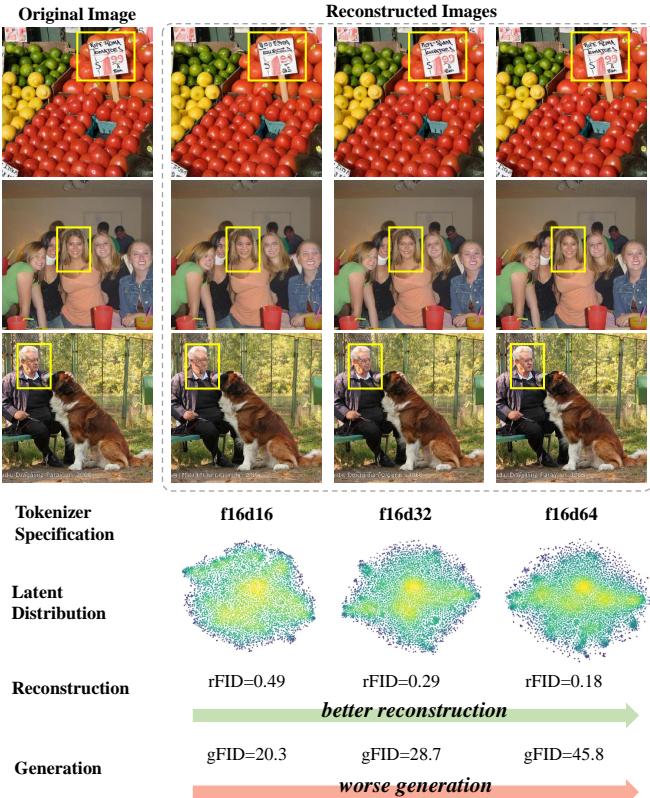
Look closely at Figure 1.
- Reconstruction (Green Arrow): As we move from
d16tod64, the Reconstructed Images get sharper. The rFID (Reconstruction FID score, lower is better) drops from 0.49 to 0.18. The model is preserving almost perfect detail. - Generation (Red Arrow): However, look at the Generated Images. They fall apart. The gFID (Generation FID score) skyrockets from 20.3 to 45.8. The diffusion model fails to learn the distribution effectively, resulting in garbled noise.
The scatter plots at the bottom of Figure 1 provide a hint as to why. In high-dimensional spaces (f16d64), the latent distribution becomes “clumpy” with high-intensity areas concentrated in small regions. This makes the space unconstrained and incredibly difficult for the Diffusion Transformer to navigate and learn.
The Solution: VA-VAE
The authors argue that the dilemma exists because we are asking the VAE to learn a high-dimensional latent space from scratch without enough guidance. The space becomes too complex and irregular.
Their solution is elegant: Don’t learn from scratch.
They propose VA-VAE (Vision foundation model Aligned VAE). The idea is to use a “teacher”—a pre-trained Vision Foundation Model (VFM) like DINOv2 or MAE—to guide the geometry of the VAE’s latent space. These foundation models have already looked at millions of images and learned excellent, structured representations of visual data.
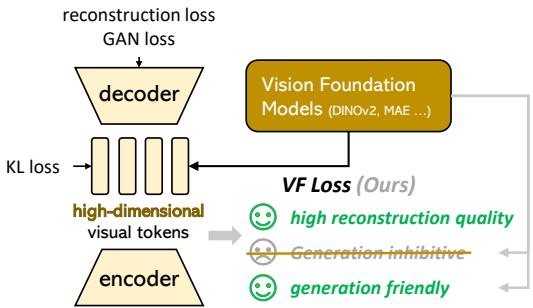
As shown in Figure 3, the architecture remains a standard Encoder-Decoder setup. However, there is a new branch. During training, the input image is passed through the Vision Foundation Model to extract features. The authors then introduce a new loss function, VF Loss (Vision Foundation Loss), which forces the VAE’s latent tokens to align with these foundation features.
This alignment creates a “map” for the VAE, ensuring the high-dimensional space remains structured and easy for the diffusion model to learn later.
Deep Dive: The VF Loss
The core technical contribution of this paper is the mathematical formulation of the VF Loss. It isn’t enough to just say “make the features similar.” You need to constrain the space without destroying the VAE’s ability to reconstruct pixel-perfect details.
The VF Loss is composed of two specific components.
1. Marginal Cosine Similarity Loss (\(\mathcal{L}_{\mathrm{mcos}}\))
First, the latent features \(Z\) from the VAE need to be projected to the same dimension as the foundation model features \(F\). This is done via a learnable linear matrix \(W\):
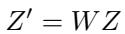
Now, we compare the projected VAE features (\(Z'\)) with the foundation features (\(F\)) at every spatial location \((i, j)\).

What is happening here?
- The formula calculates the Cosine Similarity between the VAE token and the Foundation token.
- The Margin (\(m_1\)): This is the genius part. They use a
ReLU(1 - m - similarity)structure. This effectively says: “We want the features to be similar, but not identical.” - Once the similarity passes a certain threshold (\(1 - m_1\)), the loss becomes zero. This gives the VAE “wiggle room” to retain local details required for reconstruction, rather than forcing it to perfectly copy the Foundation Model (which might ignore pixel-level textures).
2. Marginal Distance Matrix Similarity Loss (\(\mathcal{L}_{\mathrm{mdms}}\))
While the first loss aligns individual points, it doesn’t account for the relationship between points. To fix this, the authors introduce a loss that preserves the geometry of the feature space.

How it works:
- This computes the similarity between pairs of tokens (location \(i\) vs location \(j\)) within the VAE features, and compares it to the similarity of the same pair in the Foundation features.
- It ensures that if two patches of an image are semantically related in DINOv2’s eyes, they should also be related in the VAE’s latent space.
- Like the previous loss, it includes a margin (\(m_2\)) to prevent over-regularization.
3. Adaptive Weighting
Finally, a practical challenge arises: the scale of these new losses might be totally different from the standard pixel reconstruction loss. To avoid manually tuning weights for every experiment, the authors propose Adaptive Weighting.
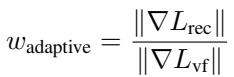

This mechanism dynamically adjusts the weight of the VF Loss based on the gradient magnitudes of the reconstruction loss. It ensures that the model balances “looking like the image” (Reconstruction) and “structuring the space” (VF Loss) equally throughout training.
LightningDiT: A Faster Baseline
To prove that VA-VAE works, the researchers needed to train diffusion models to generate images using these new tokens. However, training Diffusion Transformers (DiT) on ImageNet is notoriously slow.
To speed up the feedback loop, they built LightningDiT, an optimized version of the standard DiT architecture. While not the primary theoretical contribution, it is a significant engineering achievement. They combined several modern training “tricks” to accelerate convergence:
- Rectified Flow: A more efficient formulation of the diffusion process.
- Architecture Upgrades: SwiGLU activations, RMSNorm, and Rotary Positional Embeddings (RoPE).
- Lognorm Sampling: Better sampling of timesteps during training.
- Velocity Direction Loss: A specialized loss function to straighten the generation trajectory.
With these improvements, LightningDiT converges significantly faster than the original DiT, allowing the team to run extensive experiments on the effectiveness of their new tokenizers.
Experimental Results
Does alignment actually solve the optimization dilemma? The results suggest a resounding yes.
Expanding the Frontier
The most important result is the “Pareto Frontier” of Reconstruction vs. Generation. Ideally, we want to be in the bottom-left corner (Low reconstruction error, Low generation error).
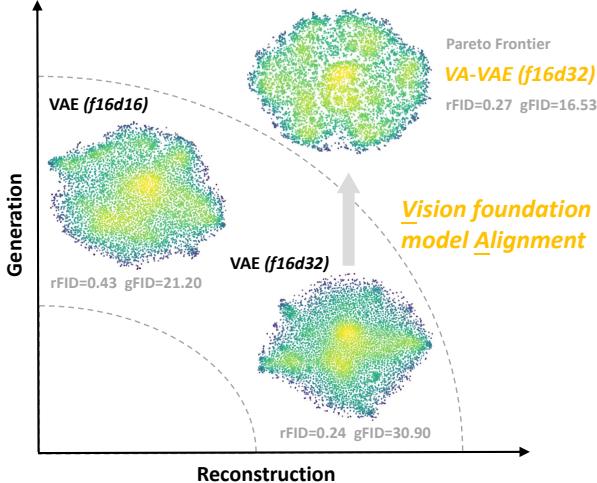
In Figure 2, notice the cluster of points.
- Bottom Left: The standard
f16d16model does okay but hits a limit. - Bottom Right: The unaligned high-dimension models (
f16d32) drift right—reconstruction improves (x-axis), but generation gets worse (y-axis). - Top Right (Green Arrow): The VA-VAE (aligned) models push the boundary. They maintain the excellent reconstruction of high-dimensional models but pull the generation quality back down to excellent levels.
Quantitative Improvements
We can see the raw numbers in Table 2.
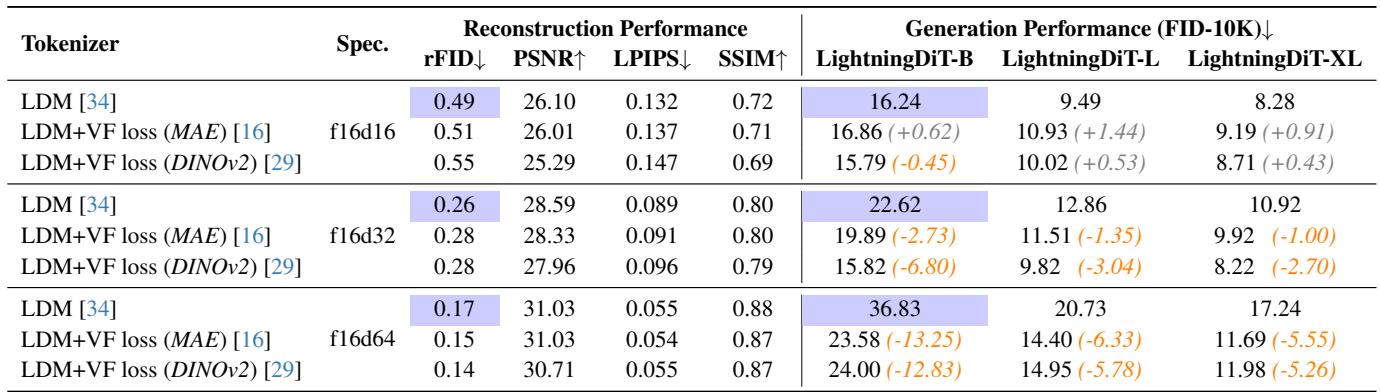
Focus on the rows for f16d64 (the highest dimension).
- Standard LDM: rFID is 0.17 (Great reconstruction), but Generative FID is 36.83 (Terrible generation).
- LDM + VF Loss (DINOv2): rFID stays low at 0.14, but Generative FID drops to 24.00.
- This proves that VF Loss enables the use of high-dimensional tokens without destroying generation capabilities.
Convergence Speed
Perhaps the most practical benefit for researchers is training speed. Because the latent space is cleaner, the Diffusion Transformer learns much faster.
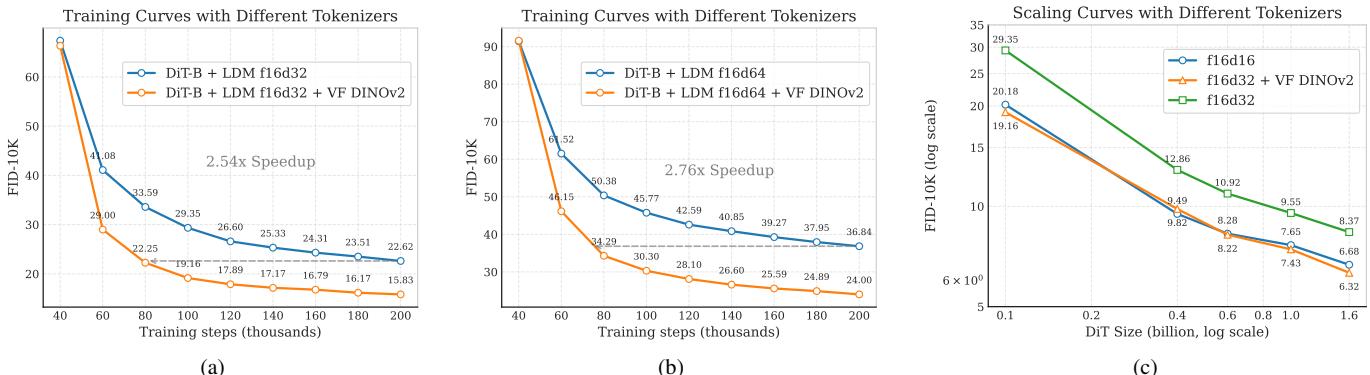
Figure 4 shows the training curves. The orange line (with VF Loss) dives down immediately, achieving lower FID scores in a fraction of the steps compared to the blue line (standard). The authors report a 2.7x speedup in convergence for high-dimensional tokenizers.
State-of-the-Art Performance
When combining the VA-VAE with the optimized LightningDiT, the system achieves remarkable results on ImageNet 256x256.
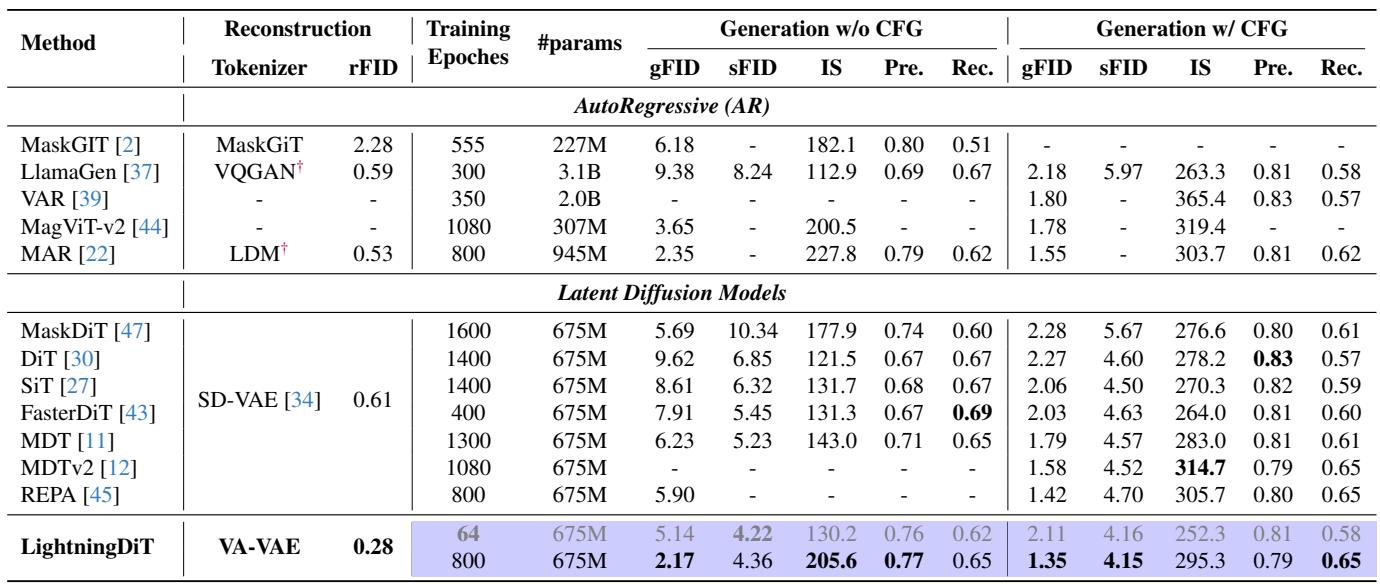
As shown in Table 3, the system achieves an FID of 1.35, beating previous SOTA methods like SiT and MDT. More impressively, it reaches a competitive FID of 2.11 in just 64 epochs, representing a 21x speedup compared to the original DiT paper.
Visual Quality
The numbers look good, but what about the images?
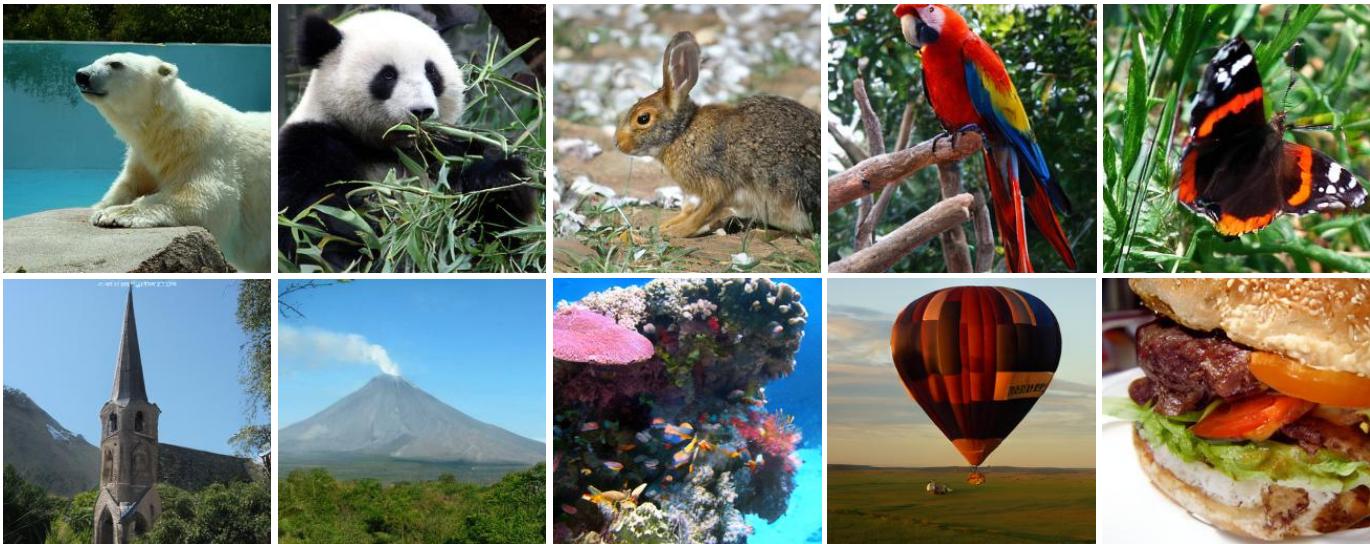
Figure 5 displays samples generated by the system. The details in the fur of the polar bear, the texture of the bamboo, and the complex lighting on the hamburger demonstrate that the model has successfully utilized the high-dimensional latent space to capture fine-grained details.
Why Does It Work?
To wrap up, we should ask: why does DINOv2 alignment make such a big difference? The authors provide a compelling visualization using t-SNE (a way to visualize high-dimensional data in 2D).
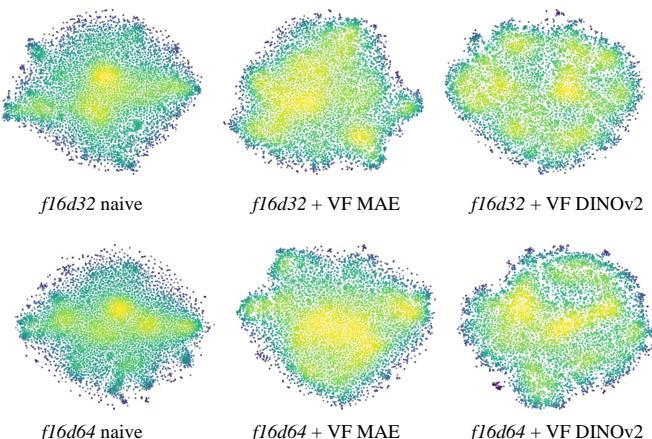
In Figure 6, look at the plots on the right (VF DINOv2).
- The Naive models (Left) show clusters that are somewhat messy and overlapping.
- The Aligned models (Right) show distinct, well-separated clusters.
This confirms that the VF Loss effectively “organizes” the latent space. It forces the VAE to group semantically similar items together (e.g., all “dog” tokens in one area, “car” tokens in another). When the Diffusion model tries to learn this space later, it has a much easier job because the underlying map is logical and structured.
This is further backed up by Table 6, which measures the “Uniformity” of the space.
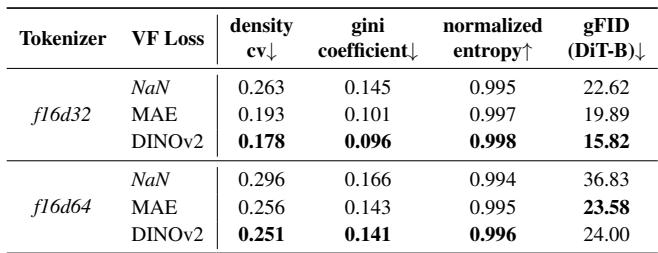
The data shows a clear correlation: lower density variation (more uniform space) leads to better Generation FID scores.
Which Foundation Model is Best?
Finally, does it matter which teacher you use?
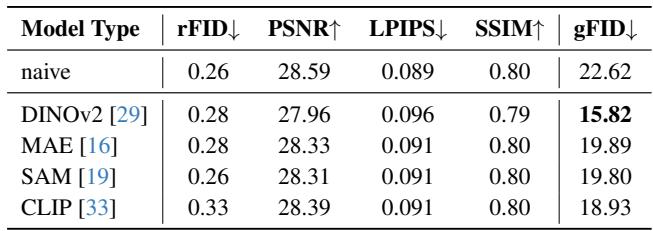
Table 4 compares using DINOv2, MAE, SAM, and CLIP. While all of them help, DINOv2 (a self-supervised model) provides the best boost. This suggests that the robust, semantic features learned by DINOv2 are the best “guide” for image generation tasks.
Conclusion
The “Optimization Dilemma” has long been a thorn in the side of high-resolution image generation. Researchers were forced to choose between crisp reconstructions (using high-dim tokens) or stable generation (using low-dim tokens), or pay a massive compute cost to brute-force a solution.
The VA-VAE and VF Loss proposed in this paper offer a smarter way forward. By aligning the VAE’s latent space with pre-trained Vision Foundation Models, we can enjoy the best of both worlds: the high fidelity of high-dimensional tokens and the training efficiency of compact ones.
Coupled with the engineering improvements in LightningDiT, this work opens the door for faster, cheaper, and higher-quality generative models. It serves as a reminder that sometimes, the best way to learn a complex task is to have a good teacher.