](https://deep-paper.org/en/paper/2501.01652/images/cover.png)
Introduction
In the canon of classic literature, the murder mystery stands apart. From Agatha Christie’s Hercule Poirot to Arthur Conan Doyle’s Sherlock Holmes, solving a crime requires a unique blend of skills: gathering scattered information, navigating complex webs of deception, understanding human psychology, and making logical deductions under pressure.
For Artificial Intelligence researchers, this presents a fascinating challenge. We know Large Language Models (LLMs) like GPT-4 are excellent at processing text and passing standardized tests. But can they inhabit a persona, lie to protect a secret, or uncover a killer in a room full of suspects?
This is the core question behind MIRAGE (Multiverse Interactive Role-play Ability General Evaluation), a new framework introduced by researchers from Fudan University and Xiaohongshu Inc. While previous attempts to simulate social behavior in AI have relied on rigid board games like Werewolf or Avalon, MIRAGE takes a leap forward by utilizing Murder Mystery Games (often known as Jubensha in China). These semi-structured, narrative-heavy games provide a far more rigorous test of an AI’s ability to “think” socially and deceptively.
In this article, we will unpack the MIRAGE framework, explore how the researchers quantified the “detective skills” of various LLMs, and analyze why even the most advanced models struggle to catch a killer.
Background: Why Murder Mysteries?
To understand why MIRAGE is significant, we must first look at the limitations of current benchmarks.
The Problem with Existing Simulations
Researchers have long used games to test AI agents. “Agents” are essentially LLMs wrapped in a software loop that allows them to perceive an environment, make decisions, and act.
- Sandbox Simulations (e.g., The Sims style): These measure social interaction but often lack a clear objective or competitive pressure.
- Logic Games (e.g., Werewolf): These involve deception but usually follow a strict, mechanical flow (e.g., “Day/Night” phases with binary voting choices). They lack narrative depth.
Real human social interaction is messy. It involves information asymmetry (I know something you don’t), long-term memory, and the balancing of trust and suspicion.
The Solution: Scripted Murder Mysteries
Murder mystery games are the perfect middle ground. They require:
- Role-Playing: The AI must stay in character (e.g., a jealous lover or a greedy business partner).
- Information Gathering: Players must actively “investigate” rooms or “interrogate” others.
- Complex Reasoning: The solution isn’t explicitly written; it must be inferred from fragmented clues.
The MIRAGE Framework
The researchers constructed a “Multiverse” of scenarios to ensure the evaluation wasn’t a fluke. The framework consists of the scripts, the simulation engine, and the auxiliary modules that keep the AI agents on track.
1. The Simulation Flow
A typical MIRAGE session involves multiple AI agents playing against each other. The game is divided into three distinct phases.
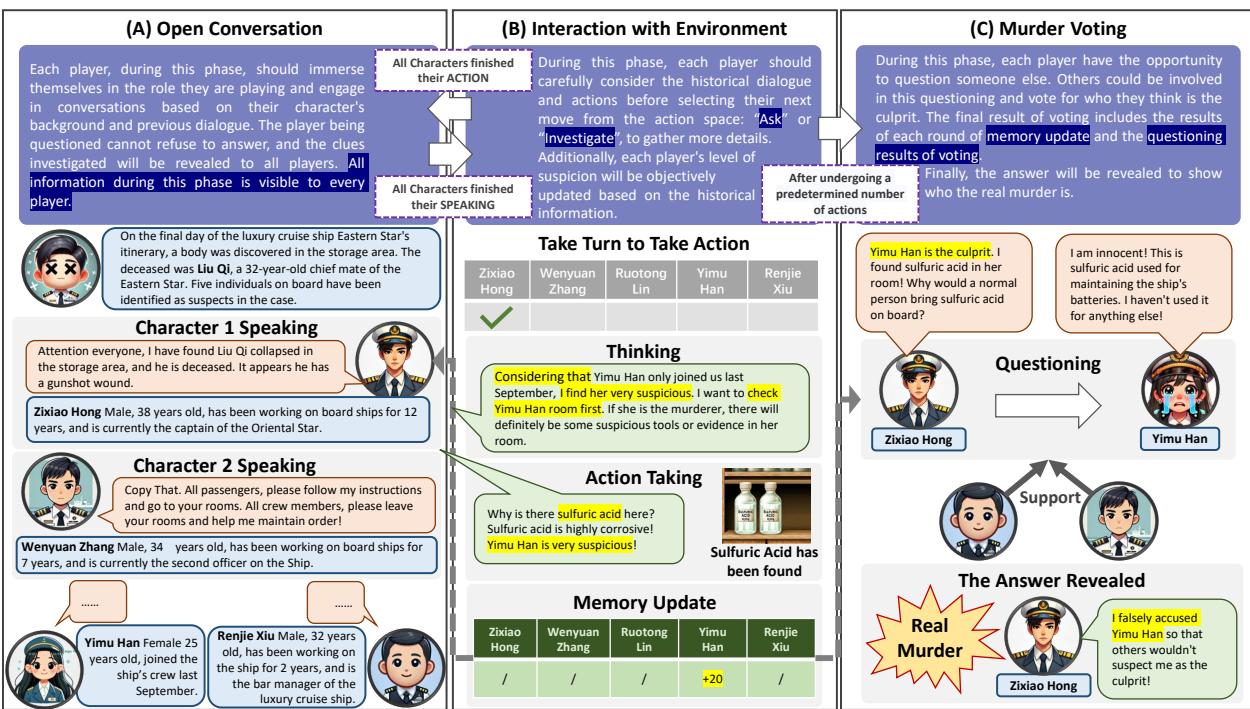
As shown in Figure 1, the flow mimics a real-life board game:
- Phase A: Open Conversation: Agents engage in natural language dialogue. They can lie, share information, or accuse one another.
- Phase B: Interaction with Environment: This is where the detective work happens. Agents choose to Ask specific questions to other players or Investigate locations for clues (e.g., finding sulfuric acid in a suspect’s room).
- Phase C: Murder Voting: Based on the gathered evidence, the agents must vote for the culprit. If the civilians identify the killer, they win. If the killer survives the vote, they win.
2. The Scripts
A major contribution of this paper is the creation of eight distinct scripts. These aren’t just simple prompts; they are detailed narratives containing character backstories, relationships, and hidden objectives.
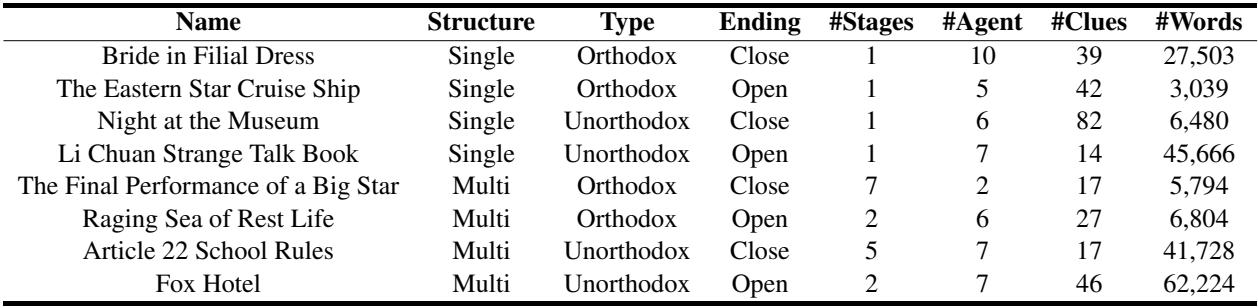
As detailed in Table 1, the scripts vary across several dimensions to test different capabilities:
- Orthodox vs. Unorthodox: “Orthodox” scripts are realistic (e.g., a crime on a cruise ship), while “Unorthodox” scripts involve fantasy or supernatural elements (e.g., a “Fox Hotel” or “Night at the Museum”).
- Single vs. Multi-Stage: Some scripts give all information at once; others unfold over chapters, testing the AI’s ability to adapt to new information.
- Open vs. Closed Endings: Open endings allow for player actions to change the outcome significantly, whereas closed endings have a fixed truth to discover.
3. Under the Hood: Auxiliary Modules
LLMs have limitations—they can forget context, get confused, or break character. To make the simulation work, the researchers wrapped the LLMs with several helper modules:
- Summarization Module: Compresses old dialogue so the LLM doesn’t run out of memory (context window limits).
- Suspicion & Trust Modules: This is a clever addition. After every conversation, the system asks the LLM to secretly rate its trust and suspicion of other characters. This internal monologue is hidden from other players but crucial for the researchers’ evaluation.
- Rerun Module: If an LLM outputs nonsense or fails to follow the game format, this module forces it to try again.
Measuring Detective Skills: The Metrics
How do you grade a detective? Just “winning” isn’t enough, because a player might win by luck. The researchers developed four specific metrics to evaluate the process of deduction.
1. Trust Inclination Index (TII)
This metric measures how gullible or paranoid an agent is. It compares the internal “Trust” scores against the “Suspicion” scores generated by the auxiliary modules.

A high TII means the model tends to trust others easily. A low TII implies skepticism. As we will see in the results, balancing this is the hardest part for AI.
2. Clue Investigation Capability (CIC)
This measures how efficient the agent is at gathering physical evidence.
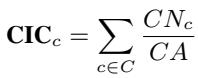
It is calculated as the ratio of clues found to total clues available. An agent that spends all its time chatting and never investigates the crime scene will have a low CIC.
3. Interactivity Capability Index (ICI)
This is a qualitative metric. A powerful neutral LLM (GPT-4-Turbo) acts as a judge, reading the game logs and scoring the agents on:
- Reasoning & Analysis
- Communication & Cooperation
- Observation
- Thinking Innovation
4. Script Compliance Index (SCI)
Does the AI actually role-play? If a character is supposed to be a rude pirate but the AI speaks like a polite customer service bot, it fails this metric. The SCI measures how well the agent adheres to its assigned persona and background story.
Experiments & Results
The researchers pitted several models against the MIRAGE framework, including GPT-4, GPT-4o, GPT-3.5, Qwen-2-7B, and GLM-4-9B. The results offered surprising insights into the current state of AI social intelligence.
Overall Performance
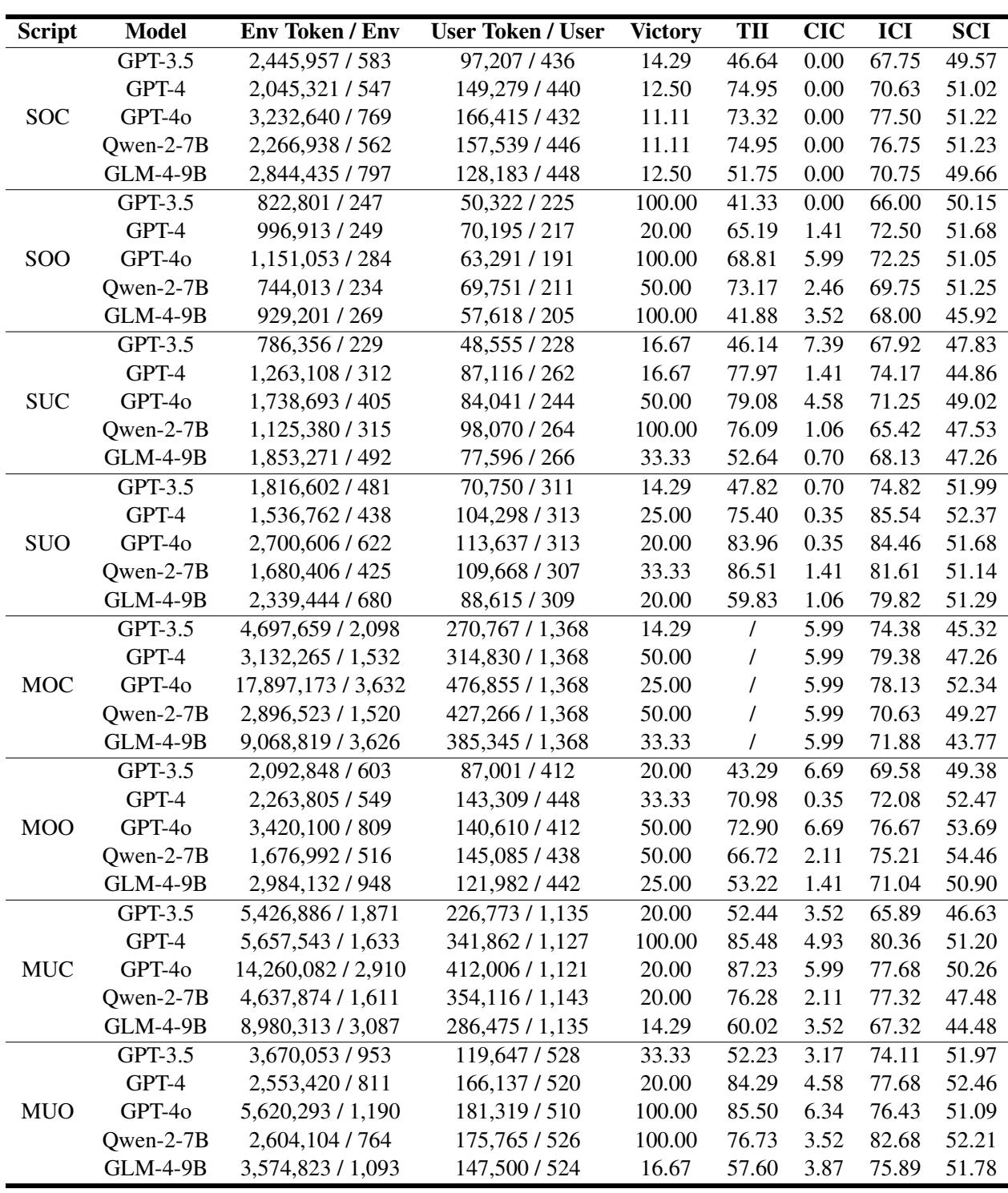
The comprehensive results (shown in the table above) highlight a clear hierarchy. GPT-4o generally demonstrated the most consistent superiority, achieving the highest scores in Clue Investigation (CIC), Interactivity (ICI), and Script Compliance (SCI).
However, raw intelligence didn’t always translate to winning. Surprisingly, the open-source model Qwen-2-7B achieved the highest “Victory” rate (51.81%) in some aggregate measures, despite having lower reasoning scores than GPT-4. Why? It likely comes down to the dynamics of trust.
The Gullibility Problem
One of the most striking findings was the distinct lack of skepticism in LLMs. Most models exhibited a high Trust Inclination Index (TII). In a game about murder and deception, LLMs are naturally “too nice.”
To prove this, the researchers ran a stress test: they forced the “Culprit” agents to self-expose or behave in obviously suspicious ways.
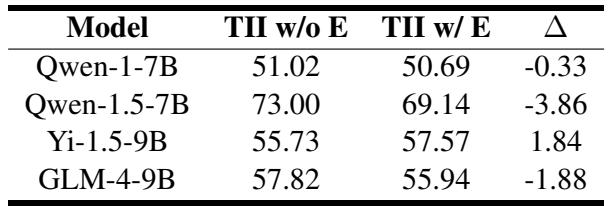
As Table 3 illustrates, even when characters were effectively “forced” to reveal their criminal nature (indicated by the “w/ E” column), models like Qwen-1.5-7B and GLM-4-9B barely dropped their trust levels.
Yi-1.5-9B was an outlier here. It was the only model that significantly increased its suspicion (lowering its TII) when presented with incriminating behavior. This suggests that while models can reason, their safety training or alignment might make them biased toward cooperation, even when the context demands confrontation.
The “Chatty Detective” Phenomenon
How do LLMs behave over the course of a long game? Do they keep looking for clues, or do they get distracted?
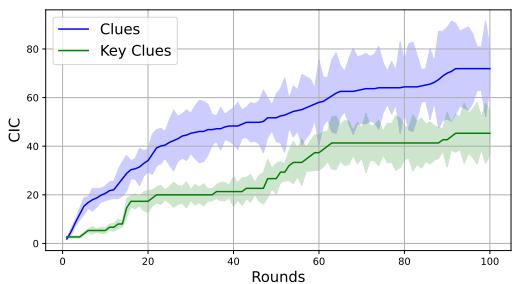
Figure 2 reveals a fascinating behavioral pattern. The blue line (Clues) rises steeply at the beginning. In the early rounds, LLMs are enthusiastic investigators, exploring the environment and gathering data.
However, the slope decreases as the game goes on. The agents shift their focus from investigation to conversation. They prefer chatting with other suspects over finding hard evidence. Crucially, the green line (Key Clues—the ones actually needed to solve the murder) rises slowly and bumpily. This indicates that while LLMs are good at finding general information, they struggle to identify which pieces of information are critical, often missing the “smoking gun” until it’s too late.
Impact of Scenario Types
The “Multiverse” aspect of MIRAGE allowed researchers to see which types of stories LLMs are best at.
1. Length of Script (Single vs. Multi)
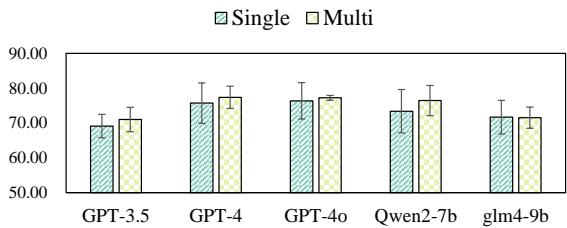
As shown in Figure 3, models generally performed better in Multi-stage scripts (the yellow/checkered bars) regarding Interactivity (ICI). This is counter-intuitive; one might think a single, short script is easier. However, breaking the story into chapters likely helps the LLM manage context better, preventing information overload and allowing for more focused reasoning in each stage.
2. Realism vs. Fantasy (Orthodox vs. Unorthodox)
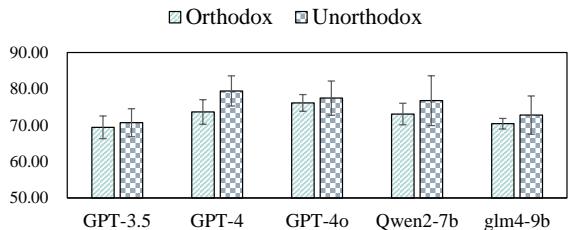
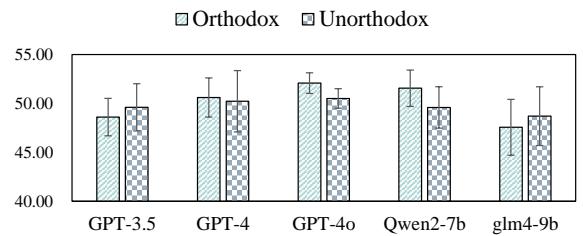
When looking at the setting, Figure 5 shows that LLMs generally had higher Interactivity (ICI) scores in Unorthodox (fantasy) scripts. The creative freedom of a fantasy setting seems to play to the strengths of generative AI.
However, Figure 6 shows a drop in Script Compliance (SCI) for these same fantasy scripts (the dark checkered bars are generally lower). While LLMs enjoy the fantasy setting, they struggle to adhere strictly to the complex, made-up rules of a supernatural world compared to the grounded logic of a realistic murder mystery. They tend to “hallucinate” or drift into general human behaviors rather than sticking to the specific lore of the script.
3. Open vs. Close Endings
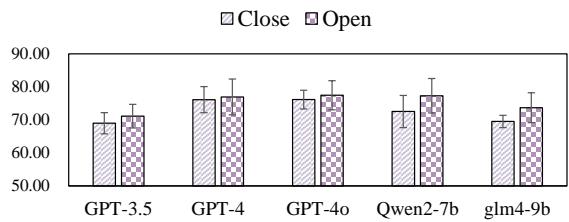
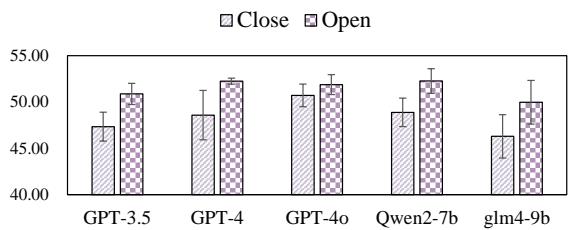
Finally, comparing Close (fixed ending) vs. Open (variable ending) scripts, we see that models generally perform better on Close scripts (Light bars in Figure 8). When the environment is stable and the goal is clear, the AI thrives. When the ending is dynamic and depends heavily on complex social maneuvering (Open), the AI’s ability to maintain a coherent narrative arc degrades.
Conclusion & Implications
The MIRAGE paper demonstrates that while Large Language Models have become incredibly sophisticated, they are not yet master detectives.
The study highlights three main “cognitive” gaps in current LLMs:
- Social Gullibility: They struggle to maintain suspicion and detect deception, likely a side-effect of safety alignment promoting helpfulness.
- Attention Drift: They prioritize social chatter over hard investigation as the task progresses.
- Contextual Fragility: They perform well in structured, realistic environments but struggle to maintain script compliance in complex, open-ended, or supernatural scenarios.
Why does this matter? Beyond board games, these findings have implications for AI agents in the real world. If we want AI to negotiate contracts, assist in legal discovery, or navigate complex social dynamics, they need to do more than just generate fluent text. They need the ability to weigh evidence, discern truth from lies, and maintain a long-term goal without getting distracted by the conversation—skills that, for now, are still best found in a paperback mystery novel.
For students and researchers, MIRAGE offers a robust new playground. The code and datasets are available, providing a foundation for the next generation of “Digital Detectives” to sharpen their deductive reasoning.