](https://deep-paper.org/en/paper/2501.03040/images/cover.png)
Introduction
Imagine you are reading a history book. You read that the “Fourth Cholera Pandemic” lasted from 1863 to 1875, and “World War II” occurred between 1939 and 1945. If someone asked you, “Did the pandemic happen before the war?” the answer is immediate and obvious. You don’t need to perform complex calculus; you simply compare the timelines. This intuitive grasp of time—understanding that events have durations, that they can overlap, start together, or follow one another—is fundamental to human cognition.
But for Large Language Models (LLMs), this “simple” task is surprisingly difficult. While models like GPT-4 and Llama have mastered syntax, grammar, and even creative writing, their ability to reason about time intervals—distinct periods with start and end points—remains a major hurdle.
Why does this matter? If we want AI to assist in legal discovery (analyzing timelines of evidence), medical diagnosis (tracking symptom progression), or historical research, it cannot simply memorize dates. It must understand the logical relationships between time periods.
In this post, we are doing a deep dive into ChronoSense, a fascinating research paper that exposes the limitations of modern LLMs in temporal reasoning. The researchers, Duygu Sezen Islakoglu and Jan-Christian Kalo, developed a benchmark to test whether these models actually understand time or if they are just reciting memorized facts.
Background: The Architecture of Time
To understand why LLMs struggle, we first need to understand how we formalize time in computer science. It isn’t enough to just look at a single timestamp. Real-world events have duration.
Allen’s Interval Algebra
More than 30 years ago, James Allen developed a framework known as Allen’s Interval Algebra. It is the gold standard for defining how two time intervals relate to each other.
When we compare two events, say Event A (pink) and Event B (blue), there are exactly 13 possible ways they can interact. These aren’t random; they cover every mathematical possibility.
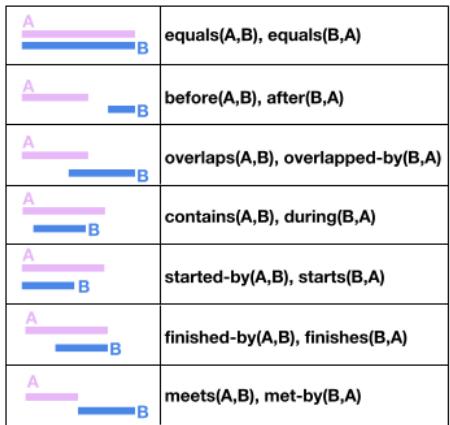
As shown in Figure 1, these relations range from the simple to the subtle:
- Disjoint Relations:
BeforeandAfter. There is a gap between the events. - Adjacency:
MeetsandMet-by. One event ends exactly the moment the other begins. - Containment:
DuringandContains. One event happens entirely inside the timeframe of another. - Overlapping:
OverlapsandOverlapped-by. They share some time, but neither fully contains the other. - Alignment:
Starts,Started-by,Finishes,Finished-by, andEquals. These relations involve events sharing a specific start or end point.
For a human, distinguishing between Overlaps and During requires a quick check of the start and end dates. For an LLM, which processes text as a sequence of tokens, reasoning that “1863 is before 1939” is one thing; reasoning that an event starting in 1863 and ending in 1875 is fully before an event starting in 1939 requires maintaining multiple numerical constraints simultaneously.
The ChronoSense Benchmark
To rigorously test this, the authors created ChronoSense, a dataset designed to diagnose temporal blindness in LLMs. The dataset is split into two primary categories: Allen Relation Tasks and Temporal Arithmetic Tasks.
1. Comparing Real-World Events (Allen Relations)
The core of the benchmark involves scraping real historical event data from Wikidata. The researchers extracted pairs of events, determined their actual start and end years, and then ground-truth labeled the relationship between them based on Allen’s Algebra.
The testing process is framed as a “Context, Hypothesis, Correctness” problem.
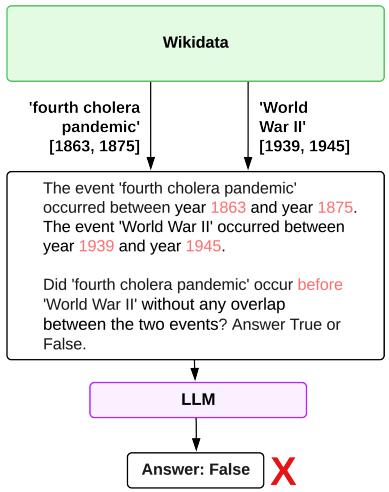
As illustrated in Figure 2, the model is fed a prompt containing:
- Context: The facts. (e.g., “The fourth cholera pandemic occurred between 1863 and 1875.”)
- Hypothesis: A question regarding their relationship. (e.g., “Did ‘fourth cholera pandemic’ occur before ‘World War II’ without any overlap…?”)
- The Task: The LLM must output
TrueorFalse.
This setup is clever because it provides the dates explicitly. The model doesn’t need to retrieve the dates from its training memory; it only needs to reason about the numbers provided in the prompt.
2. Temporal Arithmetic
Understanding relationships is one thing; calculating time is another. The benchmark includes arithmetic tasks that require the model to perform math on years. These tasks are synthetic (using generic names like “Event A”) to prevent the model from relying on memorized history.
The three arithmetic challenges are:
- End Timepoint: Given a start year and duration, when did the event end?
- Next Occurrence: Given a start year and a frequency (e.g., “every 4 years”), did the event occur in year X?
- Intermediate Timepoint: Given a start and end year, was the event active in a specific middle year?
The Prompts
How you ask the question matters. The researchers didn’t just dump raw data; they carefully crafted templates to verbalize the 13 Allen relations into natural English.
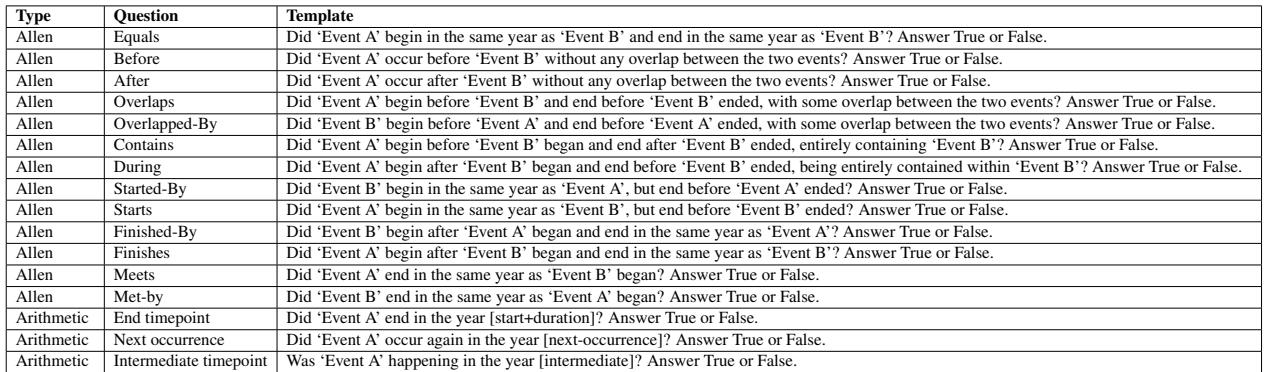
Table 3 displays these templates. Notice the precision in the language. For the Before relation, the prompt specifies “…without any overlap between the two events.” For Overlaps, it clarifies “begin before… and end before… with some overlap.” This reduces ambiguity, ensuring that if the model fails, it’s due to a lack of reasoning, not a misunderstanding of the question.
Experiments and Methodology
The researchers tested a suite of seven recent LLMs, including heavy hitters like GPT-4o, Llama-3.1-8B, and Mistral-7B.
They evaluated the models in several settings:
- 0-shot: Asking the question directly with no examples.
- Few-shot (1-shot, 3-shot): Providing one or three solved examples in the prompt to “teach” the model the format.
- Chain-of-Thought (CoT): Adding the magic phrase “Let’s think step by step,” encouraging the model to output its reasoning process before the final answer.
- Abstract Setting: A critical control test where real event names (e.g., “World War II”) were replaced with “Event A” and “Event B.” This was done to verify if models were using logic or just remembering that WWII came after the cholera pandemic.
Results: How Did They Do?
The results paint a sobering picture of current AI capabilities regarding time. Despite the hype surrounding these models, their ability to handle basic temporal logic is inconsistent and, in many cases, poor.
General Performance Overview
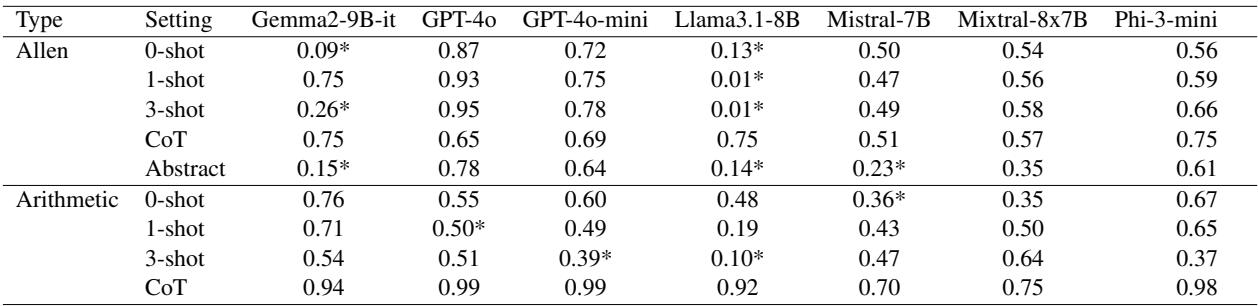
Table 1 provides the high-level summary. Here are the key takeaways:
- Low Baseline: Random guessing would yield 50% accuracy (0.50). Many models, especially in the 0-shot setting, hover dangerously close to or even below this baseline.
- The “Unclear” Problem: The asterisks (*) next to models like Gemma and Llama-3.1 indicate a failure to follow instructions. Instead of answering “True” or “False,” these models often rambled or gave ambiguous answers, leading to very low scores.
- Memorization vs. Reasoning: Look at the Abstract row. When event names were removed (forcing the model to look only at the numbers), performance generally dropped compared to the standard setting. This strongly suggests that when an LLM answers a question about WWII, it is partly relying on its memorized “vibe” of the event rather than strict temporal comparison.
- Arithmetic is Hard: The models struggled significantly with arithmetic in 0-shot settings, often performing worse than on the relation tasks.
Deep Dive: Allen Relations
Not all time relationships are created equal. Some are intuitively easier for models to grasp than others.
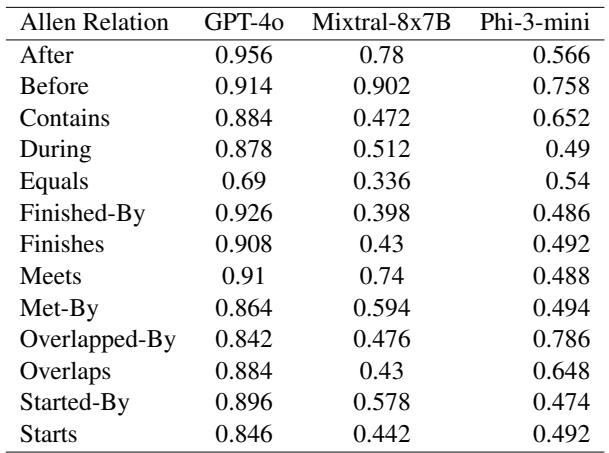
Table 2 breaks down performance by relation type.
- The Easy Stuff: Models generally performed best on
BeforeandAfter. These are the most common temporal words in the English language, so the models have seen them billions of times in training. - The Hard Stuff: Look at the scores for
Equals. Even GPT-4o drops to 0.69, and Mixtral plummets to 0.336 (worse than a coin flip). Why?Equalsrequires a strict logical check: Start A == Start B AND End A == End B. - Symmetry Failure: Logically, if you can identify
Before, you should be able to identifyAfter. They are symmetric. Yet, the models showed varying performance on symmetric pairs (Meetsvs.Met-by,Containsvs.During). This indicates the models aren’t using a robust logical framework but are instead relying on linguistic patterns.
The Power of “Let’s Think Step by Step”
One of the most encouraging findings came from the Temporal Arithmetic tasks, particularly when using Chain-of-Thought (CoT) prompting.
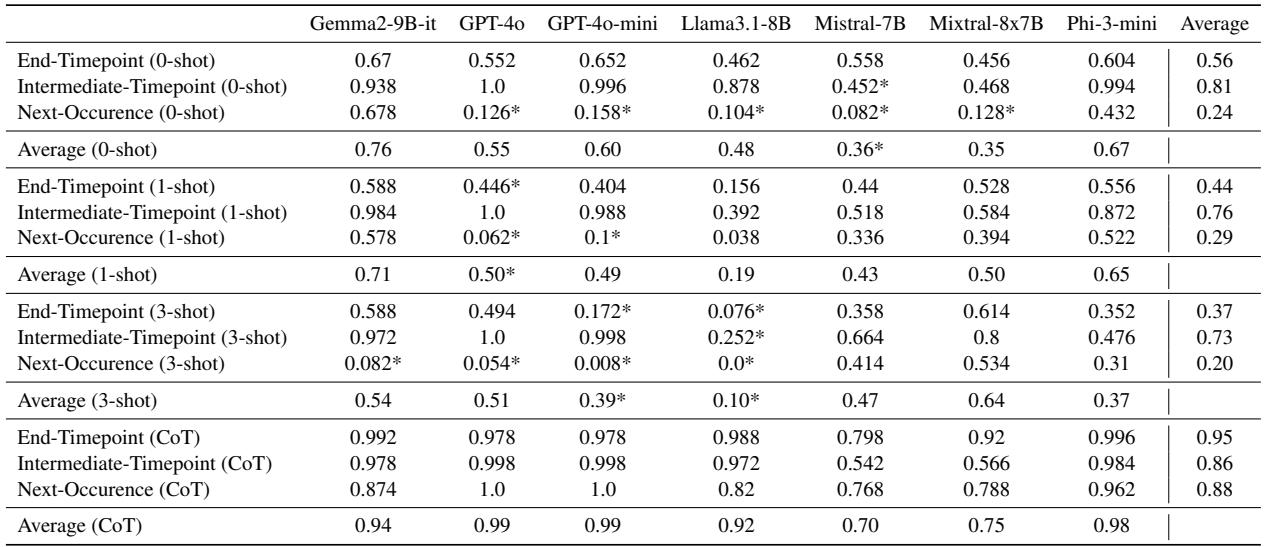
Table 9 (labeled Table 11 in the source image deck) reveals a dramatic improvement.
- Look at the 0-shot section. Performance is mediocre.
- Now look at the CoT section at the bottom. GPT-4o jumps to nearly perfect scores (0.99). Even smaller models like Phi-3-mini achieve 0.98.
Why? Arithmetic tasks like “Does an event occurring every 6 years starting in 1555 happen in 1561?” require calculation. Without CoT, the model tries to predict the next token immediately. With CoT, it generates the intermediate steps (1555 + 6 = 1561), allowing it to reach the correct conclusion.
However, notice that even CoT didn’t fix everything for the Allen relations (Table 1), suggesting that comparing intervals is conceptually different from performing simple addition.
Why Do They Fail?
The researchers provided a qualitative analysis of how the models messed up. It wasn’t just random guessing; there were patterns in the errors.
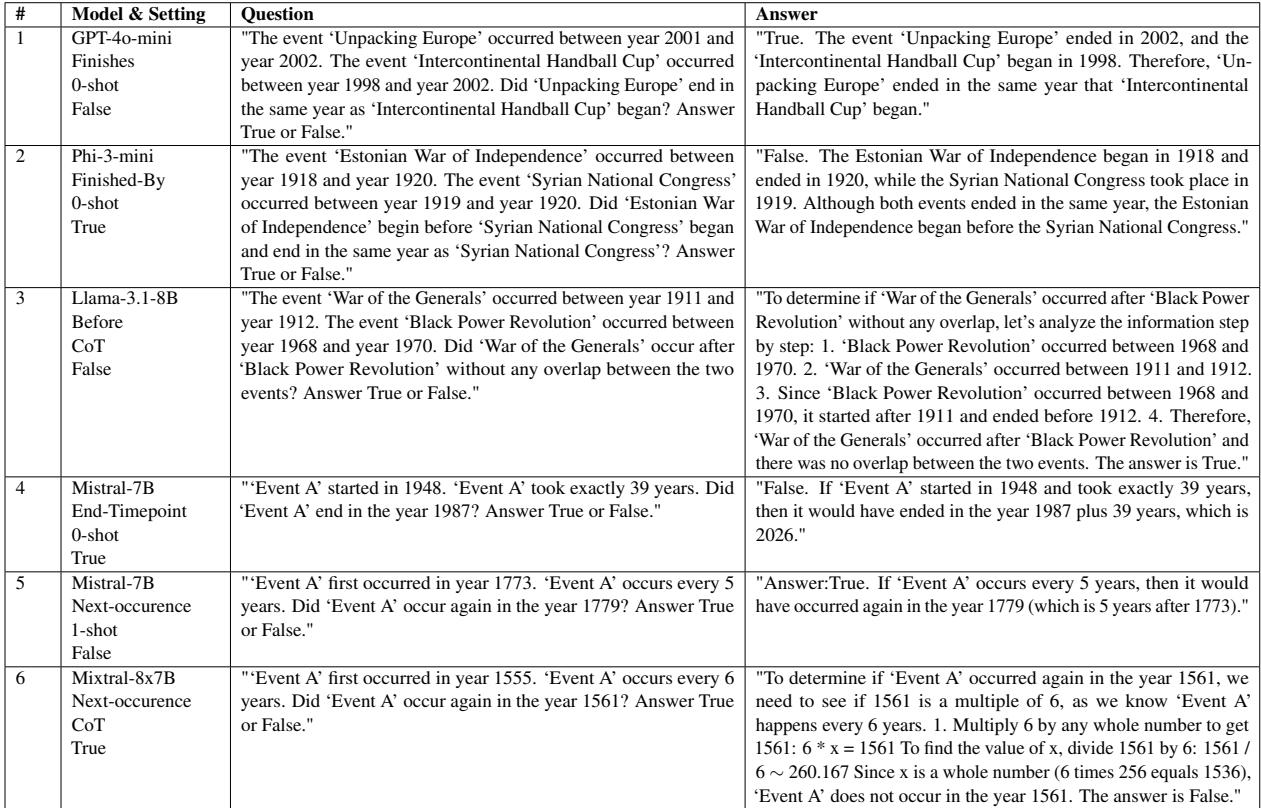
Table 12 showcases some embarrassing failures:
- Example 1 (GPT-4o-mini): The model correctly identifies the years but fails the logic check for the
Finishesrelation. - Example 4 (Mistral-7B): A classic calculation error. The model tries to add duration to a start year but gets the math wrong.
- Example 6 (Mixtral-8x7B): Over-complication. The model is asked if an event recurring every 6 years starting in 1555 happens in 1561. It tries to divide 1561 by 6 (incorrect logic) instead of simply adding 6 to the start year. It hallucinates that the math doesn’t work out.
These errors highlight a fragility in LLMs. They can “sound” correct while being logically incoherent.
Discussion and Conclusion
The ChronoSense paper serves as a vital reality check. While we are accustomed to LLMs passing the Bar Exam or writing poetry, their grasp of fundamental temporal concepts—things we use every day to organize our lives—is shaky.
Key Takeaways
- Instruction Following is a Bottleneck: Many models failed simply because they couldn’t stick to the
True/Falseformat. This makes them unreliable for automated systems that expect structured output. - Memorization Over Logic: The performance drop in “Abstract” settings proves that models lean on their training data’s factual knowledge rather than pure reasoning. They know “WWII” is a big event that happened later than others, but they struggle to compare “Event A (1939-1945)” against “Event B (1863-1875)” purely numerically.
- Prompting Matters: Chain-of-Thought is essential for any task involving dates and numbers. If you are building an application using LLMs for timelines, you must force the model to show its work.
Future Implications
The authors note that these limitations are critical for downstream applications.
- Legal AI: An AI reviewing a case file might misinterpret the sequence of events, confusing
OverlapswithDuring, potentially altering the narrative of a crime. - Historical Analysis: Tools designed to generate timelines automatically may hallucinate connections or misorder events.
ChronoSense pushes the field forward by identifying exactly where the cracks in the foundation are. By focusing on the 13 Allen intervals, the authors have provided a roadmap for future models. We don’t just need models that know more facts; we need models that understand when those facts happened relative to one another. Until then, we should probably keep checking the dates ourselves.