](https://deep-paper.org/en/paper/2501.03729/images/cover.png)
Vision-Language Models (VLMs) like CLIP have revolutionized computer vision. By aligning images and text during pre-training, they allow us to perform “zero-shot” classification—identifying objects the model has never explicitly seen during training, simply by matching them to a textual description.
But here is the catch: while zero-shot performance is impressive, it often isn’t enough for high-stakes, real-world applications. The distribution of data in the wild rarely matches the pristine conditions of training sets. To bridge this gap, researchers look to Test-Time Adaptation (TTA) and Transductive Learning. These techniques tweak the model on the fly using the incoming test data itself.
However, a new paper, “Realistic Test-Time Adaptation of Vision-Language Models”, argues that most existing TTA methods are “cheating” slightly. They assume the incoming test data is well-behaved—balanced classes, large batches, and independent samples.
In this deep dive, we will explore why current methods fail in realistic scenarios and how the authors propose a new method, StatA (Statistical Anchor), to fix it. StatA acts as a stabilizer, allowing VLMs to adapt to messy, sparse, and correlated data streams without losing their zero-shot knowledge.
The Problem: Real World vs. “Lab” Conditions
To understand the contribution of this paper, we first need to understand the limitations of current adaptation strategies.
In a standard Transductive or Test-Time Adaptation setting, the model receives a batch of unlabeled test images. It uses the statistics of this batch to refine its predictions. For example, if the model sees a cluster of images that look similar, it pushes them towards the same class label.
Existing state-of-the-art methods (like TransCLIP, ZLaP, or Dirichlet) perform beautifully if the batch contains all possible classes evenly distributed. But consider two real-world scenarios:
1. The Sparse Batch (Low \(K_{\text{eff}}\))
Imagine analyzing satellite imagery. You are looking for 50 different types of land cover. However, a single batch of images might come from a specific region—perhaps a forest or a city. In that batch, only 2 or 3 classes might actually be present. This is referred to as a low number of effective classes (\(K_{\text{eff}}\)).
If an adaptation method assumes all 50 classes are present, it might force the model to categorize some “Forest” images as “Desert” just to satisfy a class-balance constraint.
2. The Correlated Stream (Non-i.i.d.)
Consider a robot navigating a house. The video feed is a stream of correlated frames. For 10 seconds, the robot is in the kitchen (Kitchen frames). Then it moves to the hallway. The data is not Independent and Identically Distributed (i.i.d.).
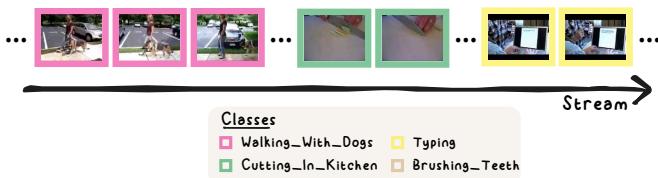
As shown in Figure 2 above, real-world data is clumpy.
- (a) Satellite patches often contain only a subset of classes.
- (b) Video streams contain sequences of the same class for long durations.
The authors of the paper evaluated existing methods against these realistic scenarios and found a worrying trend. Methods that beat the baseline in “perfect” conditions often crashed hard—performing worse than the raw zero-shot model—when subjected to low class counts or correlated streams.
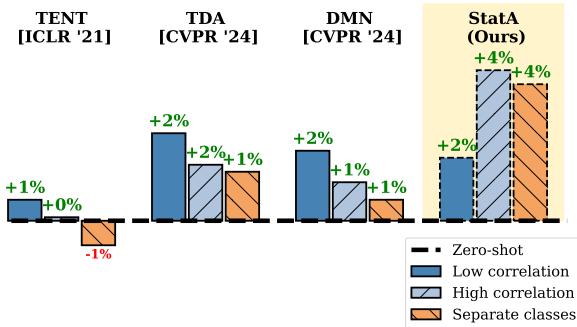
As seen in the chart above, methods like Dirichlet and ZLaP (the blue and orange bars) suffer significant performance drops (negative percentages) in “Low \(K_{\text{eff}}\)” scenarios compared to the zero-shot baseline. The goal of this research was to create a method that provides the green bars: consistent improvement regardless of the scenario.
The Solution: StatA (Statistical Anchor)
The researchers propose StatA, a transductive method designed to be versatile. The core philosophy of StatA is simple yet profound: Adapt to the visual data you see, but use the language knowledge as an anchor to prevent drifting.
Most TTA methods treat the visual features as malleable points that can be clustered freely. StatA treats the text embeddings (the class descriptions “a photo of a dog”, “a photo of a cat”) as a source of ground truth statistical priors.
The Mathematical Framework
To understand how StatA works, we must look at the objective function. The method operates within a Regularized Maximum Likelihood Estimation (MLE) framework.
We are trying to find two things:
- Assignments (\(\mathbf{z}\)): The probability that image \(i\) belongs to class \(k\).
- Statistical Models (\(\mathbf{M}\)): The parameters (Mean \(\mu\) and Covariance \(\Sigma\)) that describe the distribution of visual features for each class.
The general objective function looks like this:
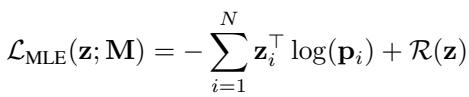
The first term is the standard log-likelihood—it tries to fit the statistical model to the data. The second term, \(\mathcal{R}(\mathbf{z})\), represents regularizers on the predictions (like smoothing).
The Gaussian Assumption
StatA assumes that the visual features for a specific class follow a Multivariate Gaussian distribution. Therefore, the probability of a feature \(\mathbf{f}_i\) belonging to class \(k\) is given by:

This is standard practice. However, if you simply optimize this based on a sparse batch (e.g., a batch with only “Forest” images), the Gaussians for the missing classes (“Desert”, “Ocean”) will become unstable or collapse, because there is no data to estimate their Mean (\(\mu\)) and Covariance (\(\Sigma\)).
The Innovation: The Statistical Anchor
This is where StatA introduces its novelty. The authors add a new regularization term, \(\mathcal{A}\), specifically for the statistical parameters \(\mu\) and \(\Sigma\).

Here, \(\alpha\) is a weighting hyperparameter. The term \(\mathcal{A}(\mu, \Sigma)\) penalizes the model if the estimated Means and Covariances drift too far from a “Statistical Anchor.”
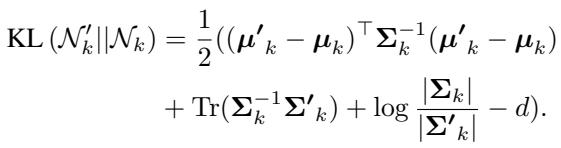
But what is the anchor? The authors derive a “fixed” Gaussian distribution \(\mathcal{N}'_k\) for each class based on the text embeddings. Since the text encoder is frozen and robust, it provides a stable reference point. The penalty is calculated using the Kullback-Leibler (KL) Divergence between the adapted distribution and this anchor distribution.
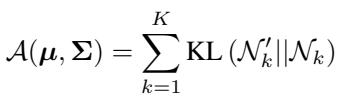
The KL divergence for multivariate Gaussians has a closed-form solution (a specific mathematical formula), making it efficient to compute:
Constructing the Anchor
You might be wondering: How do we get a Mean and Covariance from a text description?
The text encoder gives us a single vector per class (\(\mathbf{t}_k\)).
- Anchor Mean (\(\mu'_k\)): We simply set the anchor mean to be the text embedding itself (\(\mathbf{t}_k\)).
- Anchor Covariance (\(\Sigma'\)): We estimate a global variance based on the zero-shot predictions of the batch.

This setup ensures that even if no images of a “Cat” appear in the batch, the “Cat” distribution doesn’t vanish—it stays anchored to the “Cat” text embedding.
The Algorithm: How Adaptation Happens
The optimization process is iterative. It alternates between updating the class assignments (guessing the labels) and updating the statistical parameters (refining the class distributions).
Step 1: Update Assignments (\(\mathbf{z}\))
First, the model looks at the current class distributions and guesses the labels for the images. It uses a “soft” assignment, calculating the probability of each image belonging to each class.
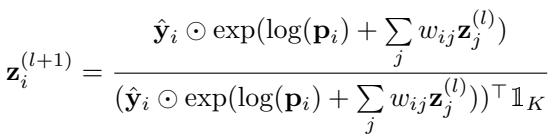
This update also includes a Laplacian regularizer (ensuring similar images get similar predictions) and a text-supervision term (don’t stray too far from the zero-shot prediction), but the logic is standard for transductive learning.
Step 2: Update Statistics (\(\mu, \Sigma\))
This is the critical step where StatA shines. The standard MLE approach would calculate the new Mean as simply the average of the images assigned to that class. StatA, however, calculates a weighted average between the batch statistics and the anchor statistics.

Let’s break down this update rule for the Mean (\(\mu_k\)):
- \(\mathbf{v}_k\): The mean of the images currently assigned to class \(k\) (Sample Mean).
- \(\mu'_k\): The text embedding for class \(k\) (Anchor Mean).
- \(\beta_k\): A mixing coefficient (between 0 and 1).
If \(\beta_k\) is 1, we trust the images completely. If \(\beta_k\) is 0, we ignore the images and stick to the text anchor.
The Magic of \(\beta_k\)
The system calculates \(\beta_k\) automatically based on how much data is available for that class.
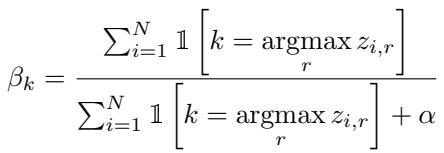
- High Count: If many images are assigned to class \(k\), the sum in the numerator is large, making \(\beta_k\) close to 1. The model “trusts” the visual data because there is enough of it to be statistically significant.
- Low Count: If few or no images are assigned to class \(k\), the sum is small. \(\beta_k\) drops closer to 0. The model relies on the Anchor.
This mechanism allows StatA to seamlessly handle classes that are missing from the batch. For a missing class, \(\beta \approx 0\), so the model keeps the distribution fixed at the text embedding, ready in case a sample appears later.
Experiments and Results
The authors subjected StatA to rigorous testing against other leading methods (MTA, Dirichlet, ZLaP, TransCLIP) across varied datasets like ImageNet, EuroSAT, and UCF101.
1. Robustness to Sparse Batches
In the “Batch Adaptation” experiment, they varied the number of effective classes (\(K_{\text{eff}}\)) present in a batch.
The Scenario: A batch size of 64, but the number of actual classes present ranges from “Very Low” (1-4 classes) to “Medium” (5-25 classes).
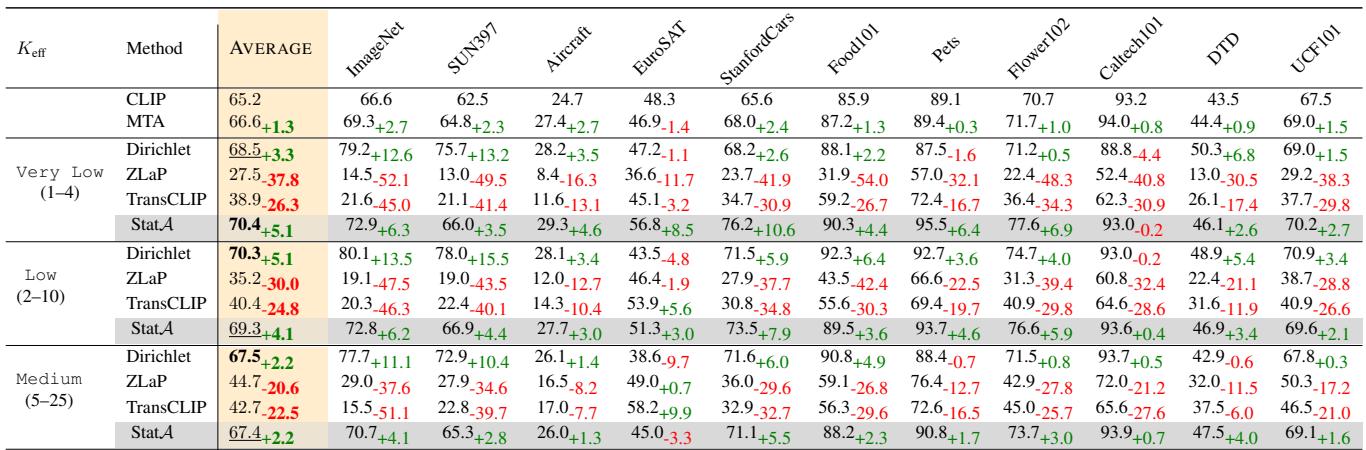
Looking at Table 1(a) above:
- ZLaP and TransCLIP crash in the “Very Low” setting (highlighted in red percentages like -37.8% or -26.3%). They perform significantly worse than the base CLIP model because they try to force-fit data into empty classes.
- StatA (our method) consistently provides positive gains (+5.1% in Very Low, +4.1% in Low), regardless of how few classes are present.
2. Robustness to Correlation (Online Streams)
In the online setting, tasks arrive in a stream. The authors controlled the correlation using a Dirichlet parameter \(\gamma\). A lower \(\gamma\) means higher correlation (e.g., seeing 50 frames of a “Cat” in a row).
The visualization below shows the correlation matrix. The darker/blockier the heatmap, the more correlated (clumped) the data is.
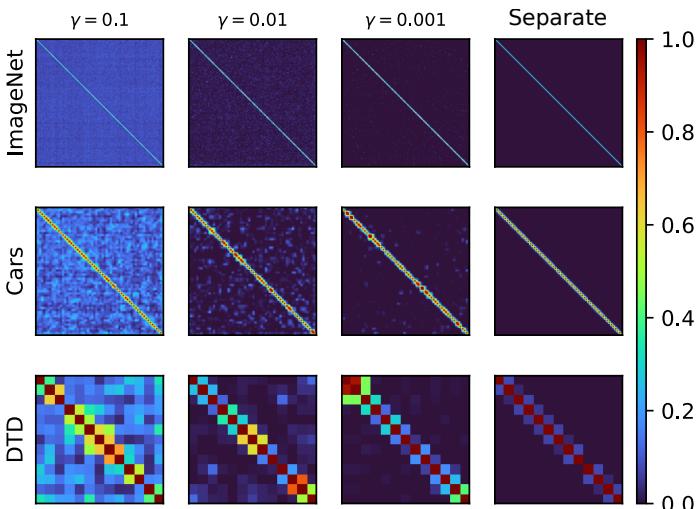
The Results: In highly correlated streams (the “Low” and “Separate” scenarios in the table below), methods that rely on maintaining a diverse memory bank (like TDA or DMN) struggle. StatA, however, remains robust.
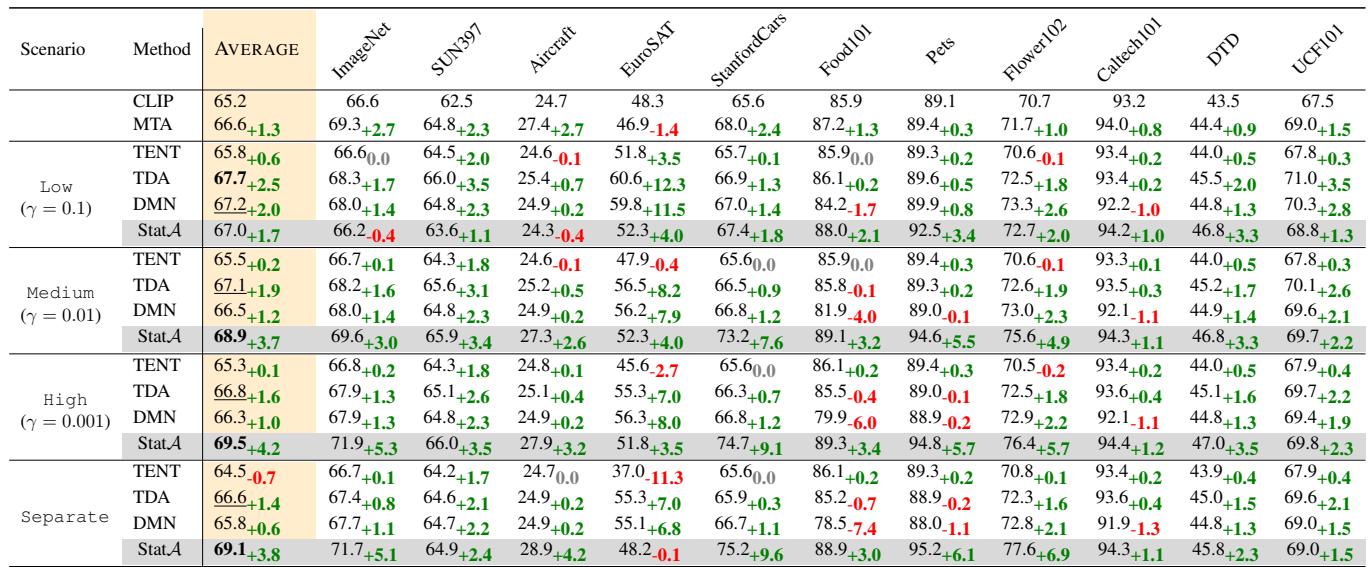
In the Separate scenario (where classes appear sequentially, one after another), StatA achieves an average accuracy of 69.1%, significantly outperforming the baseline (65.2%) and remaining competitive or superior to other methods which often degrade.
3. Computational Efficiency
One valid concern with iterative algorithms is speed. Does this adaptation slow down the inference?

As shown in Table 3, the cost is negligible. Processing a batch of 1,000 images takes about 6 seconds for the CLIP inference (extracting features). The StatA adaptation adds only 0.1 seconds. This makes it highly practical for real-time deployment.
Why Does It Work? The Role of Alpha
The hyperparameter \(\alpha\) in the objective function controls the strength of the anchor. The authors performed an ablation study to see how sensitive the model is to this parameter.
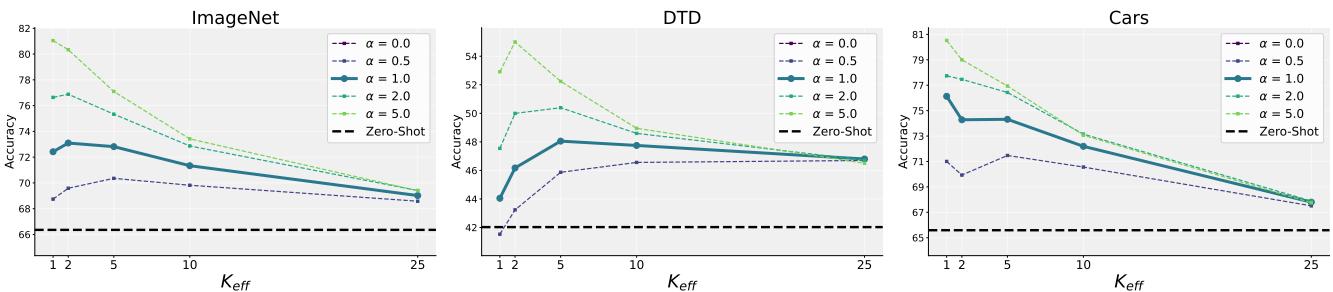
The charts above show accuracy (Y-axis) vs. number of effective classes (X-axis) for different \(\alpha\) values.
- \(\alpha = 0\) (Purple dashed): This turns off the anchor. Notice how performance plummets when \(K_{\text{eff}}\) is low (left side of charts). This confirms that standard MLE fails with sparse data.
- \(\alpha = 1\) (Thick blue line): This is the default setting. It provides the most stable performance across the board, acting as a reliable safety net.
This validates the hypothesis: in low-data regimes, you need the prior knowledge from the text encoder to constrain the optimization.
Conclusion
The paper “Realistic Test-Time Adaptation of Vision-Language Models” teaches us a valuable lesson about deploying AI: assumptions matter.
Methods that excel on paper often fail in the wild because they assume data is balanced and plentiful. By testing on sparse batches and correlated streams, Zanella et al. exposed the fragility of existing VLM adaptation techniques.
Their proposed solution, StatA, offers a mathematically elegant fix. By using the text encoder as a Statistical Anchor, the model can adapt to new visual data when it’s available, but falls back on its robust pre-trained knowledge when data is scarce.
Key Takeaways:
- Real-world data is messy: It comes in clumps (correlated) and rarely contains all classes at once (low \(K_{\text{eff}}\)).
- Don’t forget what you know: Pure adaptation can lead to drift. Anchoring adaptation to the original text embeddings stabilizes the process.
- StatA is versatile: It works for batches, streams, balanced data, and imbalanced data without needing complex hyperparameter tuning or heavy computation.
For students and practitioners looking to deploy CLIP or similar models in dynamic environments, StatA represents a significant step toward making these systems truly robust and autonomous.