](https://deep-paper.org/en/paper/2501.06058/images/cover.png)
Introduction
Imagine a team of robots deployed to fight a wildfire. This isn’t a uniform squad of identical drones; it is a heterogeneous team. Some are fast aerial scouts with limited payload, others are heavy ground rovers carrying massive water tanks, and a few are agile quadrupeds designed to navigate debris. To succeed, these robots must coordinate flawlessly. The scouts need to identify hotspots for the rovers, and the rovers need to position themselves where they can be most effective given their slow speed.
Now, imagine one rover breaks a wheel and slows down, or a new type of drone joins the team mid-mission. In traditional multi-robot systems, this scenario is a nightmare.
Current neural architectures for multi-robot coordination force a difficult choice upon researchers. You can prioritize efficiency by sharing a single “brain” (policy) across all robots, but this often fails to account for the unique capabilities of different machines. Alternatively, you can prioritize diversity by training a separate policy for every single robot, but this is computationally expensive and brittle—if the team composition changes, the system breaks.
In the paper “CASH: Capability-Aware Shared Hypernetworks for Flexible Heterogeneous Multi-Robot Coordination,” researchers from Georgia Tech propose a novel architecture that refuses to compromise. By leveraging Hypernetworks, they introduce a method called CASH that achieves the best of both worlds: the efficiency of shared learning with the flexibility of individualized behavior.
The Heterogeneity Problem
To understand why CASH is significant, we first need to define the spectrum of existing solutions in Multi-Agent Reinforcement Learning (MARL).
The Two Ends of the Spectrum
Shared-Parameter Architectures (The “One-Size-Fits-All” Approach): In this setup, every robot runs the exact same neural network. This is highly sample-efficient because experience gained by one robot trains the network for everyone. However, it struggles with heterogeneity. If you feed the same observation to a drone and a heavy rover, a shared network might output the same action, which could be disastrously wrong for one of them. Previous attempts to fix this involved appending a “Unique ID” to the input, but this is often insufficient for complex coordination.
Individualized Policies (The “Siloed” Approach): Here, every robot has its own unique neural network. This allows for specialized behavior—the drone learns to fly high, the rover learns to drive low. However, this approach scales poorly. It requires massive amounts of data to train, and crucially, it cannot generalize. If you train a team of 3 robots and want to deploy a team of 4, or swap a scout for a tanker, you have to retrain the entire system from scratch.
The CASH Solution: Soft Weight Sharing
The researchers view these two approaches not as binary choices, but as ends of a spectrum. They propose CASH to inhabit the middle ground. It uses a technique called soft weight sharing.
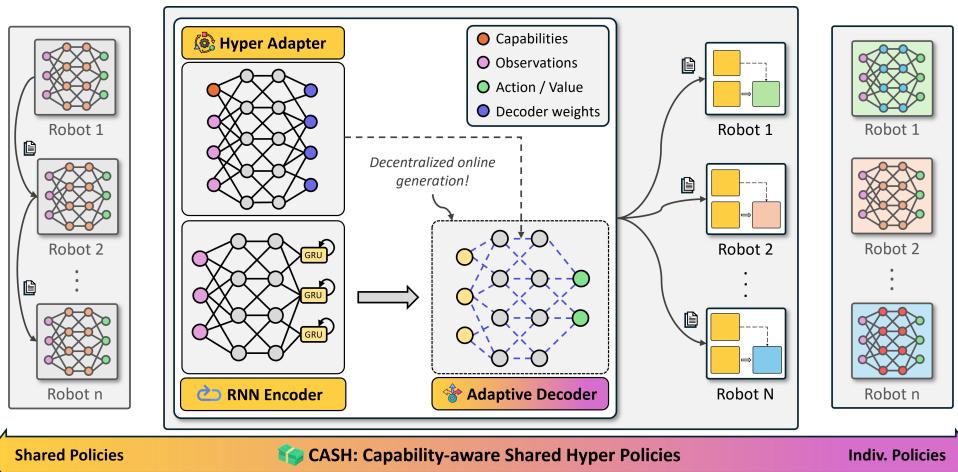
As illustrated in Figure 1, CASH sits between the rigid shared policies (left) and the disparate individual policies (right). It allows robots to share knowledge (parameters) while dynamically generating unique behaviors based on their specific capabilities (e.g., speed, sensing radius, payload).
Deep Dive: The CASH Architecture
The core innovation of CASH is the use of a Hypernetwork. In deep learning, a standard network takes an input and produces an output. A Hypernetwork is a “network that generates weights for another network.”
CASH is composed of three primary modules: the RNN Encoder, the Hyper Adapter, and the Adaptive Decoder.
1. The RNN Encoder (The Eye)
First, the robot needs to process its surroundings. The RNN Encoder takes the robot’s local observations (\(o_i^t\)) and processes them using a Gated Recurrent Unit (GRU). This handles partial observability and memory, producing a latent embedding (\(z_i^t\)) that represents the robot’s current understanding of the world. This module is shared across all robots—they all see the world through the same “eyes.”
2. The Hyper Adapter (The Brain)
This is where the heterogeneity happens. The Hyper Adapter is a hypernetwork that takes three specific inputs:
- The robot’s own capabilities (\(c_i^t\)).
- The capabilities of its teammates (\(C_{/i}^t\)).
- The current local observation (\(o_i^t\)).
Based on this context, the Hyper Adapter generates a specific set of weights (\(\theta_i^t\)).
Think of this as a coach giving instructions. Instead of giving a generic command (“Move North”), the coach looks at the player (“You are fast”) and the situation (“The enemy is on the left”) and hands the player a custom playbook for that specific moment.
3. The Adaptive Decoder (The Actor)
The Adaptive Decoder is a standard Multi-Layer Perceptron (MLP), but it doesn’t have fixed weights. Instead, its weights are populated on-the-fly by the Hyper Adapter. It takes the observation embedding from the RNN Encoder and produces the final action (or value estimate).
Because the weights (\(\theta_i^t\)) are generated dynamically, two robots with different capabilities will receive different weights for their decoders, leading to different actions even if they see the same thing. However, because the Hyper Adapter itself is shared, the team effectively learns a single, powerful model that knows how to generate specialized policies for any robot configuration.
The Importance of Layer Normalization
An interesting engineering hurdle the authors overcame was the instability of training hypernetworks. Hypernetworks are notoriously difficult to train in Reinforcement Learning (RL) settings. The authors found that including Layer Normalization in the Hyper Adapter was critical.
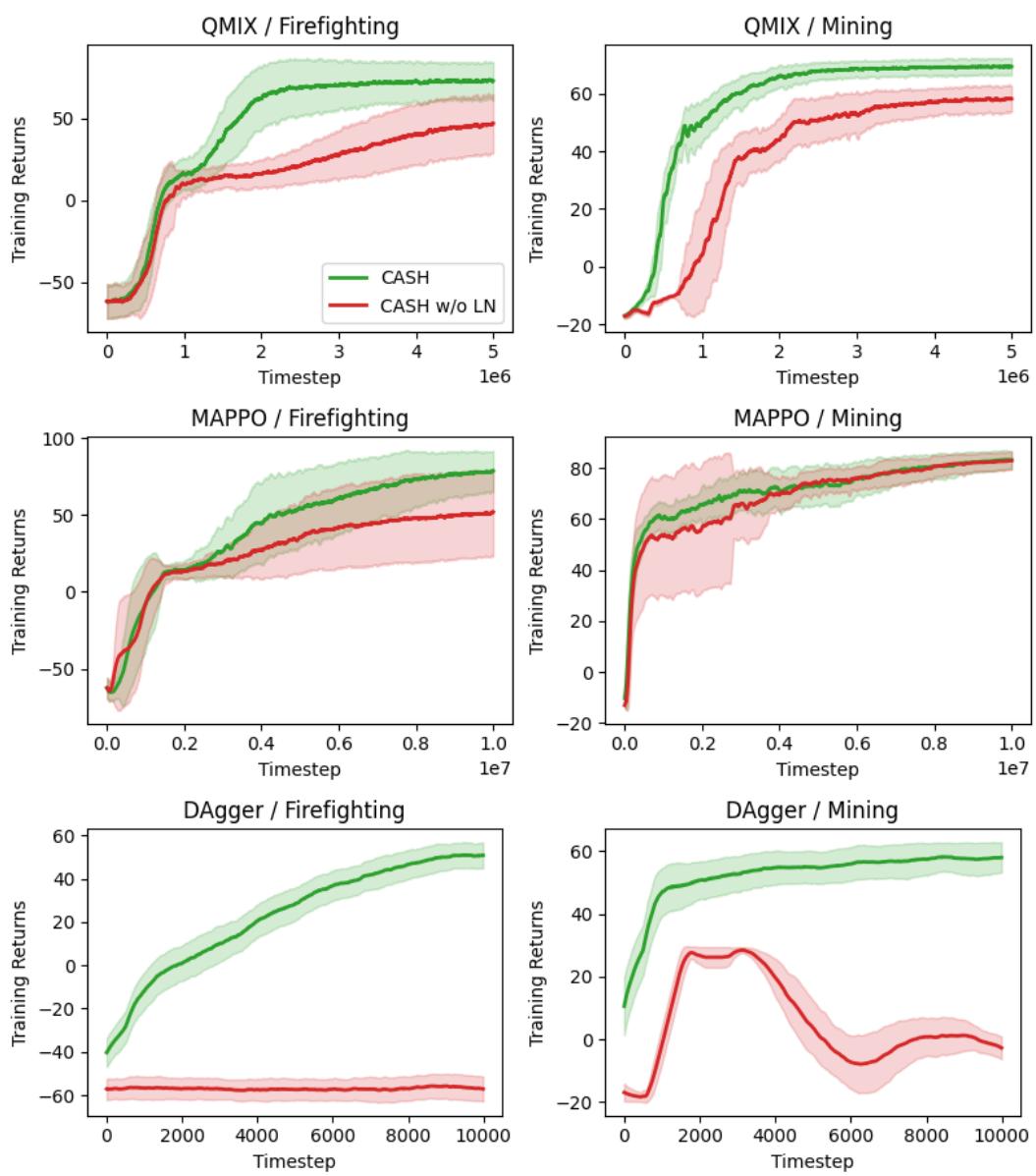
As shown in Figure 5, removing Layer Normalization (the red lines) frequently resulted in catastrophic performance drops or failure to learn, particularly in complex tasks like Mining with DAgger. This serves as a valuable lesson for students implementing hypernetworks: normalization is not just a tuning trick; it is often a structural necessity.
Experimental Setup
To validate CASH, the researchers tested it across multiple learning paradigms:
- QMIX: Value-based Multi-Agent RL.
- MAPPO: Policy-gradient RL.
- DAgger: Imitation Learning.
They utilized two distinct platforms:
- JaxMARL: A high-speed simulation environment for tasks like Firefighting (requiring coordination of speed and water capacity) and Mining (requiring coordination of carrying capacities).
- The Robotarium: A real-world hardware testbed at Georgia Tech, used for Material Transport and Predator-Prey scenarios.
The baselines for comparison were:
- INDV: Independent policies (separate networks for each robot).
- RNN-IMP: Implicit capability handling (standard shared network, hopes to infer capability from history).
- RNN-EXP: Explicit capability handling (standard shared network, capability appended to input).
Key Results and Analysis
The results highlight three major advantages of CASH: sample efficiency, zero-shot generalization, and robustness.
1. Efficiency and Parameter Count
One might assume that generating weights dynamically requires a massive model. Surprisingly, CASH consistently utilized 60% to 80% fewer learnable parameters than the baselines while achieving superior performance.
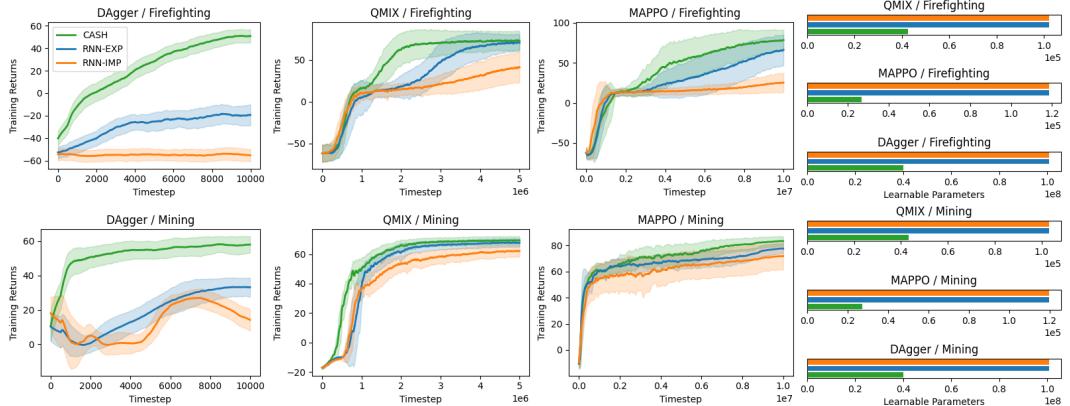
Figure 3 demonstrates that CASH (Green) achieves higher returns faster than the baselines. This efficiency stems from the “soft sharing.” The network doesn’t need to relearn how to navigate for every robot type; it learns navigation once in the Encoder/Adapter and learns how to modify that navigation based on capability in the Hypernetwork.
When compared specifically to Individualized Policies (INDV), the difference is stark.
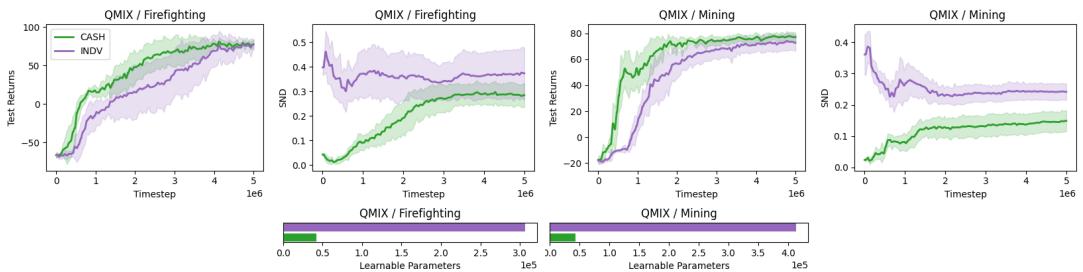
Figure 2 shows that CASH matches or exceeds the performance of INDV (Purple) but does so with a fraction of the parameters. The “SND” plots (System Neural Diversity) indicate that INDV often learns too much diversity—random variations that don’t help the task—whereas CASH learns the “appropriate” amount of diversity needed to solve the problem.
2. Zero-Shot Generalization
The standard limitation of MARL is that if you train on a specific team, you are stuck with that team. CASH breaks this limitation.
The authors evaluated the models on unseen team compositions—robots with capabilities (e.g., speeds or radii) that were not present in the training set.
- INDV cannot handle this at all; it cannot run on a new robot.
- RNN-EXP (Explicit sharing) dropped significantly in performance.
- CASH maintained high success rates.
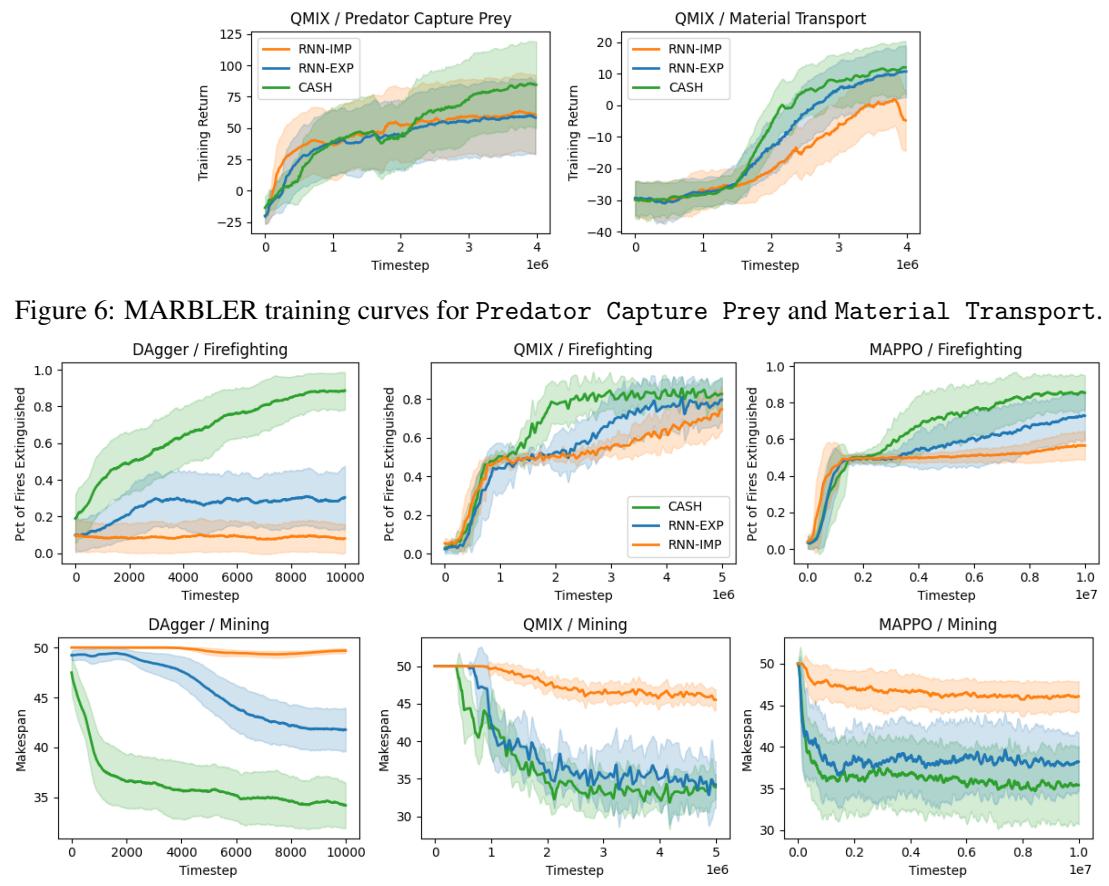
In Figure 7, looking at the top row (Firefighting), CASH (Green) maintains higher extinguishment rates on unseen teams compared to the baselines. This proves that CASH isn’t just memorizing IDs; it is learning a generalized relationship between capability and strategy.
3. Real-World Deployment and Resilience
Simulation results are promising, but the chaos of the real world is the ultimate test. The authors deployed CASH on the Robotarium hardware.
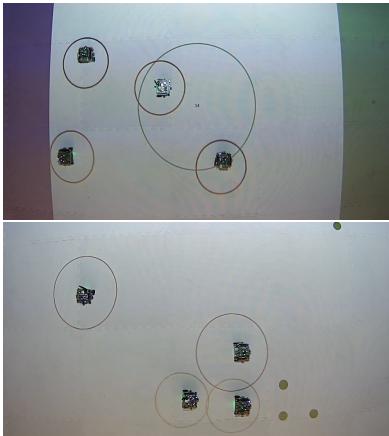
In the physical experiments (Material Transport and Predator-Prey), CASH achieved the highest rewards and lowest collision rates. But the most impressive result came from Online Adaptation.
The researchers introduced “Failure” scenarios where a robot’s speed or sensing radius was suddenly slashed by 75% mid-mission, or “Battery Drain” where capabilities decayed over time.
Because CASH generates policy weights at every timestep based on the current capability capabilities, it adapted immediately.
- RNN-IMP/EXP baselines failed to adjust; their policies were static regarding capability logic.
- CASH recognized the new capability state and generated a new, slower/more conservative policy for the damaged robot, allowing the team to continue and complete the task.

As shown in Table 2, this adaptability translated to significantly higher rewards and faster completion times (makespan) on physical hardware.
Conclusion
The CASH architecture represents a significant step forward in multi-robot learning. By identifying the trade-off between shared and individualized parameters as a spectrum, the authors utilized Hypernetworks to create a flexible middle ground.
For students and practitioners in robotics, the takeaways are clear:
- Heterogeneity matters: Simply appending a “Robot ID” to a neural network input is often insufficient for complex coordination.
- Hypernetworks are powerful tools for adaptation: They allow a system to dynamically reconfigure its “brain” based on context (capabilities), enabling zero-shot generalization.
- Efficiency and Diversity can coexist: We do not have to choose between a sample-efficient clone army and a computationally expensive diverse team.
CASH proves that with the right architecture, we can build robot teams that are not only diverse and efficient but also resilient enough to handle the unpredictable nature of the real world.