](https://deep-paper.org/en/paper/2501.09898/images/cover.png)
FoundationStereo: Bringing Zero-Shot Generalization to Stereo Depth Estimation
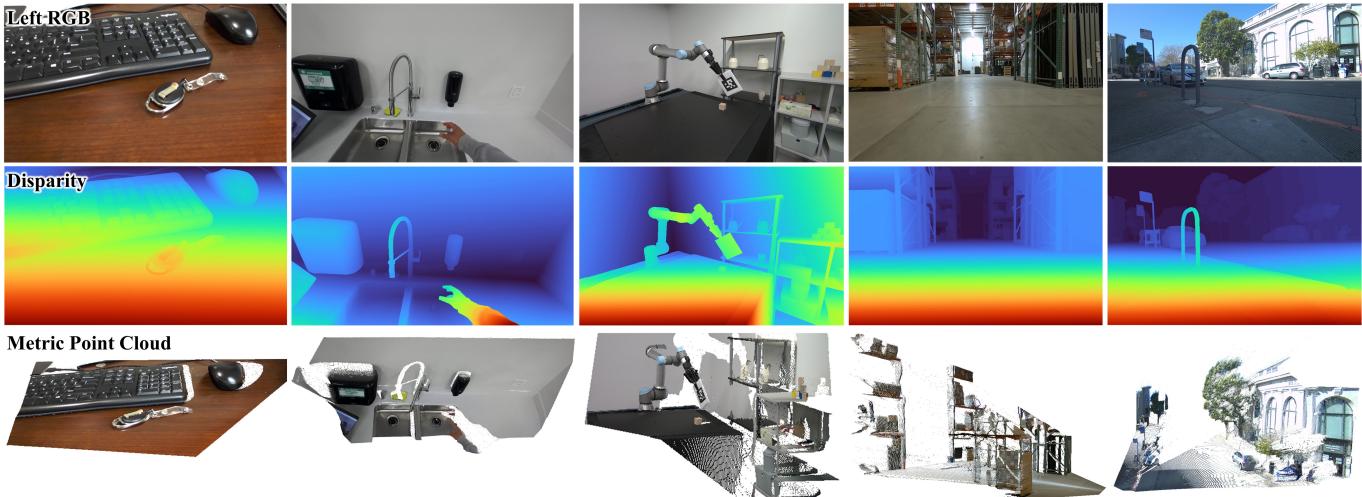
In the rapid evolution of computer vision, we have seen “Foundation Models” transform how machines understand images. Models like Segment Anything (SAM) or DepthAnything have demonstrated an incredible ability to generalize: they can perform tasks on images they have never seen before without needing specific fine-tuning.
However, one corner of computer vision has lagged behind in this zero-shot revolution: Stereo Matching.
Stereo matching—the process of estimating depth by comparing two images taken from slightly different viewpoints—has historically relied on training deep networks on specific datasets. A model trained on driving scenes (like KITTI) usually fails when tested on indoor scenes (like Middlebury). It’s a classic case of overfitting to the domain.
Enter FoundationStereo. In a recent paper by researchers at NVIDIA, a new architecture and training pipeline were proposed to bridge this gap. This model achieves strong zero-shot generalization, meaning it works exceptionally well on “in-the-wild” images without needing to be retrained for them.
In this post, we will deconstruct FoundationStereo. We will explore how it leverages synthetic data, how it adapts monocular foundation models, and the novel architectural choices that allow it to scale.
The Problem: The Generalization Gap
Traditional deep stereo networks function by finding corresponding pixels between a left and right image. If pixel \(A\) in the left image corresponds to pixel \(B\) in the right image, the horizontal distance between them is the disparity. Depth is inversely proportional to this disparity.
The challenge lies in ambiguity. Textureless walls, reflective surfaces (mirrors, glass), and thin structures (wires, fences) make it difficult for algorithms to find correct correspondences.
To solve this, modern networks use Cost Volumes—3D representations of similarity between pixels at different disparity levels. While effective, these networks usually require fine-tuning on the target environment to learn the specific statistical distribution of that environment.
FoundationStereo aims to break this cycle. The goal? A model you can download and run immediately on a robot, a drone, or a handheld camera, regardless of whether it’s indoors, outdoors, underwater, or in space, and get state-of-the-art results.
The Solution Overview
FoundationStereo achieves its performance through three main pillars:
- Scalable Data: A massive synthetic dataset with a self-curation pipeline.
- Monocular Priors: Integrating knowledge from a pre-trained “DepthAnything” model.
- Advanced Architecture: A new way to process cost volumes using “Axial-Planar” convolutions and Transformers.
Let’s look at the high-level architecture before diving into the details.
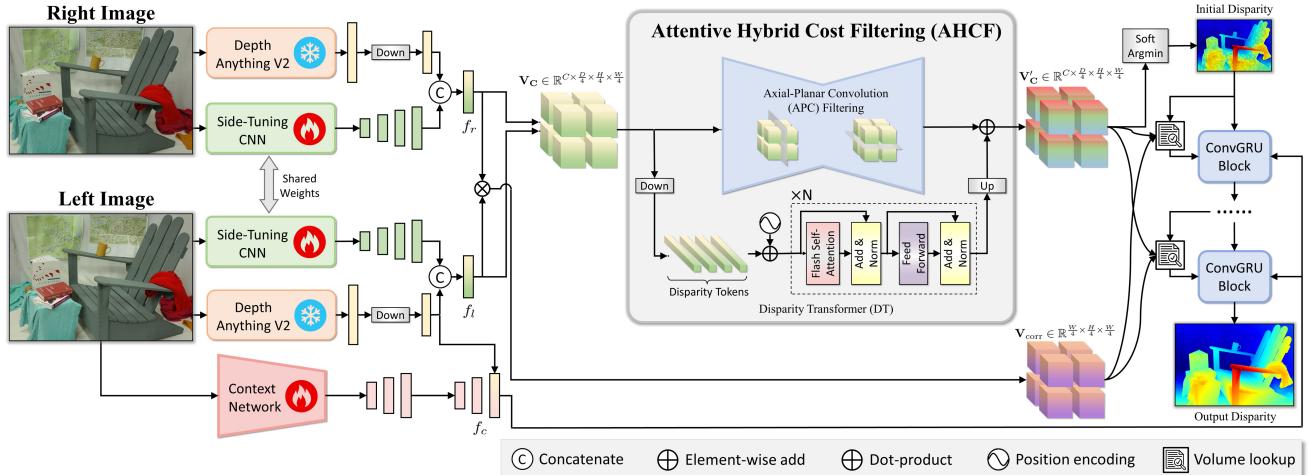
As shown above, the system takes a stereo pair as input. It processes these images through a Side-Tuning Adapter (STA) to extract features, constructs a Hybrid Cost Volume, filters it using an Attentive Hybrid Cost Filtering (AHCF) module, and finally refines the result using Recurrent Neural Networks (GRUs).
Core Method: Injecting World Knowledge
One of the smartest moves in this paper is the realization that we don’t need to learn “what the world looks like” from scratch. We already have vision foundation models that understand objects, shapes, and depth.
1. Side-Tuning Adapter (STA)
Pure stereo networks often struggle when the visual data is ambiguous (e.g., a white wall). A human, however, knows the wall is flat and continuous even without texture. This is semantic and monocular prior knowledge.
FoundationStereo integrates this knowledge by using DepthAnythingV2, a model trained on internet-scale data for monocular (single image) depth estimation.
However, simply plugging in a frozen ViT (Vision Transformer) isn’t enough. The researchers use a technique called Side-Tuning.
- They keep the massive DepthAnythingV2 model frozen (weights don’t change).
- They run a lightweight CNN (EdgeNeXt) alongside it.
- They mix the rich, semantic features from the frozen model with the high-frequency, detailed features from the CNN.
This approach gives the stereo network a “common sense” understanding of the scene (from the foundation model) while retaining the precision needed for pixel-matching (from the CNN).
2. Attentive Hybrid Cost Filtering (AHCF)
Once features are extracted, the network builds a Cost Volume. This is a 4D tensor (Batch \(\times\) Channels \(\times\) Disparity \(\times\) Height \(\times\) Width) that represents the matching cost for every pixel at every possible depth.
The researchers introduce a hybrid volume combining two types of information:
- Group-wise Correlation: How mathematically similar are the features?
- Concatenation: Preserving the raw semantic features within the volume.
The construction is defined mathematically as:
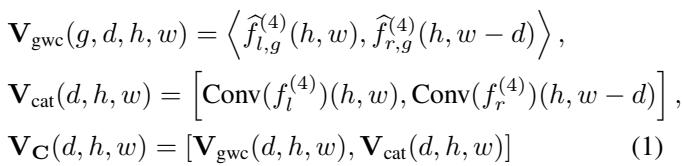
Here, \(V_{gwc}\) captures similarity, and \(V_{cat}\) preserves the rich context from the STA module.
The Bottleneck of 3D CNNs
Traditionally, networks use 3D Convolutions to process this volume. The problem? 3D Convolutions are extremely memory-hungry. This limits the resolution and the number of disparity levels you can search, effectively putting a ceiling on performance.
To solve this, FoundationStereo replaces standard 3D convolutions with two innovations:
A. Axial-Planar Convolution (APC) Instead of a heavy \(3 \times 3 \times 3\) convolution, they decouple it into two lighter operations:
- A spatial convolution (\(K_s \times K_s \times 1\)) acting on the image plane (H, W).
- A disparity convolution (\(1 \times 1 \times K_d\)) acting on the depth dimension (D).
This drastically reduces parameter count and memory usage, allowing the model to handle larger disparity ranges (up to 17 pixels in the kernel, compared to the usual 3).
B. Disparity Transformer (DT) Convolutional networks are “local”—they look at neighboring pixels. Sometimes, to resolve a depth ambiguity, you need to look at the whole picture (global context).
The authors introduce a Transformer block that operates only along the disparity dimension. It uses an attention mechanism to reason about the probability distribution of depth for each pixel globally.


By applying self-attention (implemented efficiently via FlashAttention) over the disparity tokens, the network can reason about complex scenarios, such as transparent objects or occlusions, much more effectively than CNNs alone.


3. Iterative Refinement
After the cost volume is filtered, the network predicts an initial disparity map using a Soft-Argmin operation:
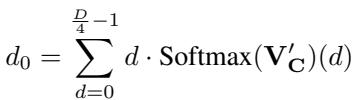
This initial guess is good, but not perfect. To get sharp edges and sub-pixel accuracy, the model uses a Recurrent Neural Network (specifically, a ConvGRU). This is similar to how an artist sketches a rough outline and then progressively refines the details.
Over several iterations (\(k\)), the GRU updates the disparity prediction (\(d_k\)) by looking up features from the cost volume and checking how well the left and right images align.
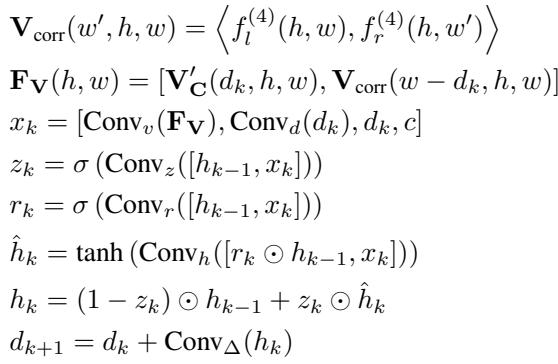
The model is trained using a loss function that ensures the disparity gets closer to the ground truth (\(\bar{d}\)) at every step of the iteration:

Visualizing the Impact
Does this complex architecture actually help? The figure below shows the difference. “W/o STA” shows the model failing on a dark textureless lamp. With the STA (Side-Tuning Adapter), the model “knows” it’s a lamp and fills in the depth correctly. Similarly, the AHCF module resolves fine repetitive structures that confuse standard 3D CNNs.

The Engine: Synthetic Data & Self-Curation
You cannot train a “Foundation” model on small datasets. Real-world stereo data with perfect ground truth is incredibly scarce (LIDAR is sparse, structured light has limited range).
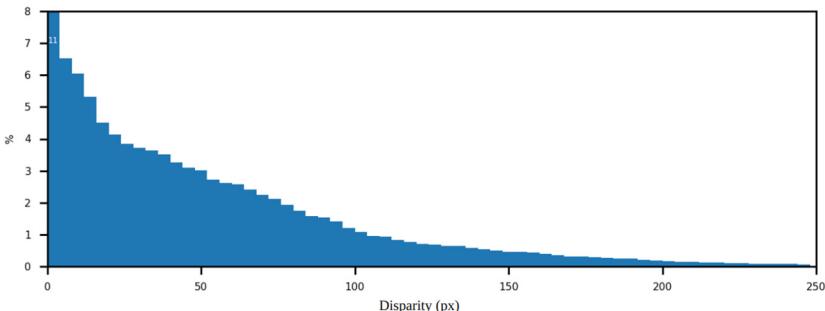
The researchers generated a massive synthetic dataset called FoundationStereo Dataset (FSD) using NVIDIA Omniverse. It contains 1 million stereo pairs—significantly larger than Scene Flow (the previous standard).
However, synthetic data isn’t perfect. Randomly generated scenes can create “impossible” or ambiguous stereo pairs (e.g., a camera inside a solid object, or extreme glare). To fix this, they developed an Iterative Self-Curation pipeline.

- Train a model on the initial dataset.
- Run the model on the dataset itself.
- If the model has extremely high error (bad prediction) on a training sample, that sample is likely ambiguous or flawed.
- Remove those samples and regenerate new ones.
This “cleaning” process significantly improves the quality of the gradients during training. The dataset includes diverse scenarios, from industrial warehouses to random flying objects, covering a wide range of lighting conditions and textures.
Experiments & Results
How does FoundationStereo stack up against the competition?
In-the-Wild Generalization
The primary goal was zero-shot performance. The researchers compared their model against other state-of-the-art models (like IGEV and RAFT-Stereo). Importantly, FoundationStereo was not trained on the target datasets for this specific test.
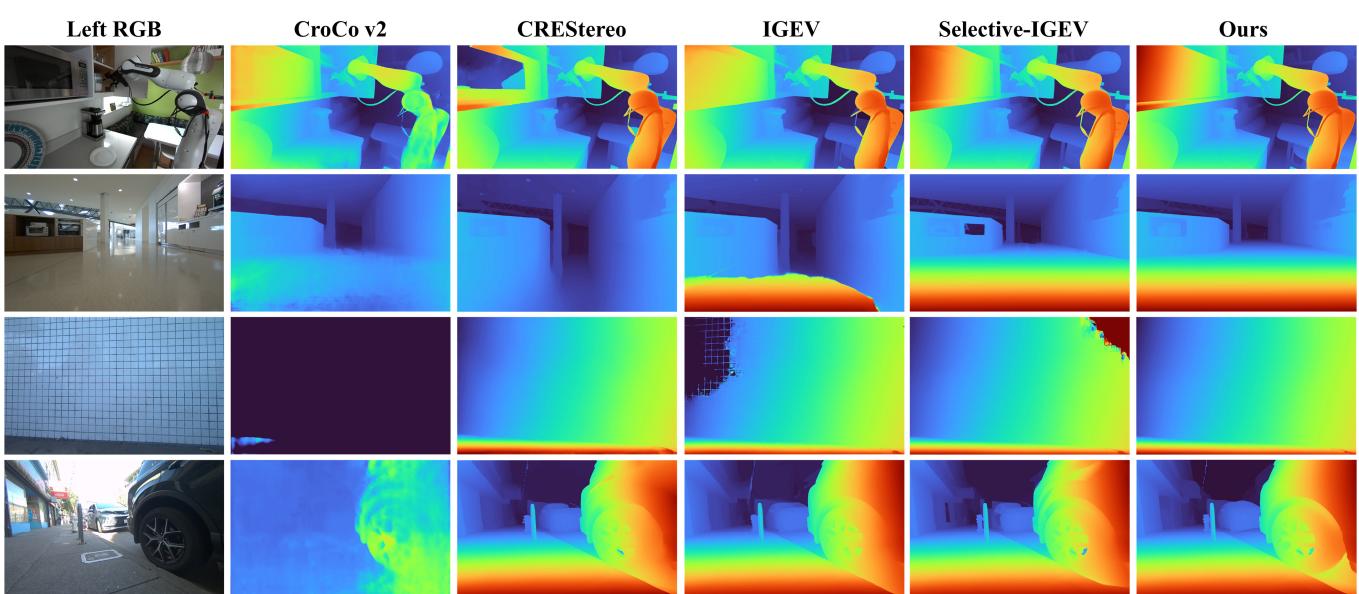
As seen in the figure above, FoundationStereo (far right column) produces significantly cleaner disparity maps. It handles:
- Reflections: Notice the floor in the second row.
- Thin Structures: The robot arm in the first row.
- Textureless Areas: The walls in the third row.
Performance on Transparent Objects
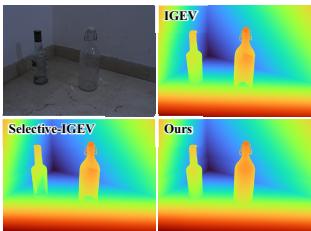
Transparent objects are the “final boss” of stereo matching because the light passes through them, confusing correspondence algorithms. Thanks to the monocular priors (which recognize the object’s shape) and the global reasoning of the Transformer, FoundationStereo excels here.
Benchmark Leaderboards
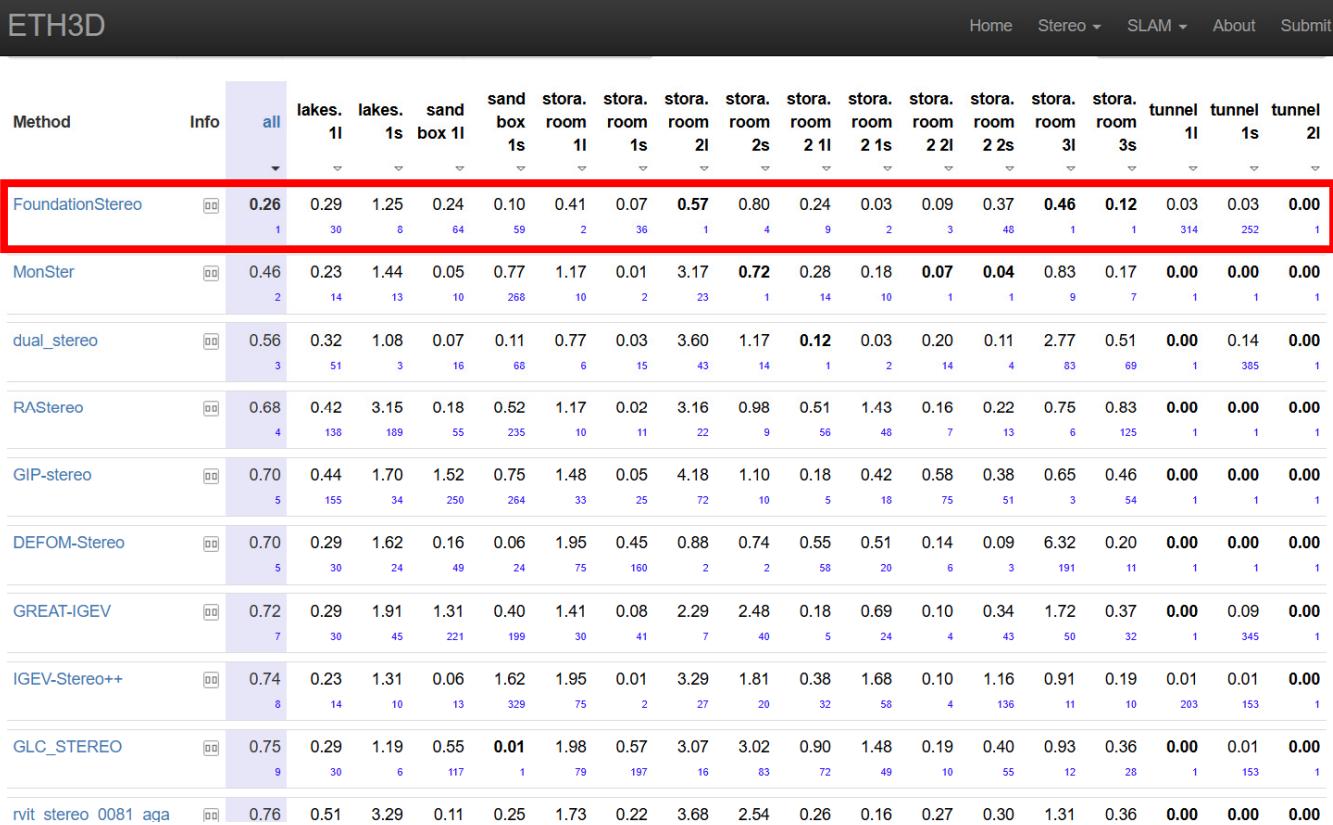
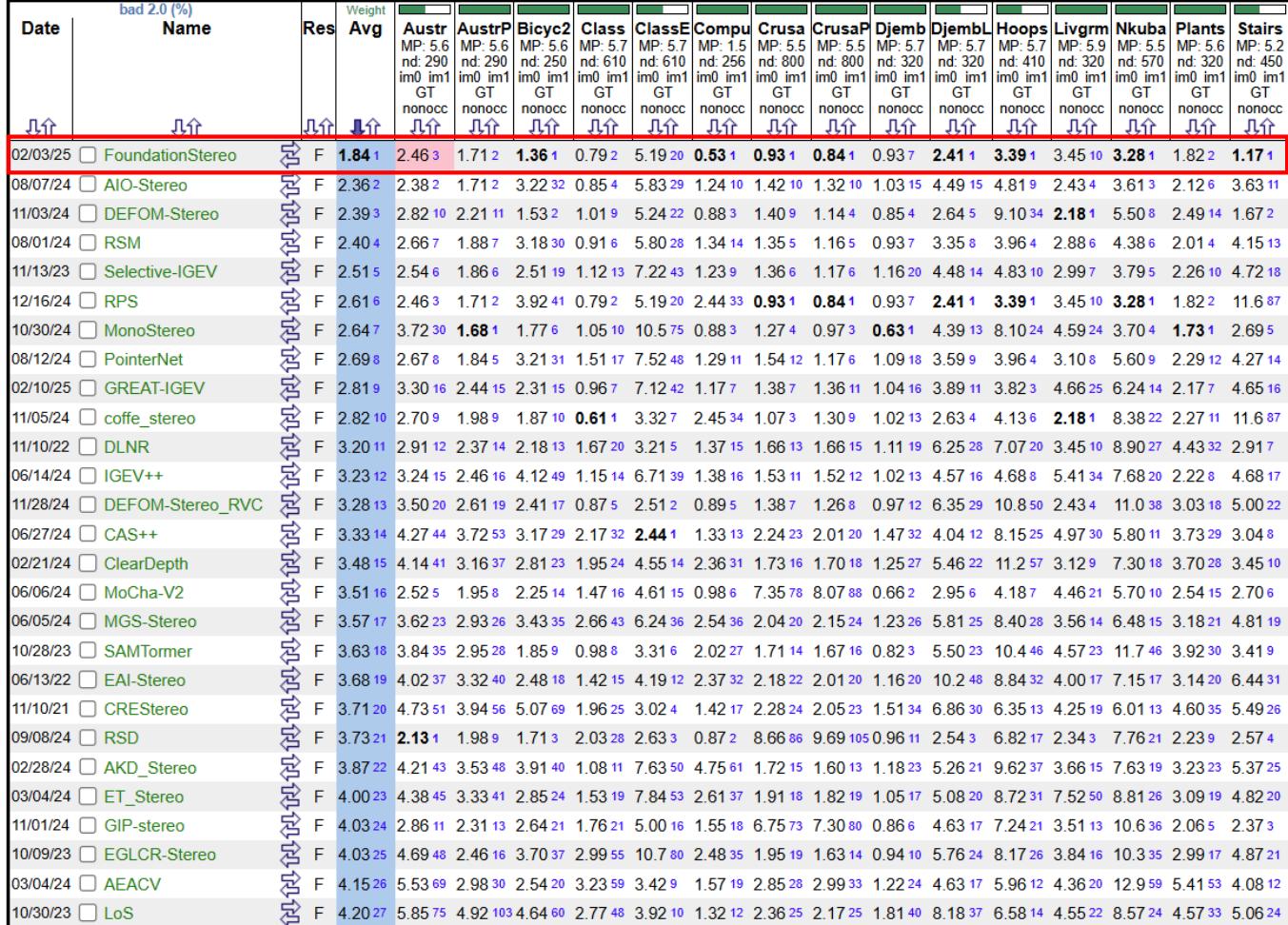
When the model is fine-tuned (trained a bit more on specific domain data), it dominates the leaderboards. At the time of the paper’s release, FoundationStereo ranked 1st on both the ETH3D and Middlebury benchmarks, two of the most respected standards in the field.
Ablation Studies
The authors performed rigorous testing to prove that each component matters.
Table 1: The Power of Side-Tuning (STA) Using the “Side-Tuning” approach (Method c) yielded the lowest error (BP-2 score of 1.97) compared to other integration strategies or freezing/unfreezing the Vision Transformer differently.
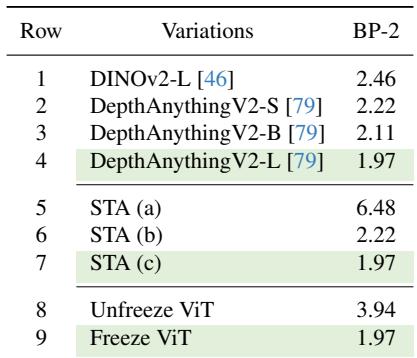
Table 2: The Cost Filtering (AHCF) Combining the Disparity Transformer (DT) and Axial-Planar Convolution (APC) provided the best results. Note that increasing the kernel size of the disparity convolution (last rows) significantly improved performance, proving that looking at a wider range of disparities is crucial.
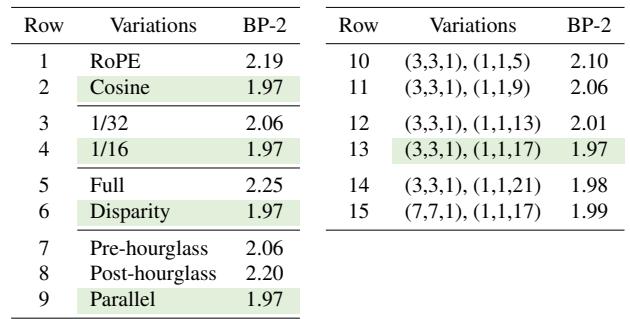
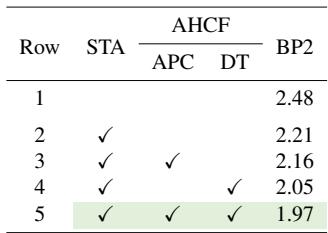
Table 3: Component Contribution This summary table shows the cumulative benefit. Adding STA reduces error. Adding AHCF reduces it further. Finally, training on the massive FSD dataset provides the final boost needed to reach state-of-the-art.
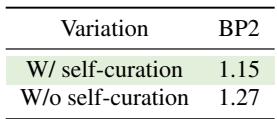
Also, the self-curation of data matters. Removing the “bad” synthetic samples reduced the error rate from 1.27 to 1.15.
Conclusion and Implications
FoundationStereo represents a significant milestone. It successfully brings the “Foundation Model” paradigm to stereo matching. By combining the “common sense” of large-scale monocular models with the mathematical precision of stereo geometry—and scaling it all up with high-quality synthetic data—we finally have a stereo system that generalizes.
Key Takeaways:
- Don’t learn from scratch: Adapting priors from models like DepthAnythingV2 is more effective than training a stereo backbone from zero.
- Architecture matters: Standard 3D CNNs are a bottleneck. Axial-Planar convolutions and Disparity Transformers allow for scalable, global context reasoning.
- Data quality is king: Generating millions of synthetic images is good, but autonomously cleaning that data (self-curation) is what makes it great.
While the model is computationally heavy (making it challenging for real-time applications on edge devices currently), it sets a new standard for accuracy. Future work will likely focus on distilling this massive capability into lighter, faster networks, bringing human-level depth perception to robots and devices everywhere.