](https://deep-paper.org/en/paper/2501.10357/images/cover.png)
Introduction
Imagine you are looking at a standard video clip. It’s a 2D sequence of images. Your brain, processing this monocular (single-eye) view, instantly understands two things: the 3D structure of the scene (what is close, what is far) and the motion of objects (where things are moving in that 3D space).
For computer vision models, replicating this human intuition is an incredibly difficult task known as Monocular Scene Flow (MSF). While we have seen massive leaps in Artificial Intelligence regarding static depth estimation or 2D optical flow, estimating dense 3D motion from a single camera remains an elusive frontier.
The problem is that most existing models are “specialists.” They might perform well on a dataset of cars driving down a highway, but if you show them a video of a dancer or a person playing with blocks, they fail spectacularly. They lack generalization.
In this post, we are deep-diving into a new paper, “Zero-Shot Monocular Scene Flow Estimation in the Wild,” which proposes a robust solution to this problem. The researchers have developed a method that not only achieves state-of-the-art results on standard benchmarks but, more importantly, possesses the ability to work “zero-shot”—meaning it can accurately predict 3D motion on types of videos it has never seen before.
Background: The “Ill-Posed” Problem
Before we look at the solution, we need to understand why Monocular Scene Flow is so hard.
Scene Flow is the 3D vector field that represents the motion of every point in a scene. If you take a 3D point at time \(t\) and track it to time \(t+1\), that vector is the scene flow.
When we try to estimate this from a single camera (monocular), we face an ill-posed problem. When an object in a video moves across the screen, the camera sees a 2D displacement. However, that 2D movement is a combination of two entangled factors:
- Geometry (Depth): How far away is the object?
- Motion: How fast is it actually moving?
A small object moving quickly near the camera can look exactly the same as a massive object moving slowly far away. Without stereo cameras or LiDAR to lock down the depth, the computer has to guess both the geometry and the motion simultaneously. If it gets the geometry wrong, the motion prediction will inevitably be wrong, and vice versa.
Current methods struggle because they treat these as separate problems or train on small, narrow datasets. This new research argues that to solve this in the wild, we need to treat geometry and motion as deeply entangled siblings and train them together on a massive scale.
The Core Method
The researchers identify three main pillars required to solve the generalization puzzle:
- Joint Reasoning: A unified architecture for geometry and motion.
- Data Scale: A massive, diverse training recipe.
- Scale Adaptation: Handling the difference between metric (meters) and relative (unitless) data.
1. The Joint Architecture
The heart of this approach is a unified, feedforward neural network. Unlike previous methods that might use one network for depth and another for flow, this model uses a Vision Transformer (ViT) backbone that shares information between tasks.
As illustrated in the overview below, the model takes two images (\(C_1\) at time \(t_1\) and \(C_2\) at time \(t_2\)) as input.
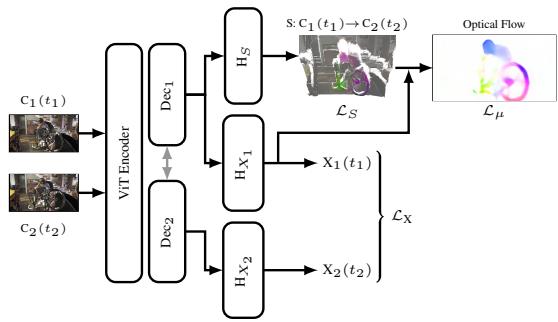
The architecture, built upon the CroCoV2 backbone, splits into two decoders but shares the underlying understanding of the scene. It outputs three specific things:
- \(\hat{X}_1\): The 3D pointmap for the first image.
- \(\hat{X}_2\): The 3D pointmap for the second image.
- \(\hat{S}\): The Scene Flow (3D offsets).
Mathematically, the network heads operate as follows:
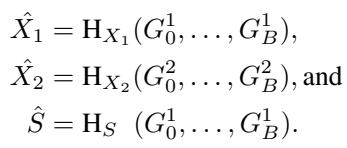
By predicting these jointly, the model creates a feedback loop of sorts. The 3D geometry prior helps the model understand motion, while the temporal correspondence (tracking points over time) helps refine the geometry.
2. The Parameterization Choice
One of the subtle but critical contributions of this paper is determining how to represent scene flow mathematically. The researchers explored three options:
- EP (End Point): Predicting the final 3D coordinate of a point.
- \(\Delta D\) + OF: Predicting the change in depth plus the 2D optical flow.
- CSO (Camera-Space 3D Offsets): Predicting the direct 3D vector difference between the start and end points.
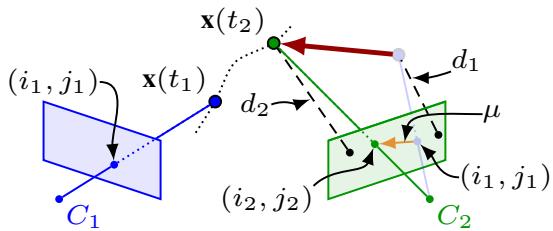
As shown in the diagram above, the CSO (Camera-Space Offsets) method (shown in red) was found to be the most effective. It explicitly models the 3D displacement, which naturally couples well with the pointmap prediction heads. The other methods, particularly those relying on separate depth changes and optical flow, degraded significantly when camera poses weren’t perfectly known—a common scenario in “wild” video.
3. A Recipe for Large-Scale Data
You cannot learn to generalize “in the wild” if you only train on city streets. The researchers aggregated a massive training set comprising over 1 million samples from diverse datasets.
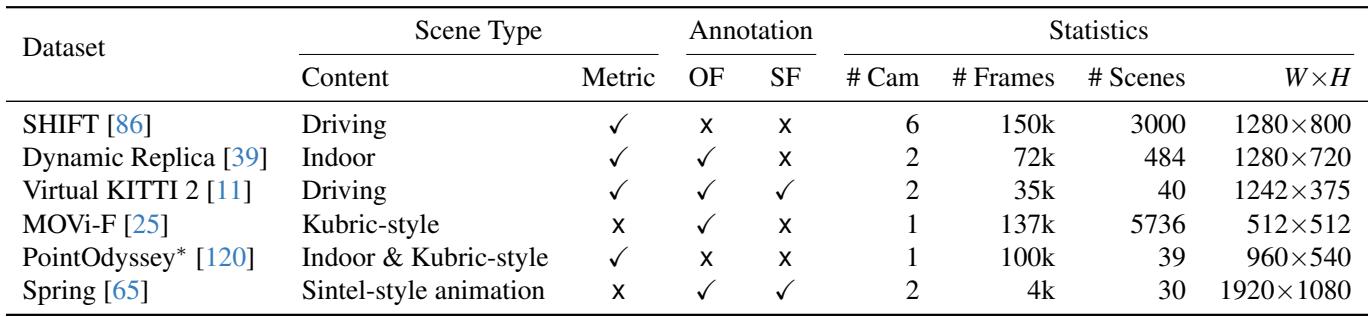
The “Data Recipe” in Table 1 above highlights the diversity:
- SHIFT & Virtual KITTI 2: Driving scenarios.
- Dynamic Replica & PointOdyssey: Indoor and object-focused scenes.
- MOVi-F: Synthetic objects with complex physics.
- Spring: Animation-style data.
This mix ensures the model sees everything from cars zooming past trees to blocks tumbling on a table.
4. Solving the Scale Ambiguity
Here lies the trickiest part of mixing datasets. Some datasets are Metric (they know that a car is 4 meters long). Others are Relative (they only know that the car is twice as big as the bike, but not the absolute size).
If you feed a neural network these two types of data simultaneously without adjustment, the loss function becomes confused. The model won’t know if “1.0” means one meter or “the whole width of the scene.”
To visualize this, look at the difference between MOVi-F (relative) and Virtual KITTI (metric):
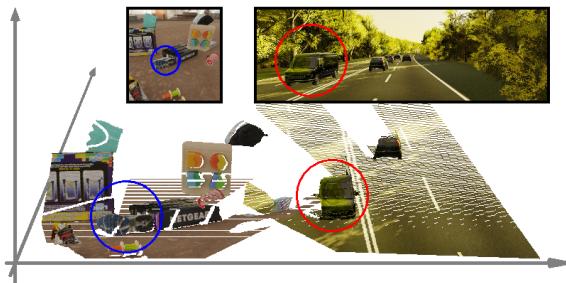
To solve this, the authors introduce a Scale-Adaptive Optimization.
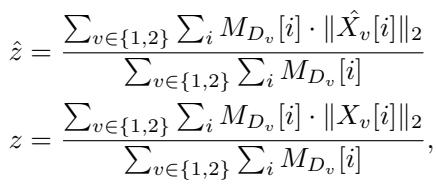
When the data is metric, they use the raw values. When the data is relative, they normalize both the ground truth and the prediction using the mean distance of valid points.
The normalization factor \(\hat{z}\) (for prediction) and \(z\) (for ground truth) is calculated as:
The normalized pointmaps and scene flow are then derived by simply dividing by this factor:
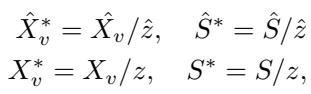
This allows the loss function to effectively “switch modes.” The network learns absolute scale where possible but falls back to scale-invariant structure learning when necessary.
5. Training with Optical Flow Supervision
Even with joint architecture, geometry (\(X\)) and scene flow (\(S\)) are distinct outputs. To glue them together tightly, the researchers use a clever trick: Optical Flow Supervision.
They take the predicted geometry and the predicted scene flow, “project” them back onto the 2D image plane, and check if the resulting 2D motion matches the optical flow.
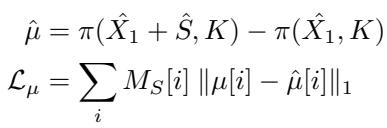
This forces consistency. If the model predicts a point is 100 meters away and moves 1 meter, that creates a tiny 2D pixel shift. If the optical flow says the pixel moved 50 pixels, the model knows its geometry/motion combination is wrong.
Experiments & Results
Does this recipe actually work? The results suggest a resounding yes, particularly in the hardest test: Zero-Shot Generalization.
Quantitative Success
The table below compares the new method against state-of-the-art peers. The most impressive rows are labeled “Out” (Out-of-Domain), meaning the model was tested on a dataset it never saw during training.
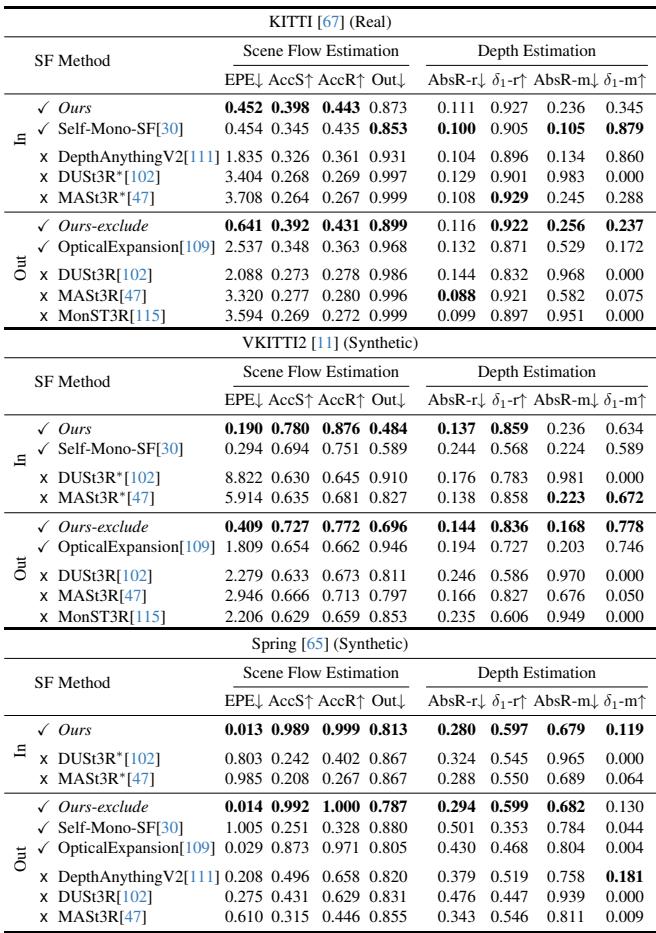
On the Spring dataset (a high-difficulty animation benchmark), the proposed method (Ours-exclude) achieves an End Point Error (EPE) of 0.014, vastly outperforming methods like Self-Mono-SF (EPE 1.005) or MASt3R baselines. It proves that the model isn’t just memorizing specific scenes; it is understanding the physics of vision.
Qualitative Magic
Numbers are great, but in computer vision, seeing is believing. The qualitative results show how the model handles complex, non-rigid motion.
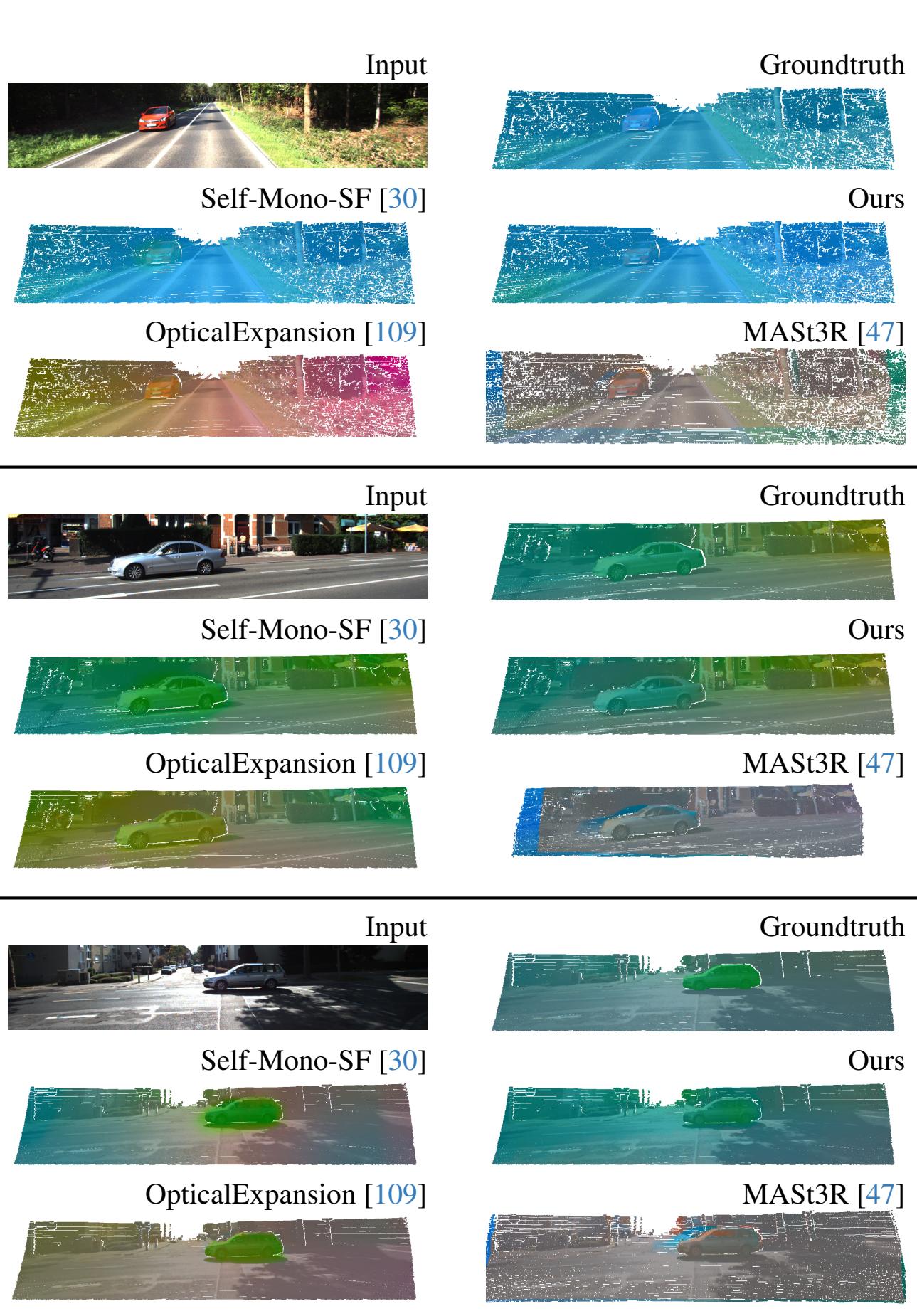
Below is a comparison on the KITTI dataset. Notice how the “Ours” column (second from left) produces flow maps that are incredibly sharp and close to the Ground Truth (leftmost), whereas competitors often introduce noise or miss moving objects entirely.
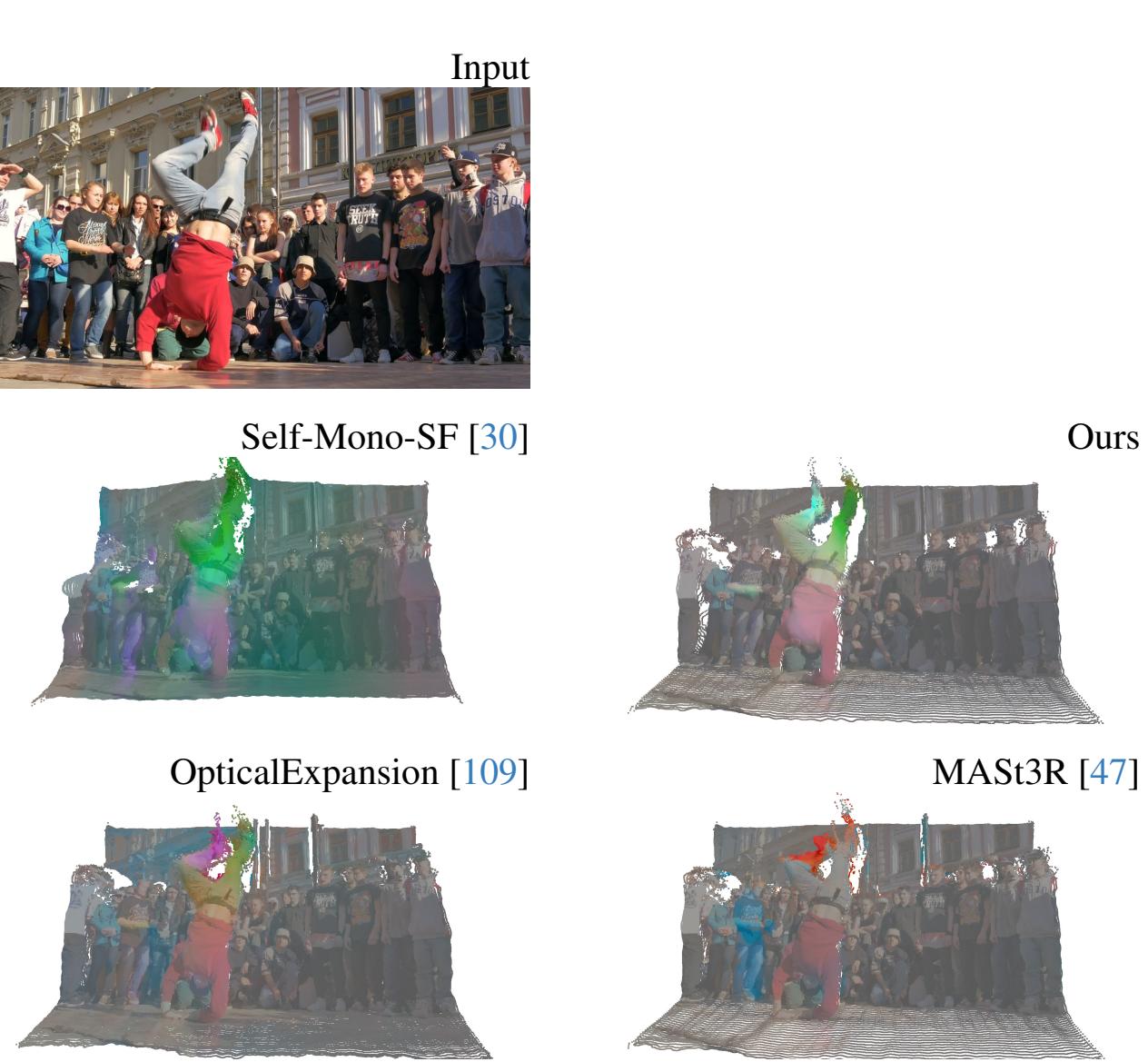
The true power of the method appears in “casual” videos, such as the DAVIS dataset (which contains random YouTube-style clips).
In the example below of a dancer, other methods struggle. Self-Mono-SF (top right) hallucinates motion in the background. MASt3R (bottom right) produces a noisy, fragmented result. The proposed method (bottom left, “Input” is top left) correctly identifies the static background and isolates the complex motion of the dancer’s legs.
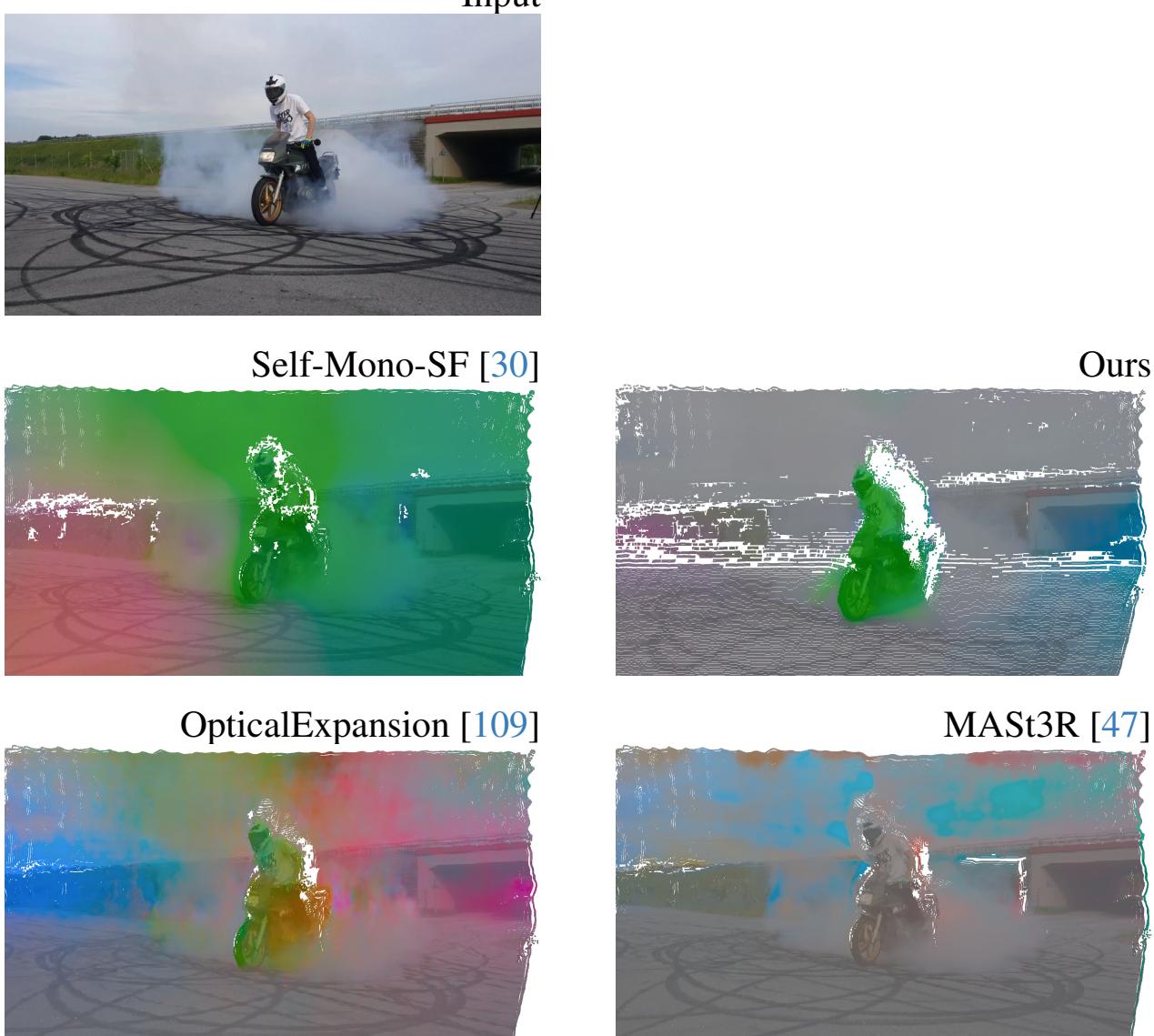
Similarly, in a scene with a motorcycle performing a burnout (below), the model correctly separates the rapid circular motion of the bike from the static environment.
Why Joint Estimation Matters
The researchers didn’t just guess that joint estimation was better; they proved it. In their ablation studies, they compared initializing their offset heads with pre-trained weights from geometry models (like DUSt3R or MASt3R) versus training from scratch.
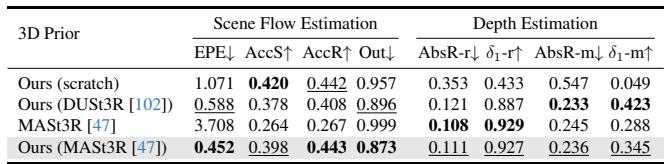
As shown in Table 4, initializing with a strong 3D prior (the “Ours (MASt3R)” row) drops the error from 1.071 (scratch) to 0.452. This confirms the hypothesis: you cannot understand motion well if you don’t first understand geometry.
Conclusion
“Zero-Shot Monocular Scene Flow Estimation in the Wild” represents a significant step forward for computer vision. By acknowledging that geometry and motion are inseparable, and by engineering a training pipeline that can digest massive, multi-scale datasets, the authors have created a model that generalizes to the real world.
The implications for this are vast.
- Robotics: Robots can navigate and interact with dynamic objects in new environments without needing specific retraining.
- Augmented Reality: Virtual objects can interact realistically with moving real-world objects using just a standard camera.
- Video Editing: Editors can apply effects to specific moving 3D layers in a flat video file.
While challenges remain—such as decomposing camera motion from object motion more explicitly—this work proves that with the right architecture and data recipe, we can effectively “tame the wild” of dynamic video scenes.