](https://deep-paper.org/en/paper/2501.11319/images/cover.png)
Introduction
In the rapidly evolving world of Generative AI, Style Transfer remains one of the most fascinating applications. The goal is simple yet challenging: take the artistic appearance (style) of one image and apply it to the structure (content) of another. Imagine painting a photograph of your house using the brushstrokes of Van Gogh’s Starry Night.
With the advent of Diffusion Models (like Stable Diffusion), the quality of generated images has skyrocketed. However, adapting these massive models for specific style transfer tasks typically requires expensive training or fine-tuning (like LoRA or DreamBooth). This led to the rise of training-free methods, which try to leverage the pre-trained knowledge of the model without modifying its weights.
While training-free methods are convenient, they often fail in two specific ways:
- Layout Destruction: The model gets so distracted by the style that it forgets the shape of the original content.
- Content Leakage: The model accidentally copies objects from the style image (e.g., a tree or a building) into the new image, rather than just copying the texture or color.
In this post, we will dive into a recent research paper, StyleSSP, which proposes a clever solution. The researchers discovered that the secret to better style transfer isn’t just in the prompting or the model weights—it lies in the Sampling Startpoint, the initial noise from which the image is born.
The Core Problems: Loss of Structure and Content Leakage
To understand why StyleSSP is necessary, we first need to look at where current methods fail.
When you ask a diffusion model to combine a “Content Image” (e.g., a ship) with a “Style Image” (e.g., a geometric vector art of a cat), the model has to balance two competing objectives. It needs to keep the ship looking like a ship, but render it with the geometry of the cat art.
Existing training-free methods often struggle with this balance.
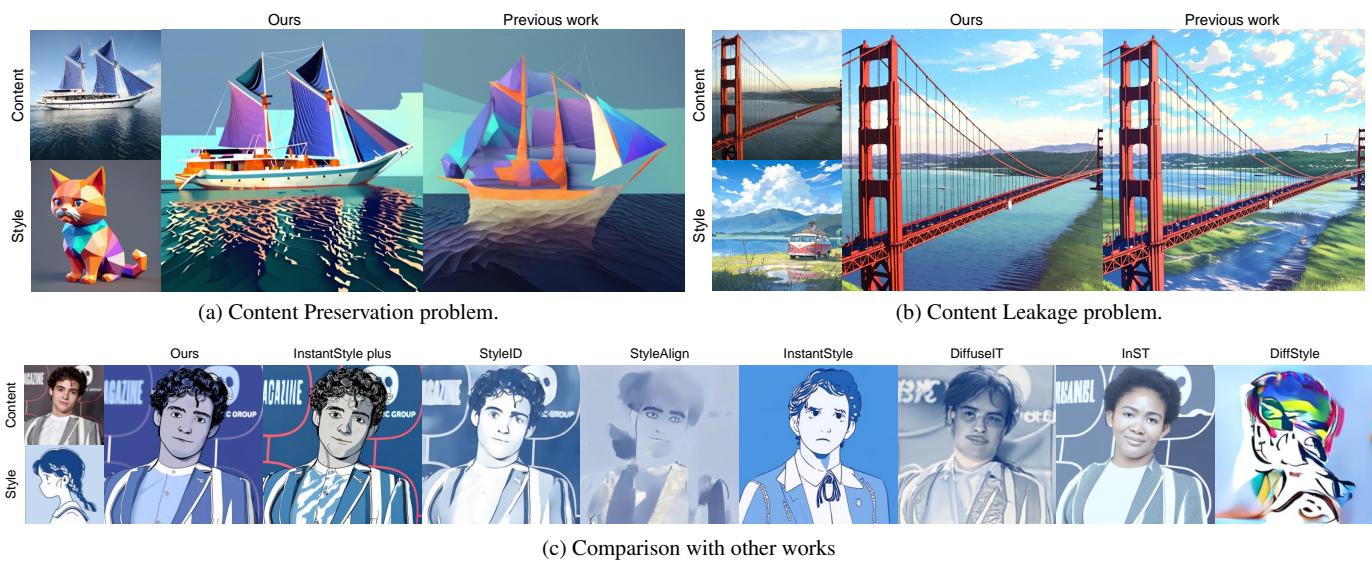
As shown in Figure 1 above:
- Panel (a) - Content Preservation Problem: Previous methods (right) often distort the original shape. The ship is barely recognizable because the “low-poly” style overwhelmed the content layout.
- Panel (b) - Content Leakage: This is a subtle but annoying issue. The user wanted the style of a landscape (greenery) applied to the Golden Gate Bridge. Previous methods (right) didn’t just copy the green color; they actually generated a lawn on top of the river. The semantic content of the style image “leaked” into the result.
The researchers of StyleSSP argue that these failures occur because the initial noise used to generate the image—the Sampling Startpoint—is not optimized for the task.
The Key Insight: The Importance of the Startpoint
In diffusion models, image generation starts with random Gaussian noise (\(z_T\)). This noise is progressively denoised to form an image. A common technique for editing images is DDIM Inversion, where you run the process backward on the original content image to get a specific noise map that “represents” that image.
Most previous works assumed that simply inverting the content image was enough. However, the StyleSSP authors found that the frequency distribution and the semantic alignment of this startpoint matter immensely.
If the startpoint contains too much “low-frequency” information (general color blobs), it might conflict with the target style. If the startpoint is too semantically close to the style image’s objects, it causes leakage.

Figure 2 (above) illustrates this sensitivity. Even slight manipulations to the startpoint (like adding noise or shifting values) dramatically change the hue, tone, and content preservation of the final image. This observation forms the backbone of StyleSSP: If we fix the startpoint, we fix the output.
The Solution: StyleSSP
StyleSSP stands for Sampling StartPoint enhancement. It is a training-free framework that modifies the initial latent noise before the generation process begins.
The method consists of two main technical innovations:
- Frequency Manipulation: To preserve the original layout (edges and shapes).
- Negative Guidance via Inversion: To prevent content leakage (unwanted objects).
Let’s look at the overall framework.
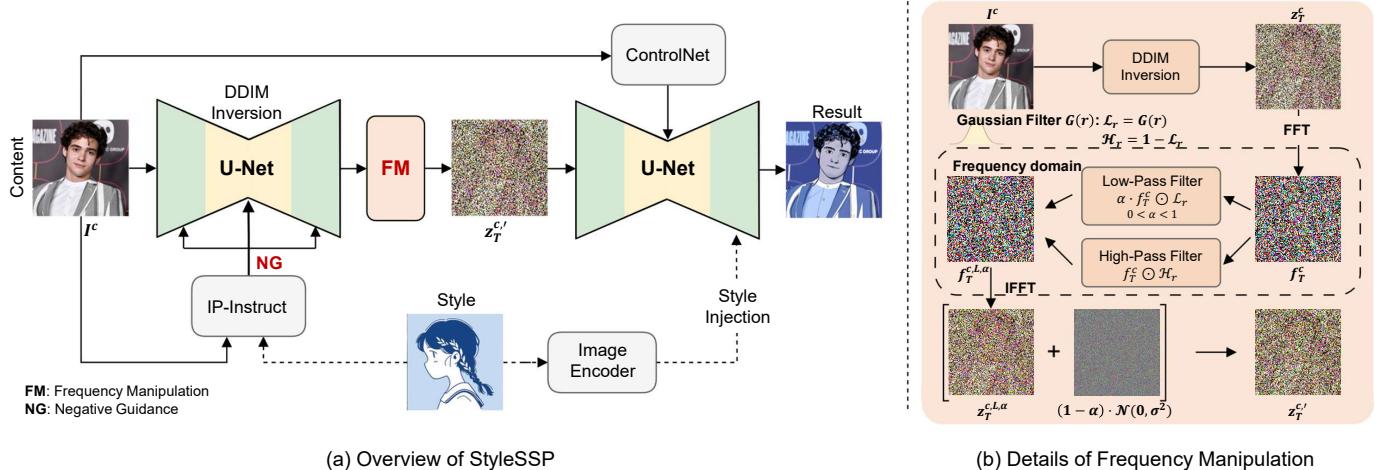
As shown in Figure 3, the process starts by inverting the content image (\(I^c\)) into latent noise (\(z_T^c\)). Crucially, during this inversion, they apply Negative Guidance (NG). Then, they apply Frequency Manipulation (FM) to this noise. Finally, this optimized noise (\(z_T^{c,'}\)) is used to generate the final stylized image.
Let’s break down these two components in detail.
1. Frequency Manipulation for Content Preservation
Why do style transfer models often lose the original shape of the object? The authors drew inspiration from the concept that high-frequency signals in an image usually represent edges, contours, and details, while low-frequency signals represent smooth gradients and general color layout.
In style transfer, you want to keep the edges of the content image (the shape of the bridge or the face) but change the colors and textures (the low-frequency information) to match the style.
If the sampling startpoint contains too much low-frequency information from the original photo, it forces the model to stick to the original colors, preventing the style from taking hold. Conversely, if we remove all information, we lose the structure.
The Solution: The authors apply a high-pass filter to the inverted latent. They keep the high-frequency components (structure) but reduce the low-frequency components.
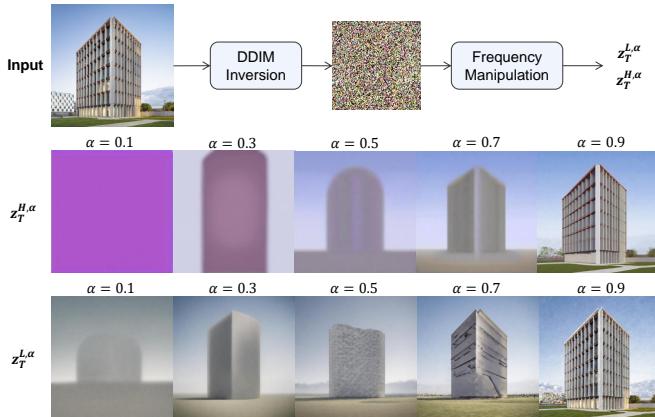
Figure 4 demonstrates the theory. The top row (\(z_T^{H, \alpha}\)) shows that high-frequency components are responsible for the sharp layout of the building. The bottom row (\(z_T^{L, \alpha}\)) shows that low-frequency components result in blurry shapes.
By mathematically suppressing the low frequencies in the startpoint, StyleSSP tells the model: “Here are the edges you must respect, but feel free to fill in the colors and textures with the new style.”
The frequency manipulation equation is defined as:
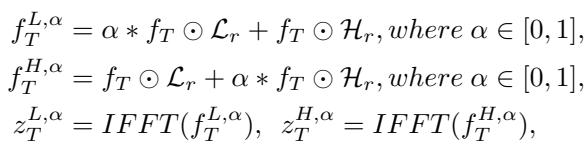
Here, \(\alpha\) is a parameter that controls how much we dampen the low frequencies. The final startpoint mixes this filtered latent with some Gaussian noise to ensure the model still has room to be creative.
Does it work? Visual evidence suggests yes. Look at the comparison below.
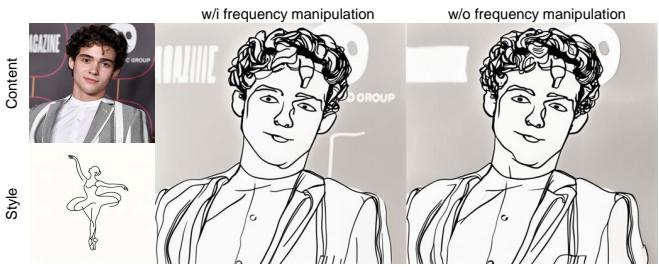
In Figure 5, notice the background behind the man. Without frequency manipulation (right), the scribbles and text on the wall are lost or blurred. With frequency manipulation (left), the model respects the high-frequency details of the original photo while still applying the sketched style.
2. Negative Guidance via Inversion to Stop Leakage
The second major contribution addresses Content Leakage. This happens when the style image contains distinct objects (like a moon, a car, or a specific tree) that the model mistakenly tries to paste into your image.
Standard diffusion models use Classifier-Free Guidance (CFG). Usually, this pushes the generated image toward a prompt. There is also the concept of a “Negative Prompt,” which pushes the image away from concepts (e.g., “ugly, blurry”).
StyleSSP introduces a clever twist: Negative Guidance during the Inversion stage.
When converting the content image into noise (DDIM Inversion), the model usually follows a deterministic path. StyleSSP intervenes in this path. It uses the semantic content of the style image as a Negative Prompt during inversion.
Mathematically, they modify the noise prediction during inversion:

What does this do? It forces the calculated noise (\(z_T\)) to be mathematically “distant” from the objects in the style image. If the style image has a “grassy field,” the negative guidance pushes the startpoint noise away from the concept of “grass.”
When the generation process starts, the noise is now “immunized” against generating grass, so the model only applies the artistic texture of the grass without generating the object itself.
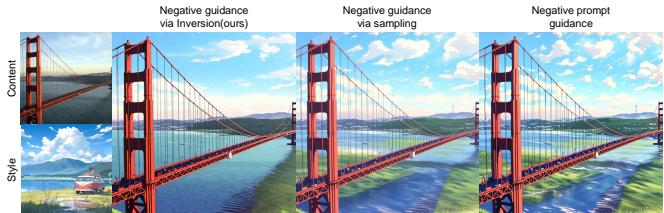
Figure 6 shows the impact. The user wants to apply an anime landscape style to the Golden Gate Bridge.
- Right & Middle: Standard negative prompting (during sampling) fails. The river turns into a grassy field because the style image contained grass.
- Left (Ours): By applying negative guidance during inversion, the river remains water. The system successfully decoupled the style (colors/lighting) from the content (grass/trees).
Implementation Details
To make this system robust, the authors didn’t rely on text prompts alone, as describing a visual style in words is often inaccurate. Instead, they used:
- IP-Instruct: A pre-trained model acting as a style/content extractor to generate the embeddings used for guidance.
- ControlNet: A popular structural guidance module. They use ControlNet (tile) to provide an additional layer of layout preservation during the generation phase.
The combination of a clean Startpoint (via StyleSSP) and structural guidance (via ControlNet) creates a powerful pipeline.
Experiments and Results
The researchers compared StyleSSP against state-of-the-art training-free methods like StyleID, InstantStyle, and StyleAlign. They used metrics like ArtFID (which measures overall style transfer quality) and LPIPS (which measures content fidelity).
Quantitative Analysis

As seen in Table 1, StyleSSP outperforms the baselines across the board.
- Lower LPIPS: Means the content structure is closer to the original.
- Lower FID/ArtFID: Means the style is statistically closer to the target art.
Qualitative Analysis
Numbers are good, but in style transfer, visual inspection is king.
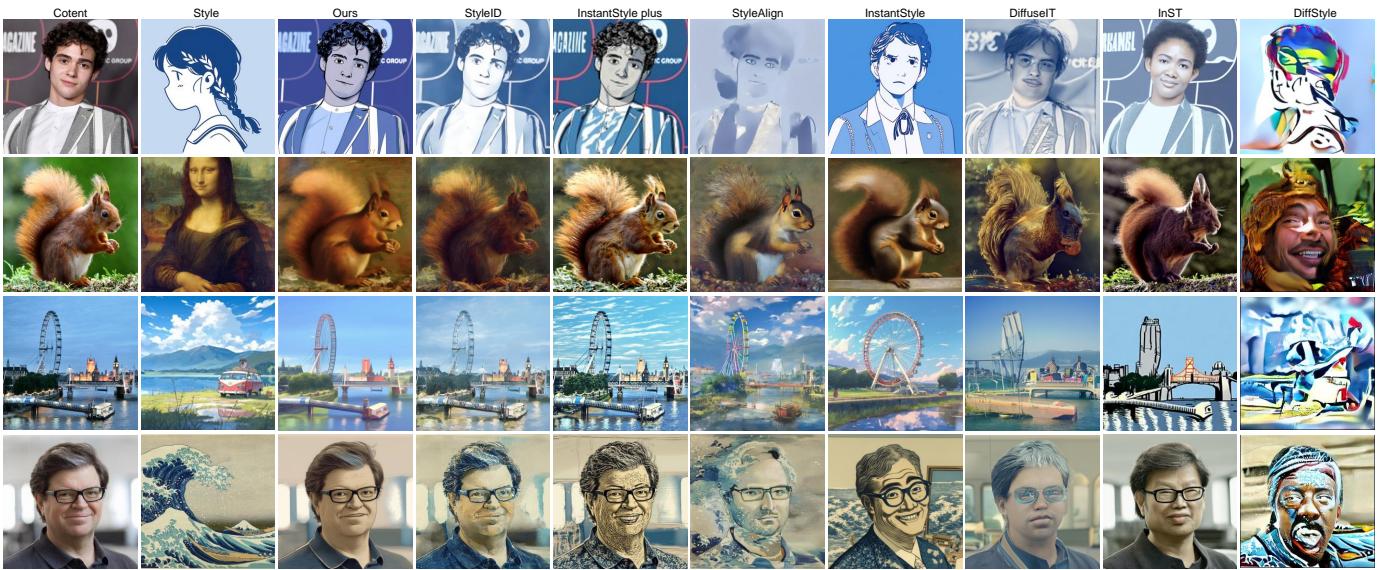
In Figure 7, look at the first row (the man’s face).
- DiffStyle creates a terrifying distortion.
- InstantStyle is a bit blurry.
- StyleSSP (Ours) maintains the facial identity perfectly while applying the sketchy artistic style.
In the fourth row (the Ferris wheel), many methods hallucinate waves or messy textures in the sky. StyleSSP keeps the sky clean while applying the color palette.
Ablation Study: Do we need both parts?
Is it just the Frequency Manipulation doing the work? Or just the Negative Guidance? The authors performed an ablation study to find out.
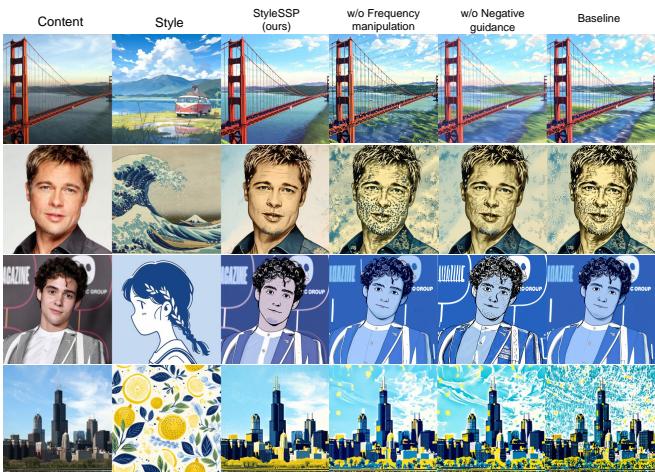
Figure 8 confirms that both components are necessary:
- w/o FM (Frequency Manipulation): Background details (like the text or fine lines) get washed out.
- w/o NG (Negative Guidance): In the bottom row, without negative guidance, the yellow “stars” or “dots” from the style image aggressively cover the man’s jacket. With NG, the jacket takes on the color but not the objects.
Conclusion
The StyleSSP paper presents a compelling argument: when using Diffusion models for editing, initialization matters. By treating the sampling startpoint as a tunable variable rather than just random noise, we can exert significant control over the output.
Through Frequency Manipulation, the method ensures that the original image’s layout and details are mathematically prioritized. Through Negative Guidance via Inversion, it ensures that the semantic objects of the style image don’t accidentally overwrite the content.
For students and researchers in Generative AI, this highlights an important trend: improvements don’t always come from bigger models or larger datasets. Sometimes, they come from a deeper understanding of the signal processing occurring inside the latent space.
StyleSSP offers a robust, training-free way to achieve professional style transfer results, solving the twin problems of layout destruction and content leakage that have plagued previous methods.
All images and data used in this post are derived from the research paper “StyleSSP: Sampling StartPoint Enhancement for Training-free Diffusion-based Method for Style Transfer”.