](https://deep-paper.org/en/paper/2501.14914/images/cover.png)
The dream of computer vision is to take a handful of photos scattered around a scene—a statue, a building, or a room—and instantly weave them into a perfect 3D model. This process is known as Structure-from-Motion (SfM).
For decades, SfM has been a game of trade-offs. You could have high accuracy, but you had to pay for it with minutes or even hours of computation time, relying on complex optimization algorithms like Bundle Adjustment. Recently, deep learning entered the chat with models like DUSt3R and MASt3R, which improved robustness but still relied on slow, iterative optimization steps to align everything globally.
But what if we could skip the heavy optimization entirely? What if a neural network could just “look” at all the images at once and output a globally consistent 3D world in a single pass?
That is the promise of Light3R-SfM, a new research paper that proposes a feed-forward framework for large-scale SfM. By replacing traditional optimization with a learnable attention mechanism, the authors have created a system that is drastically faster than state-of-the-art competitors while maintaining competitive accuracy.
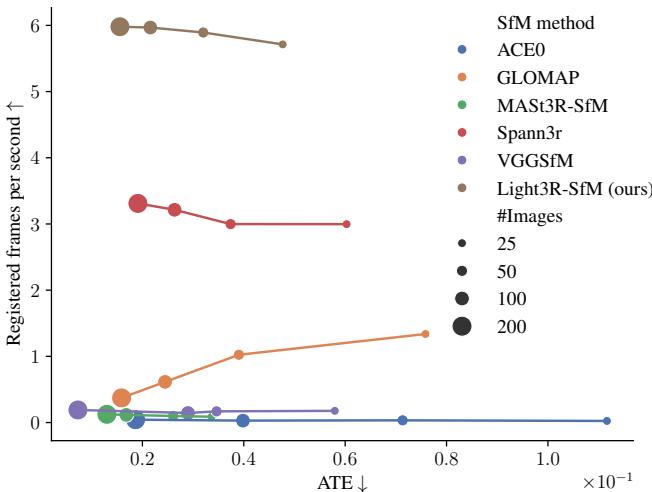
As shown in Figure 1 above, Light3R-SfM occupies a “sweet spot”: it operates at frame rates significantly higher than traditional pipelines (the vertical axis) while keeping trajectory errors low (the horizontal axis).
In this post, we will tear down the Light3R-SfM architecture to understand how it achieves this balance of speed and precision.
The Problem: The Bottleneck of Optimization
To understand why Light3R-SfM is a big deal, we need to understand the bottleneck it removes.
Standard SfM pipelines (like COLMAP) and even recent deep learning hybrids (like MASt3R) generally follow a two-step philosophy:
- Pairwise Estimation: Estimate how image A relates to image B (local geometry).
- Global Optimization: Take all those pairwise estimates and run a massive solver (Bundle Adjustment) to minimize error across the whole set.
That second step is the killer. It is iterative, meaning the computer guesses, checks the error, adjusts, and repeats. As you add more images, the time required explodes.
Light3R-SfM asks: Can we learn to align these images in the feature space (latent space) so that the network outputs globally aligned points from the start?
The Solution: Light3R-SfM Architecture
The authors propose a “feed-forward” approach. In deep learning terms, feed-forward means the data flows in one direction—from input to output—without looping back for iterative refinement.
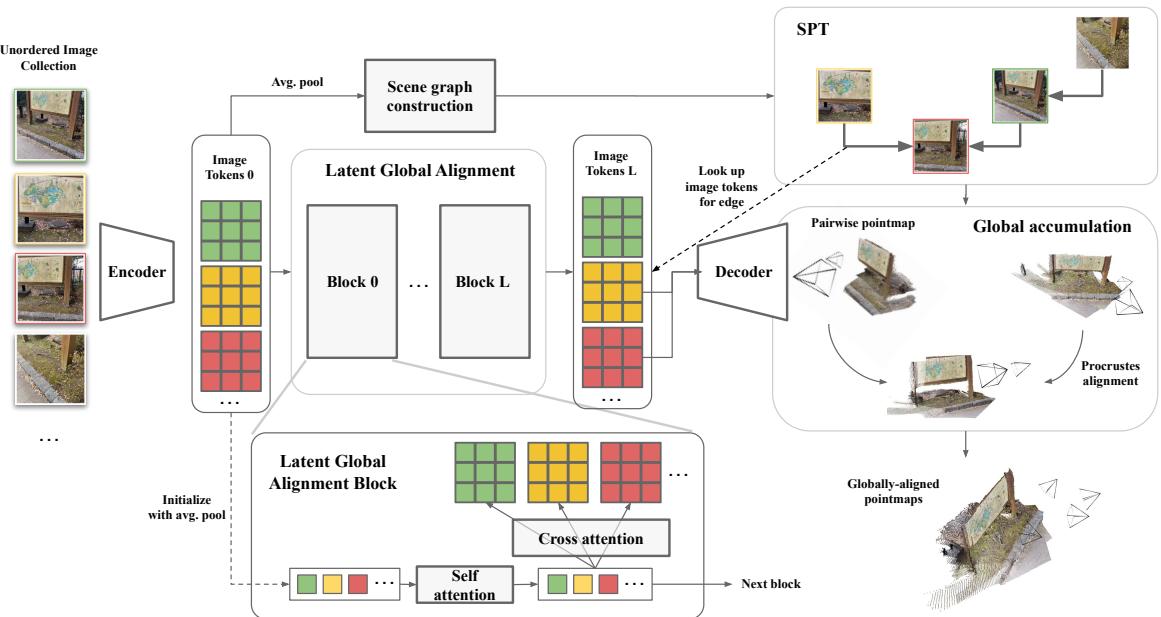
The pipeline consists of four main stages:
- Image Encoding: Turning pixels into features.
- Latent Global Alignment: The core innovation—using attention to align features globally.
- Scene Graph Construction: Deciding which images should be matched using a Shortest Path Tree.
- Decoding & Accumulation: Converting features to 3D points and assembling the scene.
Let’s break these down with a visual overview of the pipeline.
1. Encoding and Initialization
The process begins with an unordered collection of images. Each image is passed through a vision transformer (ViT) encoder. This converts the raw RGB values into a grid of feature “tokens”—essentially mathematical descriptors of patches of the image.
\[ F _ { i } ^ { ( 0 ) } = \mathtt { E n c } ( \mathbb { Z } _ { i } ) , \quad F _ { i } ^ { ( 0 ) } \in \mathbb { R } ^ { \lfloor H / p \rfloor \times \lfloor W / p \rfloor \times d } , \]
Here, \(F_i^{(0)}\) represents the initial feature tokens for image \(i\). This is standard practice in modern computer vision. However, usually, these tokens only “know” about their own image. If we stopped here, the network would have no idea how image 1 relates to image 5.
2. Latent Global Alignment
This is the most critical contribution of the paper. In traditional methods, we align cameras explicitly by rotating and translating them in 3D space after the fact. Light3R-SfM aligns them implicitly in the high-dimensional feature space before 3D coordinates are ever predicted.
The authors use an Attention Mechanism to let images “talk” to each other. However, attending every pixel of every image to every other pixel is computationally impossible (it creates a memory explosion).
To solve this, they use a clever two-step attention process:
A. Global Tokens and Self-Attention
First, they compress each image into a single “global token” (\(g_i\)) by averaging its spatial features. This token summarizes the entire image. Then, they use Self-Attention to let these global tokens interact.
\[ \{ g _ { i } ^ { ( l + 1 ) } \} _ { i = 1 } ^ { N } = \mathtt { S e l f } \big ( \{ g _ { i } ^ { ( l ) } \} _ { i = 1 } ^ { N } \big ) . \]
In this step, the global token for Image A gathers context from the global tokens of Images B, C, D, etc. It effectively learns where it sits in the global scene relative to the others.
B. Cross-Attention Update
Next, this enriched global information is propagated back to the detailed, dense feature tokens of each specific image using Cross-Attention.
\[ \boldsymbol { F } _ { i } ^ { ( l + 1 ) } = \cos \mathbf { s } ( \boldsymbol { F } _ { i } ^ { ( l ) } , \{ g _ { i } ^ { ( l + 1 ) } \} _ { i = 1 } ^ { N } ) . \]
By repeating this block \(L\) times, the detailed features of every image are updated with an awareness of the entire dataset. This allows the network to “hallucinate” or predict geometry that is consistent with the global scene, even if the camera is facing the opposite direction of the reference view.
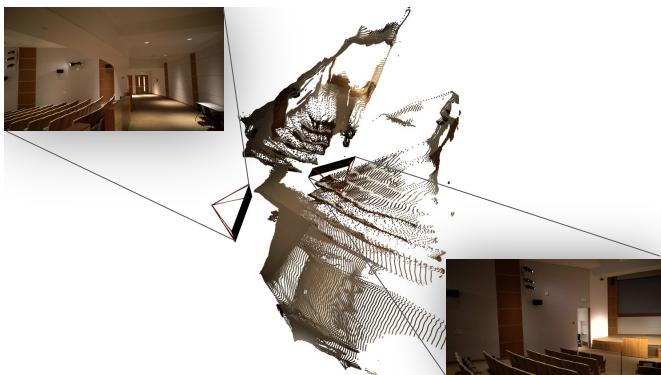
As Figure 4 shows, the decoder (conditioned on these globally aligned tokens) can successfully predict pointmaps for cameras looking in completely different directions—something purely local methods struggle with.
3. Scene Graph Construction: The Shortest Path Tree
Even with global context, we cannot afford to match every pair of images (quadratic complexity, \(N^2\)). We need a roadmap, or a “Scene Graph,” that tells us which pairs are worth connecting.
The authors compute similarity scores between images using the dot product of their feature embeddings:
\[ S _ { i j } = \langle \| \bar { F } _ { i } \| _ { 2 } , \| \bar { F } _ { j } \| _ { 2 } \rangle \]
Traditional SfM often uses a Minimum Spanning Tree (MST) to connect images. An MST tries to minimize the total “cost” of the edges. However, the authors argue that MSTs often result in deep, chain-like structures. In 3D reconstruction, long chains are bad because errors accumulate (drift) with every step you take away from the start.
Light3R-SfM instead uses a Shortest Path Tree (SPT). An SPT minimizes the distance from the root (the central image) to every other node. This creates a “flatter” tree, reducing the number of hops required to link any image back to the main coordinate system, thereby reducing drift.
4. Global Optimization-free Reconstruction
Once the graph is built, the method needs to generate the actual 3D points.
Pairwise Decoding
For every connected pair of images \((i, j)\) in the graph, the network decodes 3D pointmaps (\(X\)) and confidence maps (\(C\)).
\[ ( X ^ { i , i } , X ^ { j , i } ) , ( C ^ { i , i } , C ^ { j , i } ) = \mathtt { D e c } ( F _ { i } , F _ { j } ) . \]
Because the input features \(F_i\) and \(F_j\) have already gone through the Latent Global Alignment module, the output pointmaps are already highly consistent with the global scene.
Global Accumulation via Procrustes
To assemble the final scene, the system traverses the Shortest Path Tree. For each new image, it needs to register it to the growing global point cloud.
Instead of running an iterative solver, Light3R-SfM uses Procrustes Alignment. This is a closed-form mathematical solution that instantly finds the best rigid transformation (rotation and translation) to align two sets of corresponding points.
\[ P _ { k } = { \tt P r o c r u s t e s } ( X ^ { k } , X ^ { k , k } , \log C ^ { k } ) \]
Using the confidence maps (\(C\)) as weights, it calculates the optimal pose \(P_k\) and transforms the new points into the global frame:
\[ X ^ { l , \ l } = P _ { k } ^ { - 1 } X ^ { k , l } \]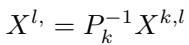
This process is lightning fast compared to bundle adjustment.
Supervision: How does it learn?
The network is trained end-to-end using a combination of pairwise and global losses.
Pairwise Loss: This ensures that for any two connected images, the predicted 3D points match the ground truth.
\[ \begin{array} { r l } { { \mathcal { L } _ { \mathrm { p a i r } } = \sum _ { ( i , j ) \in E _ { \mathrm { S P T } } } ( \mathcal { L } _ { \mathrm { c o n f } } ( P _ { i } \bar { X } ^ { i } , { X } ^ { i , i } , { C } ^ { i , i } , \mathcal { D } ^ { i } ) } } \\ & { ~ + \mathcal { L } _ { \mathrm { c o n f } } ( P _ { i } \bar { X } ^ { j } , { X } ^ { j , i } , { C } ^ { j , i } , \mathcal { D } ^ { j } ) ) , } \end{array} \]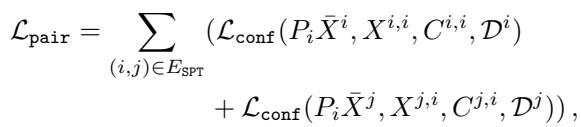
Global Loss: This is crucial for enforcing consistency. It aligns the entire predicted point cloud to the ground truth and checks the error. This signals the network to improve its Latent Global Alignment module if the overall structure is warped, even if individual pairs look okay.
\[ { \mathcal { L } } _ { \mathrm { g l o b a l } } = \sum _ { i \in \{ 1 , \dots , N \} } { \mathcal { L } } _ { \mathrm { c o n f } } ( { \bar { X } } ^ { i } , P _ { \mathrm { a l i g n } } X ^ { i } , C ^ { i } , { \mathcal { D } } ^ { i } ) \]
Experiments and Results
The researchers put Light3R-SfM to the test against heavyweights like COLMAP (traditional), MASt3R-SfM (optimization-based deep learning), and Spann3R (feed-forward competitor).
Speed vs. Accuracy
The most striking result is the runtime. On the full “Tanks & Temples” dataset, Light3R-SfM is orders of magnitude faster than optimization-based methods.
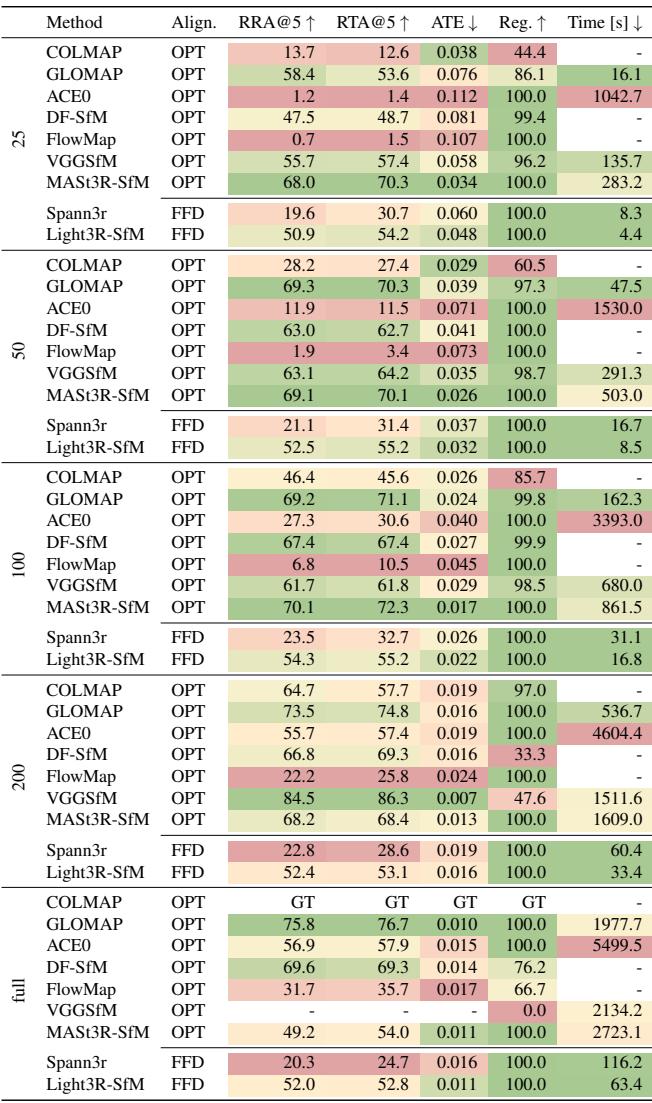
In Table 1, look at the Time [s] column.
- MASt3R-SfM takes 2723.1 seconds for the full sequence.
- Light3R-SfM takes just 63.4 seconds.
- That is roughly a 43x speedup.
While optimization-based methods (denoted as OPT) generally hold a slight edge in strict accuracy metrics (like RRA@5), Light3R-SfM is surprisingly competitive, often beating other deep learning methods and approaching the accuracy of GLOMAP.
Comparison with Spann3R
Spann3R is another recent attempt at feed-forward SfM. However, it relies on a “spatial memory” bank designed for video sequences. It processes images in order.
Light3R-SfM was tested against Spann3R on unordered image sets (the typical SfM scenario).
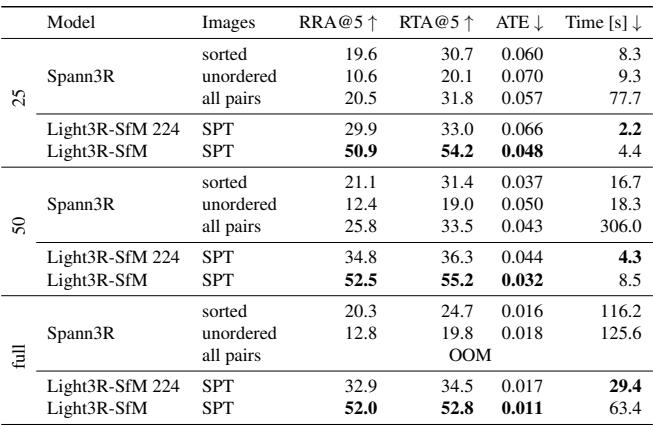
The results in Table 2 are telling. Spann3R struggles with unordered data and even runs out of memory (OOM) on full sequences. Light3R-SfM, thanks to its Shortest Path Tree graph and attention mechanism, handles these large, unordered collections robustly.
Qualitative Results
Numbers are great, but what does the output actually look like?
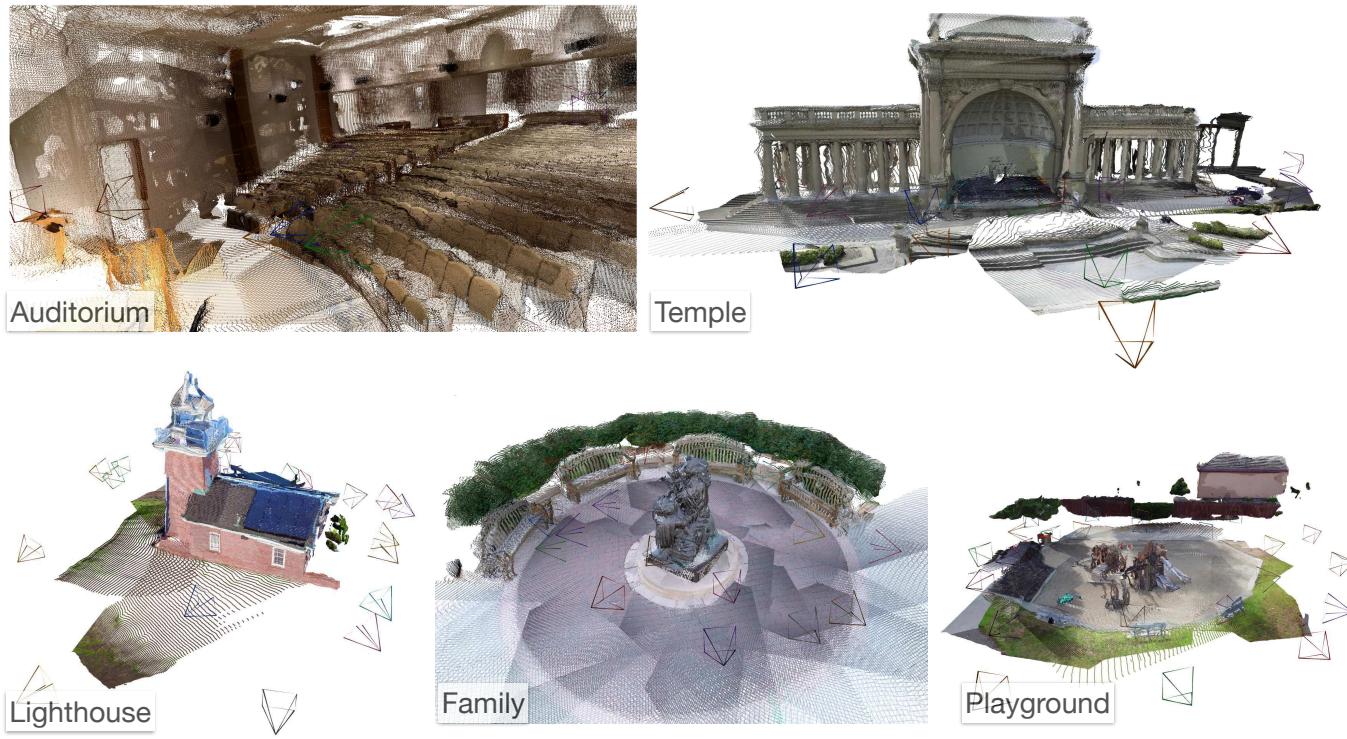
The reconstructions in Figure 8 show that Light3R-SfM captures complex geometries, from the interior of auditoriums to intricate outdoor temples.
Furthermore, on driving datasets like Waymo (where cameras move forward over long distances), Light3R-SfM shows superior stability compared to competitors.
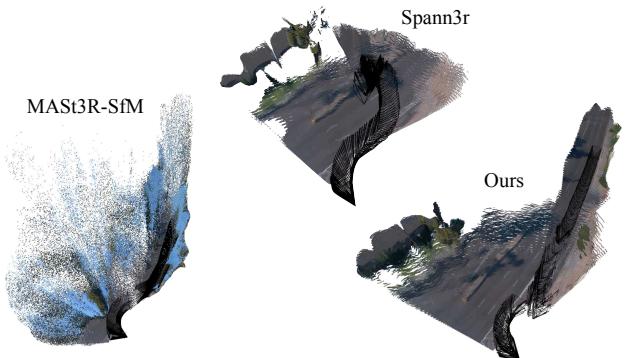
In Figure 3, notice how MASt3R-SfM fails to reconstruct the 90-degree turn correctly, and Spann3R’s prediction degrades (the “streaks” become messy). Light3R-SfM maintains a clean, coherent structure throughout the turn.
Failure Cases
No method is perfect. The authors frankly discuss limitations.
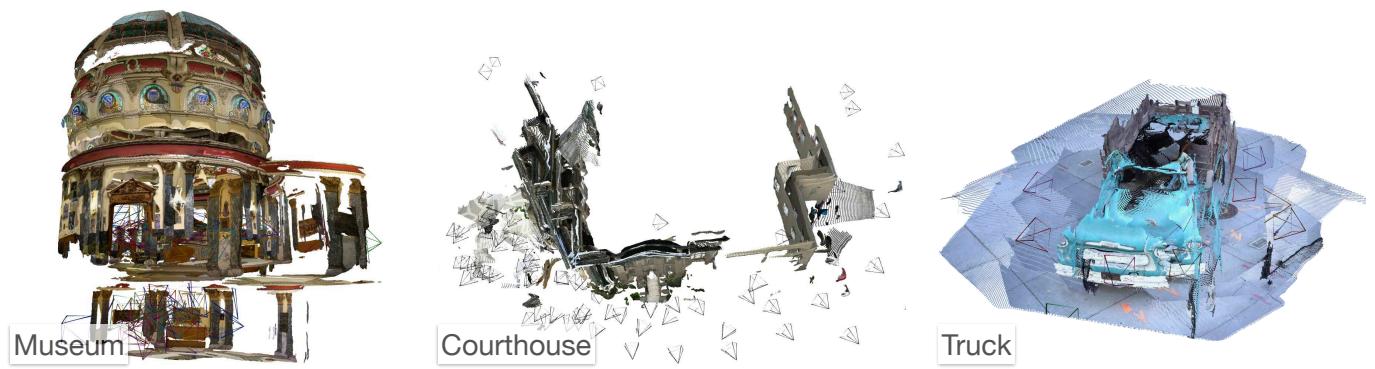
As seen in Figure 11, the method can sometimes create duplicate structures or “ghosting” effects. This usually happens when the scene graph construction fails to link two overlapping parts of the scene, or when there are small errors in the pairwise estimation that propagate. Additionally, dynamic objects (like moving cars) can confuse the confidence maps, though the network tries to filter these out.
Conclusion and Implications
Light3R-SfM represents a significant step toward “real-time” large-scale 3D reconstruction. By shifting the burden of global alignment from an iterative solver (run at inference time) to a learned attention mechanism (trained once), it drastically cuts down processing time.
Key Takeaways:
- Latent Alignment Works: You can align 3D scenes by aligning their feature tokens before generating geometry.
- Graph Structure Matters: Using a Shortest Path Tree (SPT) reduces error accumulation compared to Minimum Spanning Trees (MST) or linear chains.
- Feed-forward is the Future: We are approaching a point where neural networks can solve complex geometric problems in a single pass, challenging the decades-old dominance of iterative optimization algorithms.
For students and researchers, Light3R-SfM is a masterclass in how to identify a computational bottleneck (Bundle Adjustment) and design a neural architecture specifically to bypass it. It paves the way for applications requiring instant 3D awareness, such as robotics navigation and augmented reality, where waiting 20 minutes for a scene to process simply isn’t an option.