](https://deep-paper.org/en/paper/2501.18954/images/cover.png)
Introduction
For years, the field of object detection has been constrained by a “closed-set” mentality. Traditional models were trained to recognize a specific list of categories—typically the 80 classes found in the COCO dataset (like “person,” “car,” or “dog”). If you showed these models a “platypus” or a “drone,” they would remain silent or misclassify it because they simply didn’t have the vocabulary.
This limitation led to the rise of Open-Vocabulary Object Detection (OVD). By training models on massive amounts of image-text pairs (using frameworks like CLIP), researchers created detectors that could find objects they had never seen during training, simply by prompting them with text. However, a significant gap remains. Most current OVD methods, such as GLIP, rely on short, region-level text—simple nouns or brief phrases like “a running dog.”
But the visual world is far more complex than a list of nouns. Objects have textures, relationships, and contexts. “A man” is a simple label; “A young man in a blue shirt washing dishes in a rustic kitchen” paints a complete picture.
In this post, we explore LLMDet, a new research paper that argues that detailed, image-level captions are the missing link in building superior object detectors. By co-training a detector with a Large Language Model (LLM), the researchers demonstrate that teaching a model to “describe” an image in detail forces it to learn far richer visual representations, leading to state-of-the-art performance.
The Problem with Short Captions
To understand why LLMDet is necessary, we first need to look at how current open-vocabulary detectors are trained. Models like GLIP unify object detection and phrase grounding. They are trained to match a region in an image (a bounding box) with a word in a sentence.
While effective, this approach has limitations:
- Lack of Detail: Region-level annotations are usually short (e.g., “cat”). They miss attributes like color, texture, and action.
- Missing Context: Focusing only on isolated regions ignores the relationships between objects and the background scene.
- Vocabulary Limits: Even large datasets often repeat the same common nouns, struggling to generalize to rare concepts.
The premise of LLMDet is simple yet profound: If we force a detector to understand an image well enough to generate a long, detailed paragraph about it, the detector must learn much stronger and more generalized visual features.
The Foundation: GroundingCap-1M
You cannot train a model to learn from detailed captions if such a dataset doesn’t exist. Standard detection datasets offer bounding boxes and class names, but they lack the descriptive richness the researchers were after.
To solve this, the authors constructed a new dataset called GroundingCap-1M.
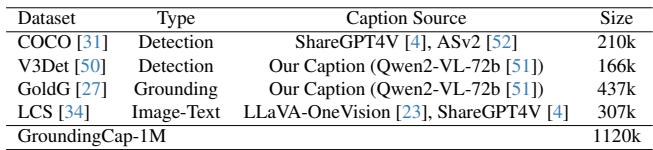
As shown in the table above, GroundingCap-1M is a massive compilation of over 1.1 million samples. It aggregates data from detection datasets (COCO, V3Det), grounding datasets (GoldG), and image-text datasets.
The “Quadruple” Formulation
Unlike standard datasets that might just pair an image with boxes, each sample in GroundingCap-1M is formulated as a quadruple: \((I, T_g, B, T_c)\).
- \(I\): The Image.
- \(T_g\): Short grounding text (e.g., “A dog and a frisbee”).
- \(B\): Bounding boxes mapped to the grounding text.
- \(T_c\): A detailed, long image-level caption.
Since human annotation for millions of images is prohibitively expensive, the researchers utilized a powerful multimodal LLM (Qwen2-VL-72b) to generate these detailed captions. They prompted the LLM to include object types, textures, colors, actions, and precise locations, while strictly avoiding hallucination (imaginary content).
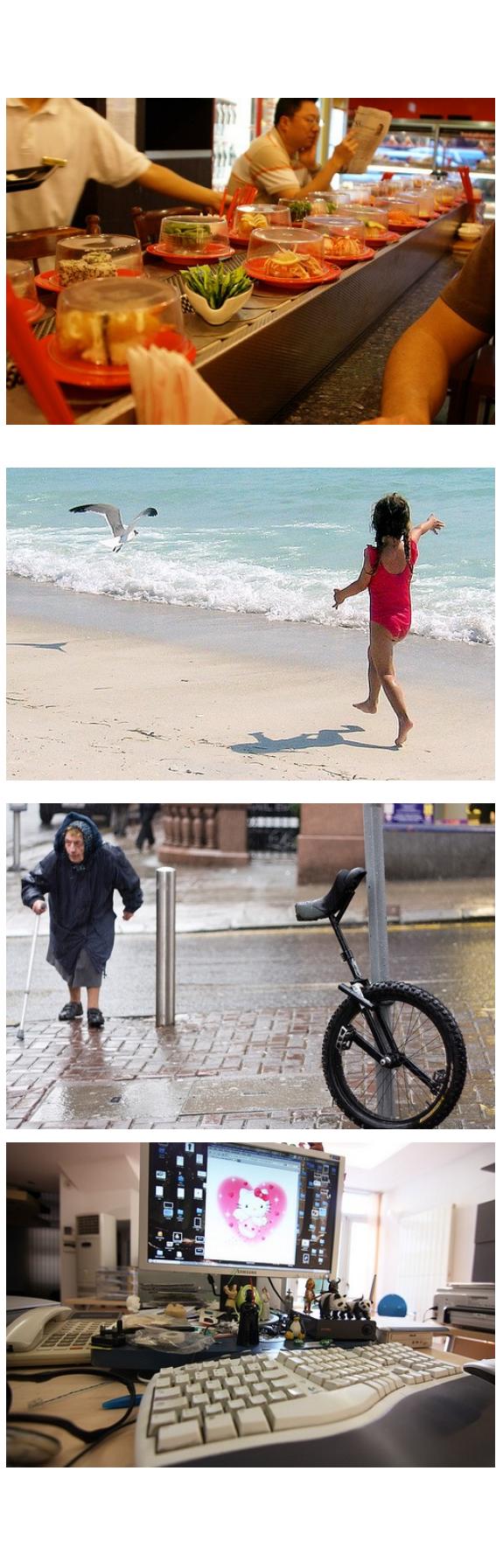
The figure above illustrates the density of information in these captions. Instead of just labeling a “tv,” the dataset describes “a television placed on top of a light-colored wooden dresser.” This richness provides the supervision signal necessary for the next step: the model architecture.
LLMDet: The Architecture
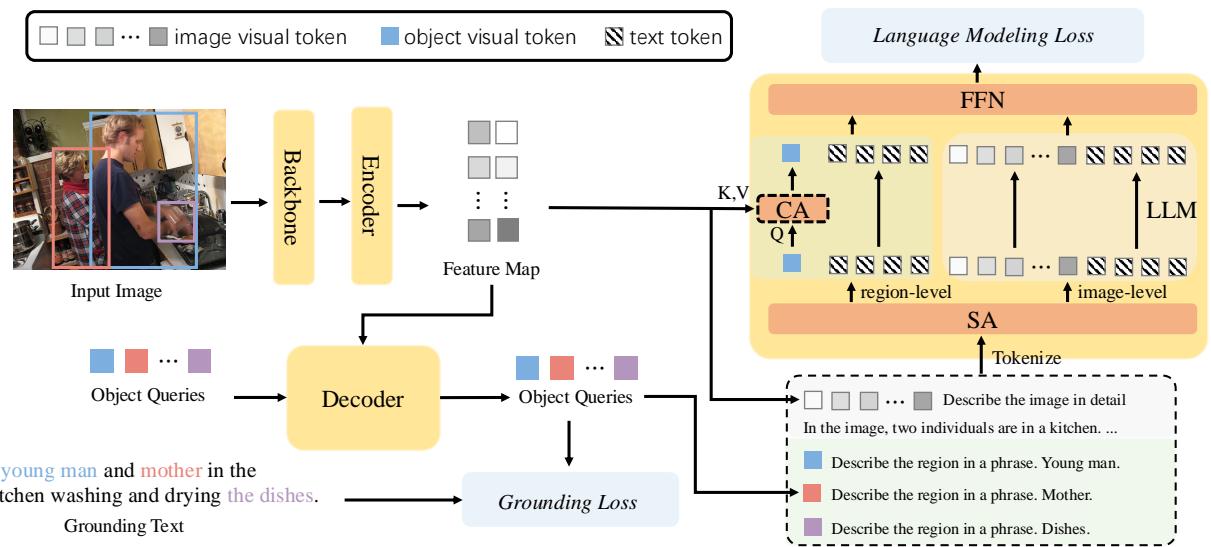
The core innovation of LLMDet is its training framework. It integrates a standard object detector (specifically a DETR-based model) with a Large Language Model.
The goal is not just to detect objects, but to co-train the detector so that its visual features are robust enough to support two tasks simultaneously:
- Grounding: Finding objects based on text.
- Captioning: Generating detailed descriptions of the image.
The Components
- The Detector: An open-vocabulary detector (the vision encoder). It extracts visual features from the image and predicts object queries (potential object regions).
- The Projector: A neural network layer that translates the visual features from the detector into “tokens” that the LLM can understand.
- The LLM: A Large Language Model (initialized from LLaVA-OneVision) that takes the projected visual features and generates text.
The Training Pipeline
Training happens in two distinct steps to ensure the components work well together without destroying pre-trained knowledge.
- Step 1: Alignment. The detector and LLM are frozen. Only the projector is trained. This teaches the system how to translate the detector’s visual representation into the LLM’s language space.
- Step 2: End-to-End Finetuning. The detector, projector, and LLM are trained together. The detector now receives gradients (feedback) from the LLM, effectively learning to “see” better so the LLM can “speak” better.
The Objectives (Loss Functions)
The model is trained using a composite loss function that balances detection accuracy with linguistic understanding.

Let’s break down the four parts of this equation:
- \(\mathcal{L}_{align}\): Grounding Loss. Ensures the model matches the right word to the right region.
- \(\mathcal{L}_{box}\): Box Regression Loss. Ensures the bounding boxes are drawn tightly around the objects.
- \(\mathcal{L}_{lm}^{image}\): Image-Level Caption Loss. The LLM takes the entire visual feature map and tries to reproduce the detailed caption from GroundingCap-1M. This forces the detector to encode global context and relationships.
- \(\mathcal{L}_{lm}^{region}\): Region-Level Caption Loss. The LLM takes specific object queries (features representing a single object) and tries to generate a short phrase for that object. This ensures fine-grained local understanding.
By minimizing this combined loss, LLMDet learns visual representations that are both locally precise (for detection) and globally semantic (for description).
Experiments and Results
The researchers evaluated LLMDet primarily on its Zero-Shot performance. This means they tested the model on datasets and classes it had never seen during training, which is the ultimate test of an open-vocabulary detector’s generalization ability.
Benchmarking on LVIS
LVIS is a challenging dataset with over 1,200 categories, including many “rare” objects.
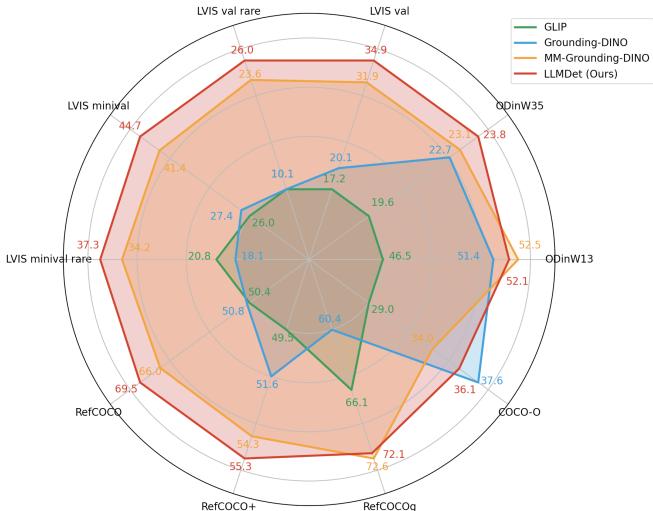
The radar chart above summarizes the results. LLMDet (the red line) consistently encompasses the other methods, indicating superior performance across the board.
For a more granular look, we can examine the specific metrics on LVIS “minival” (a validation set).
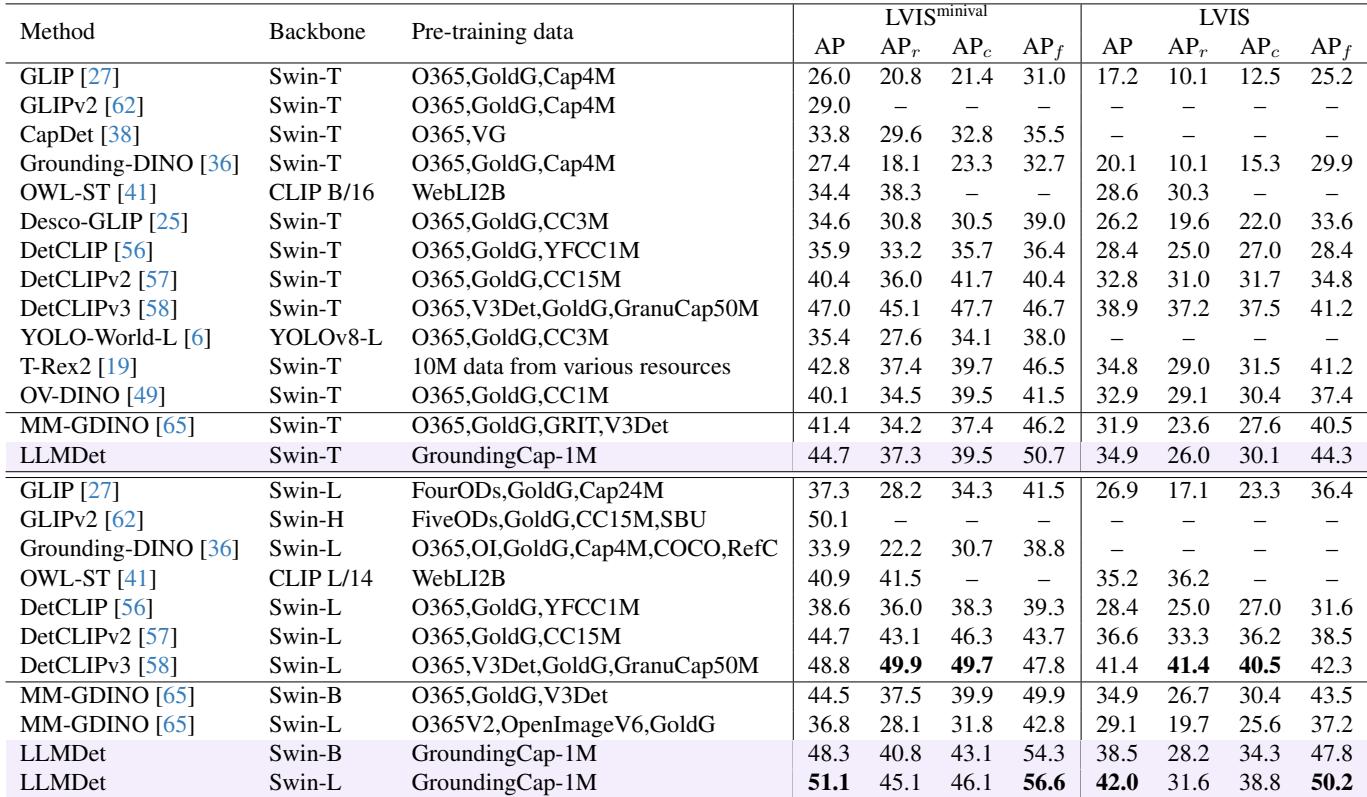
Key Takeaways from the Data:
- SOTA Performance: LLMDet achieves 44.7% AP with a Swin-T backbone, beating the previous state-of-the-art (MM-GDINO) by a significant margin (3.3%).
- Rare Class Boost: The metric \(AP_r\) (Average Precision for rare classes) sees a massive jump. With the Swin-L backbone, LLMDet achieves 45.1% \(AP_r\), compared to 28.1% for the baseline.
- Why this matters: The huge improvement in rare classes confirms the hypothesis: detailed captions (which likely contain descriptions of rare objects and attributes) help the model generalize far better than simple noun-label training.
Robustness and Transfer Learning
The team also tested LLMDet on ODinW (Object Detection in the Wild), a collection of 35 diverse datasets ranging from aerial drone imagery to chess pieces.
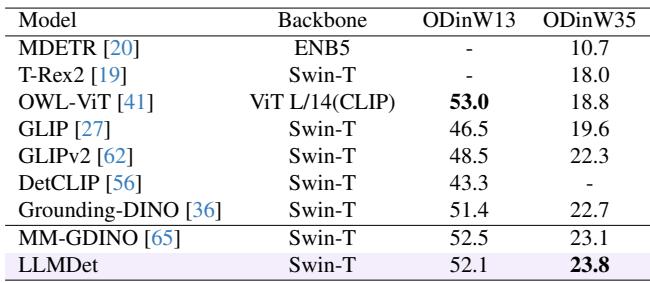
As shown in Table 3, LLMDet achieves the highest average score (23.8 AP) on the full 35-dataset suite, proving it isn’t just good at “standard” photos but can adapt to specialized domains.
They further tested on COCO-O, a dataset designed to measure robustness against domain shifts (e.g., sketches, cartoons, paintings, weather effects).
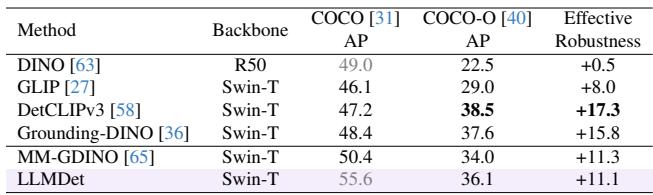
The results (Table 4) show that learning from rich language descriptions makes the model more robust to artistic style changes and visual noise.
Ablation: Do Long Captions Really Help?
Skeptics might ask: “Is it the long captions, or just the LLM?” The researchers performed ablation studies to isolate the variables.
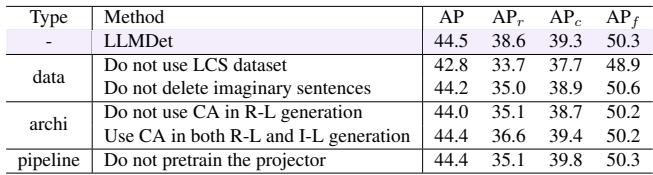
The data revealed several critical insights:
- Captions are Key: If you train without the detailed image-level captions (using only short grounding text), performance drops significantly.
- Detail Matters: Replacing the high-quality Qwen2-generated captions with simpler captions (like those from standard COCO) lowered the results. The richer the text, the better the vision model becomes.
- Hybrid Approach: Using both image-level (global) and region-level (local) generation losses yielded the best results. They complement each other.
A Mutual Benefit: Building Better Multimodal Models
An interesting secondary finding of this paper is the concept of a “virtuous cycle.”
We know that LLMs can help train detectors (as shown with LLMDet). But can a better detector help build a better Multimodal LLM (LMM)?
The researchers took their trained LLMDet and used it as the vision encoder for a new LMM.
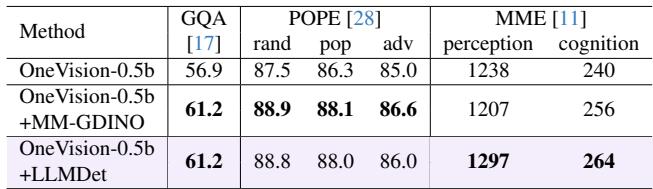
The results were positive. An LMM built using LLMDet as its “eyes” outperformed models using standard vision encoders on benchmarks like MME (Perception) and POPE (Hallucination). Because LLMDet was trained to align closely with language concepts, it feeds the LMM more semantically relevant visual tokens.
Conclusion
LLMDet represents a significant step forward in computer vision. It moves away from the paradigm of treating object detection as a simple labeling task and embraces it as a holistic understanding task.
By collecting the GroundingCap-1M dataset and using the caption generation objective, the researchers have shown that:
- Language is a powerful supervisor: Detailed descriptions force vision models to notice textures, relationships, and context they otherwise ignore.
- LLMs are the new labeling workforce: Generating high-quality training data with LLMs is a viable and highly effective strategy.
- Synergy is real: Co-training vision and language models benefits both modalities.
For students and practitioners, LLMDet illustrates that the future of AI isn’t just about bigger models, but about smarter training objectives and richer data. The ability to describe the world in detail is, it turns out, the best way to learn how to see it.