](https://deep-paper.org/en/paper/2502.02590/images/cover.png)
Introduction
In the rapidly evolving world of Embodied AI and robotics, data is oxygen. To teach a robot how to navigate a kitchen or tidy up a workshop, we rely heavily on simulation. It is safer, faster, and cheaper to crash a virtual drone a thousand times than a real one. However, there is a significant bottleneck in current simulation environments: the lack of diverse, interactive objects.
While we have witnessed a revolution in generative AI that can produce stunning static 3D meshes from a simple text prompt, these objects are frozen statues. A generated microwave looks real, but you cannot open the door. A generated car has wheels, but they don’t spin. For a robot learning manipulation skills, a static object is useless.
This brings us to a challenging problem: How do we automatically turn any static 3D mesh into a functional, articulated object with moving parts?
Existing methods have struggled with this. They either rely on handcrafted datasets limited to boring categories (like cabinets and drawers) or require dense observations that aren’t available for generated assets. This restricts robots to training on a “closed vocabulary” of objects, limiting their ability to generalize to the real world’s messy variety.
Enter ARTICULATE ANYMESH.
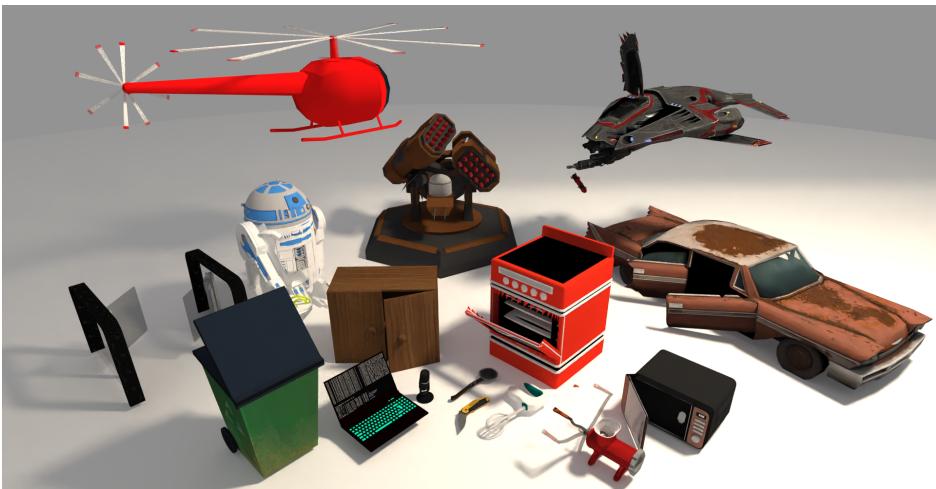
As shown in Figure 1 above, this new framework proposes an automated pipeline that can take varied inputs—from Objaverse meshes to fictional generated objects—and rig them with functional joints. Whether it’s a helicopter, a sci-fi spaceship, or a trash can, the system identifies the parts and figures out how they should move.
In this post, we will tear down the Articulate AnyMesh paper. We will explore how it leverages large Vision-Language Models (VLMs) to “see” and “reason” about geometry, allowing it to articulate objects it has never seen before.
Background: The Data Hunger in Robotics
To understand why this paper is significant, we need to look at the landscape of 3D generation.
- Static 3D Generation: Methods like DreamFusion or Magic3D can turn text into 3D shapes. However, they output a single surface mesh. The object is a solid block; a closet generated this way is just a statue of a closet.
- Part-Aware Generation: Some newer methods can generate objects with distinct parts (e.g., separating the tires from the car body). However, simply separating parts isn’t enough. The system needs to know how those parts connect. Does the door slide or swing? Where is the hinge axis?
- Articulated Object Modeling: Previous works like URDFormer or RPM-Net try to predict these joint parameters. However, they are supervised learning models trained on specific datasets (like PartNet-Mobility). If you train a model on cabinets, and then hand it a robot arm or a pair of scissors, it fails. It lacks an “open-vocabulary” understanding.
The researchers behind Articulate AnyMesh approached this differently. Instead of training a specific network to regress joint numbers (which limits generalization), they constructed a pipeline that uses the “common sense” reasoning capabilities of modern Foundation Models (like GPT-4) combined with geometric analysis.
The Articulate AnyMesh Pipeline
The core methodology is an automated framework divided into three distinct stages. The input is a rigid 3D mesh (which could come from a 3D scanner, a generative model, or an artist), and the output is a fully articulated URDF (Universal Robot Description Format) file with textures and complete geometry.
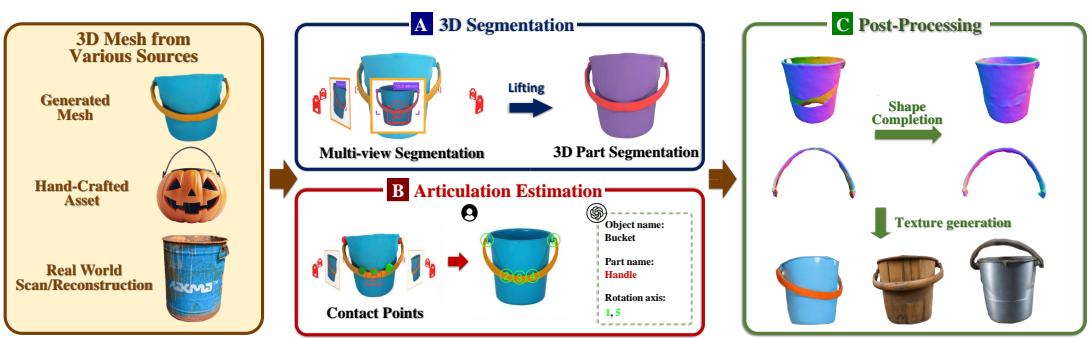
Let’s break down each stage shown in Figure 2.
Stage A: Movable Part Segmentation
The first challenge is identifying what parts of the object are supposed to move. Since the goal is “open-vocabulary” (handling any type of object), we cannot rely on a fixed list of class labels.
The authors utilize a Vision-Language Model (VLM) assistant. The process works as follows:
- VLM Querying: The system takes an image of the mesh and asks a VLM (like GPT-4o) to list the potential movable parts. For a microwave, the VLM might suggest “door” and “buttons.”
- Visual Grounding: They employ a tool called PartSlip++. This method renders the 3D object into 2D images from multiple angles. It uses open-vocabulary 2D segmentation models (grounding models) to find the parts suggested by the VLM in pixel space.
- Lifting to 3D: These 2D segmentations are “lifted” back onto the 3D mesh, grouping the mesh vertices into distinct semantic parts (e.g., the red vertices belong to the “propeller”).
This effectively slices the single rigid mesh into separate components based on their function.
Stage B: Articulation Estimation (The Core Innovation)
Once the parts are separated, the system must figure out how they move. This is where the paper introduces a novel concept: Geometry-aware Visual Prompting.
Previous methods tried to predict joint axes directly from point clouds using neural networks. The authors argue that this is too hard to generalize. Instead, they observe that joints are physically located where two parts meet. They define this as the Connecting Area.
The logic is simple: If a door is connected to a frame, the hinge must be in the area where the door meshes with the frame. The system analyzes the geometry of this connecting area to determine the joint type: Revolute (hinges) or Prismatic (sliders).
1. Revolute Joints (Hinges)
For parts that rotate (like a laptop screen or a door), the system needs to find the rotation axis.
- Cluster & Project: The system takes points from the “connecting area” and clusters them. It projects these cluster centers onto a 2D image of the object.
- Visual Prompting: Here is the clever part. They overlay numbered labels on these points in the 2D image. They then show this labeled image to GPT-4o and ask: “Which of these points define the hinge axis?”
- Reasoning: The VLM uses its visual common sense. It sees a laptop, identifies the seam between the screen and keyboard, and selects the points that lie along that seam. This defines the axis of rotation.
2. Prismatic Joints (Sliders)
For parts that slide (like a drawer), the axis is a direction vector. The authors categorize these into two types:
- Inward/Outward: Things like drawers or buttons usually move perpendicular to the object’s surface. The system fits a plane to the connecting area and uses the normal vector as the sliding direction.
- Surface Sliding: Things like a sliding window move along the surface. The system draws arrows on a 2D render and asks the VLM to pick the correct motion direction.
By offloading the “reasoning” to a VLM, the system avoids the bias of training data. It can figure out the hinge of a sci-fi treasure chest just as easily as a standard cabinet.
Stage C: Geometry and Texture Post-Processing
There is a catch to slicing up a static mesh. If you have a 3D scan of a closed microwave and you slice off the door, there is nothing behind it. The geometry is hollow; there is no “inside” to the microwave, and the back of the door is invisible.
To fix this, the pipeline includes a generative post-processing step.
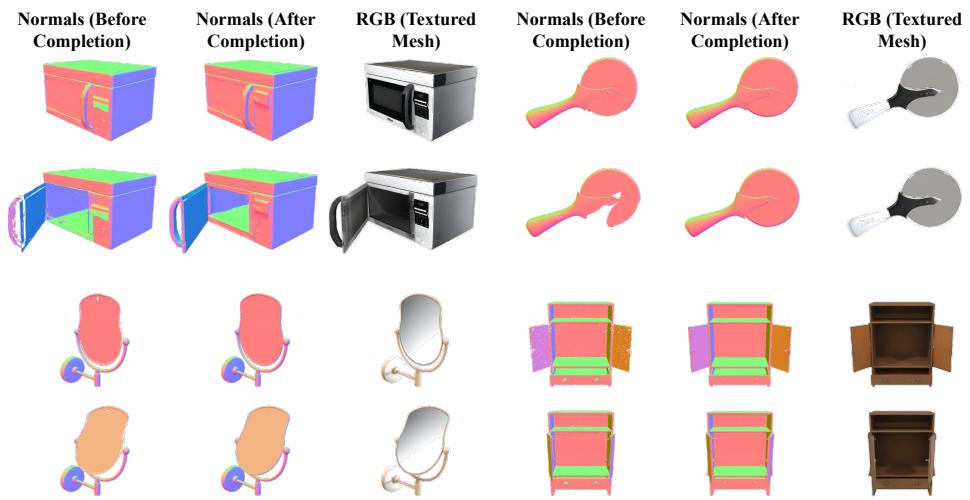
As visualized in Figure 3, this stage performs two tasks:
- Shape Completion: Using a model called HoloPart, the system “hallucinates” the missing geometry. It fills in the hole left by the door and creates a back face for the door itself.
- Texture Generation: Using a tool called Meshy, it applies realistic textures to the newly created geometry, ensuring the wood grain or metal finish looks consistent across the object.
Experiments and Analysis
The researchers validated Articulate AnyMesh through quantitative comparisons and practical robotics applications.
Quantitative Accuracy
How accurate are these VLM-predicted joints? The authors compared their method against supervised baselines like URDFormer and Real2Code using the PartNet-Mobility dataset. They tested on “In-Domain” objects (categories the baselines were trained on) and “Out-of-Domain” objects (unseen categories).
The results were telling. While the baseline methods performed decent on categories they knew, their performance collapsed on Out-of-Domain objects. Articulate AnyMesh, however, maintained high accuracy across both.
Note: In their experiments, the angle error for Articulate AnyMesh was significantly lower than URDFormer (6.2 degrees vs 33.8 degrees) on Out-of-Domain categories, proving the robustness of the VLM-based approach.
Application: Policy Learning in Simulation
The ultimate test for these generated assets is whether they are useful for training robots. The authors set up a “Real-to-Sim-to-Real” pipeline and a policy learning experiment.
They augmented standard training datasets (from DexArt) with objects generated by Articulate AnyMesh. They tested if robots trained on this larger, generated dataset could perform tasks better.
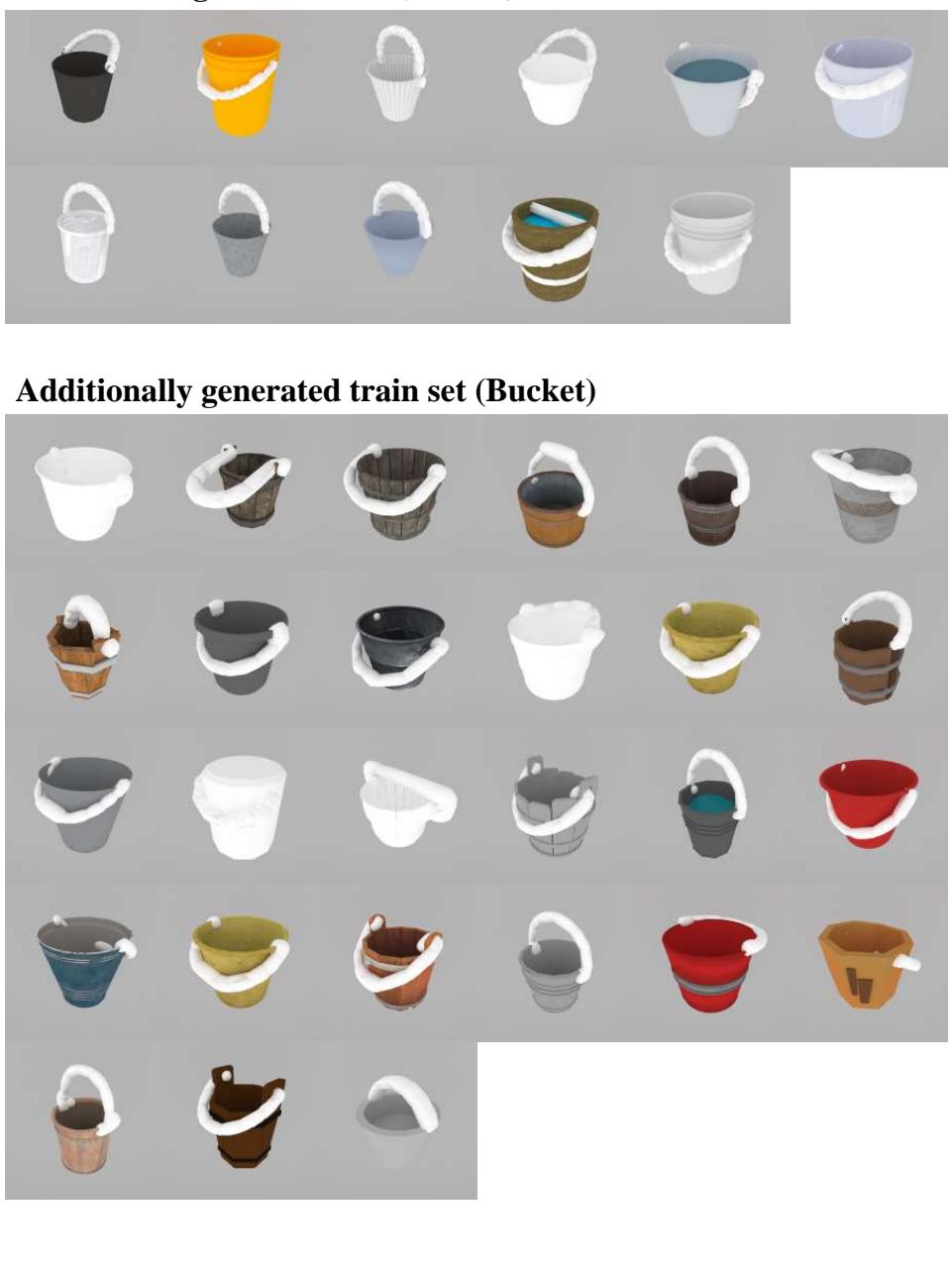 Figure 6: Original DexArt training buckets (top) vs. Articulate AnyMesh generated buckets (bottom).
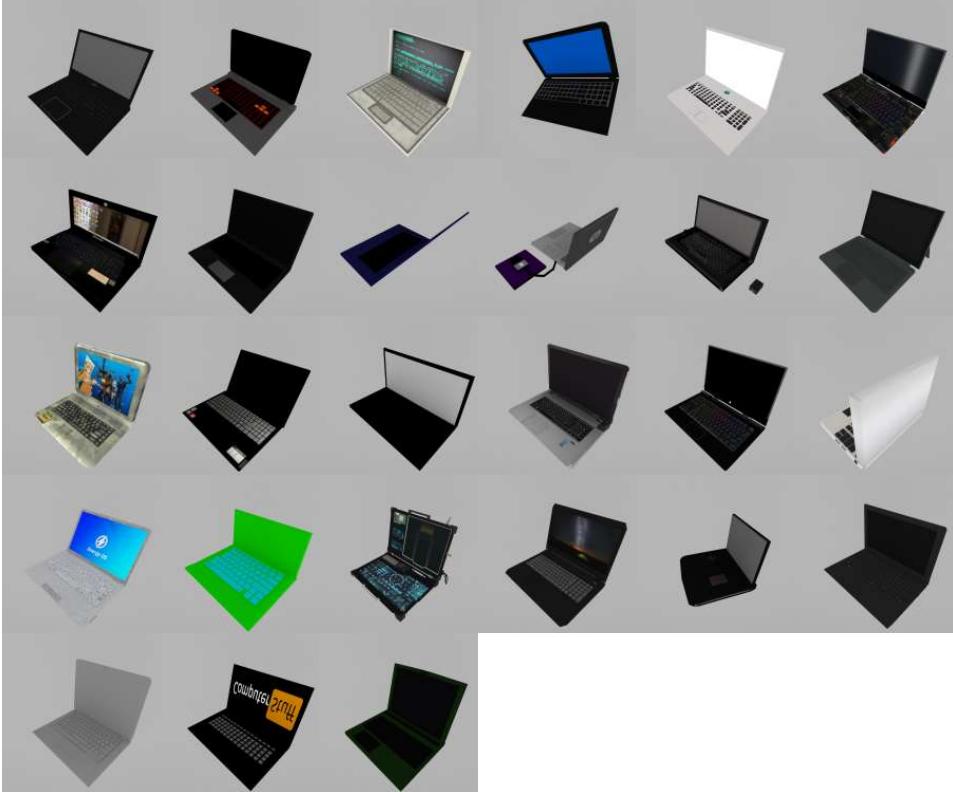 Figure 7: Original DexArt training laptops (top) vs. Articulate AnyMesh generated laptops (bottom).
As seen in the figures above, the generated datasets (bottom rows) provide vastly more visual and structural diversity than the limited original sets.
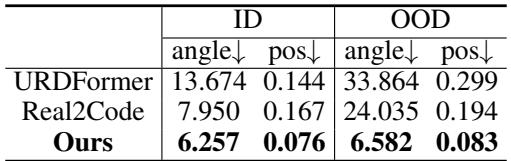
Table 2 (above) highlights the results. For tasks like opening a laptop or lifting a bucket, policies trained with the augmented dataset (Original + Generated) achieved higher success rates than those trained on the original data alone. This confirms that Articulate AnyMesh produces high-quality, physics-ready assets that actually help robots learn.
Real-to-Sim-to-Real Transfer
Finally, the authors demonstrated a “digital twin” workflow.
- They scanned real-world objects (a drill, a microwave, a wheel).
- They processed them through Articulate AnyMesh to create articulated simulations.
- They planned robot motions in the simulation.
- They executed those motions on a real robot.
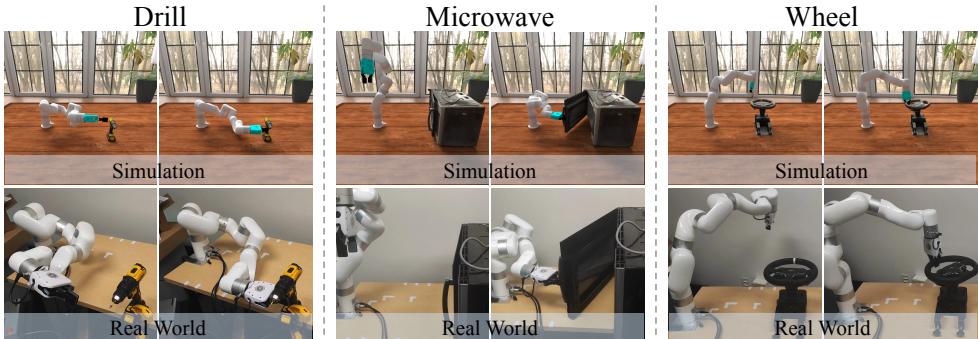
Figure 5 shows the robot successfully manipulating the real objects based on the generated articulation models. This effectively bridges the gap between static 3D scans and functional robotic interaction.
Conclusion and Implications
Articulate AnyMesh represents a shift in how we think about 3D content creation for AI. Rather than manually rigging assets or training narrow, specialized networks, the authors have shown that we can leverage the general-purpose reasoning of large Foundation Models to solve geometric problems.
By treating articulation estimation as a “visual prompting” task, the pipeline achieves true open-vocabulary capabilities. It allows researchers to populate simulation environments with an infinite variety of functional objects—from standard tools to generated fantasy vehicles.
Key Takeaways
- Generality: The method works on scanned, handcrafted, and AI-generated meshes without category restrictions.
- VLM Integration: Using GPT-4o for geometric reasoning (finding hinges) outperforms training specific regression networks for unseen objects.
- Completeness: The inclusion of shape completion and texture generation ensures the final assets are not just skeletons, but fully realized 3D objects ready for rendering and physics simulation.
For students interested in the intersection of Computer Vision, Graphics, and Robotics, this paper is a prime example of how different AI modalities (Language, 2D Vision, 3D Geometry) can be chained together to solve complex physical reasoning tasks.