](https://deep-paper.org/en/paper/2502.03444/images/cover.png)
If you have been following the explosion of generative AI, you are likely familiar with Latent Diffusion Models (LDMs), the architecture behind heavyweights like Stable Diffusion. The secret sauce of LDMs is efficiency: instead of generating an image pixel-by-pixel, they operate in a compressed “latent space.”
This compression is handled by a tokenizer (usually an autoencoder). For years, the standard advice has been to use Variational Autoencoders (VAEs). VAEs enforce a smooth, Gaussian distribution on the latent space, which theoretically makes it easier for the diffusion model to learn. But there is a trade-off: that smoothness constraint often results in blurry reconstructions and limits the fidelity of the final image.
What if we didn’t need that constraint? What if a standard Autoencoder (AE), which is better at preserving details, could be taught to organize its latent space without the heavy-handed math of a VAE?
In a recent paper, Masked Autoencoders Are Effective Tokenizers for Diffusion Models, researchers propose MAETok. They demonstrate that by using Masked Autoencoding (MAE) techniques, we can train a plain AE to learn a highly structured, semantic latent space. The result? State-of-the-art generation on ImageNet using only 128 tokens, significantly faster training times, and higher inference throughput.
In this post, we will deconstruct this paper, exploring why the structure of latent space matters more than variational constraints, and how masking is the key to unlocking better diffusion models.
The Bottleneck: Tokenizers in Diffusion Models
Before diving into the solution, let’s define the problem. Diffusion models are computationally expensive. To make them scalable, we use a two-stage process:
- Tokenization: An autoencoder compresses an image \(x\) into a smaller latent representation \(z\).
- Generation: A diffusion model learns to generate these latent codes \(z\).
The quality of the final image depends heavily on the tokenizer. If the tokenizer loses detail, the diffusion model can never recover it.
The VAE vs. AE Trade-off
Historically, researchers favored VAEs. A VAE adds a regularization term (KL divergence) to the loss function, forcing the latent codes to approximate a standard Gaussian distribution. This ensures the latent space is smooth—if you sample a point near a known code, it likely decodes into a valid image.
However, AEs (Autoencoders) usually achieve better reconstruction fidelity because they aren’t fighting the KL regularization. They focus purely on compressing and decompressing the image. The downside? Their latent spaces are often “messy.” They might be highly entangled or multi-modal, making it incredibly difficult for a diffusion model to learn the probability distribution.
The researchers behind MAETok asked a pivotal question: What exactly makes a latent space “good” for diffusion?
Theoretical Insight: Structure Over Regularization
The authors hypothesize that the variational aspect of VAEs isn’t what helps diffusion models. Instead, it is the structure of the latent space.
To prove this, they analyzed the latent spaces of AEs, VAEs, and their proposed MAETok using Gaussian Mixture Models (GMMs). A GMM attempts to fit the data distribution using a combination of Gaussian curves.
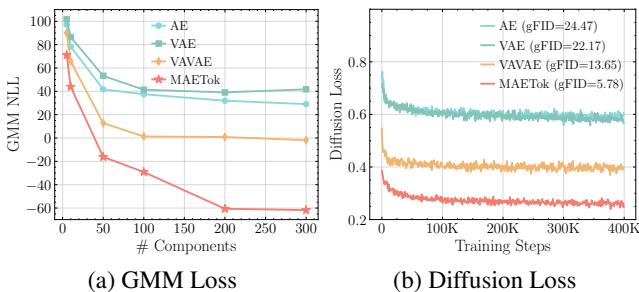
As shown in Figure 2, they found a strong correlation:
- Fewer GMM modes (lower NLL) \(\rightarrow\) Lower Diffusion Loss \(\rightarrow\) Better Generation Quality.
In simple terms, if the data in the latent space is grouped into clean, distinct clusters (fewer modes), the diffusion model has an easier time learning to generate data. VAEs help reduce these modes compared to standard AEs, but they sacrifice image detail to do so.
The Math Behind the Intuition
The paper supports this empirical finding with a theoretical analysis. They define the data distribution as a mixture of \(K\) Gaussians:
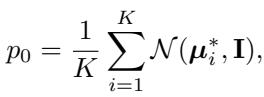
The diffusion model (DDPM) tries to minimize the score matching loss:

The researchers derived a theorem regarding the sample complexity—essentially, how much data (\(n'\)) you need to train the model to a certain error rate (\(\varepsilon\)).
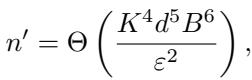
Look closely at the numerator. The complexity scales with \(K^4\). This means that as the number of modes (\(K\)) in your latent space increases, the difficulty of training the diffusion model skyrockets.
The Conclusion: We don’t necessarily need a VAE. We just need a latent space with a small \(K\) (few modes)—a space that is discriminative and well-separated.
The Solution: MAETok
Motivated by the insight that we need a discriminative latent space without the reconstruction penalties of a VAE, the authors propose MAETok.
This method uses a standard Autoencoder architecture but changes how it is trained. They borrow the concept of Masked Autoencoders (MAE), famously used in self-supervised learning for Vision Transformers.
Architecture Overview
MAETok uses a 1D tokenizer design based on Vision Transformers (ViT).
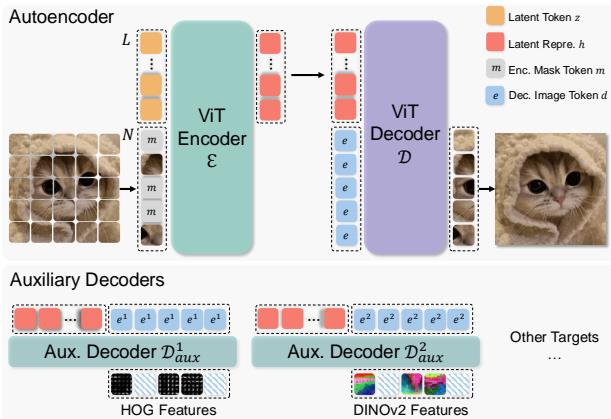
As illustrated in Figure 3, the process works like this:
- Patching: The input image is chopped into patches.
- Masking: A significant portion (40-60%) of these patches are randomly masked out.
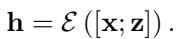
- Encoder (\(\mathcal{E}\)): The visible patches are fed into the encoder along with a set of learnable latent tokens. The encoder processes these to produce the latent representation \(h\).
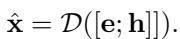
- Decoder (\(\mathcal{D}\)): The decoder takes the latent representation and a set of mask tokens to reconstruct the pixel values.
Why Masking?
Why does masking help diffusion? When an encoder has to reconstruct an image from only 40% of the pixels, it cannot rely on local shortcuts or high-frequency noise. It is forced to understand the global semantic structure of the image (e.g., “this is a dog, so there must be a tail here”).
This semantic understanding naturally leads to a latent space where similar objects are clustered together—exactly the low-mode, discriminative structure we want.
Auxiliary Decoders: Multi-Task Learning
To ensure the encoder learns rich features, the authors don’t just reconstruct pixels. They introduce Auxiliary Shallow Decoders. These are small, temporary decoders used only during training that try to predict different features from the masked tokens, such as:
- HOG (Histograms of Oriented Gradients): For edge and texture structure.
- DINOv2 & CLIP: For high-level semantic understanding.
The auxiliary loss looks like this:
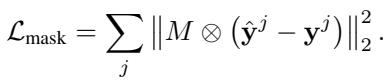
where \(M\) is the mask and \(\hat{y}^j\) is the prediction for target feature \(j\). This multi-target approach ensures the latent space captures both visual details and semantic meaning.
Decoupling Latent Structure and Reconstruction
There is one catch: high mask ratios are great for learning structure, but they can hurt fine-grained pixel reconstruction.
To solve this, the authors employ a two-stage training strategy:
- Masked Training: Train the encoder and decoders with masking. This builds the structured latent space.
- Decoder Fine-tuning: Freeze the encoder (preserving the structure) and fine-tune only the pixel decoder on unmasked images.
This allows the decoder to learn how to paint high-fidelity details onto the robust structural blueprint provided by the encoder.
Visualizing the Latent Space
Does masking actually clean up the latent space? Let’s look at the UMAP visualizations.
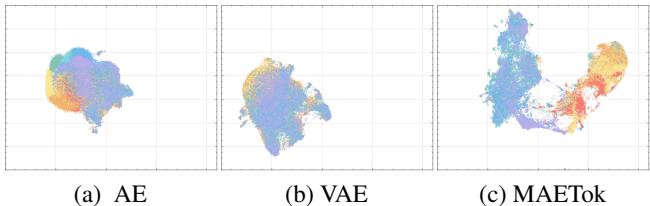
In Figure 4, compare the AE (a) and VAE (b) to MAETok (c).
- The AE (a) is a mess of overlapping colors—highly entangled.
- The VAE (b) is smoother but still overlaps significantly.
- MAETok (c) shows distinct, separated clusters.
This confirms that masking forces the encoder to separate different concepts (classes) in the latent space, reducing the number of modes the diffusion model needs to learn.
Furthermore, there is a direct correlation between how “discriminative” the space is and the final generation quality.
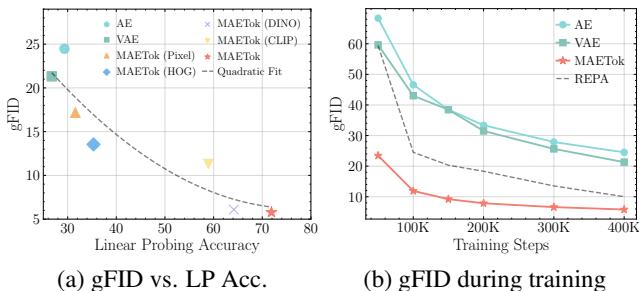
Figure 5(a) shows that as Linear Probing (LP) accuracy increases (a measure of how separable the features are), the generation FID (gFID) improves (lower is better). Figure 5(b) shows that diffusion models train much faster on MAETok latents compared to AE or VAE latents.
Experimental Results
The researchers tested MAETok on ImageNet at 256x256 and 512x512 resolutions. They used a transformer-based diffusion backbone (SiT and LightningDiT).
Quantitative Performance
The results are impressive, especially considering efficiency. MAETok uses only 128 tokens, whereas many competitors use 256 or even 1024.
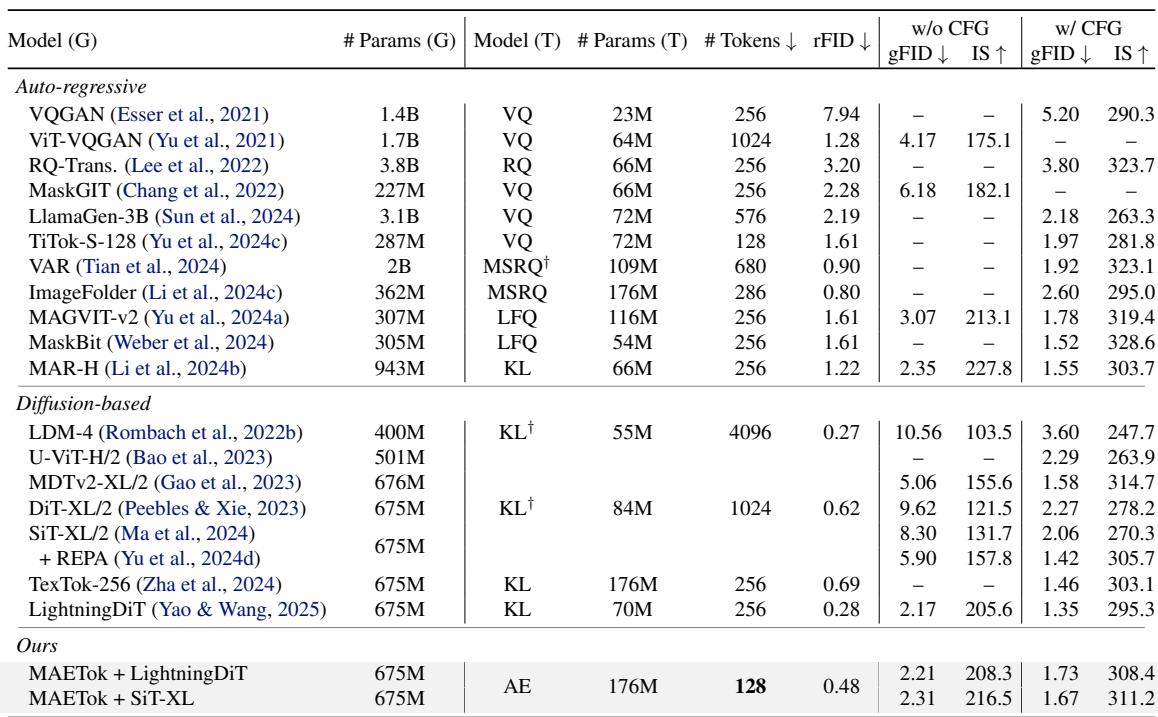
In Table 2 (256x256 resolution), look at the Ours rows at the bottom.
- gFID: MAETok achieves an FID of 2.21-2.31 without classifier-free guidance (CFG), which is comparable to or better than models using VQGAN or standard VAEs, despite using fewer tokens.
- Efficiency: Using 128 tokens dramatically reduces the computational cost of the diffusion transformer.
The advantages hold up at 512x512 resolution as well:

Table 3 shows that MAETok + SiT-XL achieves a gFID of 1.69 with CFG, beating the much larger 2B parameter USiT model while being significantly smaller (675M parameters).
Qualitative Results
The numbers are good, but what do the images look like?
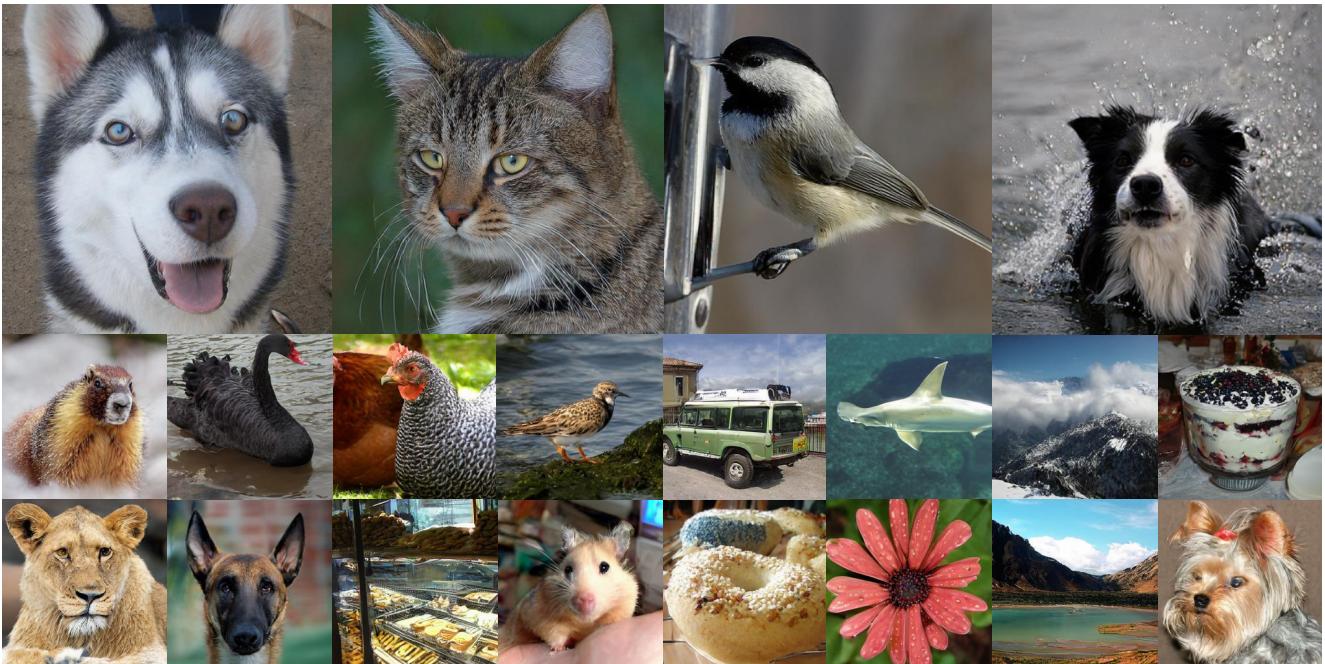
Figure 1 shows samples generated at 512x512. The images are sharp, coherent, and textured. The fur on the animals and the reflections in the water demonstrate that the 128-token compression isn’t losing critical detail.
Here are more uncurated samples showing the diversity:
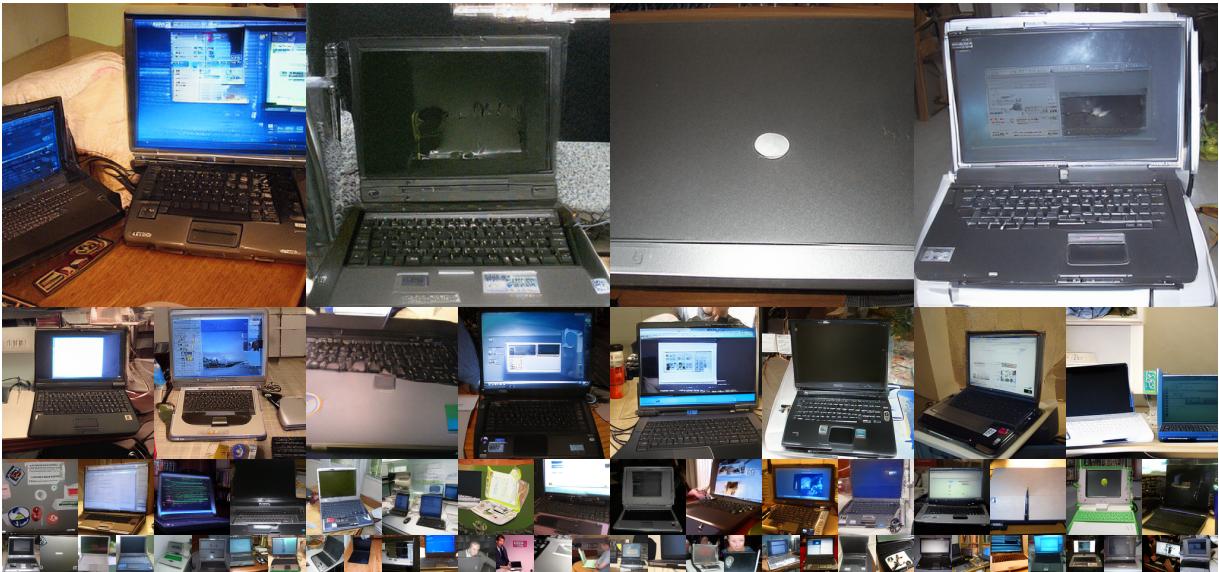
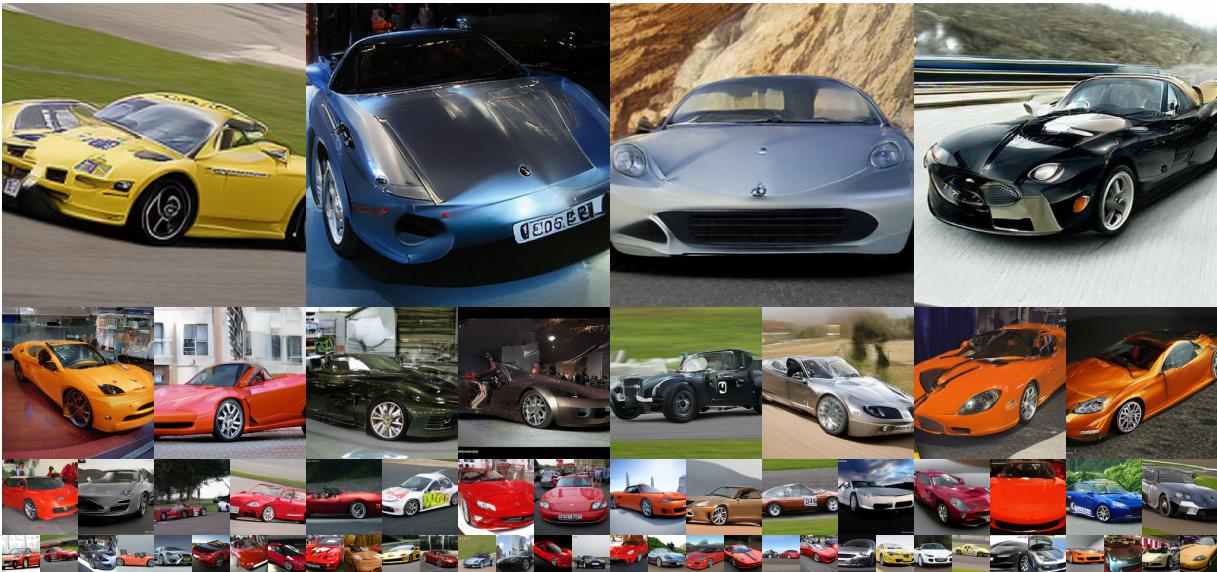
The model handles complex geometries (like laptops) and reflective surfaces (like sports cars) with high fidelity.
Discussion and Implications
The success of MAETok challenges the prevailing wisdom in generative AI. It suggests that:
- Variational isn’t vital: We don’t need the KL divergence of VAEs to train good diffusion models. We just need a latent space that is easy to model.
- Masking is a regularizer: Masked autoencoding acts as a powerful regularizer that structures the latent space naturally, grouping semantically similar items together.
- Efficiency: We can achieve SOTA results with highly compressed latent representations (128 tokens). This has huge implications for training speed. The authors report 76x faster training convergence compared to previous benchmarks.
Impact on Future Work
By decoupling the encoder’s semantic learning (via masking) from the decoder’s reconstruction (via fine-tuning), MAETok offers a flexible framework. Future work could integrate even stronger semantic teachers (like larger language models or multimodal embeddings) into the auxiliary decoders to further improve generation alignment.
Conclusion
MAETok represents a significant step forward in tokenizer design. By moving away from VAEs and embracing the “mask and predict” paradigm of MAE, the authors have created a method that is both simpler and more effective.
For students and researchers, the key takeaway is this: The structure of your data representation dictates the difficulty of your generative task. Sometimes, the best way to organize that structure isn’t through complex mathematical constraints, but through the training task itself.
This post is based on the paper “Masked Autoencoders Are Effective Tokenizers for Diffusion Models” (2025).