](https://deep-paper.org/en/paper/2502.03729/images/cover.png)
Introduction
One of the most persistent bottlenecks in robotics is data. To train a robot to perform useful tasks—like tidying a kitchen or sorting objects—we typically need thousands of demonstrations where a human manually guides the robot through the motions. This process, known as imitation learning, is slow, expensive, and difficult to scale.
Conversely, the internet is overflowing with “human data.” There are millions of videos of people cooking, cleaning, and manipulating objects. If robots could learn from this data, we could solve the scalability problem overnight. However, there is a catch: the embodiment gap. A human hand does not look or move like a robotic gripper. Furthermore, human videos are “action-free”—they contain visual information but lack the precise motor commands (joint angles, torques) that a robot needs to execute a task.
How do we bridge this gap? A new paper from Stanford University, Action-Free Reasoning for Policy Generalization, proposes a novel architecture called RAD (Reasoning through Action-free Data).
The core insight of RAD is simple yet profound: instead of trying to map human hand motions directly to robot actions, we should teach the robot to learn the reasoning behind the human’s behavior. By learning high-level logic (e.g., “I need to move the gripper above the cup”) from human videos, and low-level motor control from robot data, RAD creates a policy that generalizes far better than previous methods.
The Problem: The “Action-Label” Deficit
In standard imitation learning, we model a policy \(\pi(a|o)\), which predicts an action \(a\) given an observation \(o\). Robot demonstrations are perfect for this because they come with paired observations (camera images) and actions (motor commands).
Human videos, however, only provide observations (\(o\)). There is no label \(a\). Previous attempts to solve this usually fall into two categories:
- Visual Representation Learning: Using human videos to learn better visual encoders (like R3M or MVP) that understand the structure of the world, then freezing that encoder and training a small policy on top with robot data.
- Grounded Action Extraction: Trying to fake the action labels. This involves tracking the human hand (using tools like MediaPipe or HaMeR) and treating the hand’s trajectory as a proxy for the robot’s end-effector trajectory.
The downside of the second approach is the embodiment gap. A human hand rotating to grab a mug relies on wrist flexibility and finger dexterity that a parallel-jaw gripper simply doesn’t have. If a robot mimics human motion too literally, it often fails.
RAD takes a different approach. It assumes that while the actions differ between humans and robots, the reasoning is shared. The decision to “approach the cup from the side” is valid for both embodiments, even if the motor commands required to execute it are completely different.
The RAD Methodology
RAD builds upon recent advancements in Vision-Language-Action (VLA) models. These models, such as OpenVLA, use a Large Language Model (LLM) backbone to process visual inputs and output robot actions.
The researchers introduce a “Reasoning Chain”—a sequence of intermediate text steps that precede the final action. The model learns to predict this chain autoregressively.
The Architecture
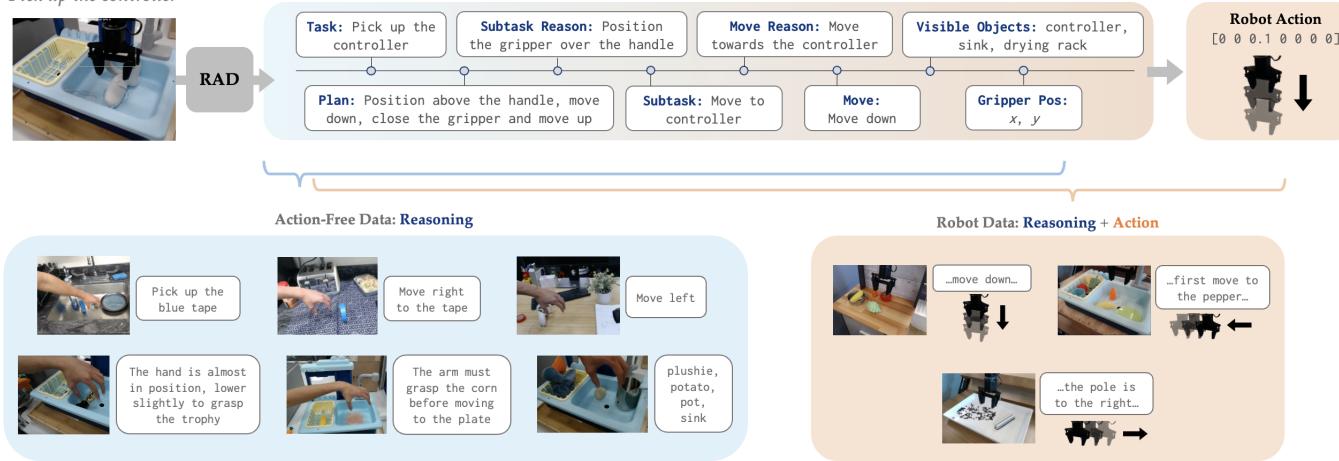
RAD trains a large transformer model on a mixture of two datasets:
- Robot Data: Contains \((Observation, Reasoning, Action)\).
- Human (Action-Free) Data: Contains \((Observation, Reasoning)\).
The robot data teaches the model how to ground reasoning into physical movement. The human data—which can be vastly larger—teaches the model how to reason about the world, handle new objects, and understand diverse environments.
The Objective Function
To train this mixed-modality model, RAD optimizes a joint objective.
For Robot Data, the model maximizes the likelihood of both the reasoning chain (\(l^1 \dots l^C\)) and the final action (\(a\)):
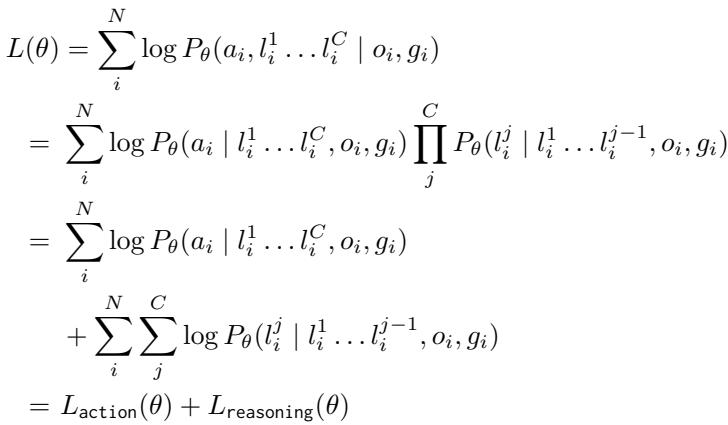
Here, \(L_{action}\) is the standard imitation learning loss, and \(L_{reasoning}\) ensures the model learns the logical steps leading up to the action.
For Human Data, since there are no ground-truth robot actions, the model only optimizes the reasoning component:

By sharing the parameters \(\theta\) across both objectives, the reasoning capabilities learned from the diverse human data transfer directly to the robot’s decision-making process.
Generating Labels: The Pipeline
You might be wondering: Where does the text-based reasoning come from? Human videos don’t come with subtitles explaining the subject’s internal monologue.
The authors developed an automated pipeline to synthesize these labels using pretrained Vision-Language Models (VLMs) and hand-tracking tools.
The reasoning chain consists of several hierarchical steps:
- Task Plan: High-level goal (e.g., “Pick up the controller”).
- Subtask Reasoning & Subtask: What segment of the task is next? (e.g., “Move to controller”).
- Move Reasoning: How should the arm move? (e.g., “Move closer to the object”).
- Move Primitive: Directional command (e.g., “Move down”).
- Gripper Position & Visible Objects: Spatial grounding.
- Action: The final robot motor command (only for robot data).
To generate these labels for human videos, the pipeline uses HaMeR (a hand-tracking transformer) to detect hand movement. It analyzes the change in hand position between frames to determine primitives (e.g., if the hand moves down, the primitive is “move down”).
Then, it feeds the image, the detected objects (via Grounding DINO), and the movement primitives into Gemini (a powerful VLM). Gemini is prompted to hallucinate the high-level reasoning that logically connects the scene to the movement.
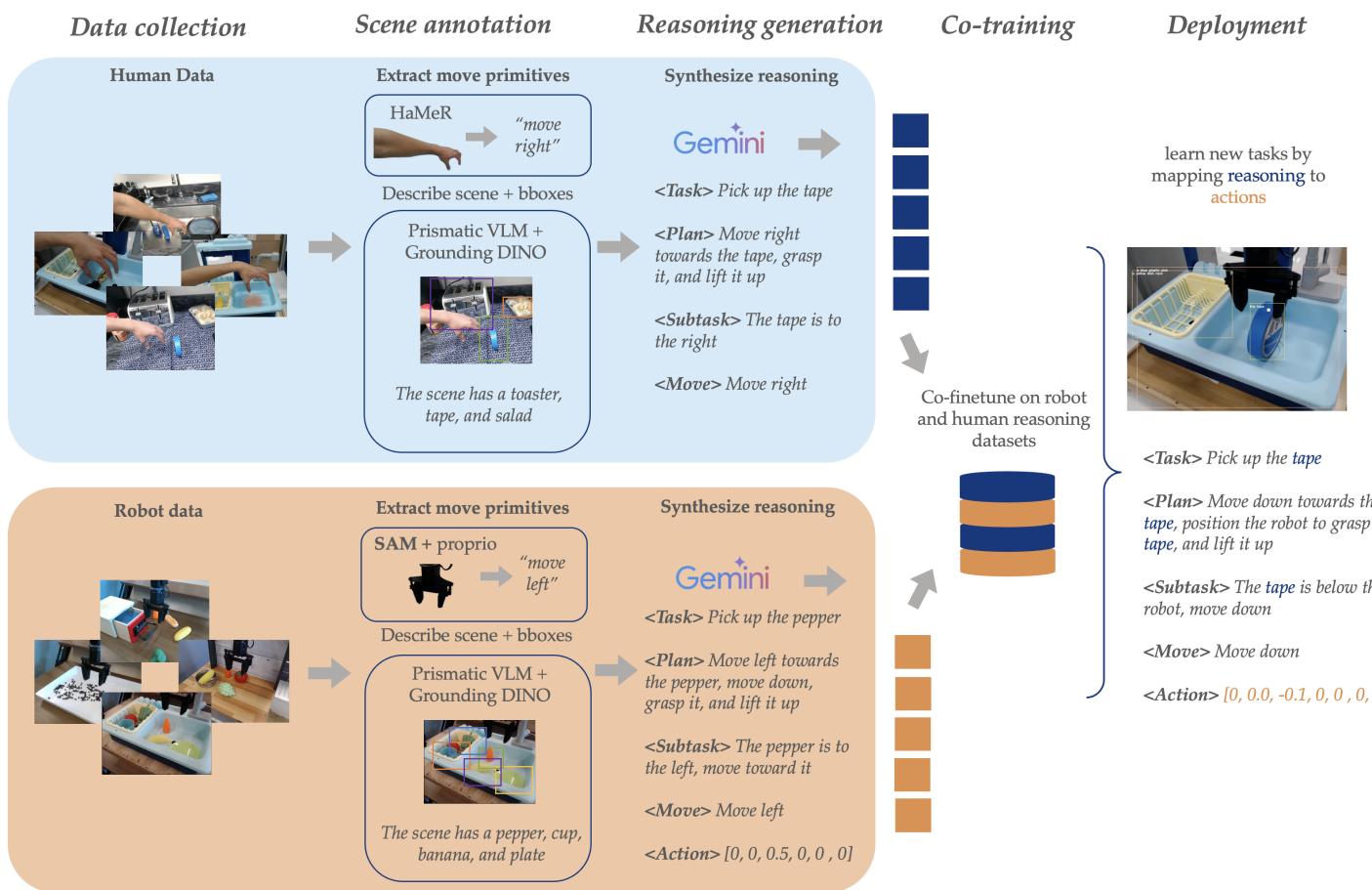
As shown in Figure 3 above, this pipeline converts raw pixels into rich, semantic “Chain-of-Thought” data. This effectively turns “action-free” video into “reasoning-rich” supervision.
Experimental Results
The researchers evaluated RAD on a real-world WidowX robot arm. They compared it against ECoT (Embodied Chain-of-Thought), a strong baseline that uses reasoning but is trained only on robot data. They also compared it against ECoT-GT (Gripper Tracking), which uses human data but only learns from the hand position, ignoring the high-level linguistic reasoning.
The experiments were designed to test generalization across three axes:
- Compositional: Known objects and tasks, but in new combinations (e.g., putting an apple on a plate, when the robot has only seen apples in bowls).
- New Objects: Tasks involving objects never seen in the robot dataset.
- New Scenes: Known tasks performed in visually distinct environments.
1. Transferring Human Behaviors to Robots
Can RAD learn a task purely from human video? To test this, the team trained the robot on tasks present in human videos but absent from the robot demonstration data.
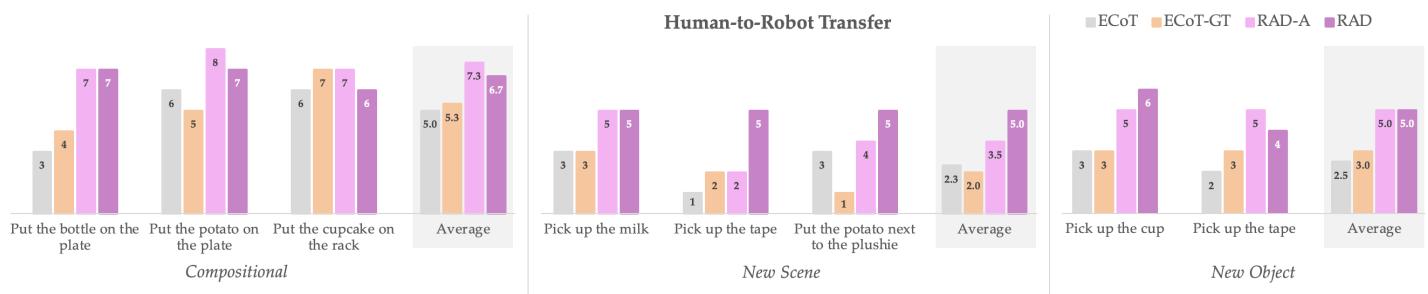
The results (Figure 4) were significant. RAD (and its axis-specific variant RAD-A) consistently outperformed the baselines.
- Compositional Tasks: RAD achieved significantly higher success rates than the baseline that only tracked hand positions (ECoT-GT). This suggests that understanding why a human moves (reasoning) is more transferable than just knowing where they move (tracking).
- Qualitative Analysis: The authors noted that RAD models showed better “grasp intelligence”—for example, grasping large cups by the side rather than the center, a nuance picked up from human reasoning traces.
2. Generalization to Completely Unseen Tasks
The Holy Grail of robotics is generalization to tasks that appear in neither the robot nor the human training data. This tests the model’s ability to extrapolate its reasoning logic.
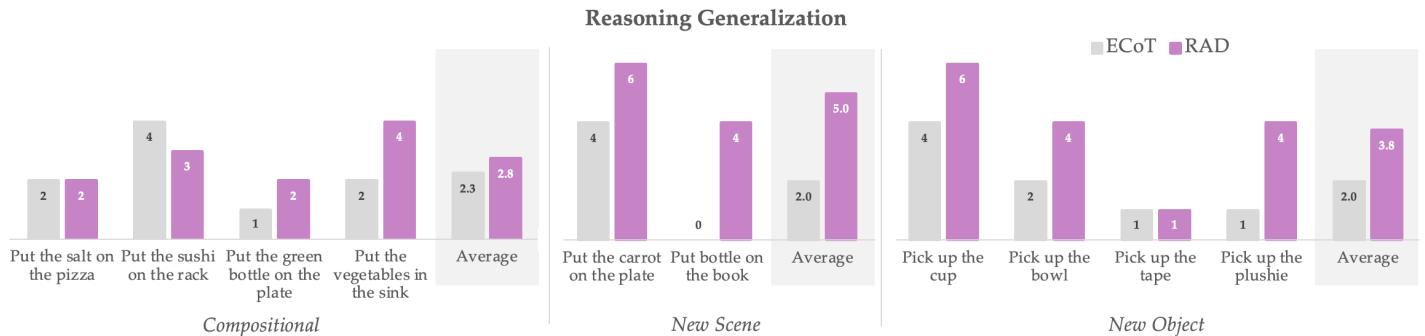
Figure 5 highlights a massive improvement. On “New Scene” generalization, RAD jumped from a 20% success rate (ECoT baseline) to 50%. By training on diverse human videos, the model learned to ignore distractors (like a random plushie in the background) and focus on the relevant objects, a skill that purely robot-trained models often lack.
3. Learning from the “Wild”
Robot lab data is clean and controlled. Real-world human video is messy. The authors collected data from “out-of-domain” environments—real kitchens, cluttered desks, and tabletops that looked nothing like the robot’s training environment.
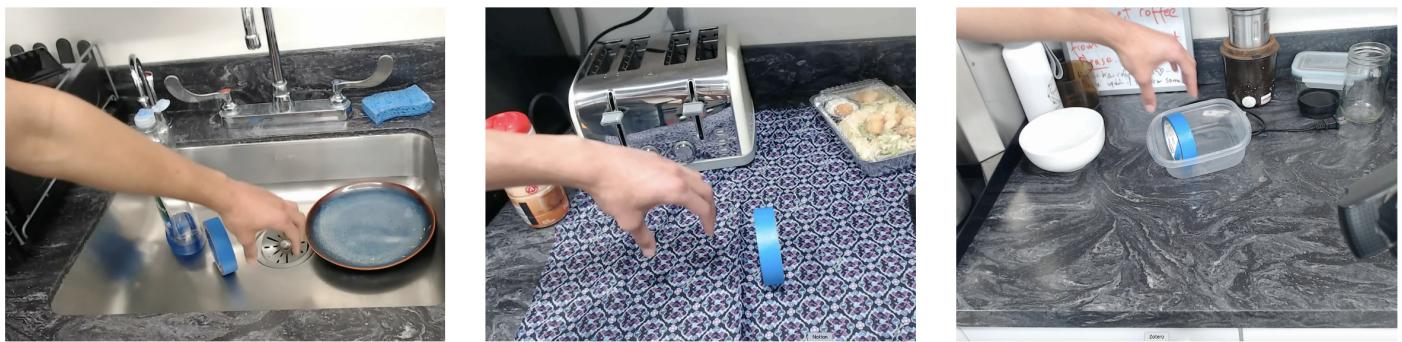
They found that adding this “wild” data improved performance significantly.
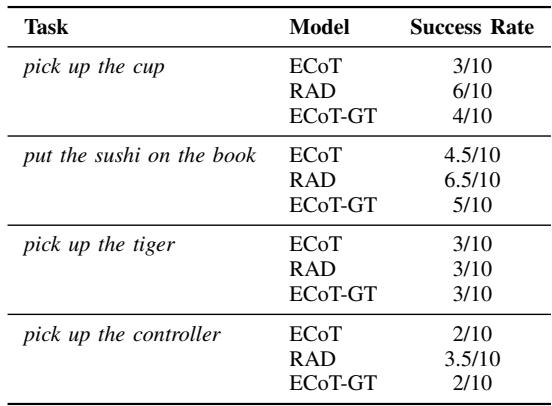
As shown in Table I, training on data from different environments (like the desk setup in Figure 9) improved the success rate on the test setup by roughly 15-20%. This confirms that the linguistic reasoning learned from diverse visual inputs is robust to background shifts.
Furthermore, scaling the amount of data mattered.
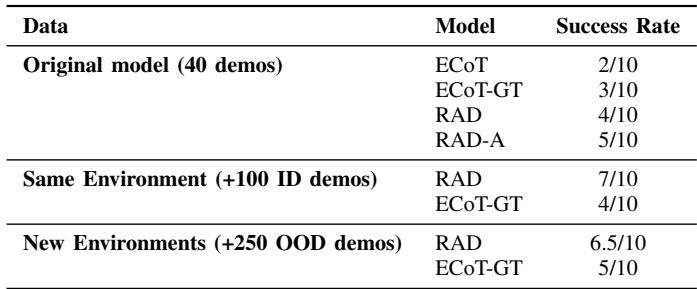
Table II demonstrates that adding 250 out-of-domain demos increased success rates from 4/10 to 6.5/10. This is a promising sign for the future: simply scraping more human videos from the internet could yield smarter robots without requiring a single new robot teleoperation session.
Conclusion and Implications
The RAD framework presents a compelling solution to the data scarcity problem in robotics. By shifting the imitation target from action to reasoning, it allows robots to learn from the massive unstructured repository of human video data available today.
Key takeaways for students and researchers:
- Language is a Universal Interface: Physical actions are specific to a body, but language-based reasoning is embodiment-agnostic. It serves as a bridge between human and robot.
- Action-Free Data is Valuable: We don’t need joint angles to learn policy. If we can extract the “intent” and “plan” from a video, we can improve the robot’s general intelligence.
- The Pipeline Matters: The success of RAD relies heavily on the quality of the automated labeling pipeline (HaMeR + Gemini). As foundation models improve, this synthetic data generation will become even more accurate, likely boosting RAD’s performance further.
This work suggests that the next generation of generalist robots won’t just be trained by teleoperators in labs, but by “watching” YouTube and learning not just what we do, but why we do it.