](https://deep-paper.org/en/paper/2502.05352/images/cover.png)
The $5.4 Billion Problem
In July 2024, a massive outage hit CrowdStrike, rippling through critical systems worldwide. Flights were grounded, hospitals were disrupted, and Fortune 500 companies faced an estimated loss of $5.4 billion. This event served as a stark reminder: modern IT systems are incredibly complex, fragile, and essential to the global economy.
Managing these systems—ensuring they stay online (Site Reliability), remain secure (Compliance), and don’t bleed money (FinOps)—is becoming too difficult for humans to handle alone. The industry is turning toward AI Agents: autonomous software powered by Large Language Models (LLMs) that can plan, reason, and execute fixes.
But here is the catch: How do we know if an AI agent is actually ready to handle a production Kubernetes cluster? If an agent hallucinates while writing a poem, it’s funny. If it hallucinates while managing a bank’s server permissions, it’s a catastrophe.
Enter ITBench.
In a new paper, researchers have introduced a comprehensive framework designed to systematically evaluate AI agents on real-world IT tasks. ITBench isn’t just a multiple-choice test; it is a live, reactive environment that simulates the chaos of modern IT operations.
In this deep dive, we will explore how ITBench works, the three major domains it tests, and the sobering results of current state-of-the-art AI models when faced with real IT crises.
The Three Pillars of Modern IT
To understand ITBench, we first need to understand the jobs it is trying to automate. The framework focuses on three distinct but interconnected personas, as illustrated below.
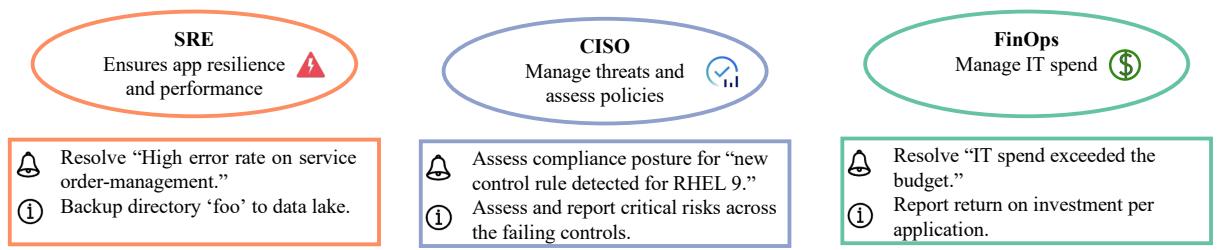
- Site Reliability Engineering (SRE): These are the digital firefighters. Their goal is availability and resiliency. When a server crashes or latency spikes, they diagnose the root cause and mitigate the issue.
- Compliance and Security Operations (CISO): These are the gatekeepers. They ensure that systems adhere to strict regulations (like CIS benchmarks) and are secure against vulnerabilities.
- Financial Operations (FinOps): These are the efficiency experts. In the world of cloud computing, costs can spiral out of control in minutes. FinOps ensures resources are used efficiently and budgets are met.
Existing benchmarks often rely on static datasets or multiple-choice questions. However, real IT work involves staring at logs, running commands, seeing what happens, and trying again. ITBench was built to reflect this reality.
Under the Hood: The ITBench Architecture
ITBench is designed as a “black box” environment for agents. The agent is given a task (e.g., “Fix the high error rate on the checkout service”), but it isn’t told how to do it. It must explore the environment, gather data, and execute commands.
The Automation Framework
The architecture is built on open-source technologies to ensure reproducibility. It consists of a Scenario Environment (the actual simulated IT system), an Agent (the AI being tested), and an Evaluator (which scores the agent’s success).
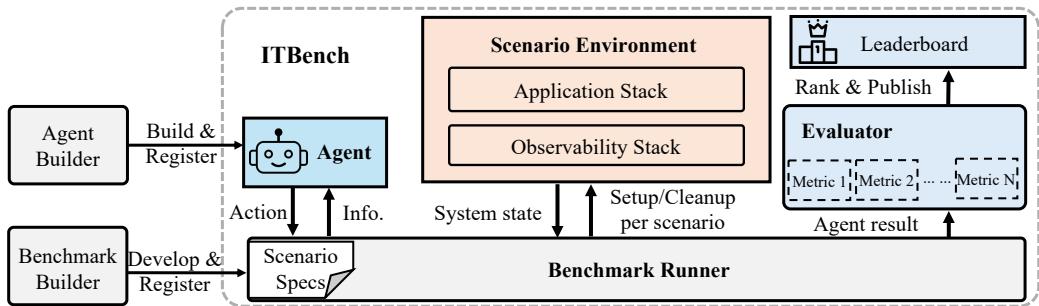
As shown in the framework diagram, the system connects two external builders—the Agent Builder and the Benchmark Builder—into a central core.
- The Benchmark Runner spins up a fresh environment (like a Kubernetes cluster) for every single test run.
- It injects a specific fault or misconfiguration (the “Scenario”).
- The Agent interacts with this environment using a set of tools.
- Finally, the Evaluator compares the final state of the system against the expected ground truth.
The Agent Loop: A POMDP
The researchers conceptualize the interaction between the agent and the IT system as a Partially Observed Markov Decision Process (POMDP). This is a fancy way of saying: “The agent cannot see everything at once.”
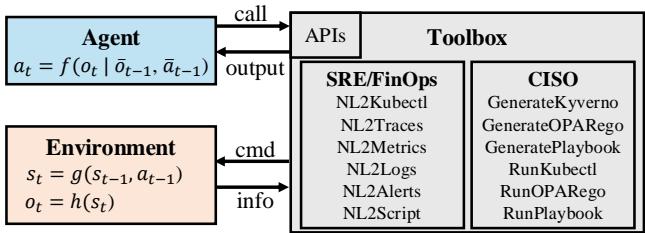
In a real IT outage, you don’t have a “God view” of the system. You only see what your tools show you.
- Observation (\(o_t\)): The agent runs a command (like
kubectl get pods) or queries a log tool. The output is its observation. - Thought: The agent processes this observation using its LLM backend (e.g., “The pod is crashing, I should check the logs”).
- Action (\(a_t\)): The agent executes a new command or a tool call.
- State Transition: The environment changes based on that action (e.g., a server restarts).
This loop continues until the agent believes it has solved the problem or hits a time limit.
Creating Chaos: The Scenarios
ITBench includes 94 scenarios derived from real-world incidents, compliance standards, and financial KPIs. Let’s break down how these scenarios mimic reality.
1. The SRE Scenarios (Fixing the Break)
The SRE scenarios are perhaps the most dynamic. The researchers took 105 real-world incidents from SaaS products and recreated them.
Imagine a “Cache Failure” scenario. The system might simulate a memory leak in a Redis cache.
- The Trigger: The agent receives an alert: “High error rate on frontend service.”
- The Data: The agent has access to Observability Data—Logs, Traces, and Metrics.
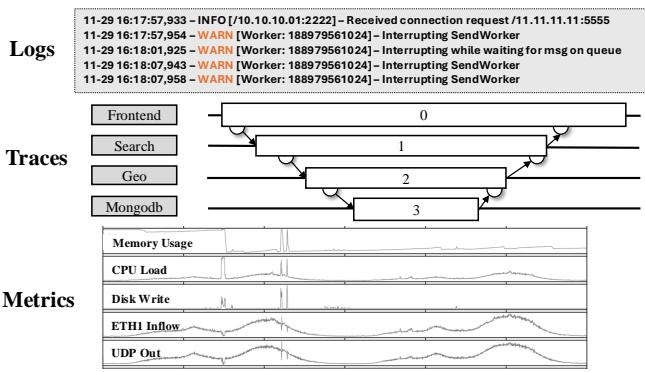
As seen above, the agent must correlate spikes in CPU load (Metrics) with specific error messages (Logs) and slow request paths (Traces). This is a “needle in a haystack” problem. The agent has tools like NL2Kubectl (Natural Language to Kubectl) and NL2Logs to query this data.
2. The CISO Scenarios (Compliance as Code)
Security isn’t just about catching hackers; it’s about rigorous configuration. CISO scenarios are based on the CIS Benchmarks (Center for Internet Security).
A typical task might be: “Ensure that no containers share the host network namespace.” The agent must:
- Inspect: Write a script (using Ansible or Kubectl) to check the current configuration.
- Verify: Write a policy (using OPA Rego or Kyverno) to enforce the rule.
- Validate: Confirm the system is compliant.
The complexity here lies in generating syntactically correct code (like Rego policies) that accurately reflects a natural language requirement.
3. The FinOps Scenarios (Optimization)
These scenarios focus on cost. An agent might be alerted that the budget for a specific service has been exceeded. It must investigate why (e.g., a misconfigured autoscaler launching too many expensive nodes) and recommend a fix that balances cost with performance.
Characterizing Complexity
Not all problems are created equal. ITBench categorizes scenarios into Easy, Medium, and Hard.
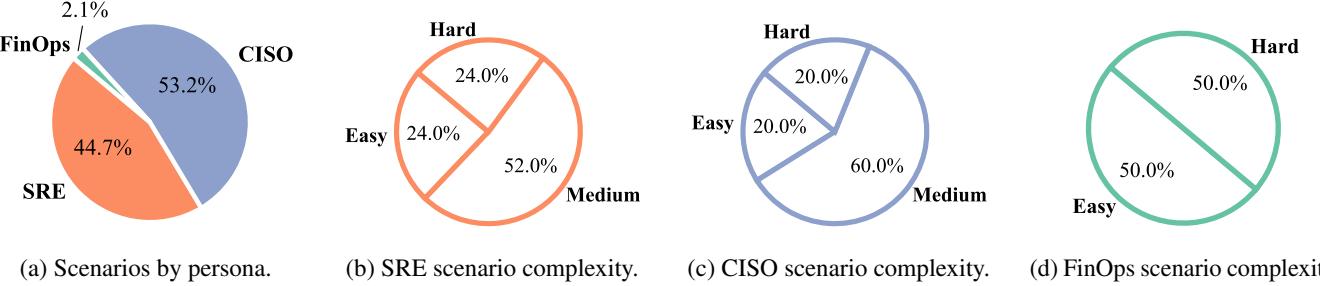
As the charts above show, complexity is determined by factors like the length of the fault propagation chain (how many dominos fell before the alert triggered) and the number of technologies involved. Some scenarios involve a simple pod restart (Easy), while others require tracing a fault through four different microservices written in different languages (Hard).
How Do We Measure Success?
If an agent fixes the problem but deletes the entire database in the process, is that a success? Obviously not. ITBench uses a rigorous evaluation leaderboard.
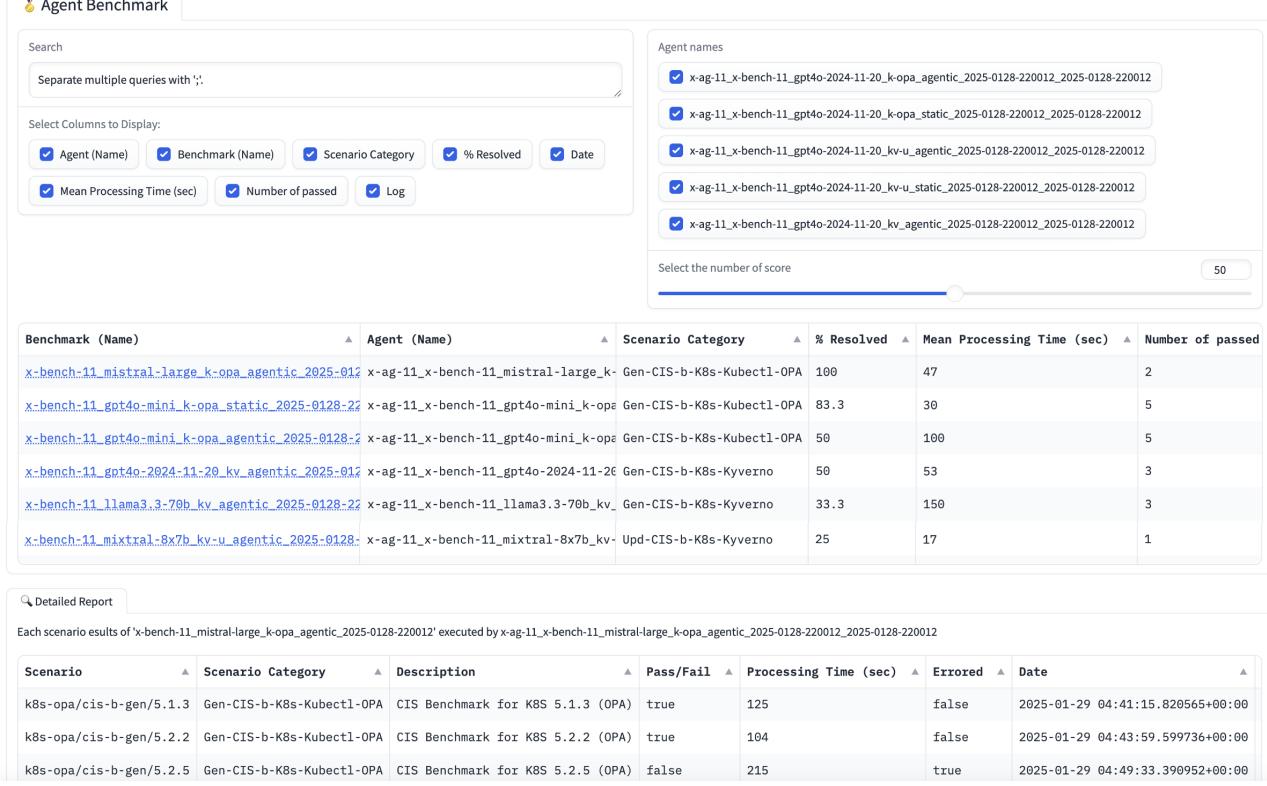
The framework uses several metrics, but the most critical ones are:
- Pass@1: Did the agent solve the problem on its first try?
- For SRE: Did the alert clear?
- For CISO: Did it correctly identify compliant vs. non-compliant setups?
- For FinOps: Did it optimize cost without breaking the app?
- NTAM (Normalized Topology-Aware Match): This is a novel metric for SRE. Sometimes an agent finds part of the problem. NTAM measures how close the agent’s diagnosis was to the real root cause within the system topology.
- MTTD / MTTR: Mean Time to Diagnosis and Mean Time to Repair. Speed matters in IT.
The Results: Are AI Agents Ready for Production?
The researchers tested several leading models, including GPT-4o, Llama-3, and Granite, using the ITBench framework. The results were revealing—and humbling.
SRE Performance: A Long Way to Go
Despite the hype surrounding AI coding assistants, resolving live incidents proved incredibly difficult.

As shown in Table 4, GPT-4o was the top performer, but it only achieved a 13.81% success rate (pass@1) for diagnosis and 11.43% for mitigation.
- Llama-3.3-70B followed with roughly 3%.
- The smaller models (8B parameters) barely registered a success.
The Complexity Cliff: The agents performed decently on “Easy” scenarios (GPT-4o solved ~36% of diagnoses). However, on “Hard” scenarios, the success rate for mitigation dropped to 0% across all models. Complex, multi-step failures are currently beyond the reasoning capabilities of even the best LLMs.
The Importance of Tracing: The researchers found that giving agents access to Trace data (detailed maps of request flows) was crucial. Without traces, GPT-4o’s diagnosis success rate dropped from 13.8% to 9.5%, and mitigation fell to nearly 3%. This highlights that better observability tools make AI agents smarter.
CISO Performance: Better, But Inconsistent
The agents fared slightly better in the security domain, likely because these tasks rely heavily on code generation (translating English rules to code), which LLMs are generally good at.
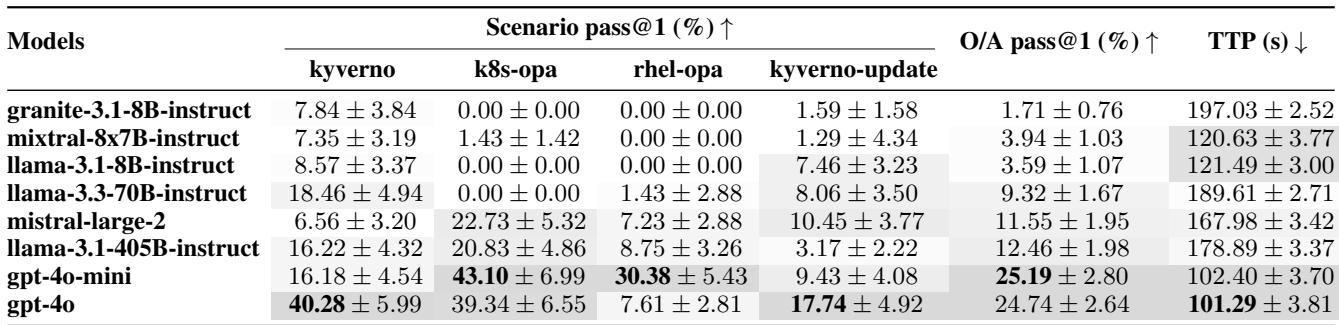
GPT-4o achieved a pass rate of roughly 40% on the “Easy” Kyverno tasks. However, performance varied wildly depending on the scenario class. For difficult updates to existing policies (kyverno-update), success rates plummeted.
The study also highlighted a major issue: Non-determinism. An agent might solve a problem on the first run and fail on the second, simply because of minor changes in how the LLM generated the code or how the environment responded.
FinOps Performance: The Hardest Challenge
The results for Financial Operations were the starkest.
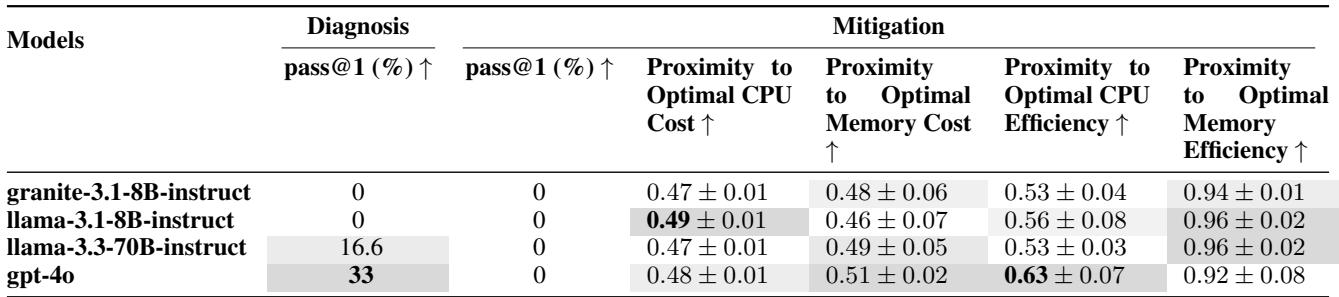
As Table 6 shows, GPT-4o managed a 33% success rate in diagnosing cost issues, but 0% of the agents were able to successfully mitigate the problem (pass@1 was 0% across the board).
Why? FinOps requires balancing conflicting goals (cost vs. performance) and understanding complex autoscaling logic. The agents often identified the high cost but recommended actions that would crash the application (like deleting all replicas) or failed to navigate the configuration files correctly.
A Look Inside the AI’s Brain
To understand why agents fail or succeed, ITBench captures their “trajectories”—the step-by-step logs of their thoughts and actions.
Here is an example of a successful trajectory using Llama-3.3:

In this case (Scenario 15), the agent:
- Checks Alerts: Sees high error rates.
- Investigates: Uses
kubectlto check the deploymentcheckout. - Reasons: Notices there is only 1 replica.
- Acts: Scales the deployment up to 2 replicas.
- Success: The patch is applied, and the service stabilizes.
Interestingly, the researchers noted that in this specific case, the agent actually misidentified the root cause (which was an HTTP request corruption), but scaling the service fixed the symptoms. This mirrors human SRE behavior: sometimes you fix the outage without fully understanding the bug!
However, failures are common. In many “Hard” scenarios, agents would get stuck in loops, repeatedly running the same kubectl command or hallucinating syntax for tools that don’t exist, until they hit the timeout.
Conclusion: The Path Forward
ITBench represents a significant leap forward in AI evaluation. It moves us away from static text benchmarks and into the messy, unpredictable world of live IT operations.
The key takeaways from the research are clear:
- We are early. With success rates around 14% for SRE and 0% for FinOps mitigation, AI agents are not yet ready to run production systems autonomously.
- Context is King. Agents perform significantly better when provided with rich observability data (traces, logs) and specialized tools.
- Complexity Kills. Current LLMs struggle with multi-step reasoning required for “Hard” scenarios involving multiple technologies.
ITBench provides the “gym” where the next generation of AI agents will train. By standardizing how we measure success—using real clusters, real faults, and real metrics—we can move closer to the vision of self-healing, secure, and efficient IT systems.
For now, Site Reliability Engineers can rest easy: the AI isn’t coming for your job just yet—but it might soon become a very helpful intern.