](https://deep-paper.org/en/paper/2502.05855/images/cover.png)
Introduction
We are currently living through a golden age of Artificial Intelligence, largely driven by Large Language Models (LLMs) and Vision-Language Models (VLMs). These models can write poetry, debug code, and analyze complex images with startling accuracy. However, when we try to transfer this intelligence into a physical robot, we hit a wall. The “brain” is brilliant, but the “body” is clumsy.
The dream of robotics is a generalist agent—a robot that can tidy your kitchen, fold your laundry, and sort trash, regardless of the environment or the specific robot hardware being used. The current state-of-the-art approach is the Vision-Language-Action (VLA) model. These models attempt to ground the vast knowledge of the internet (via VLMs) into robotic actions.
However, there is a fundamental “architectural imbalance” in current VLAs. We often pair a massive, pre-trained VLM (7 billion parameters or more) with a tiny, simple neural network (often just a few million parameters) to handle the actual motor control. It is like putting a supercomputer in charge of a puppet with only two strings. Furthermore, training these models requires massive datasets that are expensive to collect.
In this post, we are doing a deep dive into DexVLA, a new research paper that proposes a radical shift in how we build these robot brains. The researchers introduce a 1-billion parameter “Diffusion Expert”—a massive neural network dedicated solely to action—and a unique embodied curriculum learning strategy.
As we will see, DexVLA doesn’t just scale up; it fundamentally changes how robots learn to move, allowing them to perform incredibly complex tasks like folding laundry and pouring drinks with dexterous hands, often with very little specific training data.
The Bottlenecks of Modern Robot Learning
To understand why DexVLA is significant, we first need to understand the two main problems holding back current robotic learning:
- Data Scarcity: While we have trillions of text tokens to train LLMs (like GPT-4), robot demonstration data is scarce. Collecting data requires a human to physically guide a robot arm, which is slow and costly. Current models like OpenVLA or Octo rely on datasets like Open-X Embodiment, but even these aren’t enough to capture the nuance of every possible physical interaction.
- Architectural Imbalance: As mentioned, most VLAs focus on scaling the visual and language understanding parts. The component that actually decides how to move the robot arm—the “action head”—is often an afterthought. It is usually a small Multi-Layer Perceptron (MLP). This creates a disconnect: the model understands the command “fold the shirt” perfectly, but lacks the complex motor circuitry to execute the precise, fluid movements required to do it.
The DexVLA Solution
The authors of DexVLA propose a framework that treats the “action” component with as much importance as the “vision-language” component. They achieve this through a modular architecture and a human-like learning curriculum.
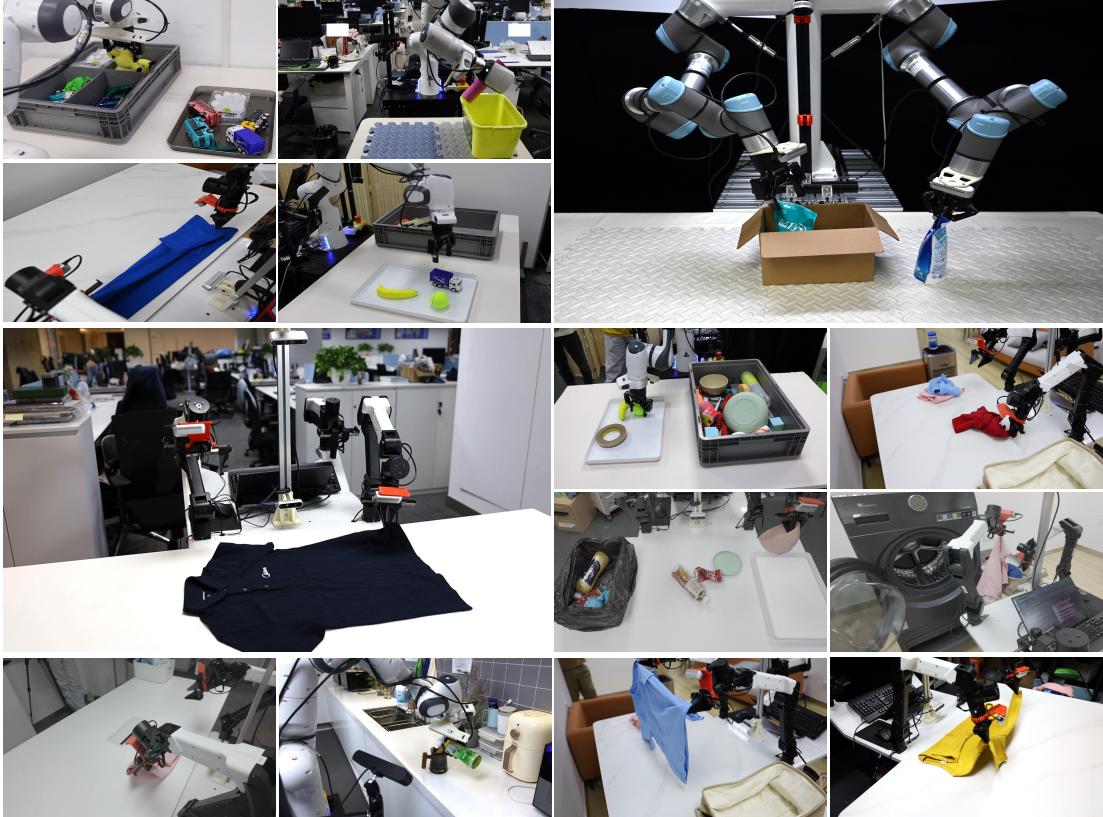
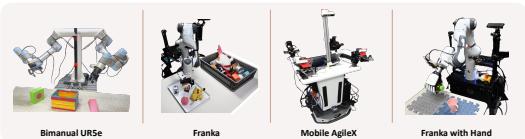
As shown in Figure 1, the goal is versatility. Whether it is sorting trash with a dual-arm robot, folding clothes, or pouring water with a five-fingered mechanical hand, the underlying system should be the same.
1. The Billion-Parameter Diffusion Expert
The core innovation of DexVLA is the Plug-in Diffusion Expert. Instead of a simple output layer, the researchers use a massive Diffusion Policy model scaled up to 1 billion parameters.
What is a Diffusion Policy?
In the context of image generation (like Stable Diffusion), a model learns to turn random noise into a clear image. In robotics, a Diffusion Policy learns to turn random noise into a trajectory of robot actions. It iteratively “denoises” a sequence of random numbers until they form a smooth, logical movement path for the robot arm.
Existing diffusion policies were generally small (ResNet or U-Net based). DexVLA uses a Transformer-based architecture (specifically ScaleDP) and scales it up massively. This huge capacity allows the model to “memorize” and generalize a vast array of physical behaviors, much like an LLM memorizes language patterns.
The Architecture
The architecture, visualized in Figure 2, is modular. It consists of:
- VLM Backbone (Qwen2-VL): This handles the “thinking.” It processes the camera feed and the text instructions.
- Projection & FiLM Layers: These act as the translator, converting the VLM’s high-level understanding into signals that can influence the action expert.
- The Diffusion Expert: The 1-billion parameter motor cortex that generates the physical movement.
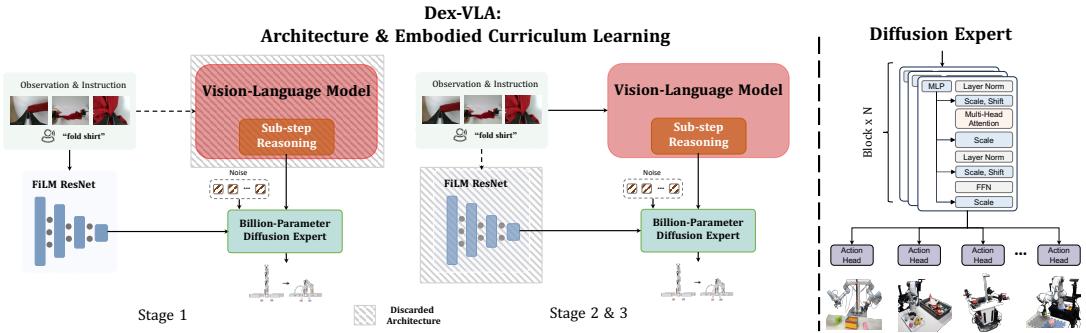
A clever design choice here is the Multi-Head Output. Because different robots have different physical structures (morphologies), the Diffusion Expert has separate “heads” for different robot types. This allows the core billion parameters to learn universal physics and motion, while the heads handle the specific wiring of a UR5e arm versus a Franka arm.
2. Embodied Curriculum Learning
Perhaps the most educational aspect of this paper is the training strategy. You cannot simply throw all data at a 1-billion parameter model and hope it converges—it would be too inefficient and unstable. Instead, the authors use Curriculum Learning, mimicking how humans acquire skills.
When a baby learns to navigate the world, they first learn to control their limbs (motor babbling), then they learn to coordinate their limbs with what they see, and finally, they learn complex tasks like “tying shoelaces.” DexVLA follows this exact three-stage progression.
Stage 1: Cross-Embodiment Pre-training (The “Gym”)
In this stage, the Vision-Language Model is not used. The focus is purely on motor skills. The Diffusion Expert is trained on a massive dataset of various robot movements.
- Goal: Learn low-level, generalizable motor patterns (how to move smoothly, how to approach objects).
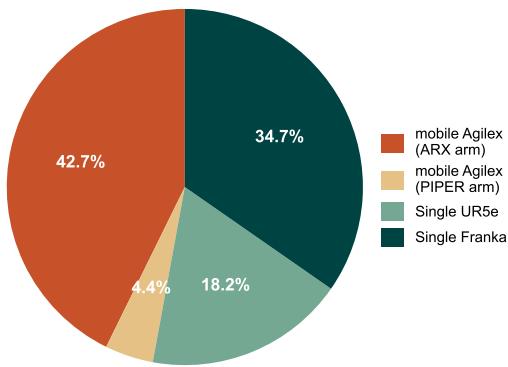
- Data: A mix of data from different robots (AgileX, Franka, UR5e).
- Technique: They use a standard ResNet to process images just for this stage. The goal is to warm up the 1B parameters so they understand physical motion.
- Why? Training the full VLA from scratch is computationally expensive and unstable. Pre-training just the “muscle memory” is 3x faster.
Figure 13 shows the diversity of data used here, ensuring the model isn’t biased toward just one type of robot arm.
Stage 2: Embodied-Specific Alignment (The “Body Awareness”)
Now, the VLM is attached. The model is trained on data specific to the target robot.
- Goal: Connect the “brain” (VLM) to the “muscles” (Diffusion Expert).
- Mechanism: The VLM’s visual encoder is frozen (to preserve its internet-scale knowledge), but the connection layers (FiLM) and the Diffusion Expert are fine-tuned.
- Result: The robot learns that “pick up the cup” (text/vision) corresponds to specific motor commands for its specific body. remarkably, after this stage, the robot can already perform many tasks without specific fine-tuning.
Stage 3: Task-Specific Adaptation (The “Mastery”)
For extremely complex tasks (like laundry folding), the model undergoes a final round of training on specific demonstrations. This refines the policy to handle delicate interactions and long-horizon planning.
3. Sub-step Reasoning: The Internal Monologue
One of the hardest challenges in robotics is Long-Horizon Tasks. If you tell a robot to “clean the table,” it involves dozens of small steps (pick up can, move to trash, drop can, return to table, pick up sponge, etc.). Standard diffusion policies often “forget” the goal halfway through or get stuck.
Previous approaches (like Google’s SayCan) used a separate, high-level planner to feed instructions to the robot every few seconds. DexVLA moves this capability inside the model.
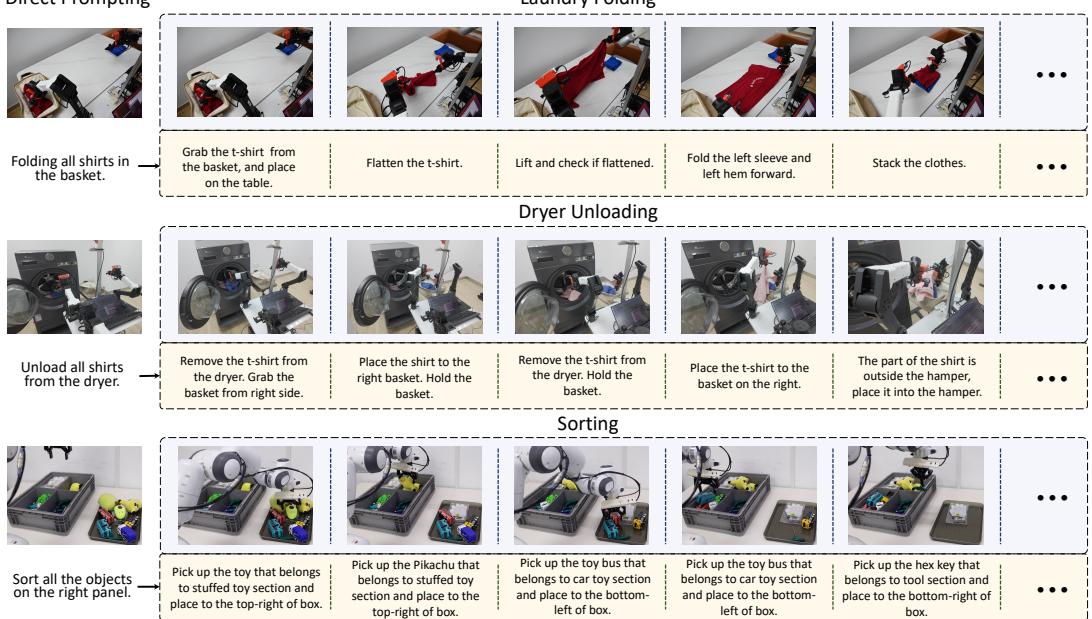
As shown in Figure 3, DexVLA is trained to generate Sub-step Reasoning. When given the command “Fold the shirt,” the VLM internally generates text tokens like “smooth wrinkles,” then “align sleeves,” then “fold bottom hem.”
These internal thoughts are injected into the Diffusion Expert via the FiLM layers. This allows the model to maintain a “chain of thought,” keeping it on track during tasks that take minutes to complete.
Experimental Results
The researchers evaluated DexVLA across a wide variety of hardware setups, including single arms, bimanual (dual-arm) setups, and even dexterous hands.
Performance Without Task-Specific Training (Stage 2)
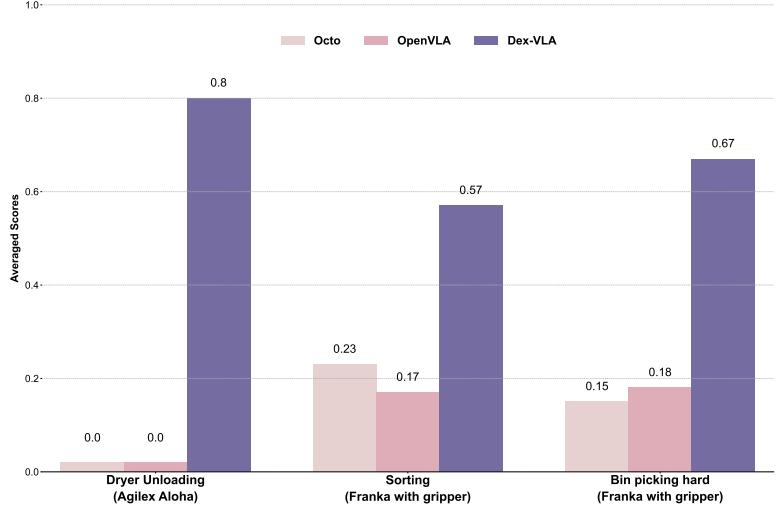
First, they checked how well the model performed after Stage 2 (Alignment) but before specific task training. This tests generalization. They compared DexVLA against top baselines: OpenVLA, Octo, and standard Diffusion Policy.
The results in Figure 6 (and visualized in Figure 5) are striking.
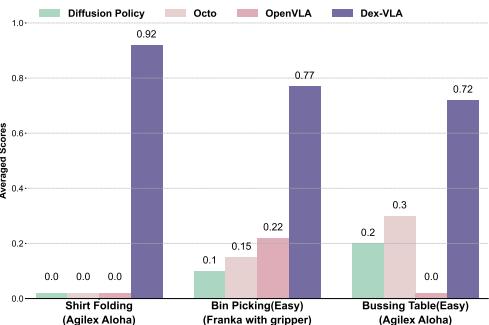
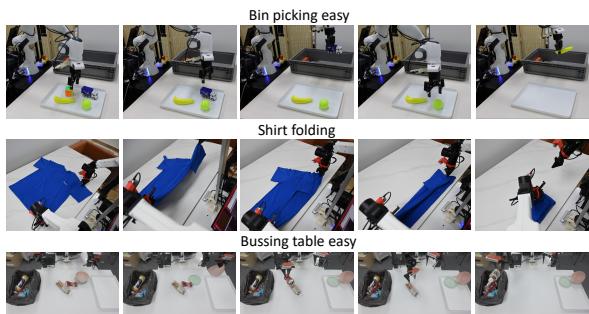
For the Shirt Folding task—which requires dual-arm coordination and handling deformable fabric—baseline models like OpenVLA scored 0.0. They couldn’t do it at all. DexVLA achieved a score of 0.92. This proves that the massive 1B parameter expert, pre-trained on diverse motion data, possesses a fundamental understanding of manipulation that smaller models lack.
Learning New Embodiments (Dexterous Hands)
One of the most expensive parts of robotics is re-training a model when you buy a new robot. The researchers tested DexVLA on a “Drink Pouring” task using a 5-fingered Dexterous Hand (seen in Figure 7)—a setup not seen in the pre-training data.
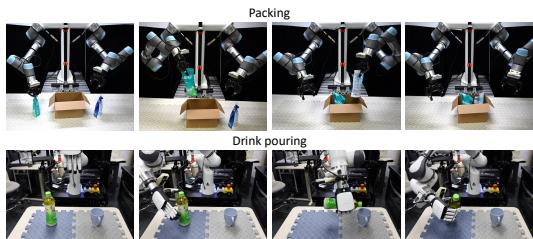
They used only 100 demonstrations (a very small amount for deep learning).
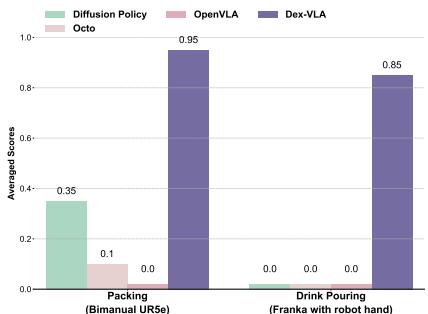
Figure 8 shows the results. DexVLA achieves nearly 90% success rates. OpenVLA and Octo fail almost completely (0% success). Even the standard Diffusion Policy, trained from scratch on this data, performs significantly worse. This confirms that the “Stage 1” pre-training creates a robust foundation that can be quickly adapted to entirely new physical bodies.
The Ultimate Test: Long-Horizon Tasks
Finally, the researchers pushed the model to its limit with tasks requiring Stage 3 training, such as Laundry Folding (taking a crumpled shirt from a basket and folding it) and Hard Table Bussing.
They compared DexVLA against \(\pi_0\) (Pi-Zero), a state-of-the-art VLA model from Physical Intelligence.
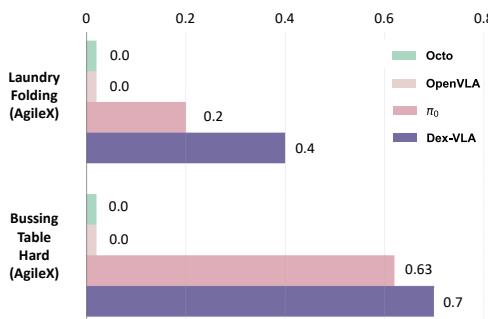
In Figure 9, we see that DexVLA outperforms \(\pi_0\) on the hardest tasks. For laundry folding, DexVLA scores 0.4, while \(\pi_0\) scores 0.2 (and others score 0). This is largely attributed to the Sub-step reasoning. Without the ability to internally break the task down (e.g., “first flatten, then fold”), the diffusion expert gets lost in the complexity of the fabric physics.
Does Size Matter? (Ablation Studies)
A critical question in deep learning is always: “Did it work because of the clever architecture, or just because you made it bigger?”
The researchers compared their 1-Billion parameter expert against a standard 93-million parameter U-Net (used in standard Diffusion Policies) and a smaller 410-million parameter expert.

Table 3 provides the answer. On the shirt folding task:
- 93M Model: 0.17 score.
- 410M Model: 0.63 score.
- 1B DexVLA: 0.92 score.
The jump in performance is massive. The authors noted that the smaller models exhibited “oscillation”—the robot arm would jitter or hesitate. The 1B parameter model smoothed out these inconsistencies, suggesting that for complex physical interactions, scale is essential for the action model, not just the language model.
Conclusion and Implications
DexVLA represents a maturing of the “Generalist Robot” concept. It moves away from the idea that a smart VLM is all you need, acknowledging that physical action requires its own massive, dedicated neural circuitry.
The key takeaways from this work are:
- Scale the Action: Just as we scaled LLMs to get better reasoning, we must scale Diffusion Policies (to 1B+ parameters) to get better motor control.
- Curriculum Matters: You can’t learn everything at once. Separating motor pre-training (Stage 1) from VLM alignment (Stage 2) is crucial for data efficiency.
- Internalize the Planner: By generating sub-step reasoning tokens, the VLM can guide the action expert through long tasks without needing external code or planners.
DexVLA suggests a future where we might have “Foundation Action Models”—pre-trained brains of pure movement that can be downloaded and plugged into any robot, from a factory arm to a humanoid butler, requiring only a quick alignment phase to get to work.