](https://deep-paper.org/en/paper/2502.06575/images/cover.png)
Introduction: The “It Works in the Lab” Problem
Imagine you have spent weeks training a robotic arm to perform a manipulation task, like picking up objects and sorting them into bins. You use Imitation Learning, showing the robot thousands of demonstrations. In your lab, under bright fluorescent lights with a standard pink table mat, the robot is a star. It achieves a 90% success rate.
Then, you move the table two centimeters closer to the window. Or maybe someone walks by wearing a bright red shirt. Or you swap the table mat for a blue one. Suddenly, the robot’s performance plummets. It flails, misses the object, or freezes entirely.
This is the classic brittleness of visuomotor policies. Robots trained on visual data are notoriously sensitive to “distribution shifts”—changes in the environment that seem minor to humans but look alien to a neural network.
Traditionally, the only way to find these failure modes is hardware evaluation. You have to physically set up the robot, change the lighting, add clutter, and run hundreds of trials. It is slow, expensive, and requires endless human supervision.
But what if we could predict these failures without touching the robot? What if we could use Generative AI to “hallucinate” these difficult scenarios and test the robot’s brain against them digitally?
This is the premise of Predictive Red Teaming, a novel approach introduced by researchers at Google DeepMind and Princeton University. In this post, we will dive deep into their paper, “Predictive Red Teaming: Breaking Policies Without Breaking Robots,” and explore RoboART, a pipeline that uses image editing and anomaly detection to stress-test robots virtually.
Background: Why Robots are Fragile
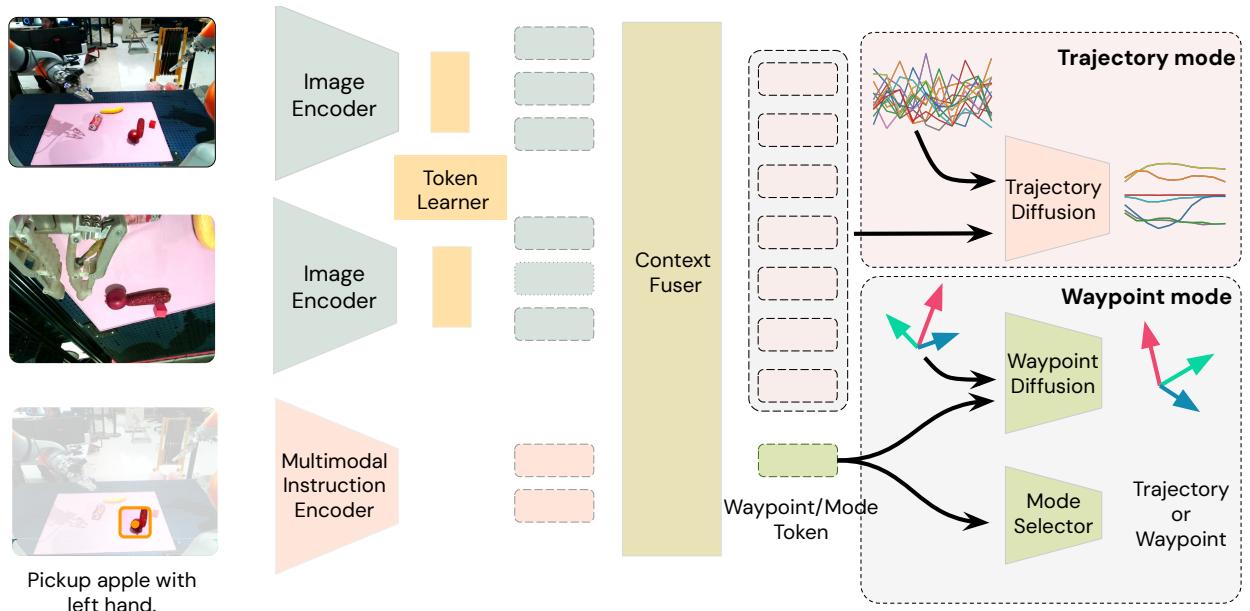
To understand the solution, we first need to understand the problem. Modern robotic manipulation often relies on Visuomotor Diffusion Policies. These are neural networks that take an image (from a camera) as input and output a sequence of actions (motor movements).
These policies are trained via Behavior Cloning. The robot watches a human do a task and tries to copy the relationship between “what I see” and “what I do.” The issue is that the robot doesn’t learn the concept of a cup; it learns pixel patterns. If the lighting changes, the pixel patterns change, and the robot enters undefined territory.
The Concept of Red Teaming
“Red Teaming” is a term borrowed from the military and cybersecurity. It involves a group (the Red Team) acting as an adversary to attack a system and find vulnerabilities. In the context of Large Language Models (LLMs), red teaming involves prompting the model to say something toxic or biased.
In robotics, Embodied Red Teaming usually means finding physical scenarios where the robot fails. However, doing this physically is unscalable. If you want to test 50 different lighting conditions and 20 different table heights, you are looking at weeks of manual labor. This paper proposes moving that process entirely into the software realm.
The Core Method: RoboART
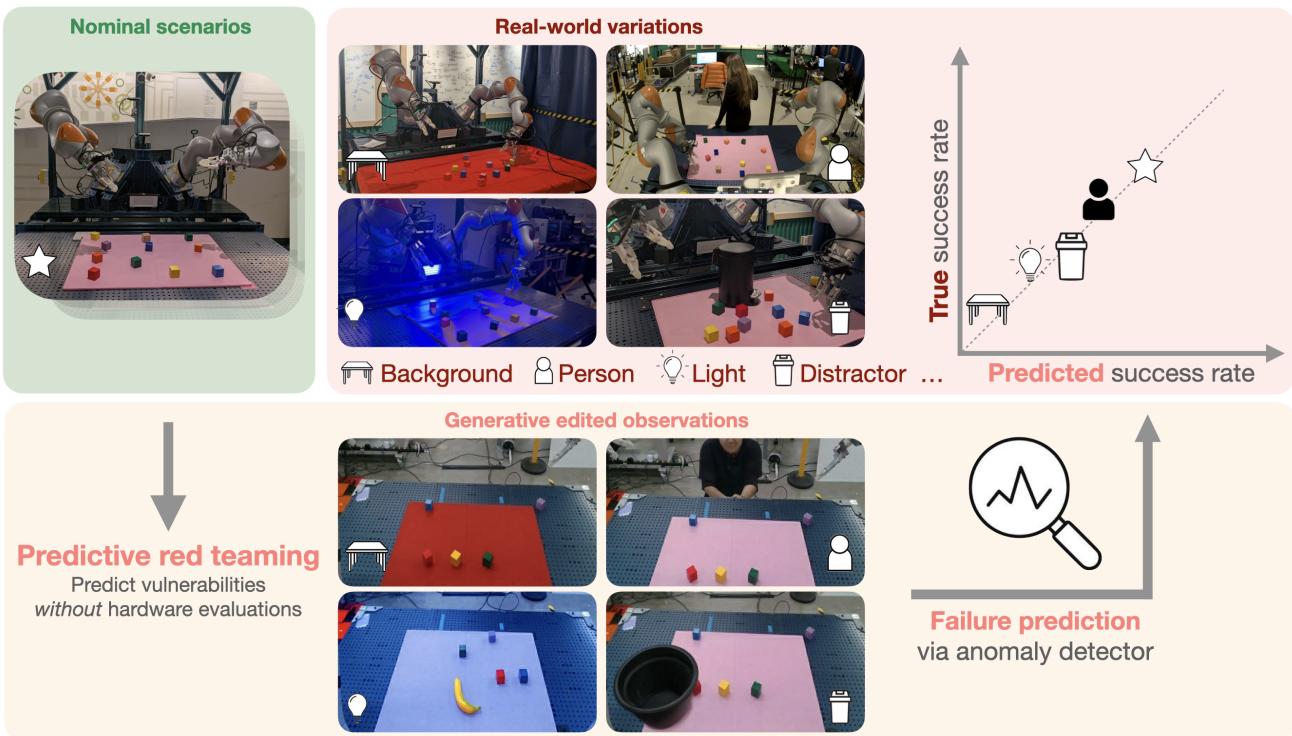
The researchers introduce RoboART (Robotics Automated Red Teaming). The goal is simple: Take a policy trained in “nominal” (normal/ideal) conditions and predict how it will perform in “off-nominal” (changed) conditions.
The pipeline consists of two distinct phases: Edit and Predict.
Phase 1: Generative Image Editing
The first step is to create the off-nominal data. Since we don’t want to physically set up a blue table or dim the lights, we use state-of-the-art Generative AI to modify the robot’s existing observations.
The team uses Imagen 3, a diffusion-based image editing model. They take the original images from the robot’s training set (where the robot was successful) and apply text-based edits.
For example, a prompt might be: “Add a large trash can at the edge of the pink mat.”
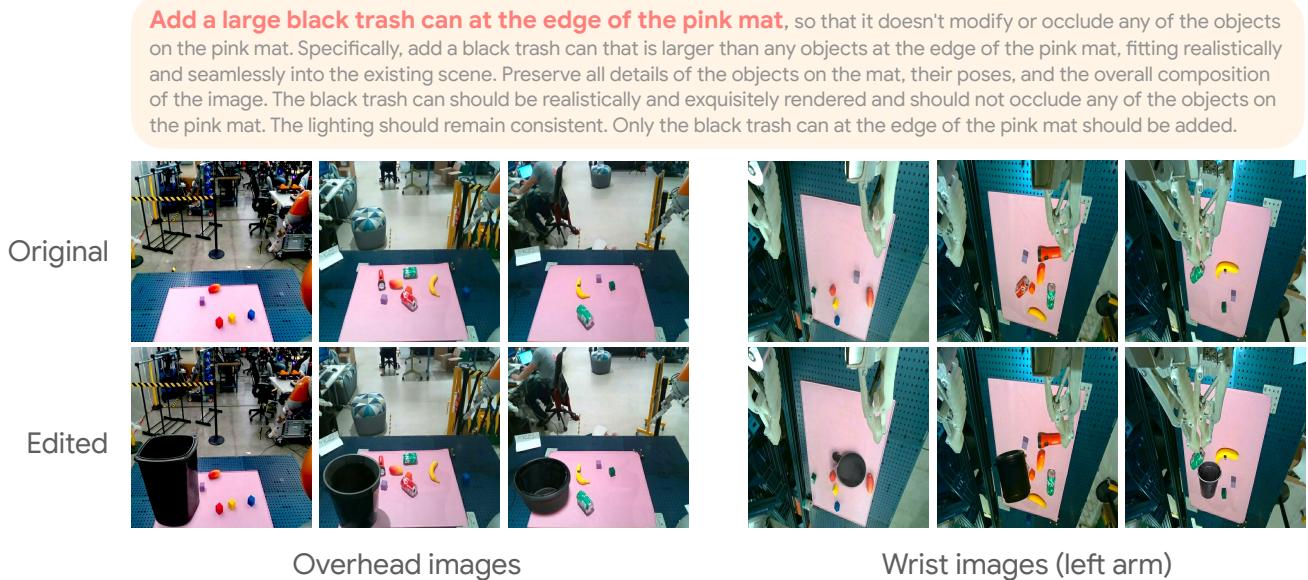
As shown in Figure 3, the results are impressive. The generative model doesn’t just paste a 2D clip-art trash can on the image; it integrates the object into the scene, respecting the camera angle (overhead vs. wrist camera) and lighting. This allows the researchers to create datasets for various environmental factors, such as:
- Lighting changes (Red, Green, Blue hues).
- Background changes (Table mat color).
- Distractors (People, trash cans, random objects).
- Geometry changes (Simulating table height changes via zooming).
The VLM Critic
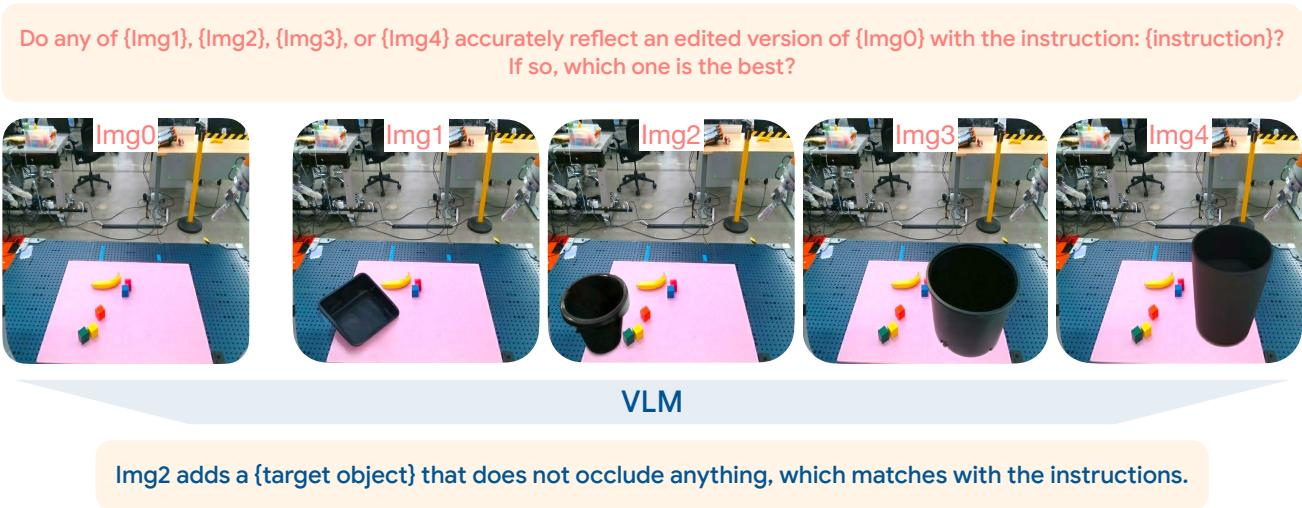
Generative models are probabilistic—sometimes they fail. They might distort the robot arm or fail to add the object requested. To automate quality control, RoboART employs a Vision-Language Model (VLM), specifically Gemini Pro 1.5.
The system generates four variations of an edit. The VLM acts as a critic, reviewing the original image, the edited candidates, and the text instruction. It selects the best edit that faithfully follows the instruction without ruining the rest of the image.
Phase 2: Failure Prediction via Anomaly Detection
Now that we have thousands of “fake” images representing difficult scenarios (e.g., a dark room with a red table), how do we know if the robot will fail? We can’t actually execute the action because the image is synthetic.
The insight here is to use Anomaly Detection. The hypothesis is straightforward: If the robot’s policy finds the new image “confusing” or “weird” compared to its training data, it is likely to fail.
The Math of Confidence
The researchers measure “weirdness” by looking at the policy’s internal embedding space. When a neural network processes an image, it turns it into a vector of numbers (an embedding). Images that are semantically similar should be close together in this space.
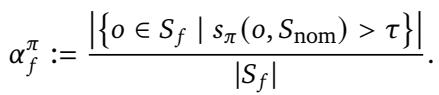
They define an Anomaly Score, denoted as \(s_{\pi}\). For a given edited observation \(o\), they calculate the cosine distance to the nearest neighbors in the original nominal dataset \(S_{nom}\).

If this distance is large, the policy is seeing something it doesn’t recognize.
To turn this score into a binary “Pass/Fail” prediction, they need a threshold, \(\tau\). They use a statistical technique called Conformal Prediction. This allows them to set a threshold based on a validation set of normal images, ensuring that the anomaly detector is calibrated to the robot’s baseline performance.

Predicting Success
Finally, the system predicts the success rate for a specific environmental factor (like “Blue Lighting”). They assume that the success rate is roughly the inverse of the anomaly rate.
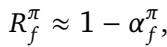
Here, \(\alpha_f^{\pi}\) is the percentage of edited images that were flagged as anomalies.
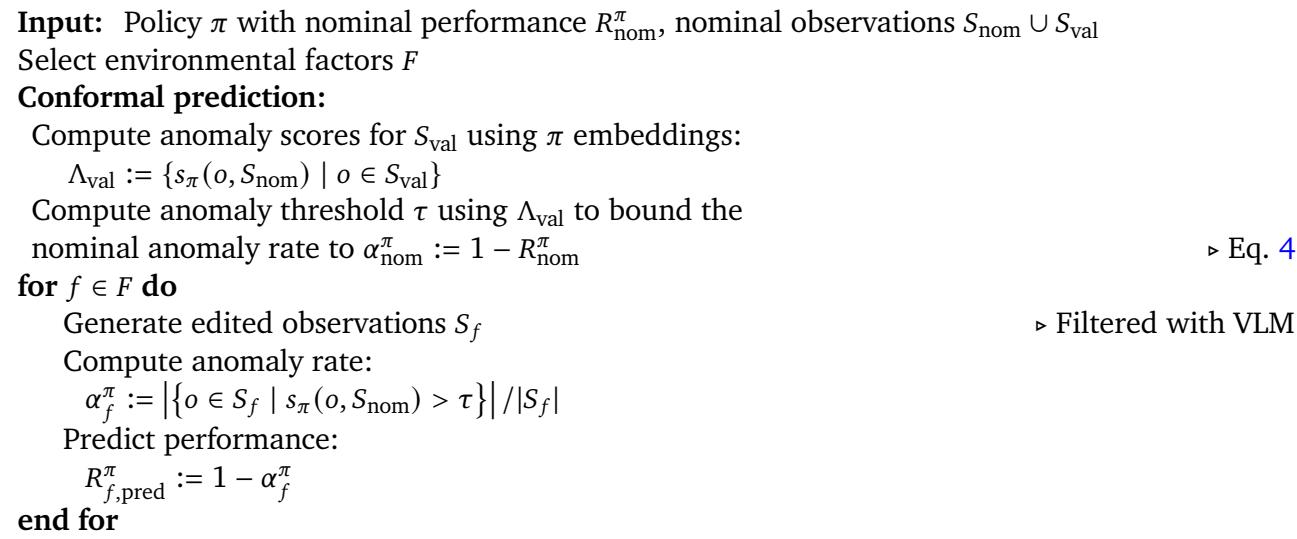
Summary of the Algorithm
The entire process is automated. The user simply defines the factors they want to test (e.g., “Person in background”), and RoboART handles the generation, filtering, and scoring.
Experiments & Results
To prove this works, the authors didn’t just stay in simulation. They ran over 500 hardware trials on real robots to verify their predictions.
The Setup:
- Task: Pick and place objects.
- Policies: They tested two different architectures:
- \(\pi_{hyb}\) (Hybrid Policy): Combines trajectory optimization with diffusion.
- \(\pi_{dfn}\) (Vanilla Diffusion Policy): A standard end-to-end learning approach.
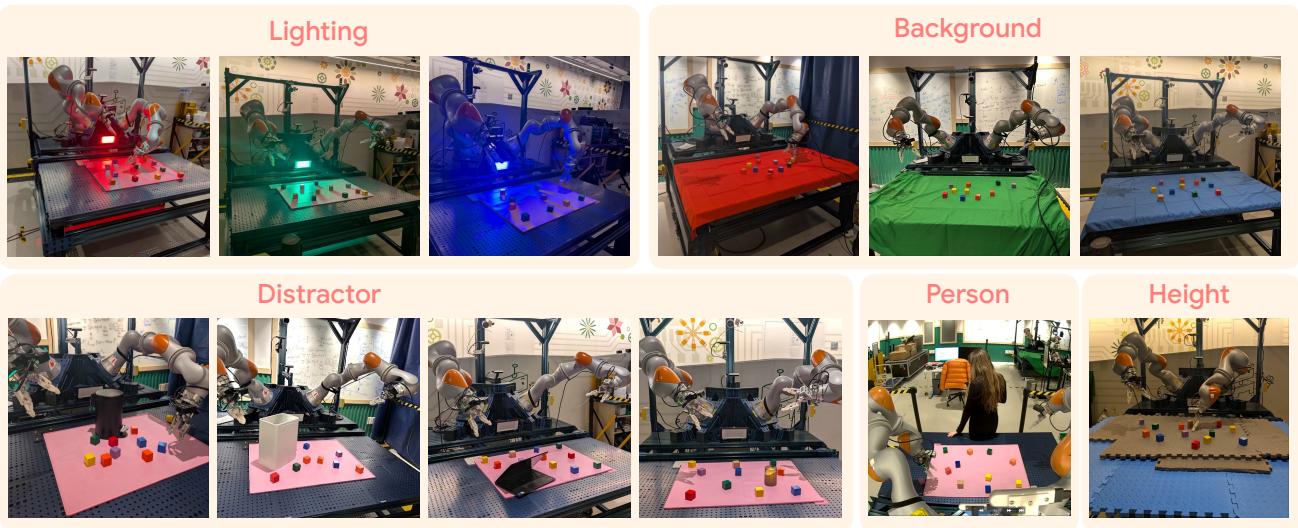
- Conditions: 12 different off-nominal conditions, including colored lighting, different background mats, and various distractors.
The Factors
The researchers tested the robot against a battery of visual challenges. As seen in Figure 2, these ranged from subtle lighting shifts to significant visual clutter.
Did the predictions match reality?
The results showed a strong correlation between RoboART’s predictions and the actual physical success rates.
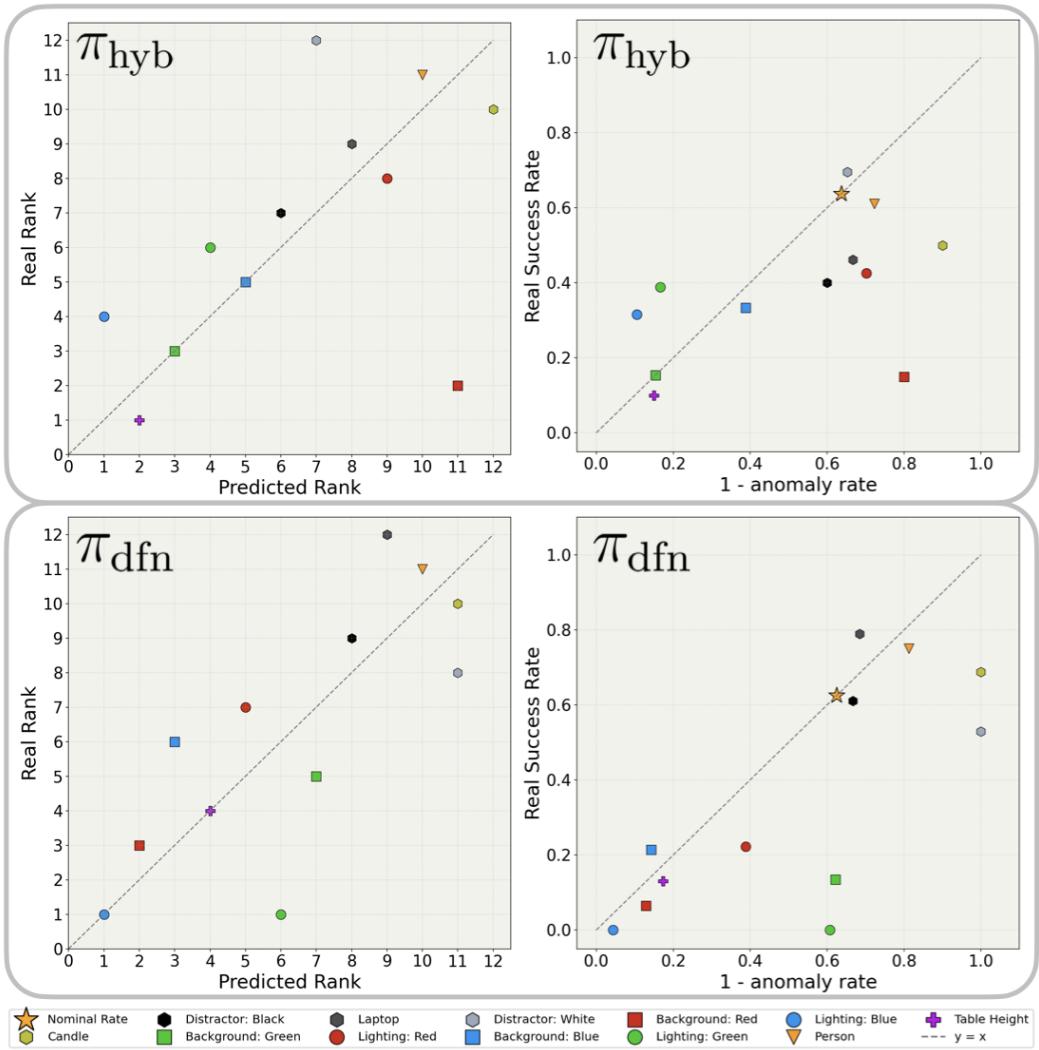
- Ranking: RoboART correctly identified which factors would be most damaging. For example, it correctly predicted that changing the table height would be devastating for the Hybrid policy, while adding a human distractor would be manageable.
- Absolute Accuracy: The average difference between the predicted success rate and the real success rate was less than 0.19 (19%). Given the noise in real-world robotics, this is highly accurate.
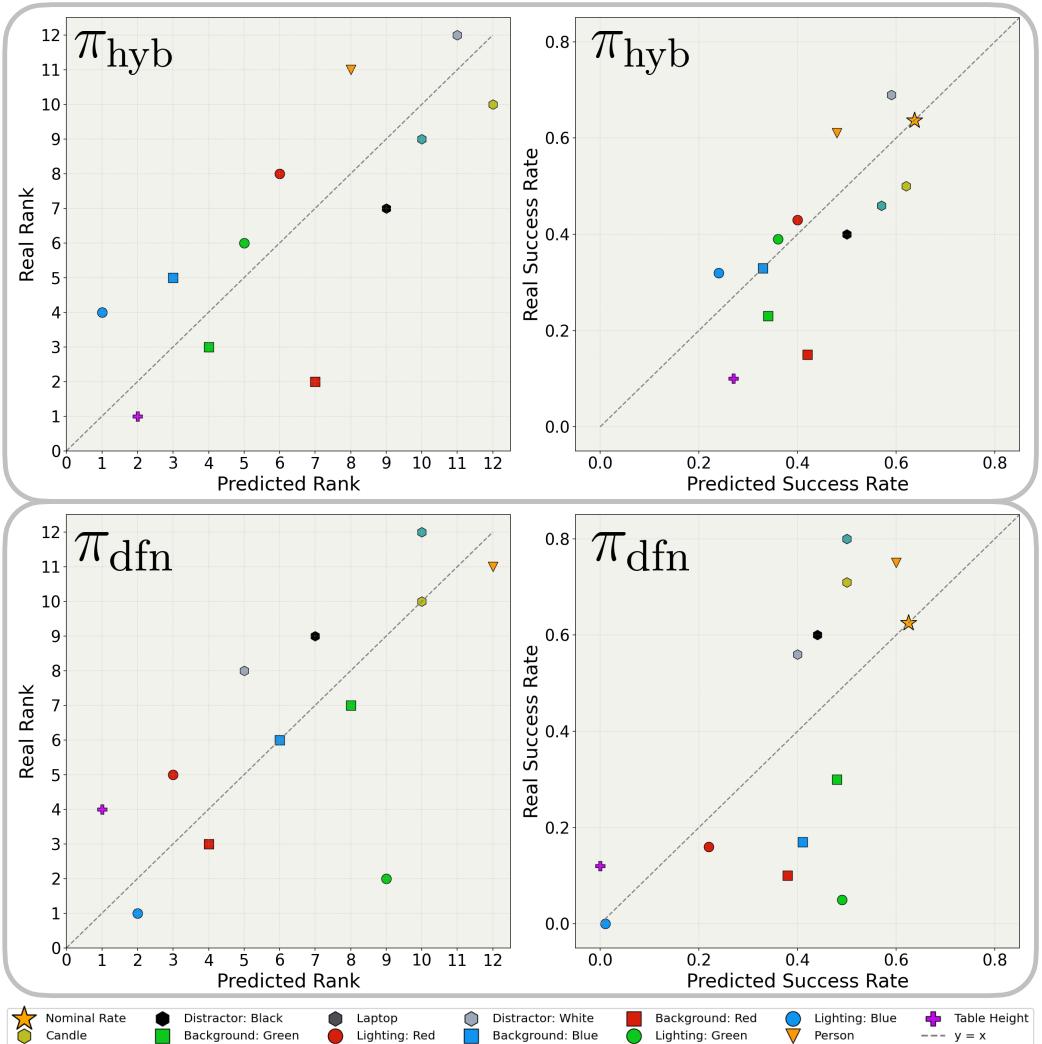
In Figure 5, you can see the correlation. The points generally hug the diagonal line, indicating that when RoboART says “this is hard,” the robot actually fails on hardware.
The “So What?”: Targeted Data Collection
Predicting failure is useful, but preventing failure is better. The most powerful application of RoboART is Targeted Data Collection.
If RoboART tells you that your robot will fail in “Blue Lighting” and on “Green Tables,” you don’t need to guess what data to collect next. You can specifically go out and collect a small amount of real-world data in those exact conditions.
The researchers did exactly this. They fine-tuned their policy with data from the three conditions RoboART flagged as most difficult.
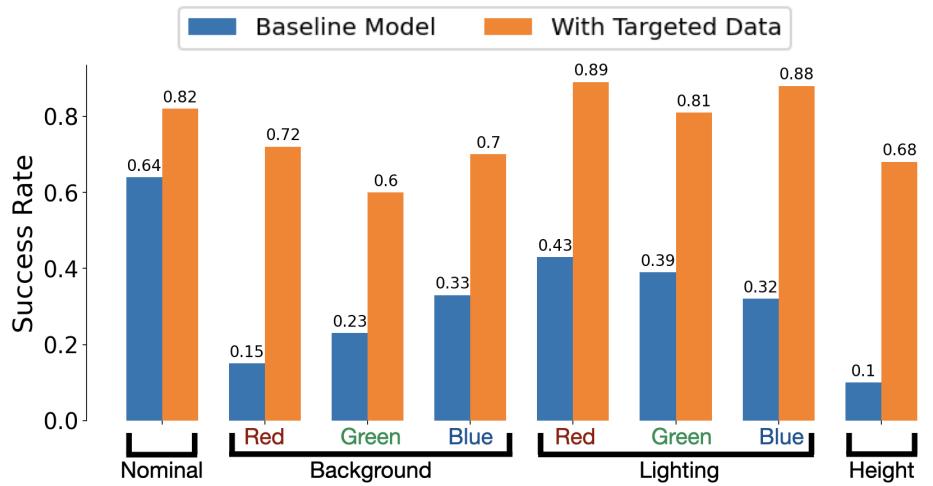
The results (Figure 6) were remarkable:
- Massive Boost: Performance in the targeted conditions improved by 2–7x.
- Cross-Domain Generalization: Surprisingly, the robot also got better at conditions it wasn’t trained on. Training on “Blue Lighting” helped it handle “Red Lighting” better. This suggests that exposing the policy to targeted distribution shifts makes the underlying visual representations more robust overall.
Conclusion and Future Implications
The paper “Predictive Red Teaming” offers a compelling solution to one of robotics’ biggest bottlenecks: the reliance on physical testing. By combining the creativity of Generative AI with the statistical rigor of anomaly detection, RoboART allows engineers to stress-test robots in thousands of virtual scenarios before deployment.
Key Takeaways:
- Generative Editing works for Robotics: Modern image editing models (like Imagen 3) are good enough to create realistic “adversarial” inputs for robot policies.
- Internal Confusion Predicts External Failure: You don’t need to run the robot to know it will fail; you just need to measure how far the input is from the training distribution in the policy’s embedding space.
- Actionable Insights: This isn’t just for evaluation. It guides the data collection process, allowing for efficient policy improvement.
Limitations
The method isn’t magic. There is an “Edit-to-Real gap.” For example, changing the lighting in an image via GenAI doesn’t always perfectly cast shadows the way real physics does. Additionally, the current method looks at single images, not temporal inconsistencies (video), which could be a future area of research.
Furthermore, RoboART relies on visual anomalies. It cannot predict failures caused by non-visual factors, such as an object being heavier than it looks (physics properties).
Despite these limitations, RoboART represents a significant step toward safer, more reliable robots. It moves us from a paradigm of “deploy and pray” to one of “predict and prepare.”