](https://deep-paper.org/en/paper/2502.07380/images/cover.png)
Introduction
Imagine watching a $50,000 quadruped robot hike up a mountain trail or a specialized drone race through a complex circuit at champion-level speeds. These feats are awe-inspiring, representing the bleeding edge of robotics. They share a common secret sauce: Sim2Real—training a policy in a high-fidelity simulation and then deploying it into the real world.
But here lies the problem: these innovations are often locked behind a paywall of expensive hardware and proprietary software. For the average undergraduate student, researcher on a budget, or robotics hobbyist, accessing the tools required to learn these modern techniques is nearly impossible. You are often left with outdated simulators and basic line-following robots, while the state-of-the-art races ahead.
This gap is what researchers from the University of Washington aim to close with Wheeled Lab.
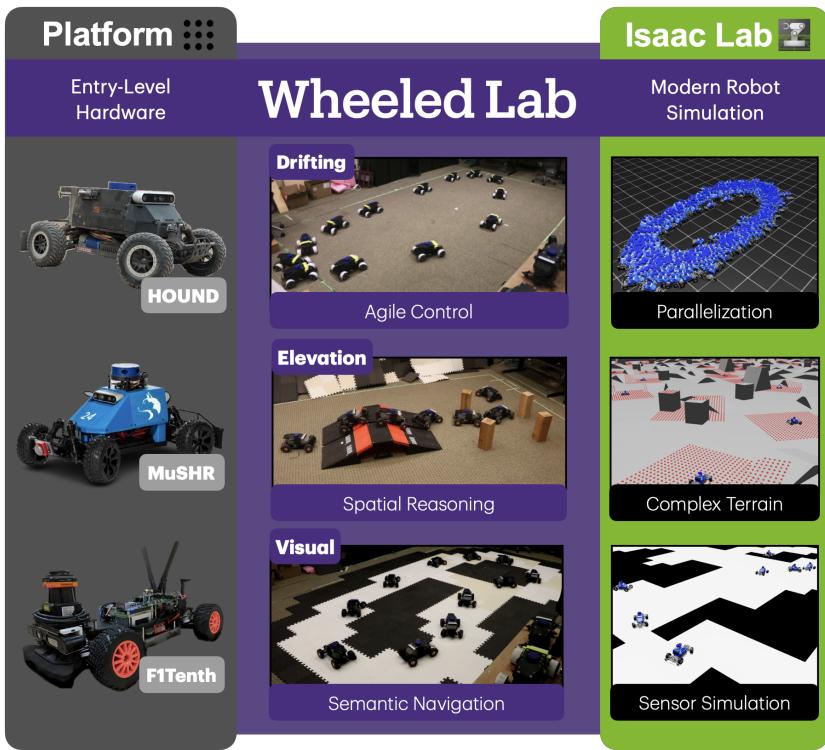
As illustrated above, Wheeled Lab is an ecosystem that bridges the divide. It connects popular, low-cost, open-source wheeled robots (like the F1Tenth or MuSHR cars) with Isaac Lab, a cutting-edge simulation framework powered by NVIDIA. The goal? To democratize access to modern robotics, allowing anyone with a few hundred dollars of hardware to perform the kind of Reinforcement Learning (RL) and Sim2Real experiments previously reserved for elite labs.
In this post, we will tear down how Wheeled Lab works, explore the modular architecture that makes it accessible, and dive into three specific case studies—Drifting, Elevation Traversal, and Visual Navigation—that prove low-cost robots can learn complex behaviors.
Background: The “Access Gap” in Robotics
To understand why Wheeled Lab is significant, we first need to look at the current landscape of educational robotics.
In recent years, the “scientific community” has moved toward massive parallelization—simulating thousands of robots simultaneously to train neural networks via Reinforcement Learning (RL). They use sophisticated physics engines that handle complex terrain and sensor noise.
In contrast, the “broader community” (classrooms, hobbyists) relies on ecosystems that are significantly more limited.
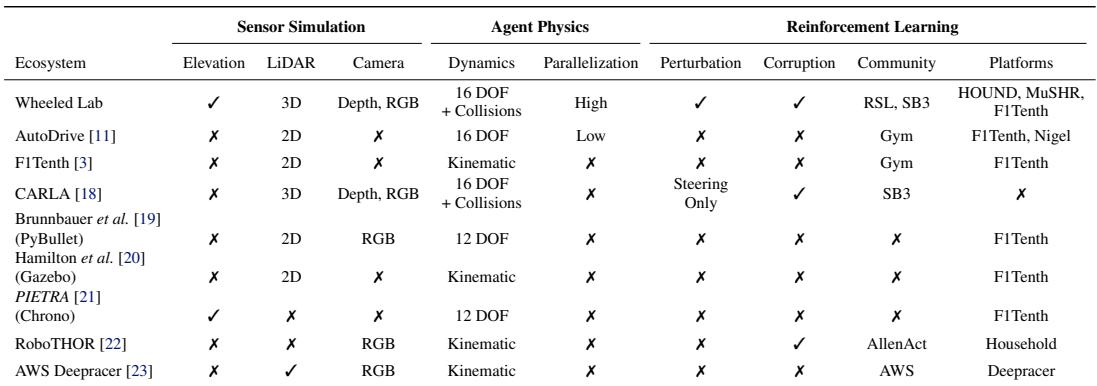
As shown in Table 1, existing low-cost ecosystems often lack crucial features:
- Sensor Simulation: Most don’t support realistic elevation maps or depth cameras.
- Physics: Many rely on simple kinematic models that don’t account for complex dynamics (like friction during a drift).
- Parallelization: They often simulate one robot at a time, making RL training excruciatingly slow.
Wheeled Lab addresses this by leveraging Isaac Lab, which supports high-fidelity physics, massive parallelization, and domain randomization—techniques essential for robust Sim2Real transfer.
Core Method: A Modular “Puzzle” Architecture
The researchers didn’t just slap a connector between a robot and a simulator; they designed a structured framework to ensure reproducibility and ease of use. They conceptualize the training process as a puzzle composed of three main modular components: Run, Agent, and Environment.
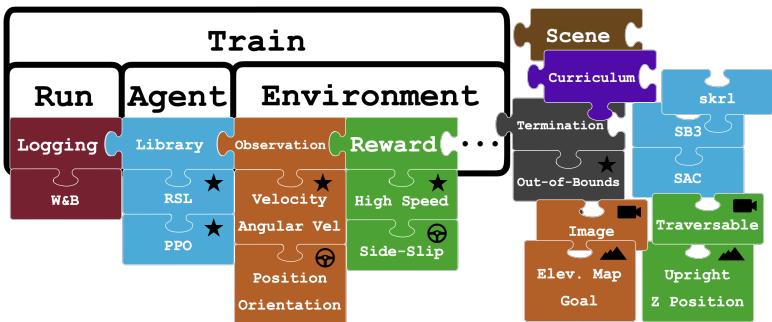
1. The Environment
This is where the physical reality is defined. It includes:
- Observation: What the robot “sees” (velocity, position, camera images).
- Reward: The function that tells the robot if it’s doing a good job (e.g., +1 for speed, -10 for crashing).
- Scene: The physical layout (walls, ramps, floor textures).
2. The Agent
This represents the brain of the robot. Wheeled Lab supports libraries like RSL (Robotic Systems Lab) and Stable Baselines 3 (SB3), allowing users to implement standard RL algorithms like Proximal Policy Optimization (PPO).
3. The Run
This handles the logistics of the experiment, including logging data to tools like Weights & Biases (W&B) to track training progress over time.
By standardizing these “puzzle pieces,” Wheeled Lab allows a student to swap out a reward function or a vehicle model without rewriting the entire codebase. This modularity is critical for education, where students might share a fleet of robots but work on different algorithmic problems.
Deep Dive: Proving the Concept with Three Tasks
To demonstrate that this low-cost stack can actually handle state-of-the-art tasks, the authors implemented three distinct policies: Drifting, Elevation, and Visual Navigation. Each task targets a specific challenge in modern robotics.
Challenge 1: Controlled Drifting (\(\pi_{drift}\))
The Problem: Drifting is a dynamically unstable maneuver. It involves losing traction on purpose and balancing steering against throttle to slide around a corner. It is incredibly sensitive to friction, weight distribution, and motor response. Traditionally, this requires expensive hardware and precise system identification.
The Solution: The researchers used RL with Domain Randomization. Instead of trying to measure the exact friction of the floor or the precise torque of the motor, they trained the robot in simulation across thousands of environments with varying friction and motor parameters.
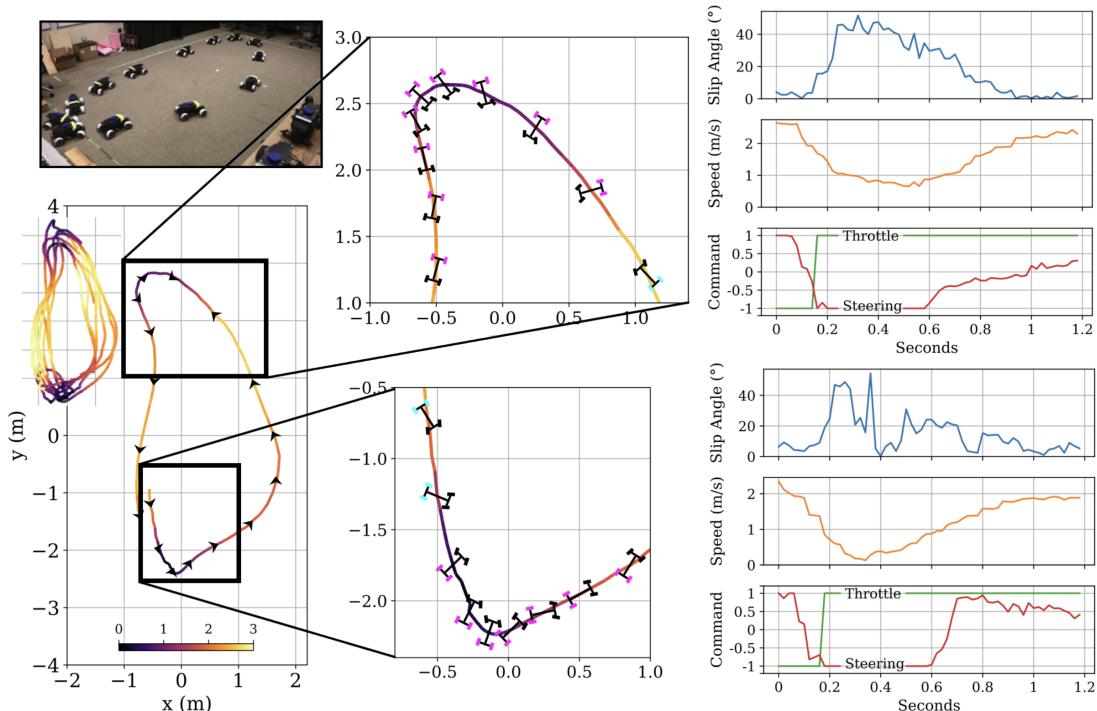
How it works: Looking at Figure 4, we can see the policy (\(\pi_{drift}\)) discovered a distinct control strategy:
- Initiation: The car cuts the throttle (blue line drops) to destabilize the rear wheels.
- Steering: It steers sharply inward to throw the rear out.
- Maintenance: It throttles up again while counter-steering to maintain the slide.
The entire sequence happens in just over a second. This is the first time a zero-shot drifting policy (transferring from sim to real without extra fine-tuning) has been demonstrated on such low-cost hardware.
Comparison to Baseline: The authors compared this against a standard baseline (\(\bar{\pi}_{drift}\)) trained without these modern randomization techniques.
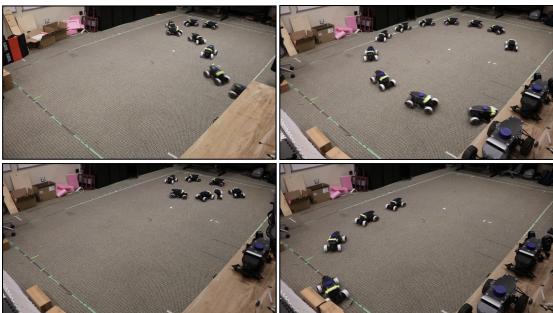
As seen in Figure 5, the baseline completely fails. It either crashes or spins out uncontrollably because it cannot handle the gap between the perfect simulation and the messy real world.
Challenge 2: Elevation Traversal (\(\pi_{elev}\))
The Problem: Most low-cost robots assume the world is flat. When faced with a ramp or uneven terrain, they often get stuck or tip over. Navigating 3D terrain requires spatial reasoning—understanding that a ramp is traversable but a wall is not, even if both look like obstacles to a 2D LiDAR.
The Solution: The researchers equipped the agents with a local elevation map (a 2.5m x 2.5m grid showing height).
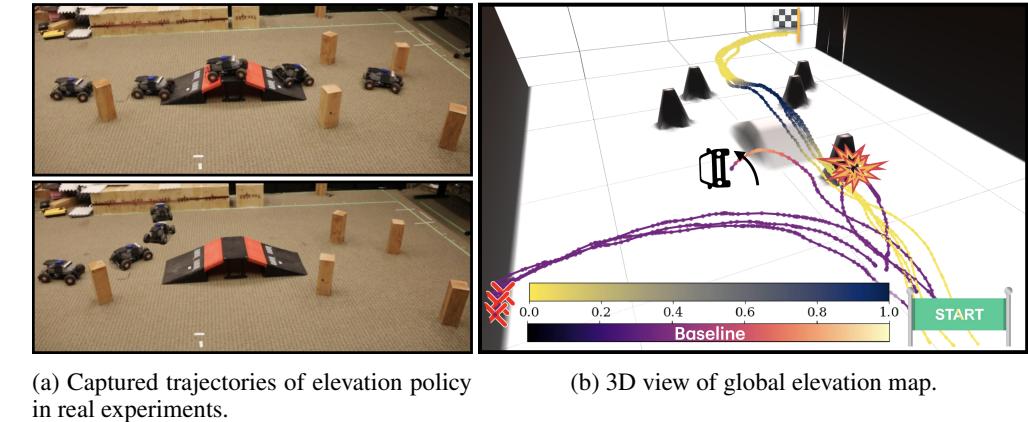
The Result: In Figure 6 (labeled Figure 8 in the image deck due to ordering, but referring to the elevation comparison), we see a stark difference:
- The Baseline (\(\bar{\pi}_{elev}\)): Shown in purple/white paths. It treats the ramp like a wall and drives around it. If forced onto the ramp, it often falls off.
- Wheeled Lab Policy (\(\pi_{elev}\)): Shown in yellow/blue paths. It successfully identifies the ramp as a valid path and navigates over it to reach the goal.
This demonstrates that low-cost robots can be trained to understand 3D geometry, provided the simulation capabilities (like height maps and suspension dynamics) are available during training.
Challenge 3: Visual Navigation (\(\pi_{vis}\))
The Problem: Using cameras is cheaper than using LiDAR, but processing visual data is hard. Images are high-dimensional, and the “Sim2Real gap” is massive for visuals—lighting, textures, and shadows look very different in a game engine compared to the real world.
The Solution: The team used a combination of procedural generation and image augmentation.
They created a training pipeline that generates random “walker” paths, converting them into traversable black-and-white maps.
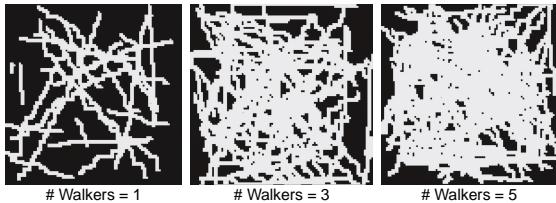
By training the robot on thousands of these randomized patterns (Figure 8) and applying augmentations like Gaussian blur and color jitter (randomly changing brightness/contrast), they forced the neural network to focus on the structure of the path rather than specific lighting conditions.
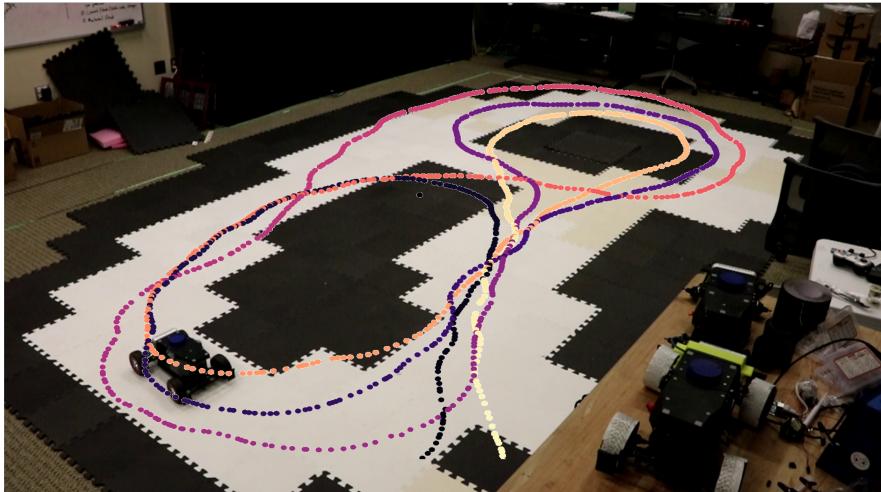
The Result: The robot successfully navigates a real-world “figure-8” track using only a camera, as shown in Figure 7.
Interestingly, the experiments revealed a counter-intuitive finding regarding neural network architectures.

As shown in Table 3, the simpler MLP (Multi-Layer Perceptron) architecture actually outperformed the more complex CNN (Convolutional Neural Network) in real-world generalization. The CNNs tended to overfit to the simulation’s visual quirks, leading to “noisy” driving in the real world, whereas the MLP (combined with strong image augmentation) learned a more robust driving policy.
Experimental Setup & Infrastructure
To achieve these results, the scale of simulation matters. One of the key advantages of integrating with Isaac Lab is the ability to run massive parallel training.
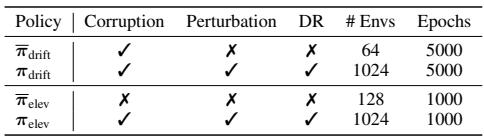
Table 2 highlights the difference in scale:
- The drifting policy (\(\pi_{drift}\)) was trained on 1,024 environments simultaneously.
- It utilized Domain Randomization (DR) and Perturbation (randomly pushing the robot in sim).
- The baseline used only 64 environments and lacked these robustness features.
This massive parallelization allows the agent to experience millions of interaction steps in a fraction of the time it would take in older simulators, leading to robust policies that can handle the chaos of the real world.
Conclusion & Implications
The “Wheeled Lab” paper is more than just a tech demo of drifting RC cars. It represents a shift in how robotics education and research can be conducted.
By bridging low-cost hardware (~\(300 to \)3000) with high-end, open-source simulation tools, the authors have removed the financial barrier to entry for modern Sim2Real research.
Key Takeaways:
- Accessibility: You don’t need a $50k robot to learn modern RL.
- Modularity: A structured software stack helps standardize experiments and makes learning easier.
- Sim2Real works for cheap robots: Through domain randomization and parallelization, even imperfect, low-cost hardware can execute complex, agile maneuvers like drifting and 3D traversal.
This work paves the way for a future where students can move beyond basic line-following and start pushing the boundaries of what autonomous systems can do, right from their classroom desks.