](https://deep-paper.org/en/paper/2502.07685/images/cover.png)
Introduction
For decades, the field of computer vision has chased a specific dream: taking a handful of flat, 2D photographs and instantly converting them into a perfect, navigable 3D world. This process, known as photogrammetry, is the backbone of modern 3D content creation, mapping, and special effects. However, the traditional road to 3D reconstruction is bumpy. It usually involves a fragmented pipeline of disparate algorithms—one to figure out where the cameras were looking, another to estimate depth, and yet another to stitch it all together.
Imagine trying to bake a cake where you need a different chef for the flour, the eggs, and the icing, and none of them talk to each other. Errors accumulate, and if one step fails, the whole cake collapses.
Enter Matrix3D.
In a new paper from researchers at Nanjing University, Apple, and HKUST, a unified solution has been proposed. Matrix3D is a “Large Photogrammetry Model” that doesn’t just do one part of the job; it does it all. By leveraging a massive multi-modal diffusion transformer, this model can handle pose estimation, depth prediction, and novel view synthesis within a single architecture.
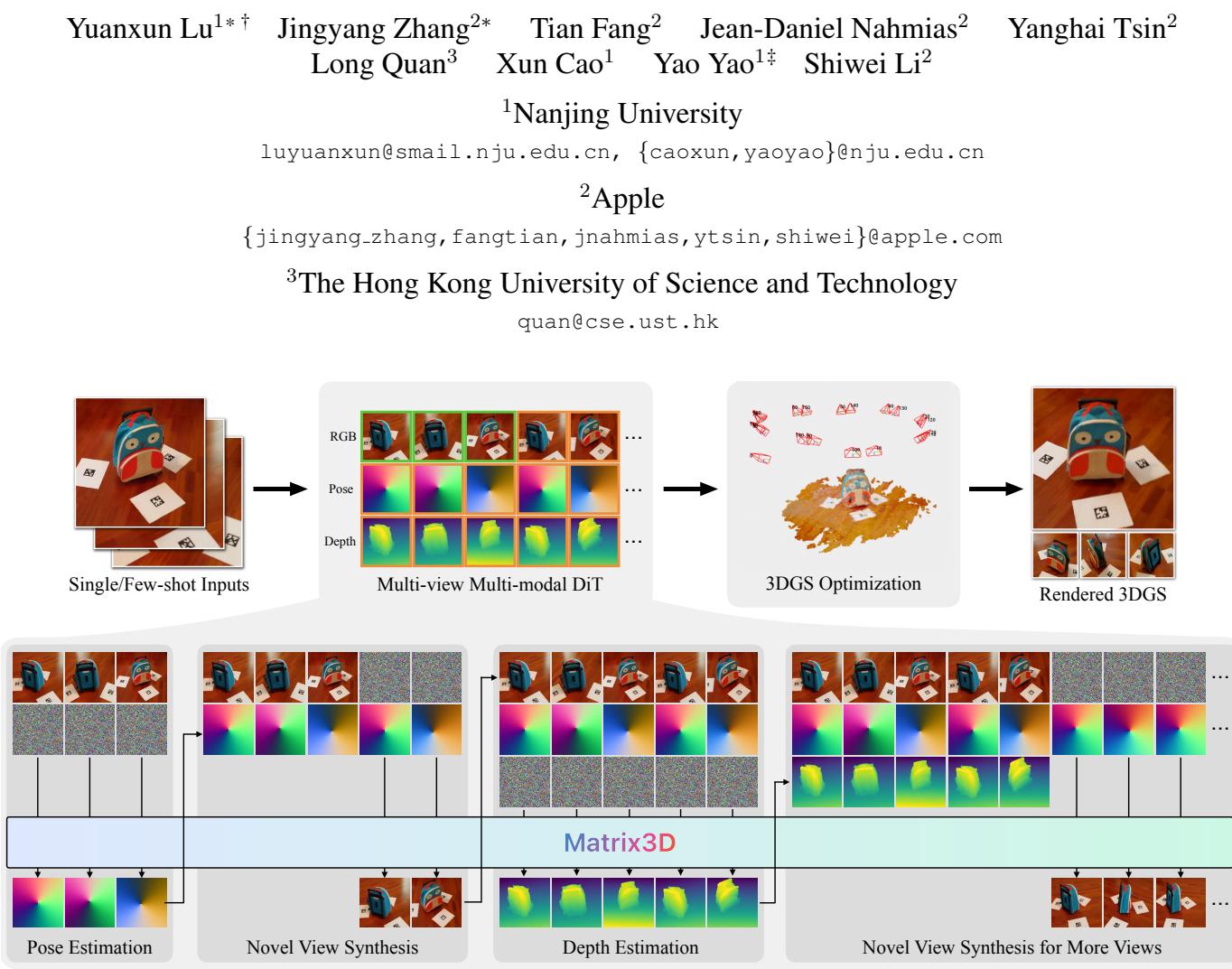
As shown in Figure 1, Matrix3D acts as a central hub. Whether you feed it a single image or a sparse collection of unposed photos, it processes them to generate the necessary geometric data—poses and depth—to initialize a high-quality 3D Gaussian Splatting optimization.
In this post, we will tear down the siloed walls of traditional photogrammetry and explore how Matrix3D uses a clever “masked learning” strategy to become the Swiss Army Knife of 3D reconstruction.
Background: The Fragmentation Problem
To appreciate what Matrix3D achieves, we first need to understand the status quo. A standard 3D reconstruction pipeline is a relay race consisting of several distinct stages:
- Structure-from-Motion (SfM): This is the starting line. Algorithms like COLMAP look at a set of images, find matching feature points (like the corner of a table), and use geometry to calculate where the cameras were positioned in 3D space.
- Multi-View Stereo (MVS): Once the camera positions are known, MVS algorithms try to figure out how far away every pixel is (depth estimation) to build a dense point cloud.
- Surface Reconstruction: Finally, those points are meshed into a solid surface or processed into a Neural Radiance Field (NeRF) or 3D Gaussian Splats.
The problem? These steps are independent. The algorithm that guesses the camera pose knows nothing about the dense geometry of the object, and the depth estimator relies heavily on the pose estimator being perfect. If SfM fails—which it often does with “sparse views” (e.g., only 2 or 3 photos with little overlap)—the rest of the pipeline fails.
Recent “Feed-forward” models (like LRM or PF-LRM) have attempted to use deep learning to go directly from Image to 3D. While fast, they often lack precision or struggle when the input images don’t have perfect camera data attached.
The researchers behind Matrix3D asked a fundamental question: What if we treated pose, depth, and RGB pixels as the same type of data and trained one model to learn the relationship between all of them simultaneously?
The Core Method: Matrix3D
The brilliance of Matrix3D lies in its unification. It doesn’t use a separate neural network for poses and another for images. Instead, it utilizes a Multi-Modal Diffusion Transformer (DiT).
1. Unifying the Representation
Transformers, the architecture behind LLMs like GPT-4, are excellent at processing sequences of tokens. To use a Transformer for photogrammetry, the researchers had to convert all 3D data into a format the model could understand: 2D maps.
- RGB Images: Standard 2D pixel grids.
- Depth: Represented as 2.5D depth maps (images where pixel intensity equals distance).
- Camera Poses: This is the clever part. Instead of using a matrix of numbers (which Transformers struggle to associate with images), they represent cameras as Plücker ray maps. Effectively, they encode the camera’s origin and viewing direction into an image-like tensor.
By converting everything into “images,” the model can process RGB, Pose, and Depth using the same underlying mechanics.
2. The Architecture
The model is built upon the Hunyuan-DiT architecture (a powerful diffusion transformer). It features a Multi-view Encoder and a Multi-view Decoder.
- The Encoder: Takes the “conditions” (what we know). This could be the input photos, or perhaps the known camera poses.
- The Decoder: Predicts the “target” (what we want). This uses diffusion—starting with noise and iteratively refining it into clear data, whether that data is a new image angle, a depth map, or a camera pose ray map.
To ensure the model understands the spatial relationships, the researchers inject positional encodings that tell the Transformer which view a specific token comes from and what modality (RGB, Pose, or Depth) it represents.
3. Masked Learning: The “Fill-in-the-Blank” Strategy
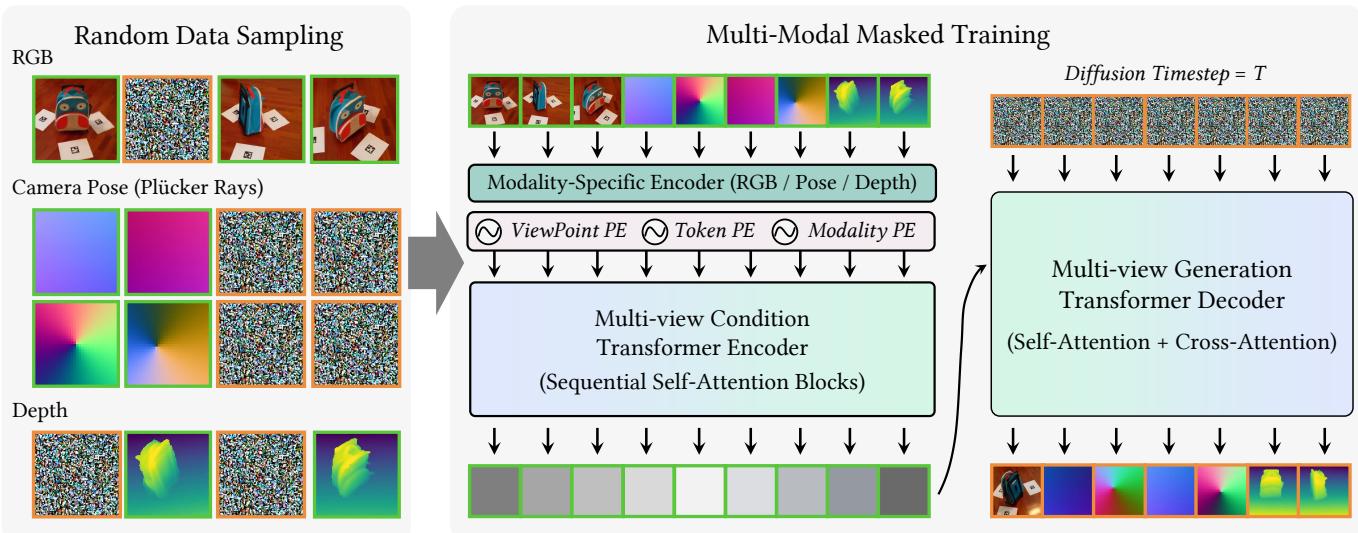
Figure 2 illustrates the most critical component of Matrix3D: its training strategy. The researchers were inspired by Masked Auto-Encoders (MAE) used in natural language processing.
In NLP, you might train a model by hiding a word in a sentence: “The cat sat on the [MASK].” The model learns to predict “mat.” Matrix3D does this for photogrammetry. During training, the system randomly masks out different parts of the data.
- Sometimes it hides the Pose, giving the model only the Images. The model must predict the pose (Pose Estimation).
- Sometimes it hides a Future Image, giving the model the Current Image and Target Pose. The model must predict the new view (Novel View Synthesis).
- Sometimes it hides the Depth, forcing the model to understand geometry.
This stochastic masking allows a single trained model to handle flexible input/output configurations. You don’t need a “pose estimator” and a “depth estimator.” you just have Matrix3D. You give it what you have, and ask it for what you lack.
4. From Prediction to 3D Gaussian Splatting
While Matrix3D is powerful, diffusion models can sometimes hallucinate inconsistent details across different views. To solve this, the researchers use the output of Matrix3D (dense images, poses, and depth maps) as the initialization for 3D Gaussian Splatting (3DGS).
3DGS is a rendering technique that represents a scene as millions of 3D blobs (Gaussians). By optimizing these blobs to match the Matrix3D predictions, the system enforces strict 3D consistency, resulting in a photorealistic, navigable 3D object.
Experiments and Results
The researchers put Matrix3D to the test on several challenging datasets, including CO3D, RealEstate10k, and Objaverse. The results demonstrate that a unified generalist model can indeed outperform specialized specialist models.
Pose Estimation
Estimating camera angles from sparse views (e.g., just 2 photos of a hydrant) is notoriously difficult. The authors compared Matrix3D against traditional methods like COLMAP and deep learning methods like RayDiffusion and DUSt3R.
As seen in Figure 3, Matrix3D (right column) aligns almost perfectly with the ground truth (black axes), significantly outperforming other methods. Quantitatively, Matrix3D achieved 95.6% accuracy in relative rotation on the CO3D dataset, compared to 90.4% for RayDiffusion and only 31.3% for COLMAP. This proves that learning geometry (depth) and appearance (RGB) together helps the model understand where the camera must be.
Novel View Synthesis (NVS)
NVS is the task of hallucinating what an object looks like from a new angle. This is crucial for filling in the gaps of a sparse scan.
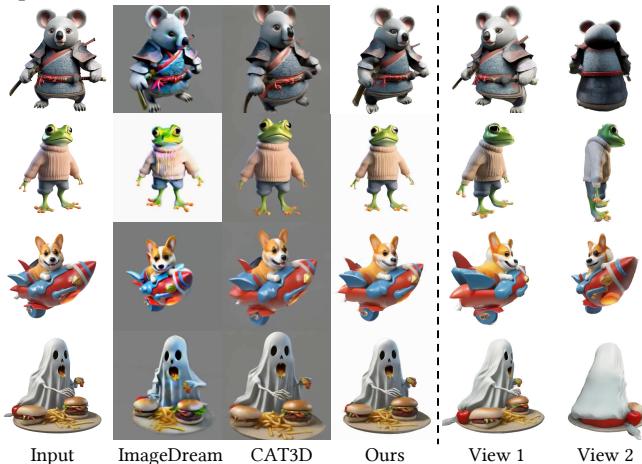
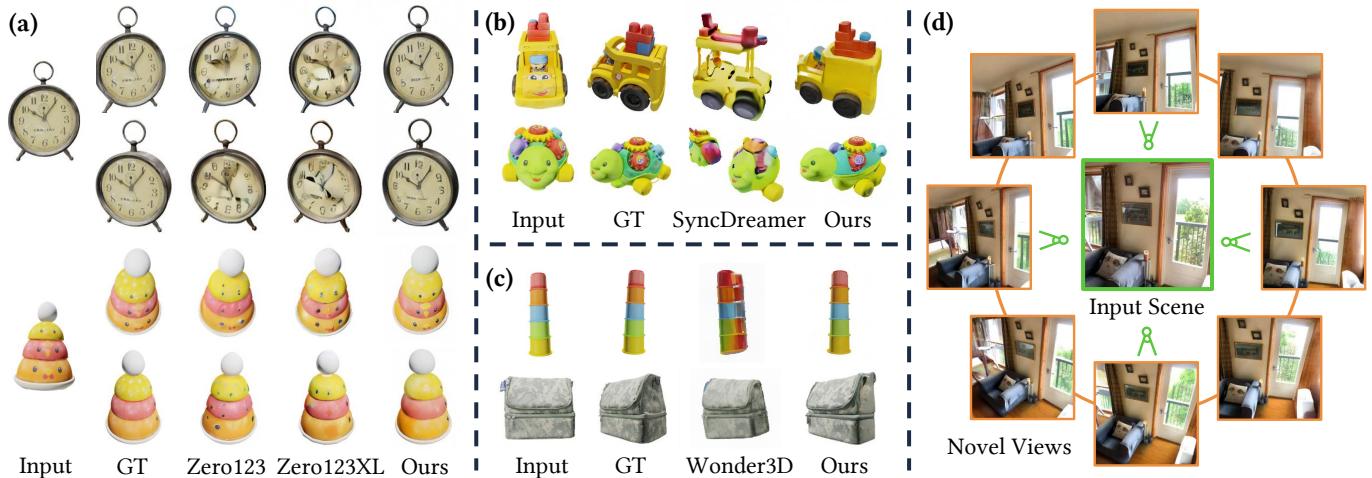
Figure 5 showcases Matrix3D’s ability to generate consistent, highly detailed views of complex objects like stylized characters. Unlike previous methods that often produce blurry or geometrically impossible results, Matrix3D maintains texture fidelity and structural integrity.
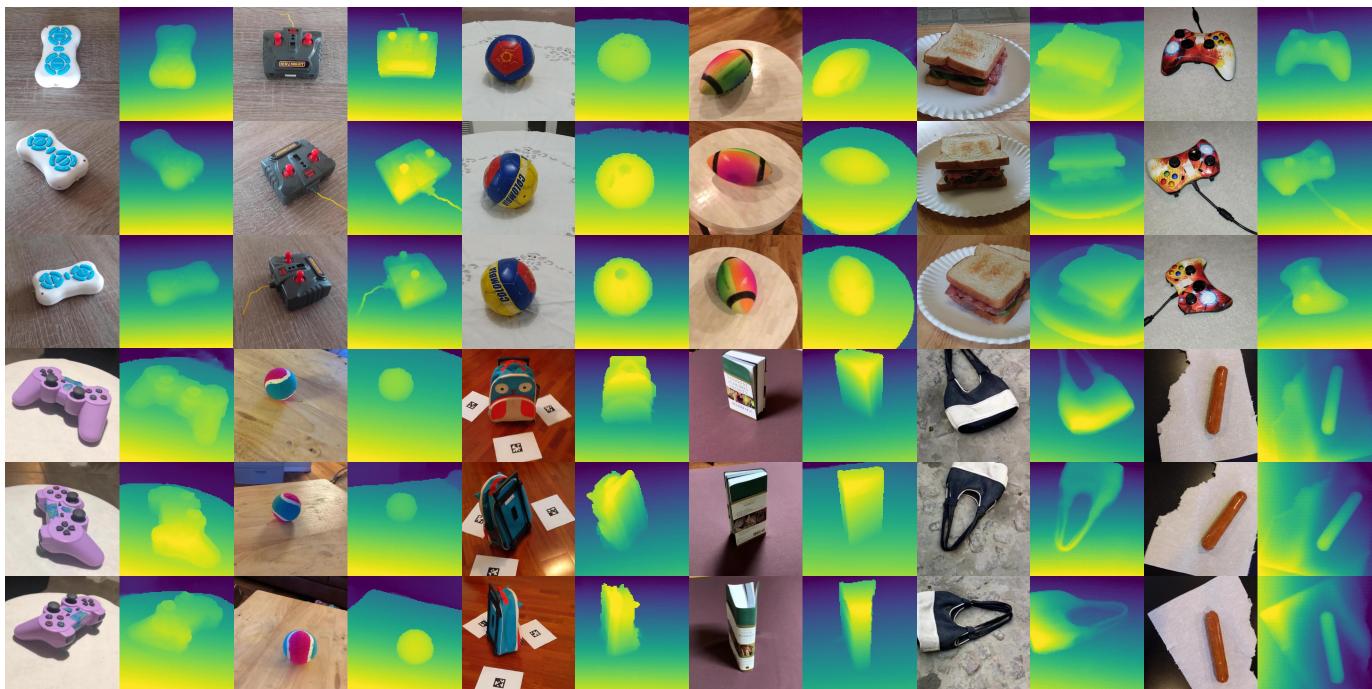
The flexibility of the model is further highlighted in Figure 10 (below), which shows the depth prediction capabilities. Even for complex shapes like game controllers or food items, the depth maps are sharp and structurally sound.
Unposed Sparse-View Reconstruction
The ultimate test of photogrammetry is taking a few photos with unknown camera positions and turning them into a 3D model. Most existing AI models require you to provide the camera poses. Matrix3D does not.
Because it can estimate its own poses and depth, it can reconstruct scenes from scratch.
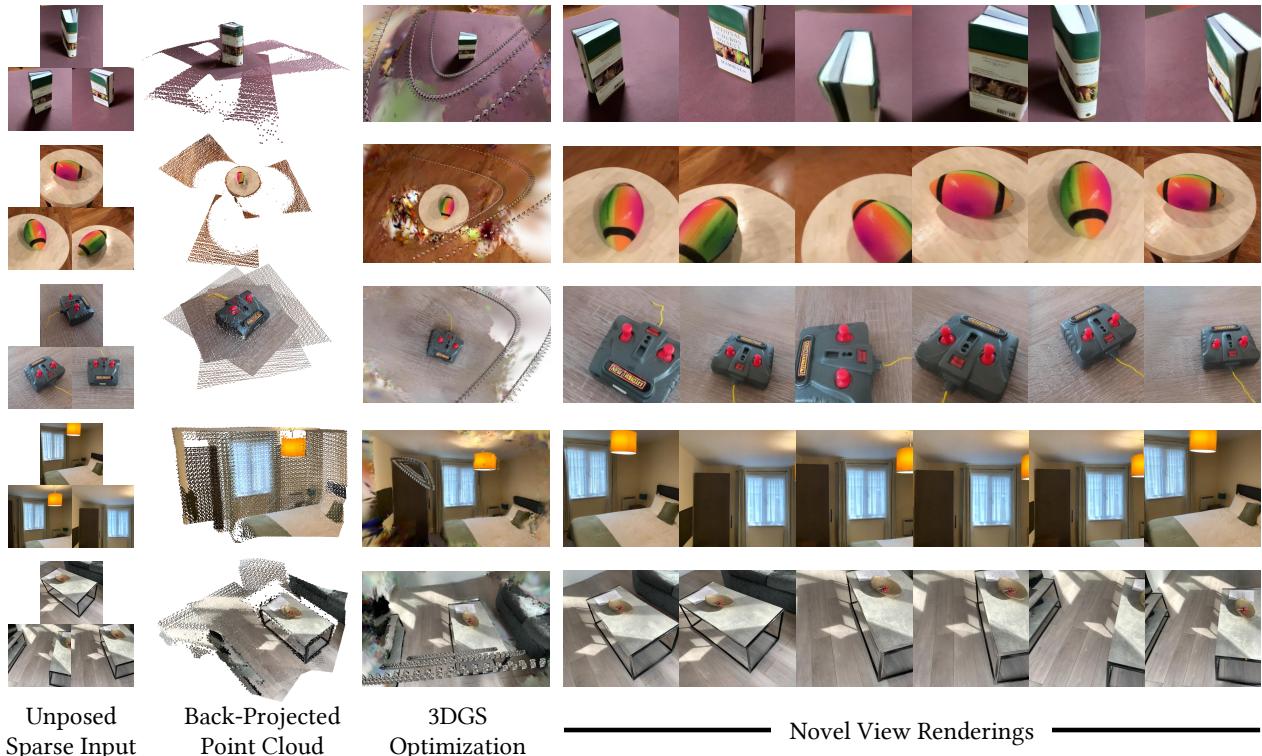
Figure 7 demonstrates this capability. From raw, unposed inputs (left), Matrix3D generates a back-projected point cloud, which initializes the 3DGS optimization. The result (right) is a high-fidelity 3D rendering. This works on diverse objects, from a remote control to a complex bedroom interior.
3D Gaussian Splatting Integration
Finally, the transition from the diffusion model’s output to the final 3D representation is handled by Gaussian Splatting. This step cleans up the noise and ensures that if you rotate the object, it looks solid and real.
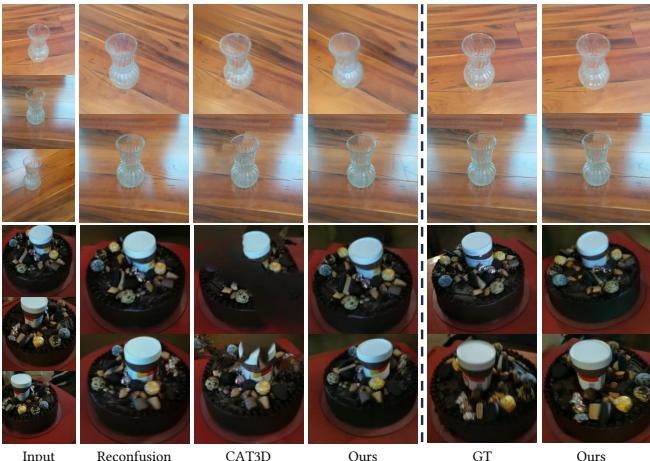
Figure 6 compares Matrix3D against other state-of-the-art reconstruction methods like CAT3D. The “Ours” column shows sharper details and better geometry preservation, particularly in the difficult top-down views of the cake and the vase.
Conclusion and Implications
Matrix3D represents a paradigm shift in how we approach 3D computer vision. By moving away from rigid, multi-stage pipelines and embracing a unified, multi-modal generative model, the researchers have created a system that is robust, flexible, and highly accurate.
The key takeaways from this work are:
- Unification works: Treating Pose, Depth, and RGB as interchangeable modalities allows for cross-pollination of features, improving accuracy across all tasks.
- Masked Learning is powerful: The “fill-in-the-blank” training strategy enables a single model to adapt to whatever data is available (or missing) at inference time.
- Better Initialization = Better 3D: By generating high-quality depth and pose estimates, Matrix3D allows optimizers like 3D Gaussian Splatting to converge on results that were previously impossible with sparse data.
For students and researchers in the field, Matrix3D suggests that the future of photogrammetry isn’t in better geometric formulas, but in larger, more generalist generative models that learn the physics of the world through massive amounts of data. The days of struggling with failed COLMAP matches may soon be behind us, replaced by a simple prompt to a model that “sees” in 3D.