](https://deep-paper.org/en/paper/2502.07785/images/cover.png)
From Selfie to Studio: How Pippo Generates High-Res 3D Avatars from a Single Photo
Imagine taking a quick, casual photo of yourself with your smartphone and, within moments, having a high-resolution, 360-degree video of your digital twin—complete with details of your back, the texture of your hair, and the folds in your clothes, all fully 3D consistent. This capability is the “holy grail” for applications ranging from the metaverse and gaming to virtual fashion and telepresence.
However, extracting a 3D human from a single 2D image is an ill-posed problem. A single photo lacks depth information; it doesn’t tell us what the back of a shirt looks like or exactly how a nose protrudes. To solve this, AI models need to “hallucinate” the missing dimensions while remaining faithful to the original photo.
In this post, we are diving deep into Pippo, a new method presented by researchers from Meta Reality Labs, the University of Toronto, and UC Berkeley. Pippo is a generative model that produces 1K resolution dense turnaround videos of a person from a single image.
What makes Pippo special? It sidesteps the need for complex, parametric body models (like SMPL) and instead relies on a clever combination of massive “in-the-wild” 2D data and high-quality studio 3D data.
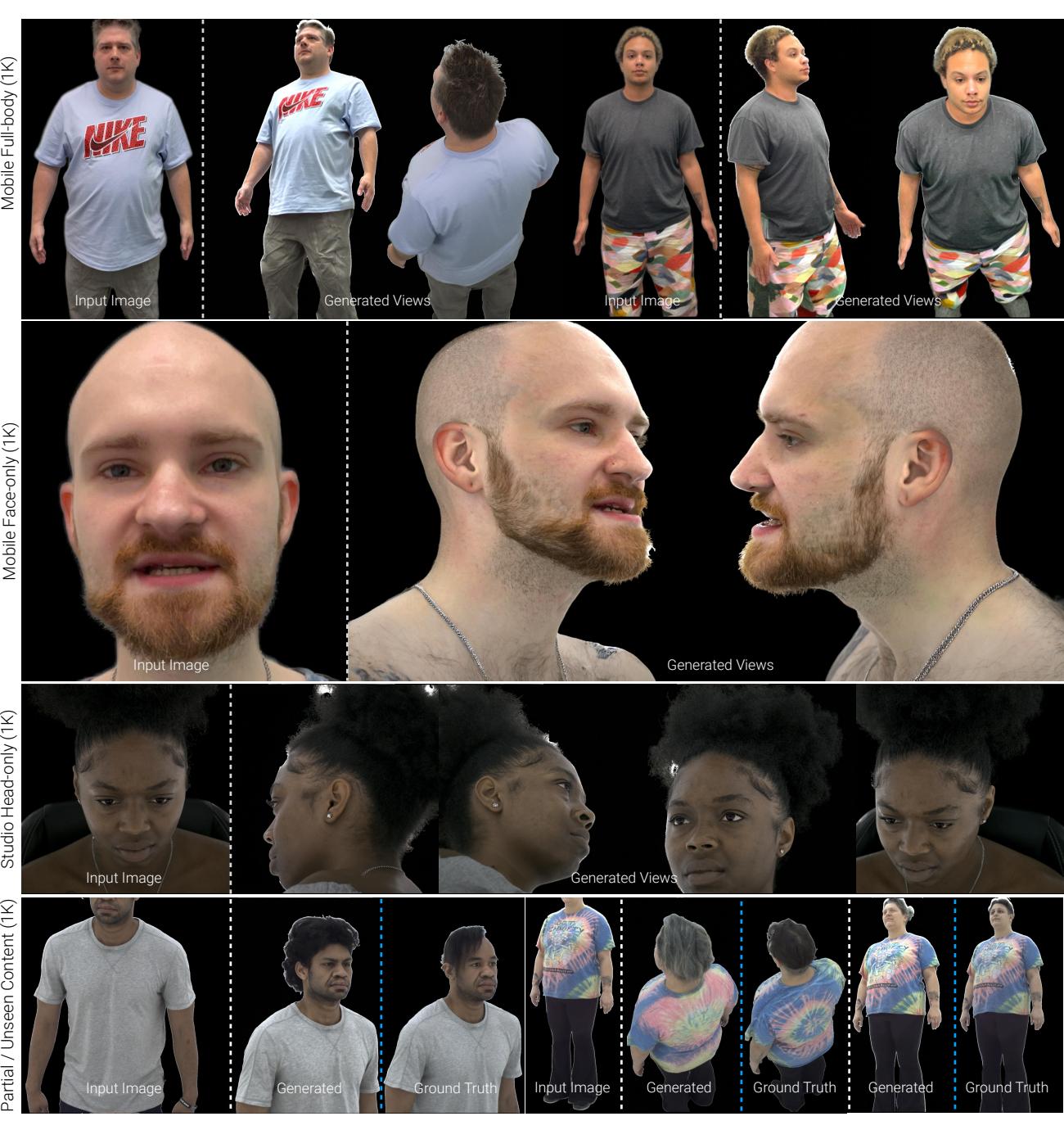
As shown in Figure 1, Pippo can take a casual mobile photo (left column) and generate photorealistic side and back views (right columns) that maintain the identity and details of the subject perfectly. Let’s explore how this works.
The Core Challenge: Data Scarcity vs. Generalization
To train a model to understand 3D humans, you generally need two things:
- Diversity: Millions of images of different people, clothing, and lighting conditions.
- 3D Ground Truth: Simultaneous views of the same person from different angles to learn geometry.
Here lies the bottleneck. We have billions of 2D images of humans on the internet (high diversity, no 3D info). We have very few 3D studio scans (perfect 3D info, low diversity, very expensive to acquire).
Previous methods usually picked one side. They either trained on 3D scans and failed to generalize to “wild” photos, or they trained on 2D images and produced inconsistent, “wobbly” 3D results.
The Pippo Strategy: The Best of Both Worlds
Pippo proposes a hybrid approach. It leverages a massive dataset of 3 billion in-the-wild images to learn what humans generally look like, and then fine-tunes this understanding using a smaller, high-quality studio dataset to learn how to rotate them in 3D.
The result is a Multi-View Diffusion Transformer. Unlike traditional U-Net based diffusion models (like Stable Diffusion), Pippo uses a transformer architecture (similar to DiT) which is better suited for handling the complex relationships between multiple views simultaneously.
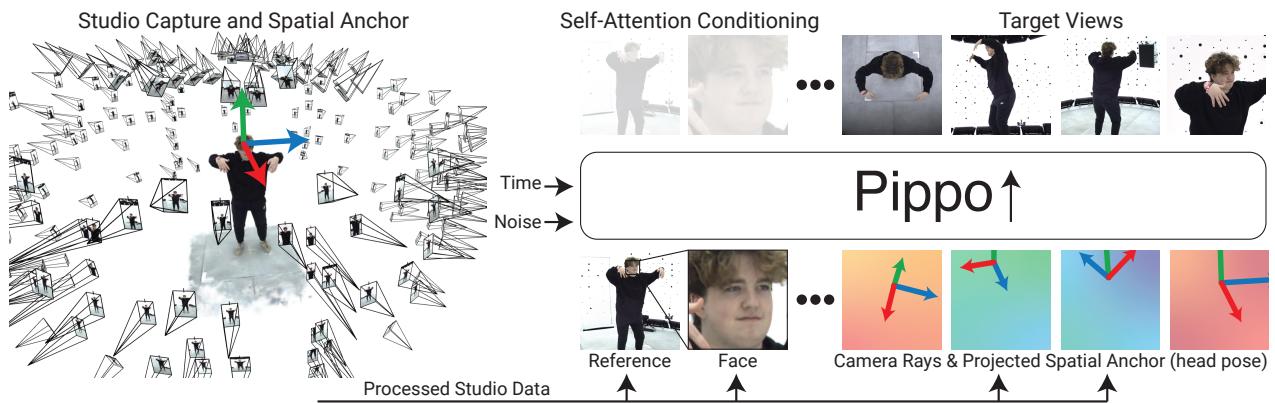
Figure 2 illustrates the high-level pipeline. The model takes a single reference image (and a face crop for detail) and predicts multiple “target views” based on requested camera angles.
The Method: Inside the Architecture
Let’s break down the technical architecture that powers Pippo. The researchers adopted a Diffusion Transformer (DiT) architecture, which treats image patches as tokens—similar to how LLMs treat words.
1. Inputs and Conditioning
To generate a new view of a person, the model needs to know three things:
- Who is it? This comes from the Reference Image and a Face Crop. These are processed and injected into the model via self-attention.
- Where is the camera? This is defined by Target Cameras (Plücker coordinates).
- Where is the person? This is a unique contribution of Pippo called the Spatial Anchor.
The Spatial Anchor
A single image is ambiguous regarding scale and placement. Is the person standing close to the camera or far away? To solve this, Pippo uses a “Spatial Anchor”—an oriented 3D point that roughly defines the center of the subject’s head and their gaze direction.
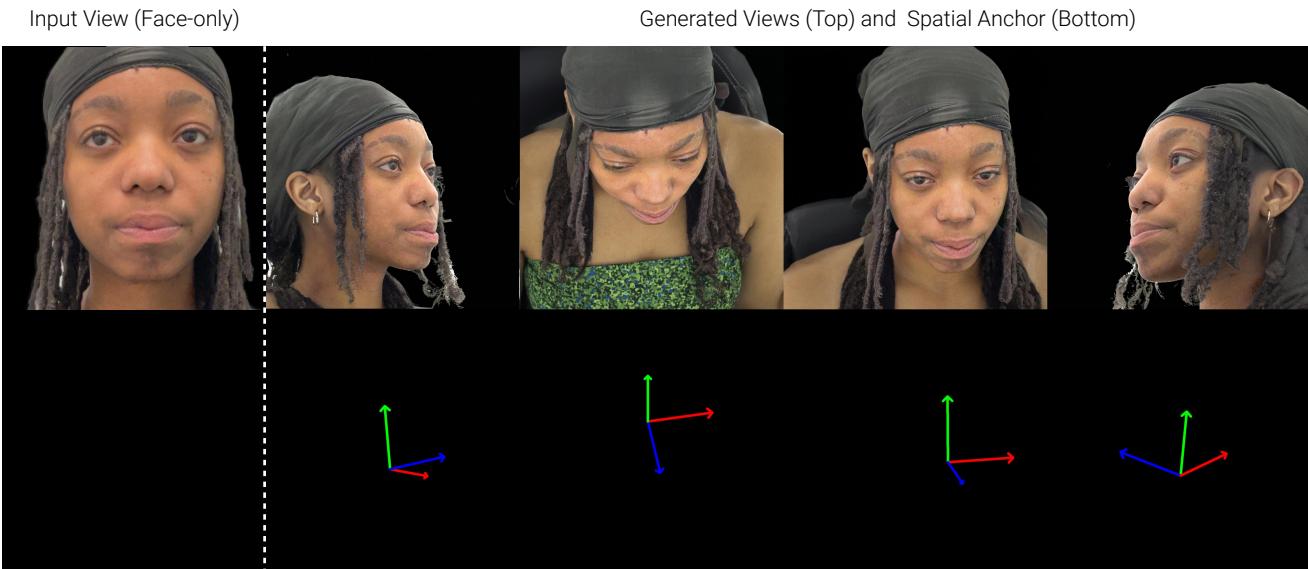
As seen in Figure 14 (above) and the pipeline diagram, this anchor is projected into 2D and provides a strong cue to the model about where the head should be located and how it should be oriented in the generated 3D space.
2. The DiT Block and ControlMLP
The heart of the model is the DiT block. The researchers made specific modifications to adapt it for multi-view generation.
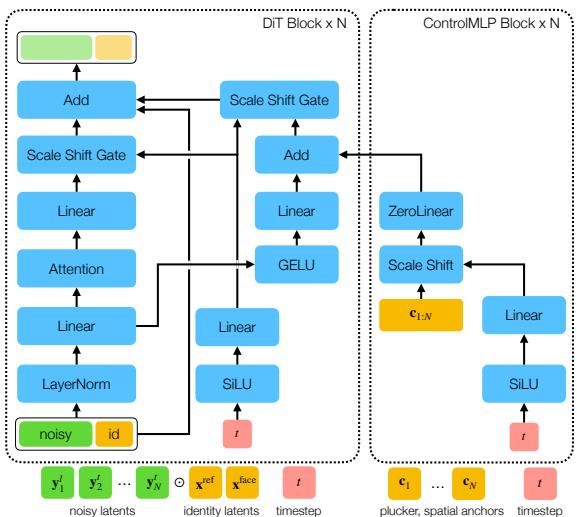
Referencing Figure 3:
- Left (DiT Block): The main backbone processes the noisy latent images (the views being generated). It uses Self-Attention to relate different parts of the image to each other and to the reference image tokens. This allows the model to “copy” details from the input photo (like a logo on a shirt) to the new generated views.
- Right (ControlMLP): This is a lightweight module inspired by ControlNet. It injects the geometric controls—the Plücker coordinates (which represent camera rays) and the Spatial Anchor.
By processing these spatial controls in a separate, lightweight MLP (Multi-Layer Perceptron) and injecting them into the main network via zero-initialized layers, the model can learn 3D consistency without destroying the rich visual priors learned during pre-training.
3. The Objective Function
The training objective is standard for diffusion models: predicting the noise added to the images.

The equation above represents the loss function. The model \(\epsilon_\theta\) tries to predict the noise \(\epsilon\) given the noisy target images \(\mathbf{y}_{1:N}^t\), the camera/anchor conditions \(\mathbf{c}_{1:N}\), and the reference identity images \(\mathbf{x}^{\mathrm{ref}}\).
The Three-Stage Training Recipe
Training Pippo is a marathon, not a sprint. The authors employ a specific three-stage curriculum to achieve high resolution and consistency.
Stage 1: Image-Only Pre-training (P1)
Goal: Learn to generate high-quality humans. Data: 3 Billion in-the-wild images (filtered for human content). Method: The model is trained as a standard image-to-image generator. It learns to denoise an image conditioned on its own semantic embedding (using DINOv2). This stage teaches the model the “texture” of reality—skin tones, fabric physics, hair structures—without worrying about 3D cameras yet.
Stage 2: Multi-View Mid-training (M2)
Goal: Learn 3D geometry and absorb the studio dataset. Data: Studio captures (hundreds of synced cameras). Method: The resolution is dropped to \(128 \times 128\) to allow for large batch sizes. The model is trained to denoise 48 views simultaneously. Because the resolution is low, they don’t use pixel-perfect spatial controls yet, just coarse camera information. This stage forces the model to understand that if a person turns 90 degrees, their profile looks a certain way.
Stage 3: Multi-View Post-training (P3)
Goal: High resolution and strict 3D consistency. Data: Studio captures. Method: Resolution is cranked up to \(1024 \times 1024\) (1K). To manage memory, fewer views (1-3) are denoised at once during training. This is where the ControlMLP (Plücker rays + Spatial Anchor) is introduced to enforce pixel-aligned precision. This stage eliminates “flicker” and ensures the eyes, nose, and ears align perfectly across views.
The Inference Challenge: Attention Biasing
Here is a fascinating problem the researchers encountered. During training, due to memory constraints, the model only sees a limited number of views at once (e.g., 12 views). But to generate a smooth video turnaround at inference time, they might want to generate 60 or more views simultaneously.
When they simply asked the model to generate more views, the quality degraded. The images became blurry, specifically in regions not visible in the input photo (like the back of the head).
The Entropy Problem
The researchers traced this issue to the Entropy of Attention. In a transformer, the attention mechanism calculates how much “focus” one token should have on another.
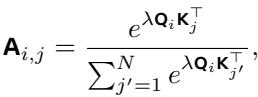
As the number of tokens (\(N\)) increases (because we are generating more views), the denominator in the softmax function (above) grows. This causes the attention distribution to flatten out—the model starts “attending” to everything a little bit, rather than focusing sharply on the relevant details. This high entropy leads to blurry, washed-out features.
The relationship between entropy and the number of tokens is logarithmic:

The Solution
Inspired by super-resolution techniques, the authors introduced Attention Biasing. They modified the scaling factor in the attention mechanism to counteract this entropy growth.
They introduced a “growth factor” \(\gamma\) (gamma) to adjust the attention temperature based on the ratio of inference tokens to training tokens:
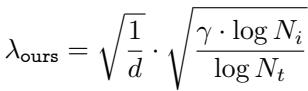
By tuning this \(\gamma\) parameter, they could force the attention to remain sharp even when generating 5x more views than the model was trained on.
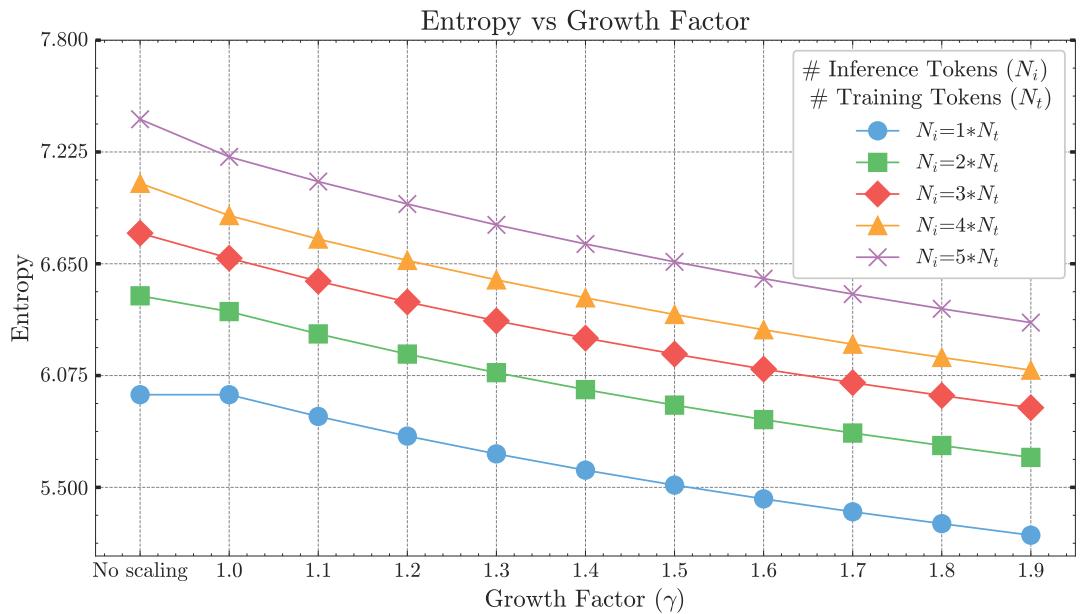
Figure 4 shows the entropy rising as the number of views increases (the colored lines going up). By applying the growth factor correction (moving right on the X-axis), they can bring the entropy back down to a healthy level.
The visual impact is striking:
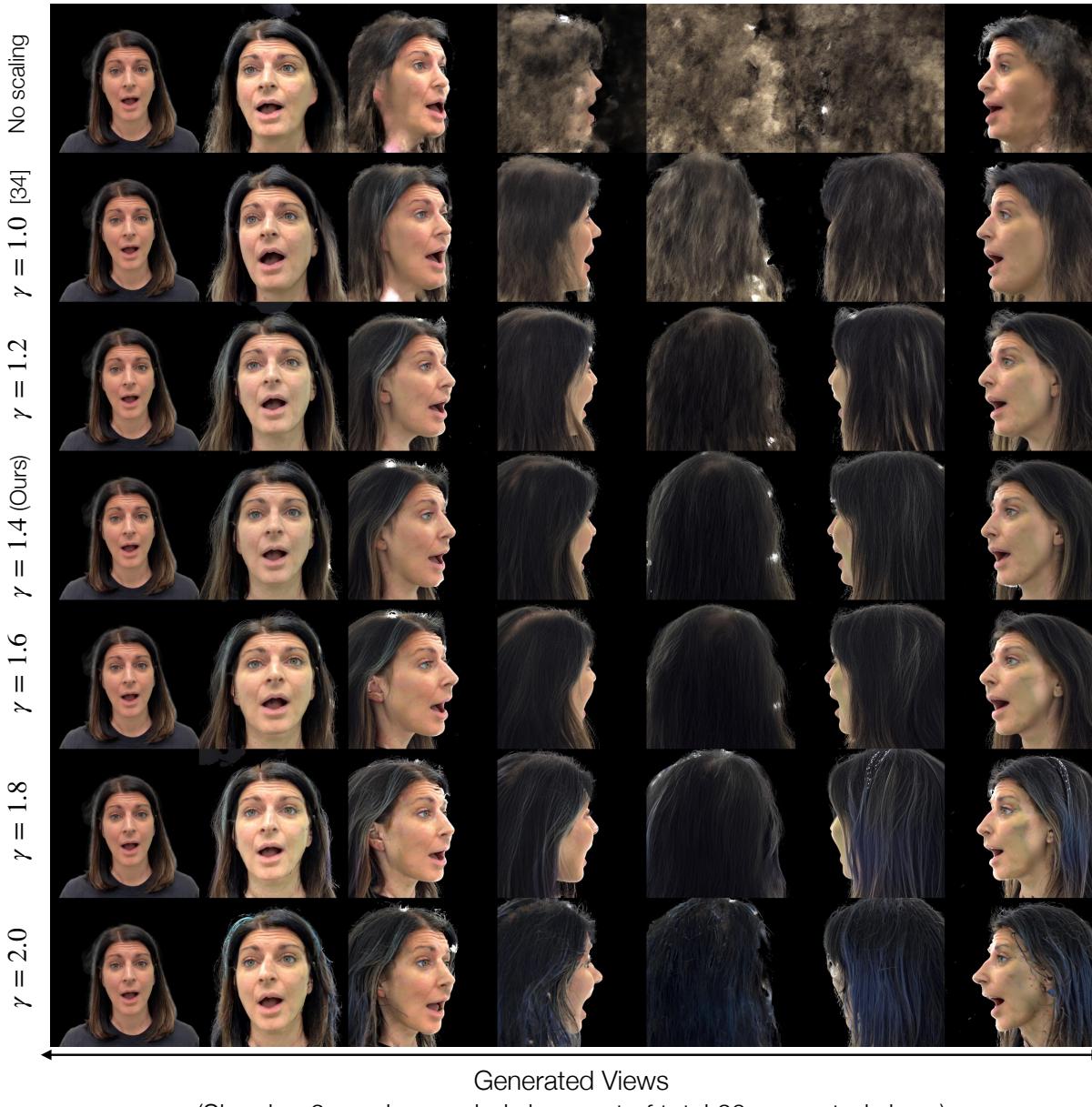
In Figure 9, look at the “No scaling” row. The back of the head (far right) is blurry and lacks texture. As the growth factor \(\gamma\) increases to 1.4 (Ours), the hair texture becomes distinct and sharp. This technique allows Pippo to generate long, smooth videos that exceed its training parameters.
Evaluating 3D Consistency: A New Metric
How do you measure if a generated 3D human is “correct” if you don’t have a ground truth 3D scan of them? Standard metrics like PSNR or SSIM require a perfect pixel-for-pixel match, which is unfair for generative models that might create a plausible but different shirt wrinkle than the ground truth.
Pippo introduces a new metric: Reprojection Error (RE@SG).
- Detect Landmarks: Use an AI keypoint detector (SuperPoint) to find distinctive features (corner of the eye, tip of the ear) in the generated images.
- Match: Use SuperGlue to find the same features across different generated views.
- Triangulate: Calculate the 3D point in space where these 2D features intersect.
- Reproject: Project that 3D point back onto the 2D images.
- Measure: Calculate the distance (error) between the reprojected point and the original feature.
If the generation is 3D consistent, the point should land exactly where it started. If the face is “sliding” or morphing between views, the error will be high. This allows evaluation of geometric consistency without needing a ground truth reference.
Experiments and Results
Pippo was put to the test against state-of-the-art baselines. The results show significant improvements in both visual fidelity and geometric consistency.
Quantitative Results
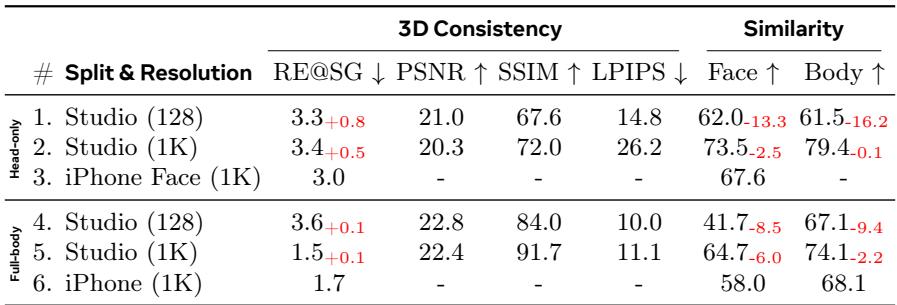
Table 3 highlights Pippo’s performance. Even on “iPhone” data (in-the-wild), the Reprojection Error (RE@SG) remains low (1.7 - 3.0), comparable to studio results. This proves the model generalizes well outside the studio.
Visual Comparison
When compared to other methods like DiffPortrait3D (head-only) and SiTH (full-body), Pippo produces more natural and detailed results.
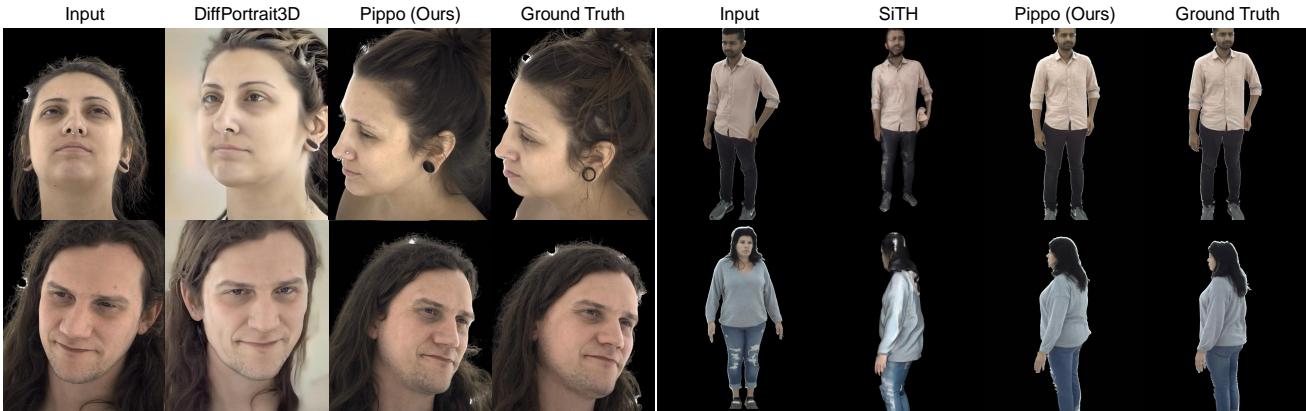
In Figure 6, notice how Pippo (third column) captures the likeness of the input better than DiffPortrait3D and creates cleaner geometry than SiTH, which suffers from some distortion.
Handling Occlusions
One of the strongest capabilities of Pippo is “inpainting” missing information. If an input photo has an arm blocking the body, or if the person is viewed from the side, Pippo must invent the missing side.

Figure 8 demonstrates this robustness. In the bottom row, the input is a view from behind/side. Pippo successfully hallucinates the face and front of the body (middle column) that looks plausible and matches the skin tone and style of the subject.
Conclusion and Implications
Pippo represents a significant step forward in digital human generation. By combining the vast diversity of 2D internet data with the geometric precision of 3D studio data, it achieves a level of quality and resolution (1K) that was previously out of reach for single-image methods.
Key Takeaways:
- Architecture Matters: The switch to Diffusion Transformers (DiT) enables better handling of multi-view tokens.
- Spatial Control: The Spatial Anchor and Plücker coordinates provide the necessary geometric grounding.
- Inference Tricks: Attention Biasing is a simple yet powerful mathematical trick to scale generation beyond training limits.
- New Metrics: Reprojection Error offers a fairer way to evaluate generative 3D consistency.
While the model is currently computationally heavy (taking minutes to generate a full set of high-res views), optimization techniques will likely bring this down. The implications for content creation are massive: soon, anyone with a smartphone might be able to scan themselves directly into a video game or virtual environment with studio-level quality.