](https://deep-paper.org/en/paper/2502.07814/images/cover.png)
Decoding the Weather with Diffusion: How Satellite Data Guides Super-Resolution
Weather forecasting is a game of scales. On a global level, we understand the movement of massive pressure systems and jet streams reasonably well. But as we zoom in—to the level of a city, a farm, or a wind turbine—things get blurry. The data we rely on, often from reanalysis datasets like ERA5, is typically provided in low-resolution grids (e.g., 25km x 25km blocks).
Imagine trying to predict the wind speed for a specific building using a pixel that covers an entire city. It’s imprecise. To solve this, meteorologists and data scientists use downscaling—the process of turning low-resolution (LR) data into high-resolution (HR) estimates.
Traditionally, this was done using mathematical interpolation (connecting the dots). Recently, Deep Learning has stepped in. But even advanced AI models often treat weather maps like random images, ignoring the laws of physics and the actual observational data orbiting above us.
In this post, we are diving deep into a paper titled “Satellite Observations Guided Diffusion Model for Accurate Meteorological States at Arbitrary Resolution”. The researchers propose a novel method called SGD (Satellite-observations Guided Diffusion). By combining the generative power of Diffusion Models with real-time satellite data (GridSat), they have created a system that can “hallucinate” accurate weather details down to a 6.25km scale, respecting both the broad trends and the fine-grained reality.
Let’s explore how they did it.
1. The Problem: The Blurring of Reality
To understand the innovation of SGD, we first need to understand the limitations of current methods.
The standard gold-mine for historical weather data is ERA5, a dataset produced by the ECMWF. While incredibly useful, it is coarse. If you need to know the temperature at a specific weather station, you traditionally have two options:
- Interpolation: You take the grid points around your location and average them (Bilinear or Bicubic interpolation). This is fast but results in “smooth” maps that miss extreme events or local topographical effects.
- Super-Resolution (SR): You train a neural network to upsample the image. However, standard SR methods often struggle with “hallucination”—they generate details that look realistic but aren’t actually true to the current weather conditions.
The authors of this paper identify a critical missing link: Satellite Observations.
ERA5 data is actually derived (in part) from satellite readings, such as brightness temperature and humidity. There is a “coupling relationship” between what a satellite sees and the atmospheric state on the ground. Existing AI downscaling methods usually ignore this, trying to predict high-res weather solely from low-res weather.
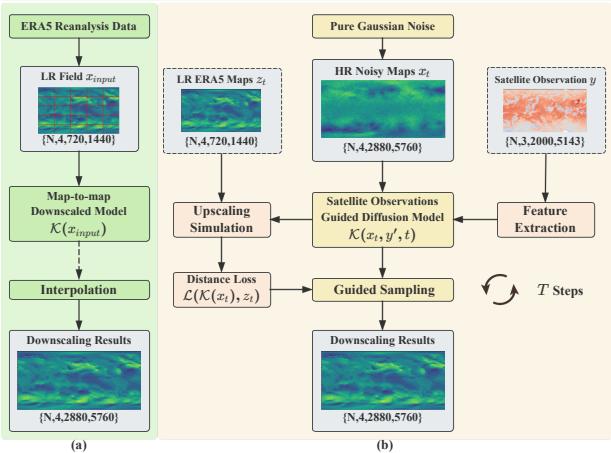
As shown in Figure 1, traditional methods (Part a) act linearly: they take the Low-Resolution field and try to stretch it. The proposed SGD method (Part b) changes the game. It treats the problem as a conditional generation process. It starts with noise and essentially “sculpts” the high-resolution map, guided by two things:
- The Satellite Observation (\(y\)): Providing the physical context.
- The Low-Resolution Input (\(z\)): Providing the boundary constraints.
2. The Core Methodology: Satellite-Guided Diffusion
The proposed model is built on Denoising Diffusion Probabilistic Models (DDPMs). If you are familiar with tools like Stable Diffusion or DALL-E, the concept is similar.
A diffusion model works in two directions:
- Forward: Gradually add Gaussian noise to an image until it is pure static.
- Reverse: Learn a neural network to remove that noise step-by-step, recovering the original image.
For weather downscaling, the “image” is a map of meteorological variables (like Wind Speed \(U_{10}\), \(V_{10}\), or Temperature \(T_{2M}\)).
2.1. The Architecture: Fusing Satellites and Reanalysis
The SGD model isn’t just generating random weather; it is generating specific weather conditioned on satellite data. The architecture uses a U-Net backbone, which is standard for diffusion models, but with a twist in how it handles inputs.
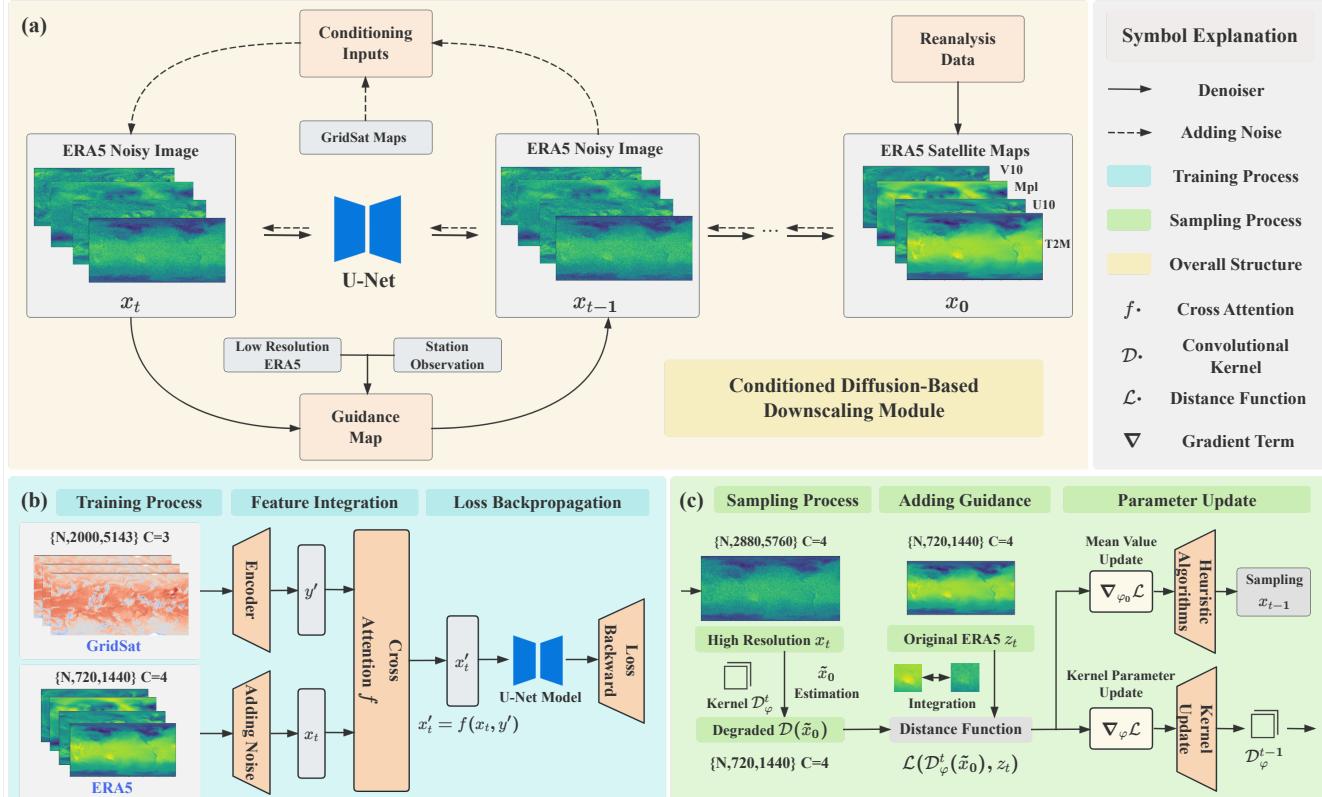
Figure 2 breaks down the workflow:
- Input Streams: The model takes a noisy ERA5 map (\(x_t\)) and a clean Satellite Observation map (GridSat, labeled \(y\)).
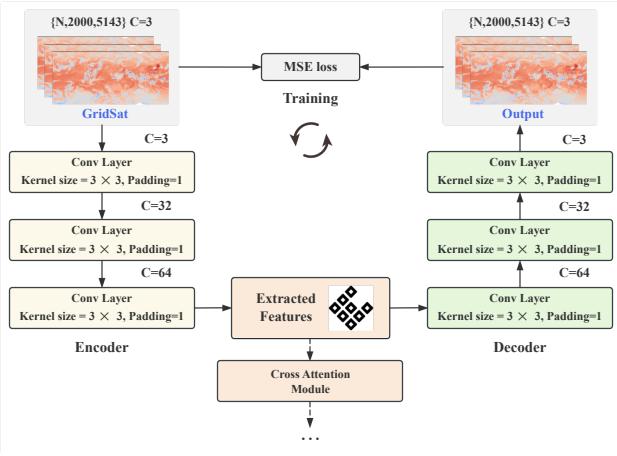
- Feature Extraction: The satellite data passes through a Pre-trained Encoder (shown in panel b) to extract meaningful features into a latent space (\(y'\)).
- Cross-Attention: This is where the fusion happens. The features from the satellite map are injected into the ERA5 generation process using a Cross-Attention mechanism.
The equation governing this attention mechanism is:

Here, \(Q\) (Query) comes from the ERA5 map being generated, while \(K\) (Key) and \(V\) (Value) come from the satellite data. This allows the model to “attend” to specific cloud patterns or atmospheric features in the satellite data when deciding how to denoise the weather map.
The pre-trained encoder structure itself is quite elegant, using a symmetric encoder-decoder setup to ensure it captures the essence of the GridSat data before passing it to the diffusion model.
2.2. Zero-Shot Guided Sampling: The “Reverse” Trick
The most fascinating part of this paper is not just how the model is trained, but how it is used (sampled).
Usually, when you use a diffusion model to upsample an image, you just ask it to generate a high-res version. But here, the researchers want to guarantee that the generated High-Resolution (HR) map is mathematically consistent with the original Low-Resolution (LR) map. If you average the pixels of the HR output, you should get exactly the LR input.
They achieve this via Zero-Shot Guided Sampling.
During the reverse diffusion steps (where the model is removing noise), they introduce a Distance Function (\(\mathcal{L}\)). This function measures the difference between:
- The generated HR map, downscaled back to LR.
- The original real LR map (\(z\)).
This seems simple, but there is a catch: How do you downscale? Most methods assume downscaling is a fixed mathematical operation (like a standard pooling layer). The authors argue this is too rigid. The relationship between a 6.25km grid and a 25km grid is complex and spatially varying.
2.3. The Optimizable Convolutional Kernel
To solve the downscaling ambiguity, the researchers introduce a dynamic, optimizable convolutional kernel (\(\mathcal{D}_\varphi\)).
Instead of using a fixed kernel to check if the generated image matches the input, they learn the kernel on the fly during the sampling process.
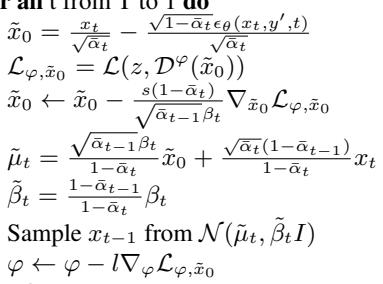
Referencing the algorithm in Figure 7 (labeled Algorithm 1 in the text):
- At each denoising step \(t\), the model estimates a clean high-res image \(\tilde{x}_0\).
- It uses the kernel \(\mathcal{D}_\varphi\) to shrink \(\tilde{x}_0\) down.
- It compares this shrunk version to the original input \(z\) using a distance function \(\mathcal{L}\).
- Crucially: It calculates gradients to update two things:
- It updates the image \(\tilde{x}_0\) to make it look more like the input.
- It updates the kernel parameters \(\varphi\) to make the downscaling simulation more accurate.
This effectively simulates the inverse physical process of downscaling, ensuring the high-resolution details are “anchored” to the low-resolution reality.
The gradient update logic is formalized as:

This dual-update mechanism allows SGD to adapt to arbitrary resolutions without needing to be explicitly retrained for every specific scale factor.
3. Experiments and Results
Does this complex machinery actually work? The researchers compared SGD against interpolation methods (Bilinear, Bicubic) and other state-of-the-art generative models (like GDP and DDNM).
3.1. Visual Quality
The visual results are striking. In Figure 3 (image below), look closely at the texture of the maps.
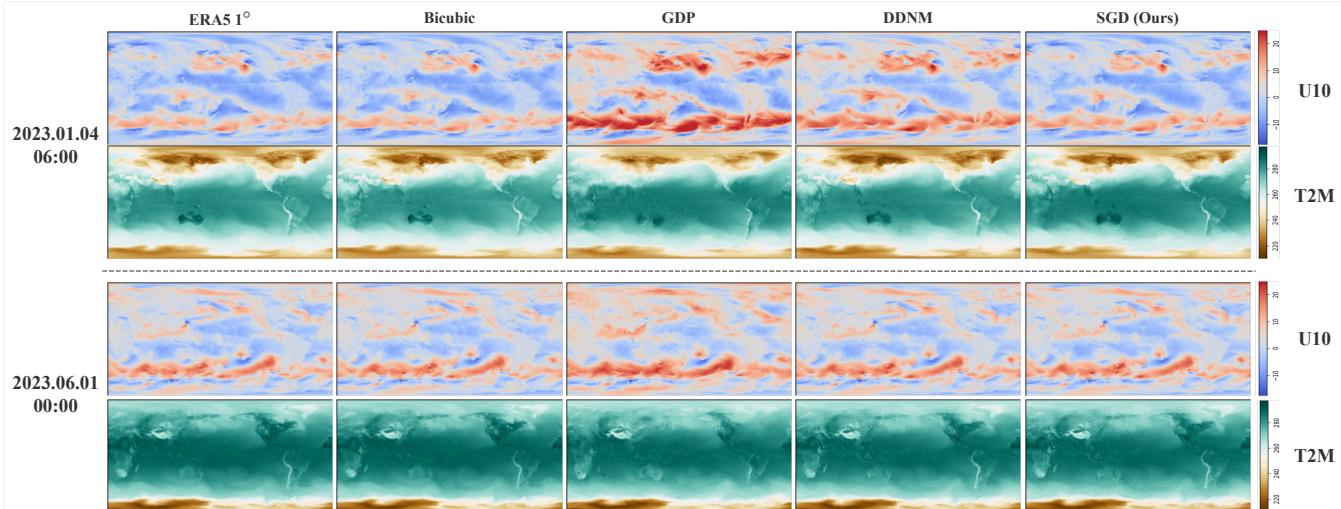
- ERA5 1°: The input data. Very blocky.
- Bicubic: Smooth, blurred, lacking any real meteorological definition.
- SGD (Ours): The right-most column. Notice the sharp gradients and local variations. It recovers the natural “roughness” of wind and temperature fields that is physically realistic but lost in other methods.
3.2. Quantitative Accuracy
Visuals are good, but numbers are better. The researchers validated their model using global weather stations (the ground truth). They checked variables like U-component of Wind (\(U_{10}\)), Temperature (\(T_{2M}\)), and Mean Sea Level Pressure (\(MSL\)).
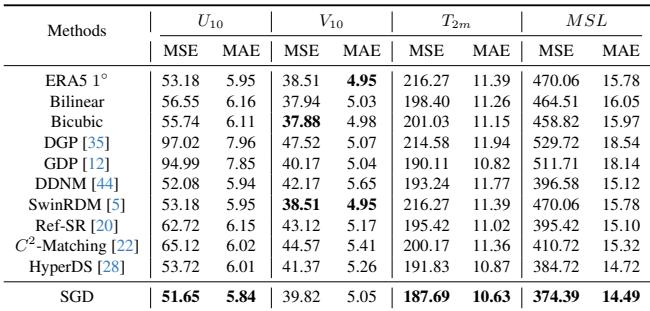
In Table 2, lower is better. SGD consistently achieves the lowest Mean Squared Error (MSE) and Mean Absolute Error (MAE) across almost all variables. For example, in Temperature (\(T_{2M}\)), SGD achieves an MSE of 187.69, significantly beating the Bicubic interpolation baseline of 201.03 and other deep learning methods.
3.3. Station-Level Guidance
One of the unique capabilities of SGD is its ability to incorporate sparse point-data (weather stations) directly into the generation process.
Because the sampling is guided by a distance function, the researchers can add a term that penalizes the model if the generated pixel at a specific latitude/longitude doesn’t match the actual weather station reading there.
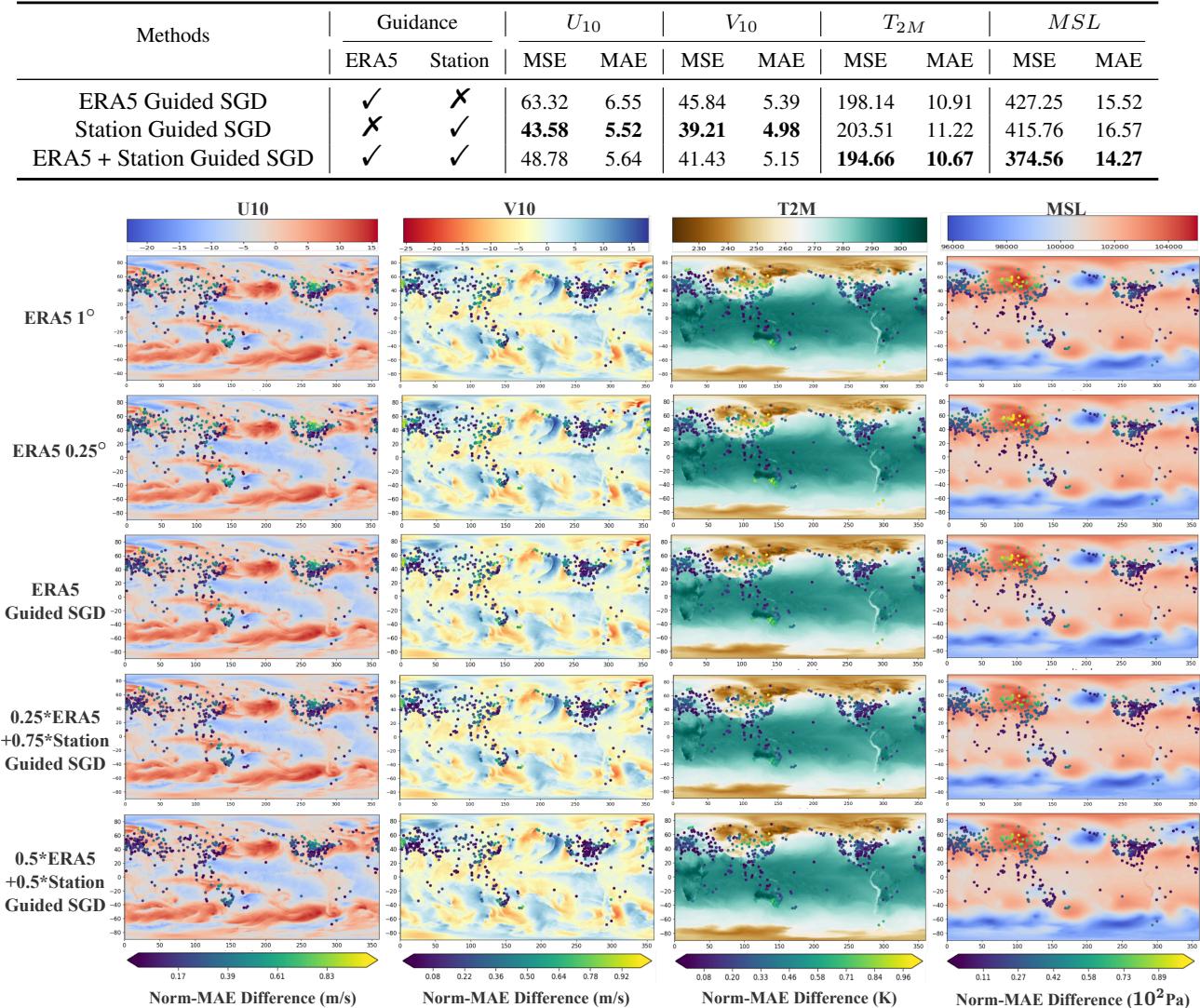
Figure 5 visualizes the error (MAE) at various stations.
- Top Row: Using only ERA5 guidance. You see a mix of colors, indicating varying error levels.
- Bottom Row: Using “ERA5 + Station” guidance. The dots become notably darker (indicating lower error).
This confirms that the model acts as a bridge: it takes the spatial structure from satellite/reanalysis data and “pins” it to the precise values recorded by ground instruments.
3.4. Bias Correction
The team also analyzed how different weighting strategies in the distance function affect the output. If you rely too much on stations, you might overfit to those points and distort the surrounding area. If you rely too much on ERA5, you inherit its biases.
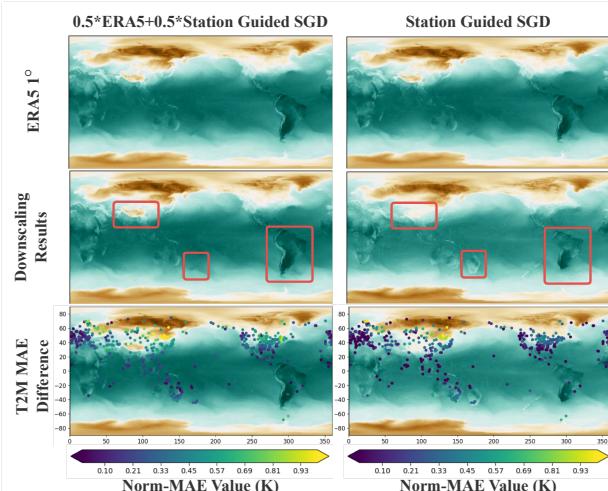
Figure 4 highlights this trade-off. The mixed approach (0.5 ERA5 + 0.5 Station) often provides the best balance, offering faithful details (high resolution) while correcting the systematic biases present in the low-resolution data.
4. Conclusion and Implications
The Satellite-observations Guided Diffusion (SGD) model represents a significant step forward in meteorological downscaling. By moving away from simple interpolation and embracing the complexity of generative AI, the authors have provided a tool that can generate high-resolution weather maps that are consistent with both satellite imagery and ground-level physics.
Key Takeaways:
- Context Matters: Feeding raw satellite observation features into the diffusion model (via Cross-Attention) provides essential cues about atmospheric states that low-res grids miss.
- Simulation during Generation: The use of an optimizable kernel during sampling allows the model to “learn how to downscale” in real-time, ensuring mathematical consistency between the input and output.
- Flexibility: The patch-based sampling method means this can be applied to maps of arbitrary size and resolution.
For students and researchers in climate science, this paper highlights the potential of Physics-Guided AI. We aren’t just generating pretty images; we are generating data that respects the physical constraints of the atmosphere, paving the way for more hyper-local weather forecasting for agriculture, renewable energy, and disaster preparedness.
This isn’t just about seeing the weather more clearly; it’s about understanding it at the scale where life actually happens.