](https://deep-paper.org/en/paper/2502.08532/images/cover.png)
If you have ever trained a neural network, you have likely encountered the “alchemy” of optimization. You tweak the learning rate, you add a scheduler, and—perhaps most importantly—you apply gradient clipping to stop your training loss from exploding.
While gradient clipping is a standard tool in the deep learning toolbox, it is often treated as a heuristic—a practical hack to keep things stable. But what if gradient clipping wasn’t just a hack? What if it was actually a specific instance of a much broader, mathematically elegant framework?
In the paper “Nonlinearly Preconditioned Gradient Methods,” researchers Oikonomidis, Quan, Laude, and Patrinos propose exactly such a framework. They introduce a family of algorithms that generalize gradient descent by applying nonlinear transformations to the gradient. This approach not only explains why gradient clipping works but also unifies methods like Adam and Adagrad under a single theoretical roof, while offering new ways to tackle difficult, non-convex optimization problems.
In this post, we will break down the mathematics of nonlinear preconditioning, explore the concept of “generalized smoothness,” and see how these methods perform in practice.
The Problem with Standard Gradient Descent
To understand the innovation, we first need to revisit the standard. The goal of optimization is simple:
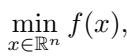
Standard Gradient Descent (GD) iterates by moving in the direction of the negative gradient: \(x^{k+1} = x^k - \gamma \nabla f(x^k)\).
This works beautifully when the function \(f\) is “well-behaved.” In mathematical terms, “well-behaved” usually means \(L\)-smooth. A function is \(L\)-smooth if its gradient doesn’t change too fast—specifically, if the gradient is Lipschitz continuous. Geometrically, this means we can place a quadratic parabola (determined by the constant \(L\)) on top of the function at any point, and the function will never rise above that parabola.
The catch: Many modern objective functions (like those in neural networks) are not \(L\)-smooth. They might grow exponentially or have polynomial steepness (like \(x^4\)). In these regions, the standard quadratic upper bound fails. If you use a fixed step size \(\gamma\), a large gradient can shoot your parameters off into infinity. This is the “exploding gradient” problem.
Practitioners fix this by clipping the gradient or using adaptive methods like Adam. This paper asks: Can we derive these fixes from first principles?
The Core Method: Nonlinear Preconditioning
The authors propose a generalized update rule that applies a nonlinear transformation to the gradient before the update. Given a current point \(x^k\), a step size \(\gamma\), and a scaling parameter \(\lambda\), the iteration is:

Let’s unpack this equation:
- \(\nabla f(x^k)\): The standard gradient.
- \(\lambda\): A scaling factor (think of it as inverse temperature or sensitivity).
- \(\nabla \phi^*\): This is the gradient of a convex function \(\phi^*\), which is the convex conjugate (or dual) of a reference function \(\phi\).
The “magic” lies in the choice of \(\phi\). If we choose \(\phi(x) = \frac{1}{2}\|x\|^2\), then \(\nabla \phi^*\) is just the identity function, and we recover standard Gradient Descent. However, by choosing different reference functions, we can change the geometry of the update.
Isotropic vs. Anisotropic Reference Functions
The authors focus on reference functions generated by a scalar “kernel” function \(h: \mathbb{R} \rightarrow \mathbb{R}\). They identify two main families:
- Isotropic: The function depends on the Euclidean norm, \(\phi(x) = h(\|x\|)\). This treats all directions in space equally but scales the step size based on the magnitude of the total gradient.
- Anisotropic: The function is a sum of kernels applied to each coordinate, \(\phi(x) = \sum h(x_i)\). This allows the algorithm to take different step sizes for different coordinates—similar to how Adam or Adagrad works.
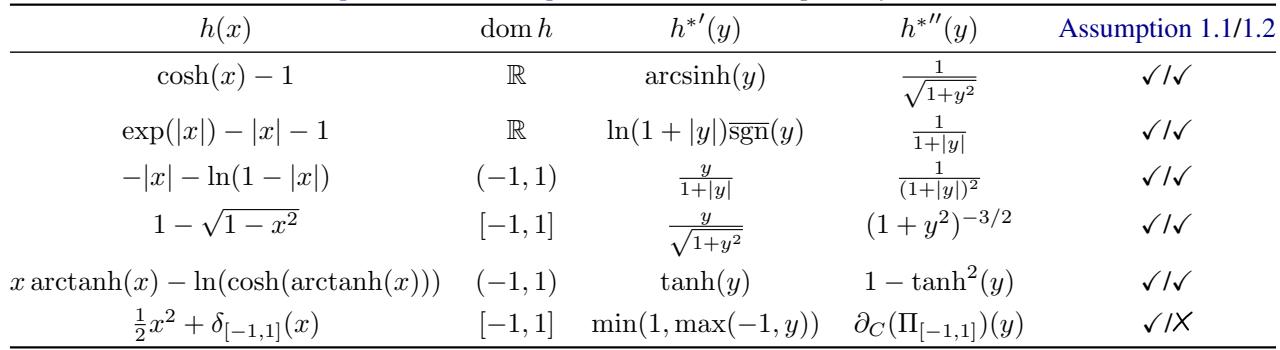
The table below lists several kernel functions \(h(x)\) and their properties. Notice how familiar functions like \(\cosh\) or the Huber-like loss (\(\frac{1}{2}x^2 + \delta\)) appear.
Recovering Famous Algorithms
One of the strongest arguments for this framework is its ability to recover popular algorithms simply by changing the reference function \(\phi\).
1. Adagrad (without memory): By choosing the kernel related to the algebraic function \(1 - \sqrt{1-x^2}\), the update rule becomes:

2. Adam (without momentum): By using a logarithmic barrier kernel, we derive a coordinate-wise update that looks exactly like a simplified version of Adam:
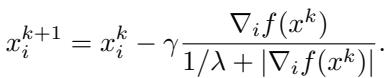
3. Gradient Clipping: This is perhaps the most interesting connection. If we choose a reference function based on the quadratic plus an indicator function (essentially bounding the domain), the update rule becomes:

Here, the update naturally “clips” the gradient. If the gradient norm is small, it acts linearly; if it is large, it saturates. This proves that gradient clipping isn’t just a heuristic—it is the mathematically correct optimizer for a specific class of non-Lipschitz functions.
Generalized Smoothness: The Theory of \(\Phi\)-Convexity
Why do these nonlinear updates work? They work because they respect the geometry of the function better than standard GD.
As mentioned earlier, standard GD assumes the function is bounded by a quadratic curve (a parabola).

This inequality (3) essentially says “the function \(f\) doesn’t grow faster than a parabola.”
The authors introduce \((L, \bar{L})\)-anisotropic smoothness. Instead of a parabola, they bound the function using the nonlinear reference function \(\phi\).

The visualization below illustrates this concept perfectly. The blue curve is our function \(f\). Standard smoothness tries to fit a parabola on top of it. Anisotropic smoothness fits a different shape (the dashed orange lines)—perhaps a shape that grows linearly or exponentially—which might hug the function much tighter, allowing for larger, safer steps.
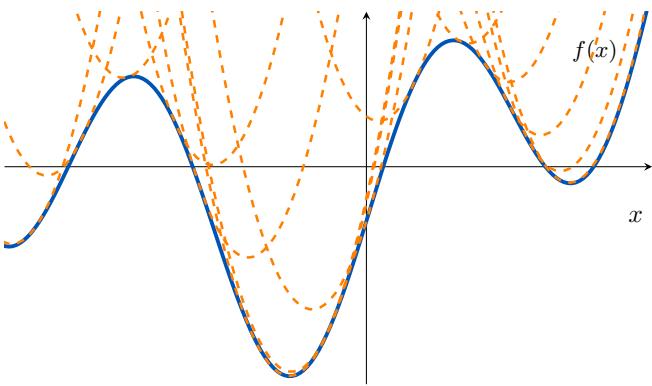
This concept relates to \(\Phi\)-convexity (or \(c\)-concavity in optimal transport). If \(-f\) is \(\Phi\)-convex, it means \(f\) can be represented as an envelope of these nonlinear shapes.
Second-Order Conditions
How do you check if your function satisfies this new smoothness condition? For standard smoothness, we check if the eigenvalues of the Hessian \(\nabla^2 f(x)\) are bounded by \(L\).
For this generalized smoothness, we check a “relative” condition. We need the Hessian of \(f\) to be bounded “relative” to the curvature of our reference function.

Or, in terms of eigenvalues:

Basically, if the curvature of your cost function (\(f\)) explodes (gets very steep), you need your reference function (\(\phi\)) to also have high curvature (steep gradient) to compensate and keep the update stable.
Convergence Analysis
The paper provides rigorous proofs that these methods converge for both convex and non-convex problems.
Non-Convex Setting
For general non-convex functions (like neural networks), the authors prove that the algorithm finds a stationary point (where the gradient is zero). The convergence rate depends on the reference function.
For example, using the reference function related to \(\cosh\) (which behaves like \(L_1\) norm for large values and \(L_2\) for small values), the gradient norm decreases at a rate of \(O(1/\sqrt{K})\).

Convex Setting
If the function is convex, the results are even stronger. The authors prove an \(O(1/K)\) convergence rate for the function values, which matches standard gradient descent but applies to a much broader class of functions.

Experimental Results
The theory is sound, but does it work? The authors tested these preconditioned methods on several problems.
1. The “Norm to Power” Toy Problem
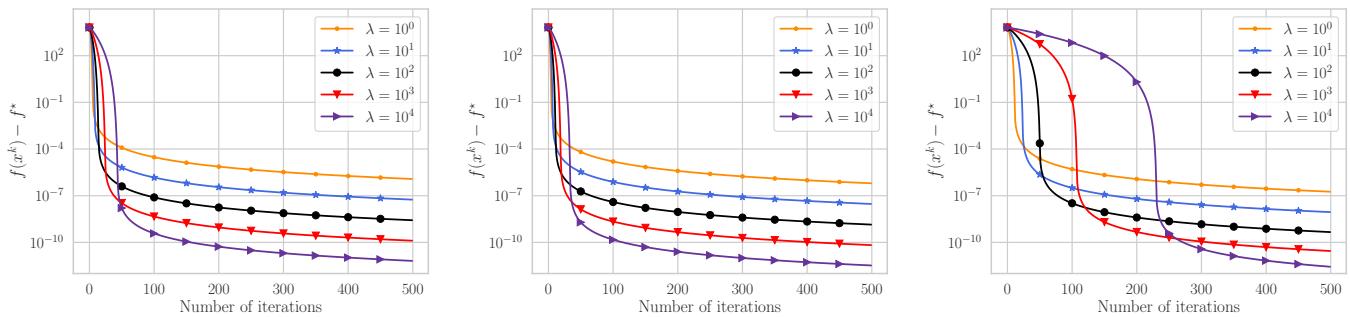
Consider minimizing \(f(x) = \frac{1}{4}\|x\|^4\). This function is convex but not Lipschitz smooth—it gets steeper and steeper as you move away from zero. Standard GD struggles here because a fixed step size that is stable far away is too slow near zero, and a step size that is fast near zero causes explosions far away.
The figure below shows the convergence.
- Left/Middle: Preconditioned methods (orange/blue) converge reliably.
- Right: This compares the isotropic method against gradient clipping.
2. Non-Convex Phase Retrieval
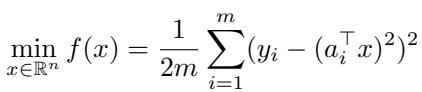
Phase retrieval is a classic non-convex problem involved in reconstructing signals. The objective function is:
Here, the authors compared their Isotropic (\(\phi_1\)) and Anisotropic (\(\phi_2\)) methods against standard GD and Gradient Clipping.
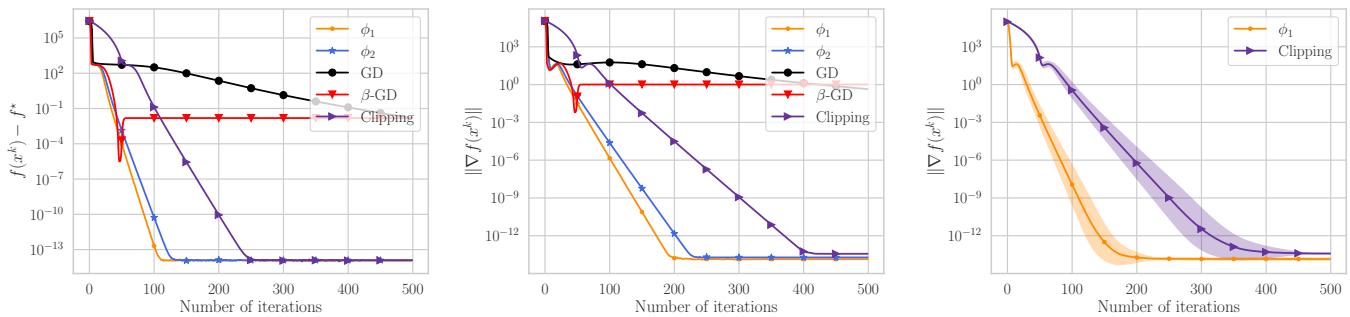
- Left Graph: The function value \(f(x) - f^*\). Notice how the nonlinear methods (Orange/Blue) drop drastically faster than standard GD (Black).
- Right Graph: This shows the gradient norm over 100 random instances. The isotropic method (Orange) consistently finds flatter minima (smaller gradients) faster than Gradient Clipping (Purple).
3. Neural Network Training
Finally, they trained a simple fully connected network on MNIST. This is the ultimate test of “generalized smoothness” because the loss landscape of a neural net is notoriously complex.
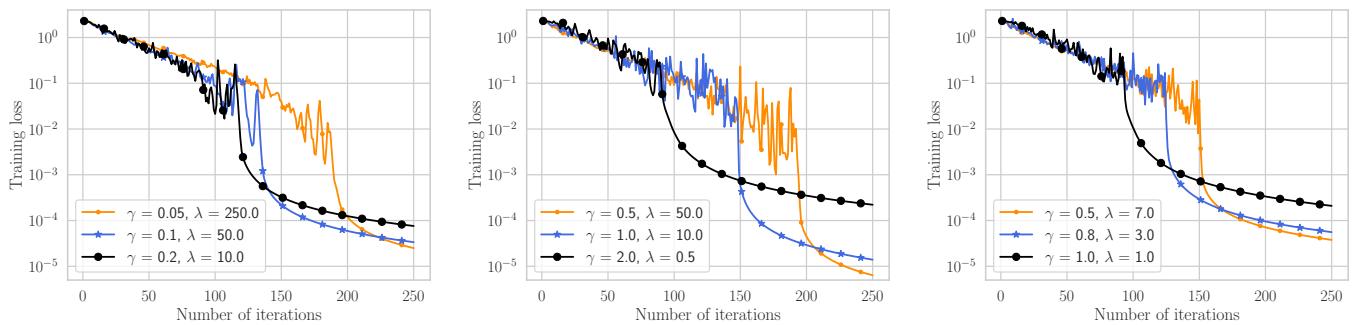
The plots show training loss for different step sizes (\(\gamma\)) and scaling parameters (\(\lambda\)).
- Left: Using the \(\cosh\)-based preconditioner.
- Middle: Using the Adam-like preconditioner (\(-\ln(1-|x|)\)).
- Right: Standard Gradient Clipping.
The proposed methods (Left/Middle) show smooth convergence curves comparable to, and in some configurations more stable than, standard clipping.
Conclusion and Implications
The paper “Nonlinearly Preconditioned Gradient Methods” does something very satisfying: it takes a collection of disparate optimization tricks (like clipping and adaptive coordinate scaling) and unites them under a rigorous mathematical framework.
By viewing optimization through the lens of Majorization-Minimization with nonlinear reference functions, we gain:
- Justification: We now know why clipping works—it’s the optimal strategy for functions satisfying a specific smoothness condition.
- Flexibility: We can design new optimizers by simply choosing different kernel functions (\(h\)) that match the geometry of our specific loss landscape.
- Stability: These methods naturally handle steep gradients without requiring the manual hackery often associated with deep learning training.
For students and researchers, this work opens the door to thinking about optimization not just as “going downhill,” but as “shaping the hill” to make the descent as smooth as possible.