](https://deep-paper.org/en/paper/2502.08900/images/cover.png)
Introduction
In the era of Large Language Models (LLMs), it is easy to assume that artificial intelligence has “solved” language. We can open ChatGPT, type a sentence in English, and instantly receive a fluent translation in French, Spanish, or Japanese. However, this apparent mastery masks a significant digital divide. While models like GPT-4 excel at high-resource languages—those with billions of words of text available on the internet—they frequently fail when tasked with low-resource languages, and particularly indigenous languages.
For speakers of languages like Navajo, Arápaho, or Kukama, current AI tools are often unreliable or entirely non-functional. The reason is simple: these models learn by probability. Without massive datasets to calculate the probability of the next word, the model hallucinates, producing fluent-sounding but nonsensical translations.
So, how do we solve this without waiting decades to digitize millions of nonexistent documents?
A recent paper explores a fascinating solution: if we can’t give the model more text, perhaps we can give it the meaning directly. By using a sophisticated linguistic tool called Uniform Meaning Representation (UMR), researchers are testing whether we can “guide” GPT-4 to translate indigenous languages by explicitly showing it the semantic structure of a sentence.
The Problem: The Low-Resource Wall
To understand the solution, we first need to understand the bottleneck. GPT-4 is a statistical engine. When it translates from French to English, it relies on having seen millions of French-English sentence pairs during its training. It recognizes patterns.
However, for indigenous languages, that data scarcity is extreme. As noted by Robinson et al. (2023), the most significant predictor of ChatGPT’s translation performance is simply the number of Wikipedia entries in that language. For languages like Arápaho or Kukama, the internet presence is negligible compared to English.
When you ask an LLM to translate a low-resource language in a “zero-shot” setting (giving it the prompt without any examples), it lacks the internal linguistic map to navigate the grammar and vocabulary. It often resorts to word-by-word literal translation or completely guesses based on the few fragments it might have seen, leading to errors that strip the original text of its true meaning.
The Solution: Uniform Meaning Representation (UMR)
The researchers propose bridging this gap using Uniform Meaning Representation (UMR). To understand UMR, we have to look at its predecessor, Abstract Meaning Representation (AMR).
AMR is a way of mapping a sentence into a graph that represents “who did what to whom.” It strips away the syntactic surface—like whether a sentence is active or passive—and focuses purely on the logic. For example, “The boy wants the girl to believe him” becomes a graph connecting the concepts of “want,” “believe,” “boy,” and “girl.”
However, AMR was designed primarily for English. It struggles to capture the nuances of other languages, particularly those with complex morphological structures (how words change shape) found in many indigenous languages.
This is where UMR comes in. UMR is designed from the ground up to be cross-lingual. It uses a lattice-based structure that allows for different levels of granularity depending on the language. It captures tense, aspect, and modality in a way that applies universally, not just to English grammar.
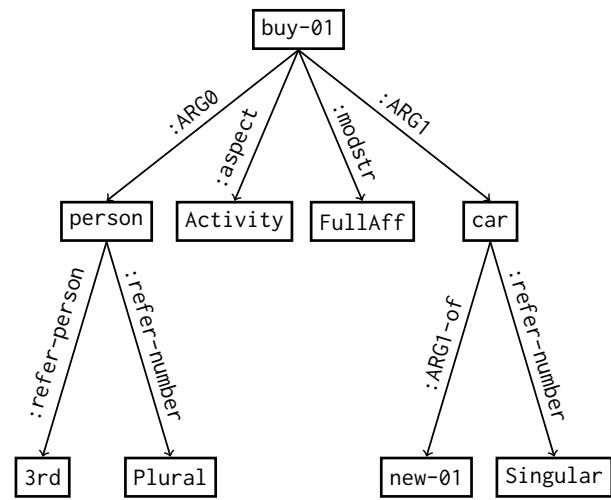
As shown in Figure 1, a UMR graph is a visual breakdown of a sentence’s logic. In this example for the sentence “They were buying a new car,” the root action is buy-01.
- The ARG0 (the agent, or doer) is a person. The graph further specifies this is a
3rdperson reference and isPlural(“They”). - The ARG1 (the theme, or thing bought) is a car. The graph specifies it is
new-01andSingular.
The text below the image is the “PENMAN” notation, which is a way of writing this graph structure in a text format that a computer (or an LLM) can read. The hypothesis of the paper is straightforward: if we provide GPT-4 with this “logic map” alongside the indigenous sentence, can it use the map to navigate the translation more accurately?
Methodology: Teaching GPT-4 New Tricks
The researchers designed an experiment focusing on translating from three indigenous languages into English:
- Navajo (spoken in the Southwestern United States)
- Arápaho (an Algonquian language spoken in Wyoming/Oklahoma)
- Kukama (spoken in the Peruvian Amazon)
They utilized a recently released UMR dataset containing sentences in these languages along with their UMR graphs and English translations. The goal was to see if adding the UMR graph to the prompt improved the quality of the English translation generated by GPT-4.
The Four Prompting Protocols
The core of the study involved testing four different ways of asking GPT-4 to translate a sentence. This is often referred to as “prompt engineering,” but here it serves as a rigorous scientific variable.
1. Zero-shot
This is the baseline. The prompt simply asks the model to translate the text.
Prompt: “Please provide the English translation for this [Source language] sentence…”
2. Zero-shot with UMR
Here, the researchers provide the indigenous sentence and its corresponding UMR graph (in text format).
Prompt: “…sentence (which is accompanied by a Uniform Meaning Representation parse)…”
3. Five-shot
This leverages “In-Context Learning.” The prompt provides the target sentence, but precedes it with five examples of other sentences in that language and their correct English translations.
- Adaptive Selection: Crucially, the researchers didn’t just pick five random sentences. They used an adaptive approach, mathematically calculating which 5 sentences in the database were most similar (using a metric called chrF) to the target sentence. This acts like a mini-tutorial for the model before it attempts the task.
4. Five-shot with UMR
This is the “kitchen sink” approach. The prompt includes the five example sentences, the five corresponding UMR graphs for those examples, the target sentence, and the target UMR graph.
Experiments and Results
The researchers ran these prompts on over 1,000 sentences across the three languages. To evaluate the quality of the translations, they used two standard metrics:
- BERTscore: Uses a pre-trained language model to measure how similar the meaning of the translation is to the reference English sentence.
- chrF: Measures character n-gram overlap. It is very strict and checks if the exact character sequences match.
The results, visualized below, reveal a clear hierarchy of performance.
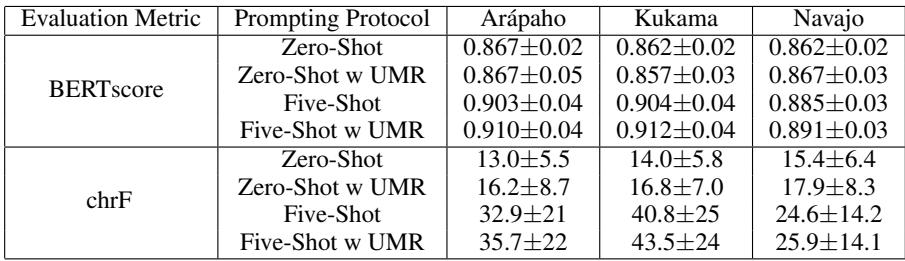
Looking at Table 1, we can draw several key conclusions:
- Demonstrations are King (Five-shot vs. Zero-shot): The biggest leap in performance comes from moving from Zero-shot to Five-shot. For example, in Kukama, the chrF score jumps from 14.0 (Zero-shot) to 40.8 (Five-shot). This confirms that even for extremely low-resource languages, showing the model a few relevant examples is incredibly powerful.
- UMR Adds Value: In almost every category, adding the UMR graph improves the score. Look at the Arápaho chrF scores: Zero-shot is 13.0, but Zero-shot with UMR is 16.2.
- The Best Combination: The highest scores across the board almost always come from the Five-shot with UMR protocol.
Statistical Significance
Are these improvements just random noise, or are they statistically significant? The researchers performed t-tests to verify their findings.
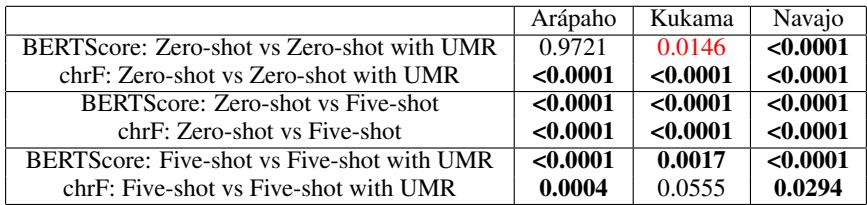
Table 2 confirms the robustness of the results. The bolded entries represent statistically significant improvements (\(p < 0.05\)).
- Zero-shot vs. Zero-shot with UMR: Significant improvement in 5 out of 6 comparisons.
- Zero-shot vs. Five-shot: Extremely significant improvement in all cases (\(p < 0.0001\)).
- Five-shot vs. Five-shot with UMR: Significant improvement in 4 out of 6 comparisons.
This statistical backing suggests that UMR isn’t just a placebo; it is providing genuine linguistic signal that the model uses to correct its translations.
Qualitative Analysis: Seeing the Difference
Numbers are useful, but examples tell the story. The paper provides a striking example from Kukama to illustrate why UMR matters.
Source Sentence: ay ra yupuni yapana iwirati English Reference: “He run in the forest” (Note: The reference itself contains a grammatical error, reflecting the nature of field data).
- Zero-shot output: “He plays with his younger brother at the river.”
- Verdict: Complete hallucination. The model recognizes the language but guesses the context entirely wrong.
- Zero-shot with UMR output: “The person is working there today.”
- Verdict: Still wrong, but the structure is getting slightly closer to a simple subject-predicate form.
- Five-shot output: “He has already started walking in the forest.”
- Verdict: Much better. It captures the setting (“forest”) and the actor (“He”), but gets the specific action wrong (“walking” instead of “running”).
- Five-shot with UMR output: “He has already started running in the forest.”
- Verdict: Success. The semantic graph explicitly contained the concept for “run,” allowing the model to correct “walk” to “run.”
This progression clearly demonstrates that while providing examples (Five-shot) helps the model understand the general vibe and syntax of the language, the UMR graph acts as a semantic anchor, preventing the model from substituting similar but incorrect verbs.
Conclusion & Implications
This research highlights a promising path forward for low-resource language technology. We cannot simply “scale up” our way out of the problem for indigenous languages because the data does not exist. Instead, we must be smarter about the inputs we provide.
The findings show that GPT-4 is capable of utilizing abstract semantic graphs (UMR) to guide its translation process. When combined with adaptive few-shot prompting (showing the model similar examples), the performance gains are substantial.
Why does this matter?
- Preservation: It offers a tool to assist in the translation and documentation of endangered languages.
- Efficiency: It suggests we don’t need billions of sentences to build useful tools; we need high-quality, structured annotations like UMR.
- Hybrid AI: It supports the idea that the future of AI isn’t just raw neural networks, but “neuro-symbolic” approaches where we combine the fluency of LLMs with the structured logic of linguistic representations.
While UMR annotation is expensive and requires expertise, this paper proves that the investment yields returns. By mapping the meaning of indigenous languages, we can help modern AI understand them, ensuring these rich linguistic traditions are not left behind in the digital age.