](https://deep-paper.org/en/paper/2502.09376/images/cover.png)
If you have worked with Large Language Models (LLMs) in the last two years, you have almost certainly encountered LoRA (Low-Rank Adaptation). It has become the default standard for fine-tuning massive models on consumer hardware.
But from a mathematical perspective, LoRA is somewhat of a puzzle. It involves optimizing a matrix factorization—a problem known to be non-convex and potentially fraught with “spurious” local minima (traps in the loss landscape where the model stops learning but hasn’t solved the task). Yet, in practice, LoRA almost consistently works. It converges, and it converges well.
Why?
Previous theoretical attempts to explain this relied on “linearization”—essentially assuming the model behaves linearly during training. While this makes the math easier, it doesn’t capture the reality of training deep neural networks.
In this post, we are going to dive into a fascinating paper titled “LoRA Training Provably Converges to a Low-Rank Global Minimum or It Fails Loudly (But it Probably Won’t Fail).” The researchers strip away the simplifying assumptions of previous works to analyze the actual loss landscape of LoRA. They arrive at a striking conclusion: LoRA training either finds the perfect low-rank solution, or it fails in a way that is so obvious (high rank, massive weights) that you can’t miss it. Furthermore, they explain why standard training practices make that failure highly unlikely.
Let’s unpack the math, the method, and the implications.
1. The Setup: How LoRA Changes the Problem
To understand the landscape analysis, we first need to agree on what LoRA actually does mathematically.
When we fine-tune a pre-trained model, we usually have a weight matrix \(W_0 \in \mathbb{R}^{m \times n}\). In “full fine-tuning,” we would update every parameter in this matrix. LoRA freezes \(W_0\) and instead learns a low-rank update \(X\). This update is factorized into two smaller matrices, \(A\) and \(B\), such that the new weight is:

Here, the rank \(r\) is much smaller than the dimensions of the model (\(m\) or \(n\)). \(A\) is initialized with random Gaussian noise, and \(B\) is initialized to zero, ensuring that at the start of training, the update \(X\) is zero.
The Objective Function
The goal of fine-tuning is to minimize a loss function (like cross-entropy) over a dataset. Let’s denote the loss of the full fine-tuning setup as \(\widehat{\mathcal{L}}^{\mathrm{full}}(\mathbf{X})\).
When we use LoRA, we are optimizing the same objective, but parameterized by \(A\) and \(B\).

This simple change in parameterization introduces non-convexity. Even if the original loss landscape for \(X\) was a nice, smooth bowl (convex), splitting \(X\) into \(AB^\top\) creates symmetries and ridges that can theoretically trap an optimizer in a bad spot.
2. The Core Problem: Spurious Local Minima
In optimization theory, we often look for “Stationary Points” (where the gradient is zero) or “Second-Order Stationary Points” (SOSPs), where the gradient is zero and the curvature (Hessian) is positive—meaning we are at the bottom of a valley.

The fear in non-convex optimization is converging to a spurious local minimum. This is a valley floor that is not the lowest point in the landscape (the global minimum). If your optimizer gets stuck here, your model performs poorly, and no amount of extra training will fix it.
The authors of this paper set out to determine if and where these spurious minima exist in LoRA training.
3. Main Result: The Dichotomy of Solutions
The researchers define two “regimes” based on the geometric properties of the loss function: the Special Regime and the Generic Regime.
To do this, they rely on two sophisticated mathematical concepts:
- Restricted Strong Convexity (RSC): Roughly speaking, this means the loss function curves upward nicely in the directions that matter (low-rank directions).
- Restricted Smoothness (RSM): This means the function doesn’t curve too sharply in those same directions.
The “Fail Loudly” Theorem
The paper’s main contribution is a theorem proving that in the “Generic Regime” (which represents realistic training scenarios), the loss landscape is structured very specifically.
If you find a local minimum in LoRA training (specifically, a Second-Order Stationary Point), it falls into one of two categories:
- It is a Global Minimum: It has low rank and small magnitude. This is the solution we want.
- It is a Spurious Local Minimum: It has high rank (equal to the LoRA rank \(r\)) and large magnitude (huge weights).
This is a powerful result. It says there are no “subtle” failures. You won’t get stuck in a bad local minimum that looks somewhat like a good solution. If LoRA fails, it fails dramatically.
The visualization below summarizes this theorem perfectly:
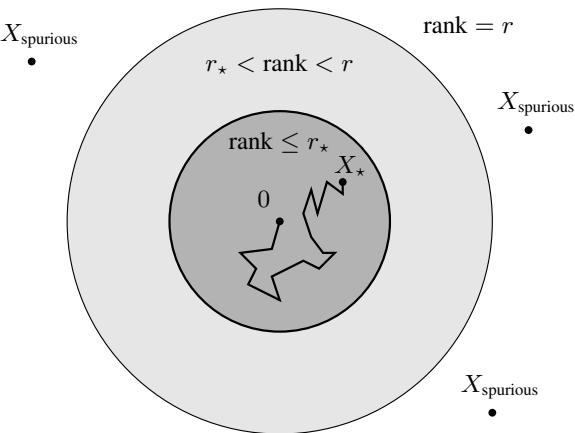
As shown in Figure 1, the global minimum \(X_{\star}\) resides in the center. It has a rank lower than or equal to the true necessary rank \(r_{\star}\) and exists near the initialization point (0).
The spurious local minima (\(X_{\text{spurious}}\)), however, live far outside this region. They correspond to solutions where the matrices \(A\) and \(B\) have exploded in magnitude and utilize the maximum possible rank \(r\).
Mathematically, the authors prove that if a solution \(X_{\square}\) is spurious, its norm satisfies a lower bound:
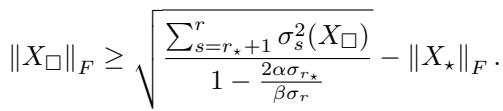
This inequality essentially states that the distance of a spurious solution from the origin is very large compared to the global optimum.
4. Why LoRA Probably Won’t Fail
If spurious local minima exist, why doesn’t LoRA get stuck in them? The authors argue that the specific design of LoRA training—specifically Zero Initialization and Weight Decay—creates an implicit bias that steers the optimizer toward the center of Figure 1 (the good solution) and away from the outer edges (the bad solutions).
1. The Power of Zero Initialization
Recall that LoRA initializes \(B=0\), meaning the update matrix \(X = AB^\top\) starts at exactly 0.
Since we are fine-tuning a pre-trained model, we assume the necessary update \(X_{\star}\) is relatively small. The pre-trained model already knows a lot; it just needs a nudge. Therefore, the global minimum is conceptually “close” to 0.
The spurious minima, as proven by the theorem, are “far” from 0.
Standard optimizers like SGD or Adam traverse the landscape locally. Starting at 0 places the optimizer in the immediate basin of attraction of the low-magnitude global minimum. To reach a spurious minimum, the optimizer would have to travel a long distance, escape the pull of the global minimum, and climb into a high-norm region.
2. The Role of Weight Decay
Practitioners almost always use weight decay (L2 regularization) during LoRA fine-tuning. The paper highlights a crucial equivalence here.
Optimizing LoRA with weight decay on \(A\) and \(B\) is mathematically equivalent to optimizing the full matrix \(X\) with Nuclear Norm Regularization.

The Nuclear Norm (denoted as \(\|X\|_*\)) is the sum of the singular values of a matrix. Minimizing the nuclear norm encourages the matrix to be low-rank.
This provides a theoretical force that pushes the solution away from the “High Rank” spurious minima.
- Theorem 1 says spurious minima have high rank (full rank \(r\)).
- Weight Decay penalizes high-rank solutions.
Therefore, the combination of starting at zero (small magnitude) and using weight decay (preference for low rank) effectively effectively makes the spurious regions “uphill” or unreachable for the optimizer.
5. Experimental Evidence
The authors didn’t just stop at the math; they ran experiments on RoBERTa (NLP) and Vision Transformers (ViT) to validate their claims.
Validation 1: Does Weight Decay Reduce Rank?
The theory relies on the assumption that the true global minimizer is low-rank. They tested this by performing full fine-tuning (not LoRA) with nuclear norm regularization and checking the rank of the resulting matrix.
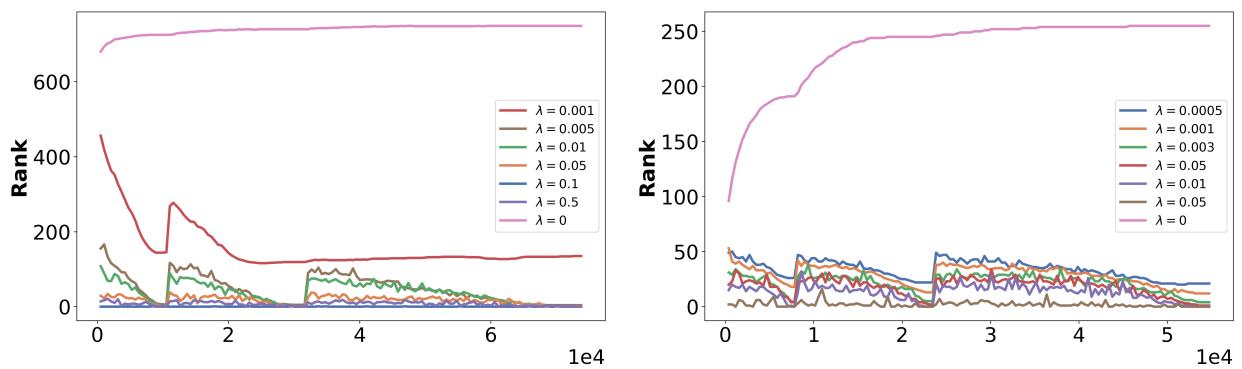
As shown in Figure 3, as the weight decay parameter \(\lambda\) increases (moving from pink lines to blue/green lines), the rank of the converged solution drops dramatically. This confirms that finding a low-rank solution is a natural outcome of regularized fine-tuning.
Validation 2: Can we force a “Loud Failure”?
To test the existence of the spurious minima predicted by their theorem, the authors tried to break LoRA. They compared standard Zero Initialization against a Large Random Initialization (initializing both \(A\) and \(B\) with large random values, placing the start point far from zero).
The results confirm the “Fail Loudly” theory:
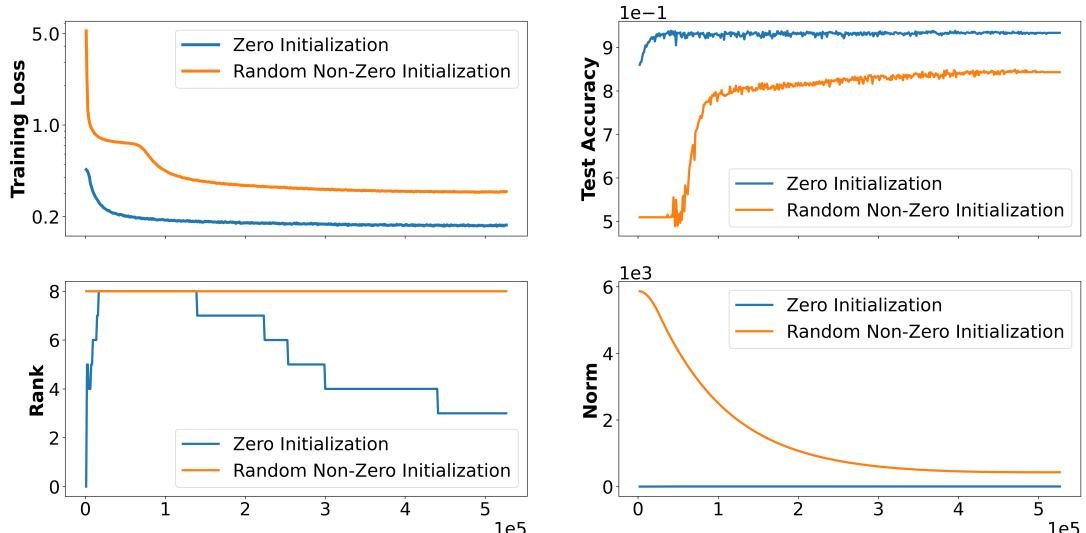
In Figure 2, look at the Blue line (Zero Initialization) versus the Orange line (Random Non-Zero Initialization):
- Top Left (Training Loss): Zero init converges to a low loss. Random init gets stuck at a much higher loss.
- Bottom Left (Rank): Zero init finds a solution with Rank ~1. Random init is stuck at the maximum Rank (8).
- Bottom Right (Norm): Zero init keeps the matrix norm small. Random init explodes the norm.
This is the dichotomy in action. The Random Initialization trapped the model in one of those outer, high-rank, high-norm “spurious” valleys depicted in Figure 1. It failed, and it failed “loudly”—the metrics clearly show something is wrong.
Conversely, the standard Zero Initialization (Blue line) successfully navigated to the low-rank, low-norm global minimum.
6. Conclusion
This paper bridges the gap between the empirical success of LoRA and our theoretical understanding of it. By moving away from simplified linearization and analyzing the true non-convex landscape, the authors provide a reassuring picture for practitioners.
Key Takeaways:
- The Landscape is Structured: LoRA doesn’t just work by luck. The loss landscape is set up such that bad local minima are distinct from good global minima.
- Bad Minima are Obvious: If LoRA fails, it won’t be subtle. You will see high ranks (if you check singular values) and large weight magnitudes.
- Standard Practice is Optimal: The default habits of the community—initializing \(B=0\) and using weight decay—are theoretically justified mechanisms that protect the training process from these failures.
So, the next time you fire up a LoRA fine-tuning run, you can rest easy. The math says it probably won’t fail—and if it does, you’ll definitely hear it.