](https://deep-paper.org/en/paper/2502.09416/images/cover.png)
If you have ever tried to grade an essay, you know it is subjective. Now, imagine trying to teach a computer to grade thousands of corrections for grammatical errors instantly. This is the challenge of Grammatical Error Correction (GEC) evaluation.
We rely on automatic metrics to tell us which AI models are best at fixing our grammar. We assume that if a metric gives Model A a higher score than Model B, then Model A is actually better. But often, when humans review the outputs, they disagree with the metric. Why does this happen?
A fascinating research paper, “Rethinking Evaluation Metrics for Grammatical Error Correction,” argues that the problem isn’t just the metrics themselves—it is the process we use to aggregate their scores. While humans rank systems by comparing them against each other (relative evaluation), automatic metrics typically just average out scores (absolute evaluation). This fundamental disconnect leads to inaccurate rankings.
In this deep dive, we will explore how researchers are rethinking GEC evaluation by forcing machines to play by human rules, revealing that even older evaluation metrics might be more powerful than we realized.
The Core Problem: A Tale of Two Processes
To understand the innovation of this paper, we first need to understand the status quo. There is a “gap” between how humans evaluate GEC systems and how computers do it.
How Humans Evaluate (Relative Evaluation)
When researchers want to know which GEC system is the best (the “Gold Standard”), they don’t usually assign a score of 0 to 100 for every single sentence. It is cognitively difficult for a human to look at a corrected sentence and say, “This is exactly an 87/100.”
Instead, humans perform pairwise comparisons. They look at the output of System A and System B side-by-side and decide which one is better, or if they are tied.
Once thousands of these face-offs are recorded, researchers use a rating algorithm—most commonly TrueSkill (the same algorithm used to rank players in online video games like Halo)—to calculate a leaderboard. This method creates a relative ranking based on wins, losses, and ties.
How Machines Evaluate (Absolute Evaluation)
Automatic metrics operate differently. Whether it’s an edit-based metric like ERRANT or a neural metric like BERTScore, the standard procedure is:
- Feed the system’s output into the metric.
- The metric spits out a score (e.g., 0.85) for that specific sentence.
- Calculate the average of all sentence scores to get a “corpus-level” score.
- Rank the systems based on these averages.
This seems logical, but it creates a methodological gap. We are comparing a leaderboard derived from relative skill ratings against a leaderboard derived from absolute averages.
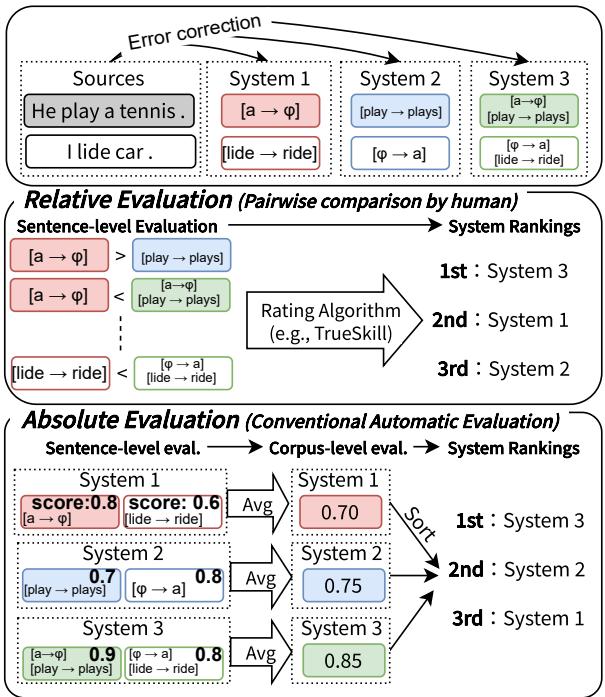
As illustrated in Figure 1, this difference matters.
- On the left (Human/Relative): Humans compare outputs directly. In the example, System 3 wins its matchups, leading to a 1st place ranking via TrueSkill.
- On the right (Automatic/Absolute): The machine assigns individual scores. System 3 gets an average of 0.85, putting it in 1st place in this specific toy example.
However, in real-world scenarios, these two methods often diverge. A system might have a high average score because it performs very well on easy sentences, but it might lose every direct comparison on difficult sentences. By averaging, we lose the nuance of the “matchup.” The authors of the paper hypothesize that if we want automatic metrics to correlate with human judgment, we should force the metrics to use the exact same aggregation method: TrueSkill.
The Proposed Method: Aligning the Process
The researchers propose a simple yet profound shift: stop averaging automatic scores. Instead, use automatic scores to simulate pairwise battles, and then run those results through TrueSkill.
Here is how the new Proposed Aggregation Method works:
- Sentence-Level Scoring: First, calculate the metric score for every sentence generated by every system, just like before.
- Simulated Pairwise Comparison: For a specific input sentence, look at the scores for System A and System B.
- If Score(A) > Score(B), record a “Win” for System A.
- If Score(A) < Score(B), record a “Win” for System B.
- If scores are equal, record a “Tie.”
- TrueSkill Aggregation: Feed these thousands of virtual wins and losses into the TrueSkill algorithm.
- Final Ranking: Generate the leaderboard based on the TrueSkill rating (\(\mu\)).
By doing this, the researchers eliminate the procedural gap. Both the human “Ground Truth” and the automatic prediction are now derived using the same mathematical framework. The only variable left is the quality of the metric itself.
Experimental Setup
To test if this method actually improves evaluation, the authors performed a meta-evaluation using the SEEDA benchmark. SEEDA is a dataset designed to check how well automatic metrics agree with human ratings.
They tested various types of metrics:
- Edit-based metrics (ERRANT, PT-ERRANT): These check if the system made specific edits (like changing “play” to “plays”) that match a reference.
- N-gram based metrics (GLEU+, GREEN): These look at overlapping sequences of words between the output and the reference.
- Sentence-level metrics (SOME, IMPARA, Scribendi): These use neural networks (like BERT) to assess the semantic quality and grammaticality of the sentence without necessarily needing a strict reference.
The goal? Compare the rankings produced by the standard “Averaging” method against the new “TrueSkill” method and see which one correlates better with actual human rankings.
Results: A Significant Improvement
The results were compelling. For most evaluation metrics, switching to the TrueSkill aggregation method significantly improved their correlation with human judgments.
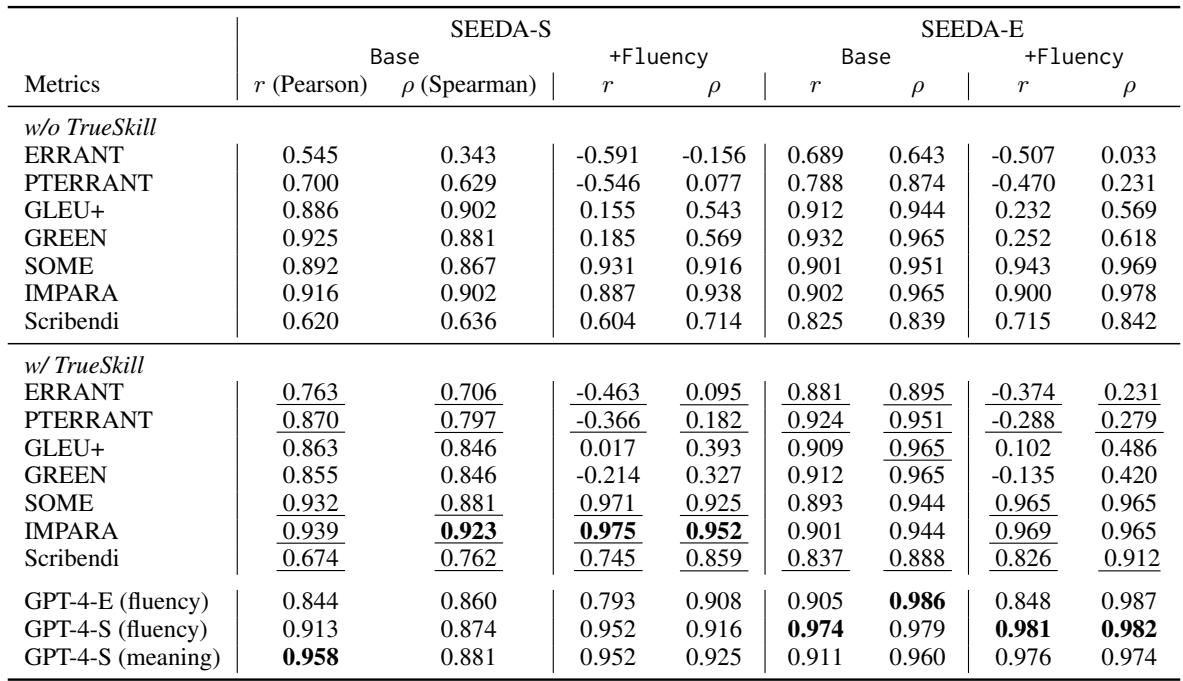
Take a look at Table 1 below. The top half shows the conventional method (averaging), and the bottom half shows the proposed method (TrueSkill).
Key Observations from the Data:
- Pearson Correlation Increase: Look at the column
SEEDA-S r (Pearson).
- ERRANT jumped from a correlation of 0.545 to 0.763.
- PT-ERRANT improved from 0.700 to 0.870.
- IMPARA improved from 0.916 to 0.939.
- Beating GPT-4: This is perhaps the most shocking result. Recently, Large Language Models like GPT-4 have been touted as the best way to evaluate other models. However, looking at the
SEEDA-Scolumn, the metric IMPARA (using the TrueSkill method) achieved a Pearson correlation of 0.939, which is higher than GPT-4-S (fluency) at 0.913.
- Implication: We don’t necessarily need massive, expensive LLMs to evaluate grammar correction. Smaller, specialized metrics like IMPARA can be state-of-the-art if we simply use the correct aggregation method.
- The N-gram Exception: You might notice that GLEU+ and GREEN (the n-gram metrics) did not improve; in fact, some got slightly worse.
- Why? The paper explains that metrics like GLEU+ use a “brevity penalty”—they harshly penalize short sentences. In an absolute averaging system, this is just one low number mixed into the average. But in a pairwise comparison, a brevity penalty might cause a system to lose a “matchup” it should have won, simply because the sentence was short. This flaw in the metric becomes magnified when using TrueSkill.
Analyzing Robustness: The Window Analysis
Correlation across the whole dataset is good, but does the metric work for the best systems? Sometimes a metric is good at distinguishing a terrible system from a mediocre one, but fails to tell the difference between two excellent systems.
To test this, the authors used Window Analysis. They looked at correlations for specific “windows” of rankings (e.g., only the top 8 systems, or systems ranked 2nd to 9th).
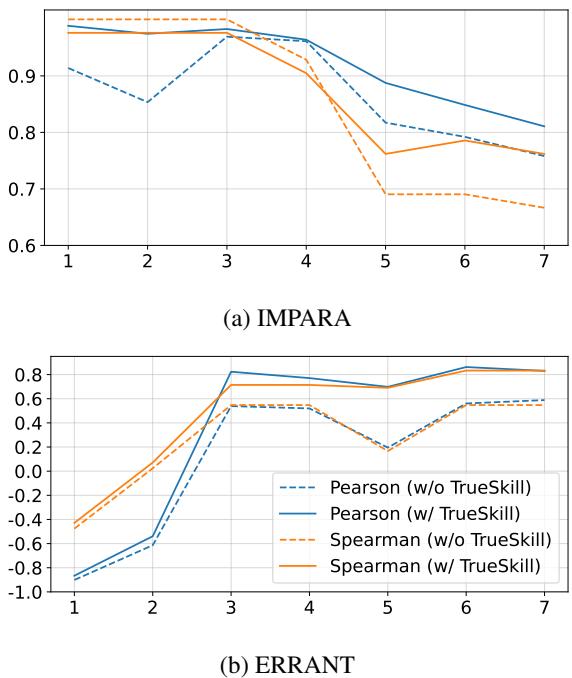
Figure 2 visualizes this robustness.
- Graph (a) IMPARA: The lines remain relatively high and stable. This indicates that IMPARA is reliable across the board. Whether you are comparing mid-tier models or top-tier models, using TrueSkill (the dashed lines) generally yields high agreement with humans.
- Graph (b) ERRANT: This graph tells a different story. While TrueSkill (dashed lines) helps ERRANT perform better than the baseline (solid lines), the correlation drops significantly as we move to the right (higher \(x\) values). This means ERRANT struggles to rank the very best systems.
- Why? Top-tier GEC systems often rewrite sentences extensively to make them sound more fluent. Edit-based metrics like ERRANT are rigid—they look for specific word changes. If a system rewrites the whole sentence correctly, ERRANT might punish it because it doesn’t match the specific “edits” in the reference.
Conclusion and Future Implications
This research highlights a crucial lesson for Data Science and NLP: The algorithm you use to aggregate your data is just as important as the data itself.
By simply changing the evaluation procedure from “Averaging” to “TrueSkill,” the researchers proved that:
- Existing metrics (like ERRANT and IMPARA) were being underestimated.
- Specialized BERT-based metrics can arguably outperform GPT-4 in evaluation when given the right statistical framework.
- The gap between human and machine evaluation is partially artificial—created by different processing methods rather than just a lack of model understanding.
What does this mean for the future?
The authors strongly recommend that future GEC benchmarks adopt TrueSkill (or whichever rating algorithm humans are using) for automatic metrics. If humans decide to switch to averaging in the future, machines should switch to averaging. The key is alignment.
Furthermore, this encourages the development of metrics specifically designed for pairwise comparison. If we know the final score will be determined by “System A vs. System B,” we should train evaluator models to predict that specific preference, rather than training them to output an arbitrary absolute score.
For students and researchers entering the field, this is a reminder: always question the standard operating procedure. sometimes, the key to better results isn’t a bigger model, but a smarter process.