](https://deep-paper.org/en/paper/2502.09829/images/cover.png)
In the world of modern robotics, training a policy is only half the battle. The other half—and often the more expensive half—is figuring out if it actually works.
Imagine you have trained a robot to perform household chores. It can pick up a cup, open a drawer, and wipe a table. But can it pick up a red cup? Can it open a stuck drawer? To be sure, you need to test it. Now, imagine you have five different versions of this robot software (policies) and fifty different tasks. That is 250 unique combinations. If you run each combination 10 times to get statistically significant results, you are looking at 2,500 physical experiments.
In computer vision, running 2,500 tests takes seconds. In robotics, it requires a human to reset the scene, move objects, and reboot systems. It is prohibitively expensive.
This blog post explores a recent research paper, “Efficient Evaluation of Multi-Task Robot Policies With Active Experiment Selection,” which proposes a smarter way to handle this bottleneck. Instead of testing everything randomly, the researchers treat evaluation as an active learning problem, prioritizing experiments that give the most information for the lowest cost.
The Problem: The Combinatorial Explosion
The core issue is the “physicality” of robotics. Unlike software evaluations that run in the cloud, robot evaluation consumes real-world time and physical effort.
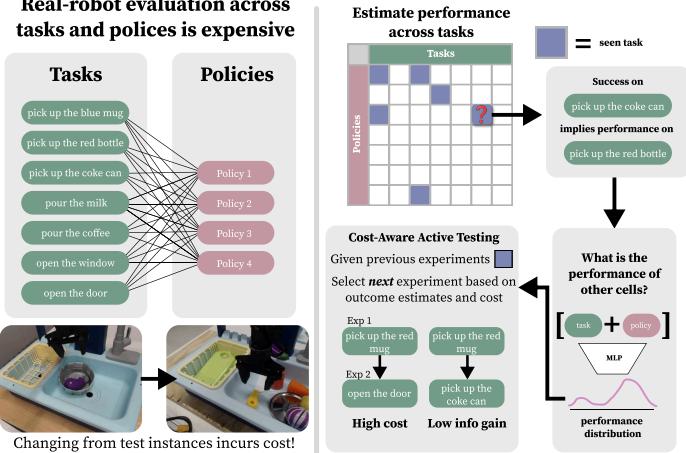
As shown in Figure 1, blindly evaluating every policy on every task is inefficient. However, tasks often share structures. If a robot effectively picks up a Coke can, it is highly probable it can also pick up a red bottle. These tasks are semantically and physically similar.
The researchers argue that we can exploit these latent relationships. By modeling the performance distribution across all tasks and policies, we can intelligently select which experiment to run next, drastically reducing the total effort required to understand a robot’s capabilities.
The Solution: Active Testing
The authors formulate robot evaluation as a Population Parameter Estimation problem. Rather than just calculating a simple success rate (e.g., “60% success”), they aim to learn the underlying probability distribution of outcomes for every policy-task pair.
They introduce a framework consisting of two main components:
- A Surrogate Model: A neural network that predicts how well a specific policy will perform on a specific task.
- Active Experiment Selection: A strategy to pick the next experiment based on what the surrogate model is currently unsure about, while factoring in the cost of running that test.
1. The Surrogate Model
To predict performance, the system needs to understand what a “task” and a “policy” are. The authors use an architecture where both the policy and the task are converted into vector embeddings. These embeddings are fed into a Multi-Layer Perceptron (MLP) which outputs the parameters of a distribution (like the mean and variance of a Gaussian for continuous rewards, or a success probability for binary outcomes).
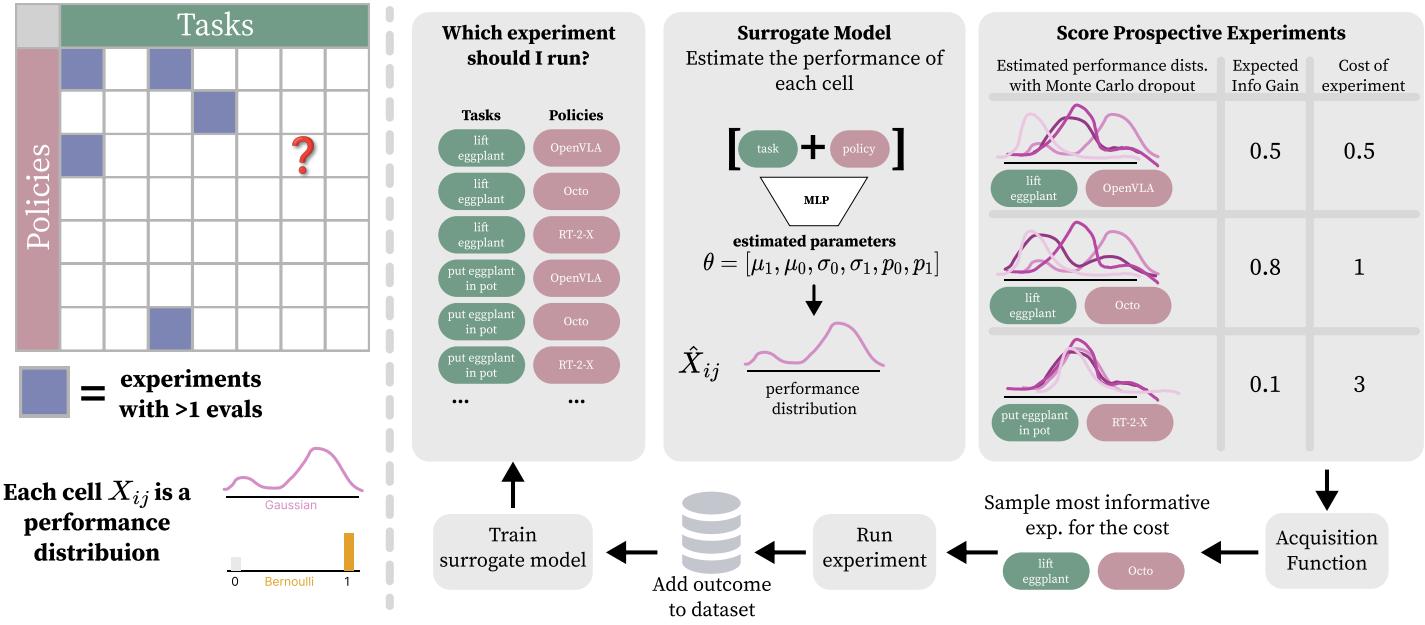
The Power of Language A key contribution of this paper is how they represent tasks. They found that using Natural Language Processing (NLP) embeddings allows the model to generalize between tasks. However, not all words are created equal.
In robotics, the verb usually dictates the dynamics of the task (e.g., “lift,” “push,” “open”), while the noun dictates the object. The researchers discovered that standard language embeddings often focus too much on nouns. To fix this, they constructed a task embedding that heavily weights the verb:
\[ e _ { T _ { j } } = 0 . 8 \cdot e _ { T _ { j } } ^ { \mathrm { v e r b } } + 0 . 2 \cdot e _ { T _ { j } } ^ { \mathrm { t a s k } } + 0 . 1 \cdot \mathcal { N } ( 0 , 1 ) . \]As seen in the equation above, the embedding \(e_{T_j}\) is a weighted sum of the verb embedding and the full task description, plus a small noise term to help separate semantically similar tasks in the vector space. This allows the model to understand that “picking up an apple” is mechanically similar to “picking up a ball.”
2. Cost-Aware Experiment Selection
Once the surrogate model can predict outcomes, the next step is deciding which experiment to run. The goal is to maximize Expected Information Gain (EIG). In simple terms, we want to run the experiment that will most reduce the model’s confusion about the robot’s overall capabilities.
However, in the real world, information isn’t the only factor—cost is critical. Switching tasks (e.g., clearing a table to set up a door-opening task) is much more expensive than repeating the current task.
The authors propose a Cost-Aware Acquisition Function:
\[ a _ { \mathrm { c o s t - a w a r e } } ( \pi _ { i } , T _ { j } , T _ { \mathrm { c u r r e n t } } ) = \frac { \mathbb { Z } ( \pi _ { i } , T _ { j } ) } { ( \lambda \cdot c _ { \mathrm { s w i t c h } } ( T _ { \mathrm { c u r r e n t } } , T _ { j } ) ) + 1 } , \]Here is how to read this equation:
- The numerator, \(\mathbb{Z}(\pi_i, T_j)\), represents the information gain (how much we learn).
- The denominator includes the cost of switching from the current task (\(T_{current}\)) to the new task (\(T_j\)).
- \(\lambda\) is a hyperparameter controlling how much we care about cost.
If a potential experiment offers high information gain but requires a very expensive scene change, the score drops. The system will favor informative experiments that are “nearby” or cheap to execute, only switching contexts when the information gain is massive.
Experimental Setup
To validate this approach, the researchers used offline datasets from real-world and simulated robot evaluations. This allows them to simulate the active learning process without physically running thousands of hours of robot time for the paper itself.
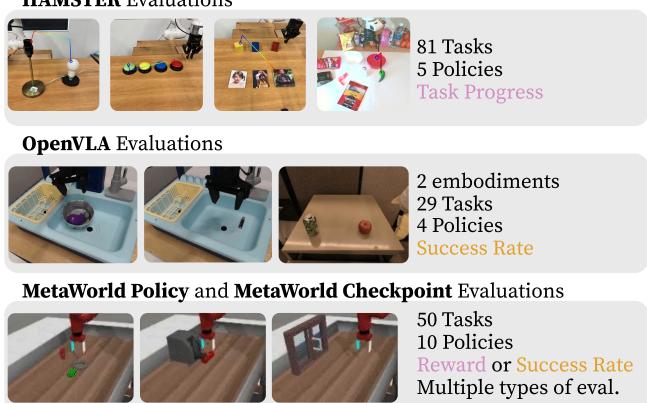
They tested on three distinct domains shown in Figure 3:
- HAMSTER: High diversity with 81 tasks and 5 policies.
- OpenVLA: 29 tasks across different robot embodiments (types of robot arms).
- MetaWorld: A standard simulation benchmark where they could extensively test both different policies and different checkpoints of a single policy.
Key Results
Does Language Help?
First, the authors analyzed if their specific “Verb-heavy” embedding strategy actually helped the surrogate model learn faster.
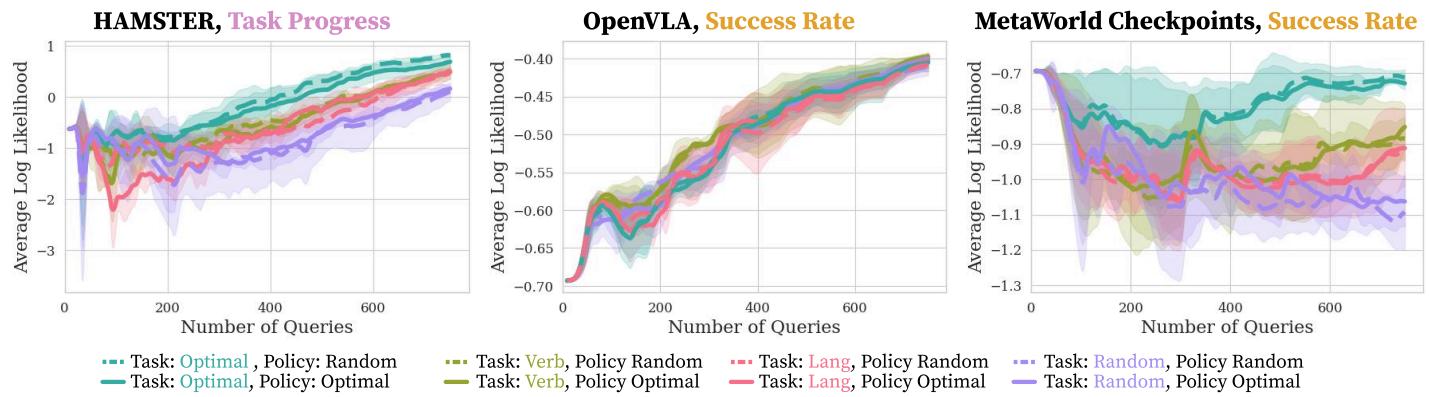
Figure 4 shows the log-likelihood (a measure of how well the model predicts the data) over time. The “Verb” representation (green lines) consistently outperforms standard language embeddings and random embeddings. This confirms that focusing on the action (the verb) provides a strong prior for predicting robot performance.
Is it Cost-Efficient?
The most critical question is whether this method saves effort. The researchers compared their cost-aware EIG method against random sampling (the standard way people evaluate robots today).
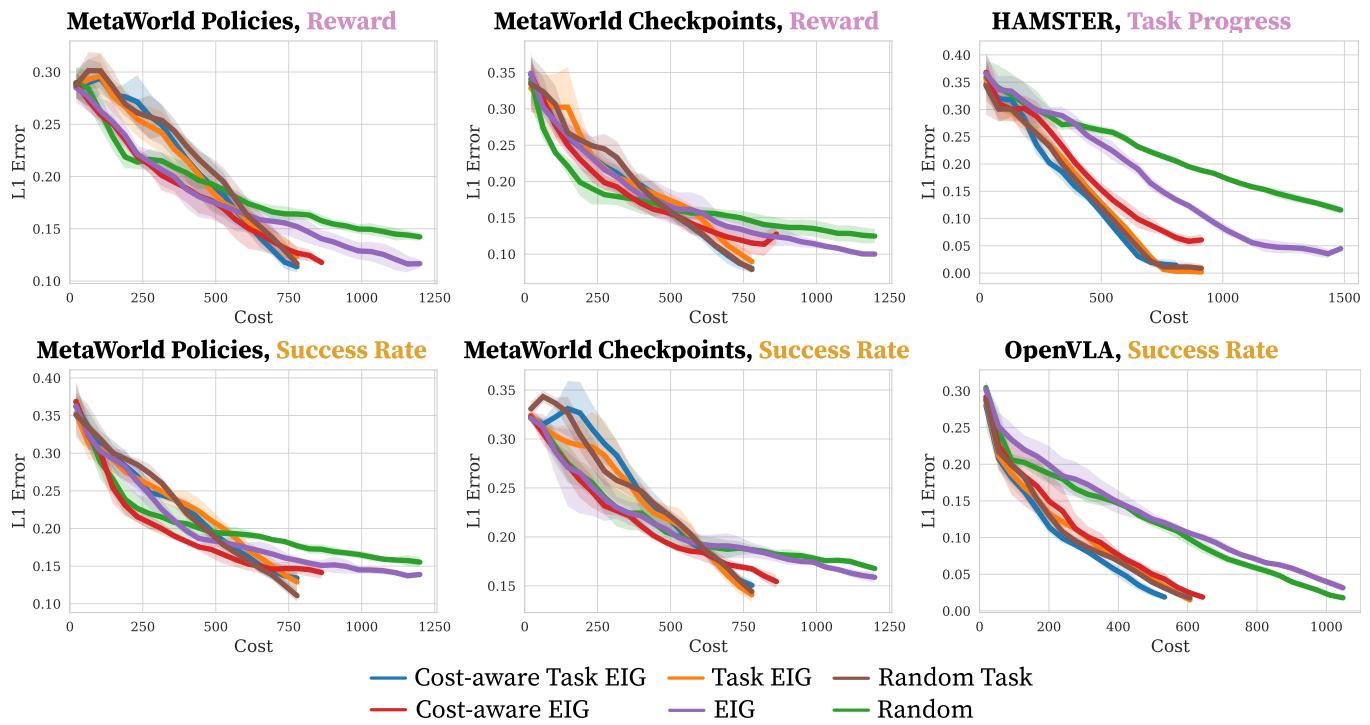
In Figure 6, we look at the L1 Error, which measures the difference between the predicted performance mean and the ground truth.
- Lower is better.
- Left is better (lower cost).
- The Cost-aware Task EIG (blue line) drops rapidly, meaning it estimates the true performance of the robot very quickly with minimal “expenditure.”
- Random sampling (brown/green lines) requires significantly more cost to reach the same level of accuracy.
Visualizing the Learning Process
To make this concrete, we can visualize the surrogate model’s “brain” as it runs. Figure 7 shows heatmaps of the predicted performance across tasks and policies.
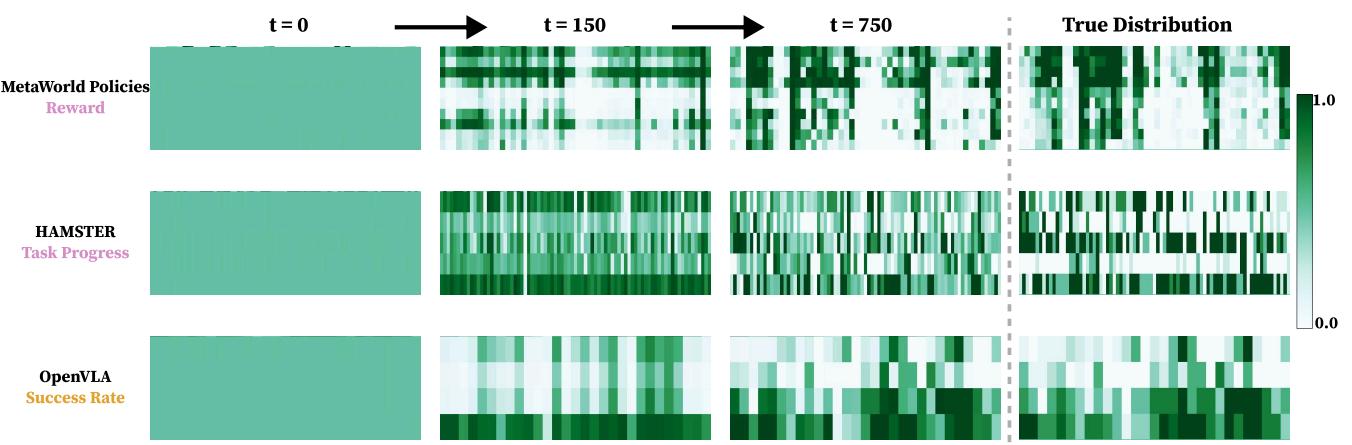
- At t=0: The model knows nothing; the map is uniform.
- At t=150: Patterns begin to emerge. The model starts to realize some tasks are harder than others.
- At t=750: The predicted map looks strikingly similar to the True Distribution (far right), despite only sampling a fraction of the possible experiments.
Conclusion and Takeaways
This paper highlights a crucial shift in robotics: moving from “brute force” evaluation to “intelligent” evaluation. By treating the evaluation phase as a learning problem in itself, researchers can save vast amounts of time and resources.
Key Takeaways:
- Structure exists: Robot tasks are not independent. Success on one predicts success on another.
- Language is a bridge: Using verb-focused embeddings helps transfer knowledge between tasks.
- Cost matters: incorporating the physical cost of switching tasks into the selection algorithm drastically improves efficiency.
As robot policies become more general and capable of performing hundreds of tasks, methods like this will become standard practice to ensure we can verify their safety and reliability without needing an army of human supervisors running experiments 24/7.