](https://deep-paper.org/en/paper/2502.10392/images/cover.png)
Introduction: The “Where is it?” Problem in Robotics
Imagine you are asking a home assistance robot to “pick up the red mug on the table to the left.” For a human, this is trivial. For a machine, this is a complex multi-modal puzzle known as 3D Visual Grounding (3DVG). The robot must parse the natural language command, perceive the 3D geometry of the room (usually via point clouds), understand the semantic relationships between objects (table, mug, left, right), and pinpoint the exact bounding box of the target.
While accuracy in this field has improved dramatically in recent years, one major bottleneck remains: Speed.
Most state-of-the-art methods are too slow for real-time applications like robotics or Augmented Reality (AR). They either rely on a slow two-stage process (detect everything first, then match) or computationally heavy point-based sampling methods.
In this deep dive, we are looking at a paper that proposes a solution: TSP3D (Text-guided Sparse Voxel Pruning). This new single-stage framework achieves a massive leap in inference speed—surpassing previous fastest methods by over 100%—while simultaneously achieving state-of-the-art accuracy.
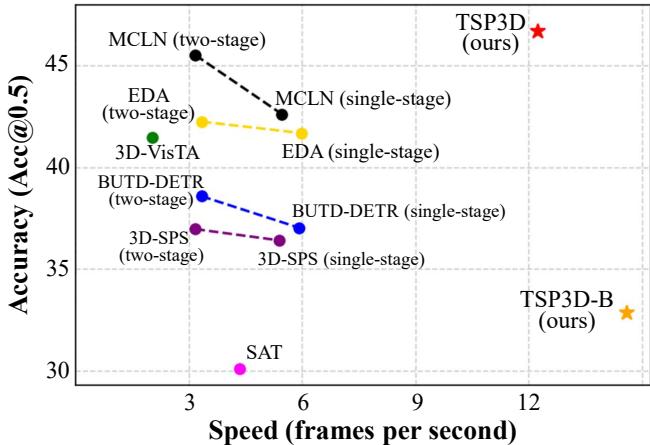
As shown above, TSP3D breaks the traditional trade-off curve, pushing into the top-right quadrant of high accuracy and high frames-per-second (FPS). Let’s explore how the researchers achieved this.
Background: Why is 3DVG so Slow?
To understand the innovation of TSP3D, we first need to understand the inefficiencies of current approaches.
1. Two-Stage vs. Single-Stage
Early 3DVG methods adopted a two-stage framework.
- Detection Stage: Run a 3D object detector to find every object in the room.
- Matching Stage: Compare every detected object with the text query to find the best match.
This is redundant. The detector spends resources identifying the ceiling, the floor, and the bookshelf behind you, even if the query is about a specific chair.
Single-stage methods attempted to fix this by integrating detection and grounding. However, they mostly rely on point-based architectures (like PointNet++). Point clouds are unstructured data. To process them, networks must perform “Furthest Point Sampling” (FPS) and k-Nearest Neighbor (kNN) searches repeatedly. These operations are computationally expensive and difficult to parallelize efficiently.
2. Point Clouds vs. Sparse Voxels
Point-based methods also suffer from a resolution problem. To keep calculations manageable, they aggressively downsample the scene (e.g., reducing 50,000 points to 1,024). This often destroys the geometric details of small or thin objects.
The alternative—popular in standard 3D object detection but rarely used in grounding—is Sparse Voxel Convolution.
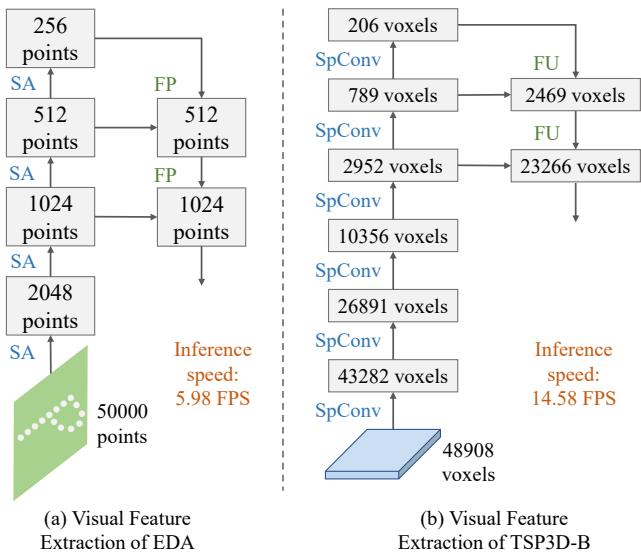
As illustrated in Figure 6, sparse voxel architectures (right) can maintain a much higher resolution than point-based architectures (left) while actually being faster to compute, thanks to optimized sparse libraries.
So, why hasn’t everyone switched to Sparse Voxels for Visual Grounding? The challenge is the sheer volume of data. In visual grounding, we need to fuse the 3D scene features with the text features. Ideally, we use mechanisms like Cross-Attention. However, a high-resolution voxel grid contains vastly more elements than a downsampled point set. Running complex attention mechanisms on tens of thousands of voxels is computationally prohibitive.
This is the specific problem TSP3D solves: How do we use high-resolution sparse voxels for accuracy, without the massive computational cost of fusing them with text?
The Core Method: TSP3D
The researchers propose a single-stage, multi-level sparse convolutional architecture. The central idea is “Pruning.” Instead of processing the entire scene at full resolution, the network uses the text query to identify and remove (prune) irrelevant voxels early in the process.
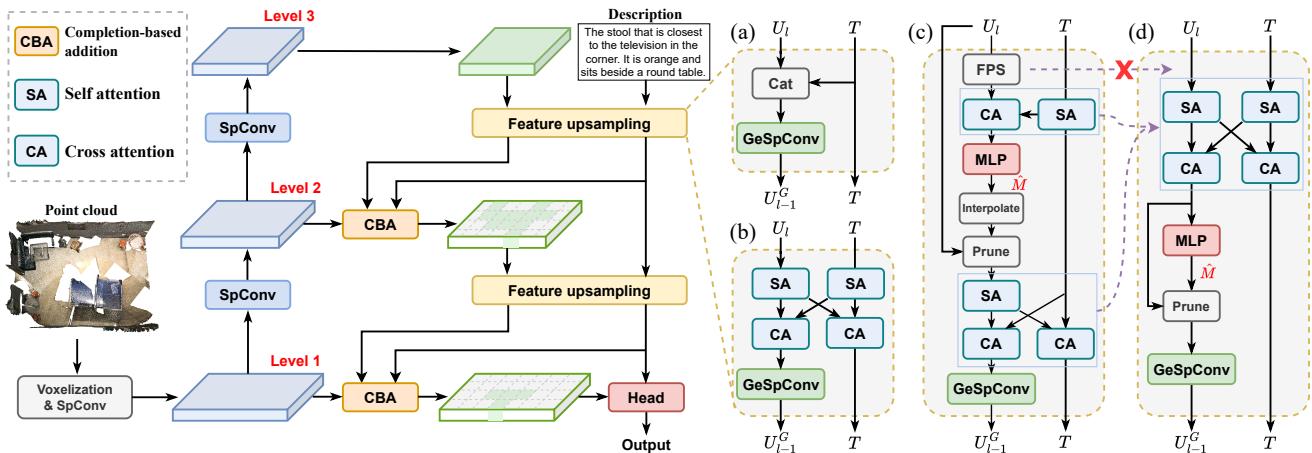
The architecture, shown in Figure 2, consists of a backbone that extracts features at three different levels (resolutions). The magic happens during the upsampling process, where the low-resolution features are refined. This process relies on two novel components:
- Text-Guided Pruning (TGP): efficiently removing irrelevant data.
- Completion-Based Addition (CBA): fixing mistakes if we pruned too much.
1. Text-Guided Pruning (TGP)
The goal of TGP is to reduce the number of voxels so that we can afford to run heavy cross-modal attention layers. TGP operates on the intuition that if the query is “the chair,” we can safely discard voxels belonging to walls, floors, or tables as we process the scene.
The TGP module works in two stages:
- Scene-level Pruning: Occurs at higher levels (Level 3 to 2). It distinguishes objects from the background.
- Target-level Pruning: Occurs at lower levels (Level 2 to 1). It focuses specifically on the target and objects mentioned in the text (referential objects).
How it works: Instead of running attention on the full voxel grid, TGP first creates a “pruning mask.”
- The system takes the voxel features and interacts them with the text features (using Cross-Attention).
- A small Neural Network (MLP) predicts a probability score for each voxel: “Is this voxel relevant to the text?”
- If the score is below a threshold, the voxel is removed (masked out).
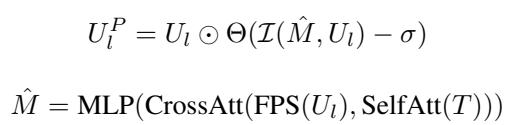
As defined in the equation above, the pruned features \(U_l^P\) are the result of applying a binary mask (derived from the text-voxel interaction) to the original features.
The Result of Pruning: By the time the network reaches the final prediction layers, the voxel count is reduced to nearly 7% of its original size. This massive reduction allows the network to use powerful feature fusion techniques without blowing up the GPU memory or killing the frame rate.

Figure 4 visually demonstrates this. Notice how the scene starts full (top row), but after scene-level and target-level pruning, the remaining voxels (bottom row) cluster tightly around the target object (the blue box).
2. Completion-Based Addition (CBA)
Pruning is risky. What if the network misunderstands the text or the geometry and accidentally deletes part of the target object? For example, pruning might remove the legs of a chair because they look like thin noise, leaving only the seat. This would make accurate bounding box regression impossible.
To solve this, the authors introduce Completion-Based Addition (CBA).
In a standard U-Net architecture, upsampled features are usually combined with features from the backbone (skip connections) via addition or concatenation. The authors realized they could use this step to “repair” the over-pruning.
The Logic of CBA: CBA compares the pruned features with the original backbone features. It identifies “missing” regions—areas that exist in the backbone, are likely relevant to the target, but are missing from the pruned set.
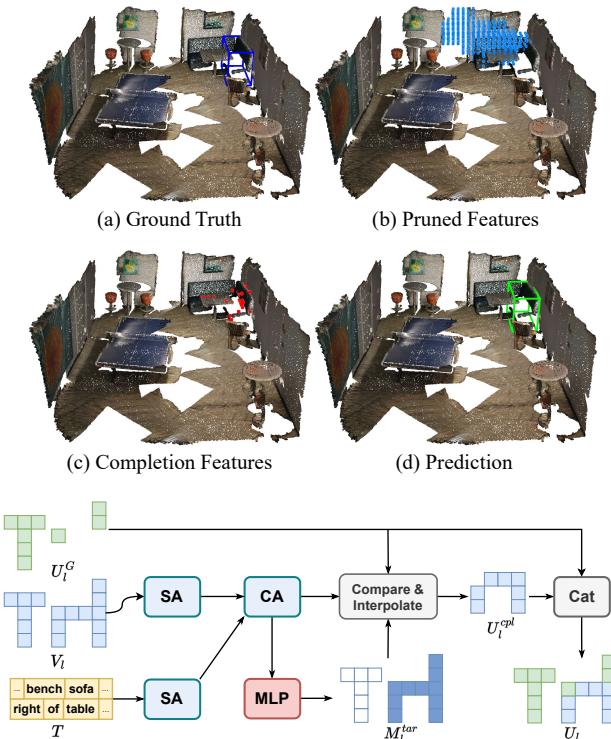
As shown in Figure 3, if the pruning step creates a gap (panel b), CBA looks at the ground truth/backbone data and fills that gap back in (panel c).
The CBA Algorithm:
- Relevance Check: The backbone features \(V_l\) interact with the text to predict a “Target Mask” (\(M^{tar}\)). This tells us where the target should be based on the raw, unpruned data.
- Missing Detection: The system compares this Target Mask with the current Pruned Features.
 The mask \(M^{mis}\) represents voxels that are targets but are not in the current feature set.
 - Completion: The system interpolates features for these missing voxels and adds them back into the main stream.
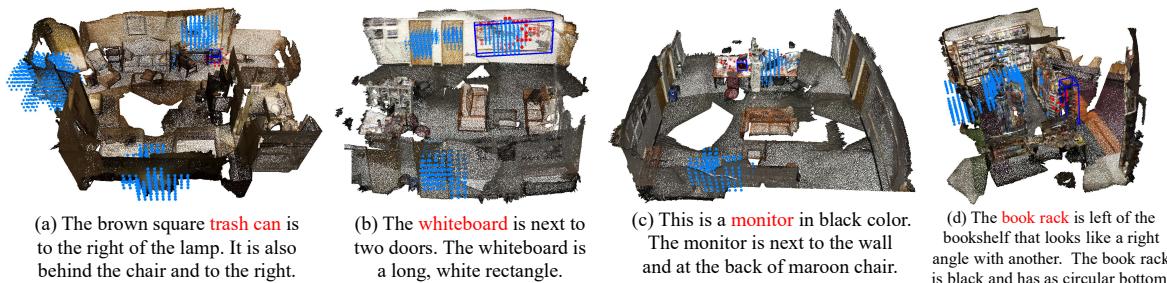
Figure 5 shows CBA in action. The blue points are the pruned features. The red points are the features CBA decided to add back. Notice in example (b) (the whiteboard) and (c) (the monitor), the pruning was too aggressive, leaving gaps. CBA successfully identified the missing geometry and filled it in, ensuring the final bounding box covers the whole object.
Experiments and Results
The researchers evaluated TSP3D on standard datasets: ScanRefer, Nr3D, and Sr3D.
Quantitative Performance
The results show that TSP3D dominates in both metrics that matter: Accuracy and Speed.

On the ScanRefer dataset (Table 1), TSP3D achieves an [email protected] of 46.71%, beating the previous best single-stage method (MCLN) and even outperforming complex two-stage models.
More impressively, look at the Inference Speed column.
- Previous best single-stage methods: ~5 to 6 FPS.
- Two-stage methods: ~2 to 3 FPS.
- TSP3D: 12.43 FPS.
This is a massive jump, effectively doubling the speed of the nearest competitor.
We can look deeper into why it is so fast by breaking down the computational cost per component:
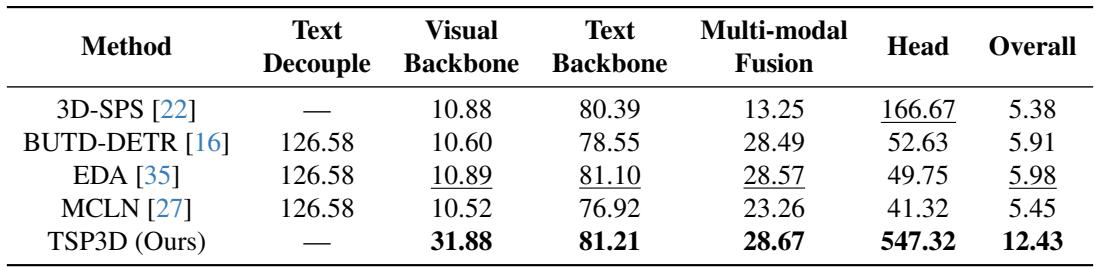
Table 6 reveals that the Visual Backbone of TSP3D runs at 31.88 FPS, compared to ~10 FPS for point-based backbones used by other methods. This validates the choice of sparse voxel convolution over point-based sampling.
Qualitative Comparison
Does the math translate to better visual results? Yes.
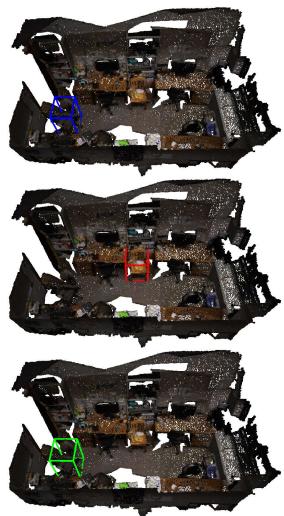
In Figure 7, we see TSP3D (Green boxes) compared to a strong competitor, EDA (Red boxes).
- In row (b), the target is a specific chair. EDA fails to localize it correctly, likely confused by the clutter. TSP3D finds it precisely.
- In row (c), the query is about a specific category (document organizer). EDA misclassifies or mislocates, while TSP3D captures the correct object.
The ability to maintain high resolution through sparse voxels allows TSP3D to distinguish between similar-looking objects and capture fine details that point-based methods blur out.
Conclusion
The paper “Text-guided Sparse Voxel Pruning for Efficient 3D Visual Grounding” presents a significant step forward for 3D perception. By moving away from point-based architectures and embracing Sparse Voxel Convolution, the authors unlocked raw speed.
However, speed usually comes at the cost of processing capability. The researchers overcame this by implementing Text-Guided Pruning (TGP), which intelligently discards the majority of the scene that isn’t relevant to the user’s command. To ensure this efficiency didn’t hurt accuracy, they added a safety net: Completion-Based Addition (CBA), which heals the 3D representation where pruning cuts too deep.
Key Takeaways:
- Sparse Voxels > Points: For 3D Visual Grounding, sparse voxels offer a better balance of resolution and speed than point clouds.
- Pruning is Powerful: You don’t need to process the whole room to find a single cup. Pruning irrelevant data early saves massive computational resources.
- Real-Time is Possible: TSP3D is the first framework to realistically enable real-time 3D visual grounding (>12 FPS) without sacrificing accuracy.
This work sets a new baseline for future research in embodied AI and robotics, proving that we don’t have to choose between a robot that understands us well and a robot that understands us quickly.