](https://deep-paper.org/en/paper/2502.13487/images/cover.png)
In the rapidly evolving world of Artificial Intelligence, we have become accustomed to models that can write poetry, code, and even describe images with uncanny accuracy. Large Vision-Language Models (LVLMs), like GPT-4V or Llama-Vision, have revolutionized how machines perceive the world. However, there is a distinct gap between generating content and evaluating it.
Creating a model that can generate a caption for an image is one thing; creating a model that can look at five different captions and robustly judge which one is the most helpful, accurate, and safe is entirely different. This is the domain of Reward Models (RMs), the silent engines behind the Reinforcement Learning from Human Feedback (RLHF) process that aligns AI with human intent.
Building these judges for multimodal tasks is notoriously difficult and expensive because it requires massive datasets of human preferences (e.g., “Image A matches Text B better than Text C”). But what if we didn’t need to train a new model from scratch? What if we could take a model that understands images, and a separate model that understands human textual preferences, and simply… mash them together?
This is the premise of the research paper “Transferring Textual Preferences to Vision-Language Understanding through Model Merging.” The researchers explore a fascinating, training-free approach to create powerful Vision-Language Reward Models (VLRMs) by merging the weights of existing models.
In this post, we will tear down the methodology, the mathematics of model merging, and the surprising results that suggest 1 + 1 might actually equal 3.
The Problem: The High Cost of Judgment
To understand why this research is significant, we first need to look at the bottleneck in current multimodal AI development.
State-of-the-art models rely heavily on RLHF. To do RLHF, you need a Reward Model—a digital critic that scores the AI’s outputs. In the text-only domain, we have excellent Reward Models because we have abundance of text preference data.
However, Vision-Language Reward Models (VLRMs) are lagging behind. Why?
- Data Scarcity: Collecting data where humans rate image-text pairs is slow and expensive.
- Computational Cost: Training a VLRM from scratch requires massive compute resources.
- The “Judge” Gap: While LVLMs are good at answering questions about images, they are often poor “judges” of quality. They struggle to assign accurate scalar scores to generated content.
The researchers asked a pivotal question: Can knowledge derived from text-only preference data be transferred to LVLMs without additional training?
If successful, this would allow us to “download” the judging capabilities of a text-based model and “upload” them into a vision-based model, instantly giving it the ability to evaluate multimodal content.
The Solution: Model Merging
The proposed solution utilizes Model Merging. This is a technique where you combine the parameters (weights) of two different neural networks into a single model. This isn’t about running two models side-by-side (ensembling); this is about mathematically averaging their brains into one.
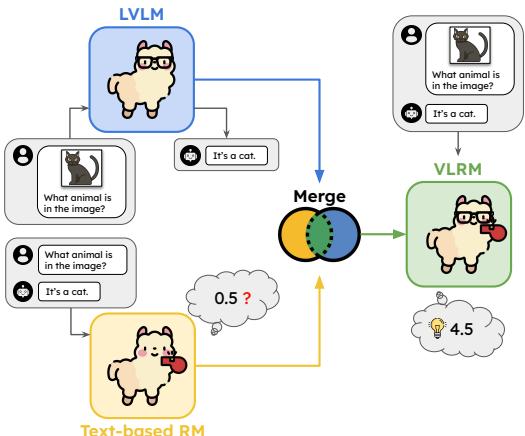
As illustrated in the framework above, the process involves two distinct source models:
- Text-based RM: A model trained to score text responses based on human preferences (the llama with the glasses on the left).
- LVLM: A model trained to understand and describe images (the standard llama).
By merging them, the researchers aim to create a VLRM (the llama with the pink bow) that possesses the visual understanding of the LVLM and the critical scoring capability of the RM.
Methodology: How to Build a Frankemodel
Model merging isn’t as simple as just adding two files together. The models must be homologous—meaning they must share a common architectural ancestry. In this paper, the researchers utilize the Llama-3.1 family. Because both the vision model (Llama-3.2-Vision) and the reward model (Tulu-2.5-RM) are derived from the same pre-trained Llama-3.1 base, their weight matrices are compatible.
1. Dissecting the Components
To merge the models successfully, we have to understand their anatomy.
The Pre-trained Base (\(\theta^{\mathrm{PRE}}\)): This is the common ancestor (Llama-3.1-8B). It consists of embeddings, transformer layers, and a language head.

The Text-based Reward Model (\(\theta^{\mathrm{RM}}\)): This model has been fine-tuned on text preferences. Crucially, it replaces the standard language head (which predicts the next word) with a Reward Head (\(\theta_{\mathrm{rm}}^{\mathrm{RM}}\)) that outputs a scalar score (good vs. bad).

The Large Vision-Language Model (\(\theta^{\mathrm{LVLM}}\)): This model has been fine-tuned on multimodal data. It includes a Vision Encoder and an Adapter to process images.
2. The Merging Architecture
The goal is to assemble a VLRM. We cannot merge every single part because the architectures aren’t identical (the RM doesn’t have eyes/vision encoders).
The merged model (\(\theta^{\mathrm{MERGE}}\)) is constructed by:
- Keeping the Vision components from the LVLM (\(\theta_{\mathrm{venc}}^{\mathrm{LVLM}}, \theta_{\mathrm{adapt}}^{\mathrm{LVLM}}\)). This ensures the new model can still “see.”
- Keeping the Reward Head from the RM (\(\theta_{\mathrm{rm}}^{\mathrm{RM}}\)). This ensures the new model can “judge.”
- Merging the Transformer Layers (\(\theta_{\mathrm{trans}}^{\mathrm{MERGE}}\)). This is where the magic happens—blending the reasoning capabilities of both parents.
- Merging Embeddings (\(\theta_{\mathrm{emb}}^{\mathrm{MERGE}}\)).

3. Merging Strategies
The paper explores four different mathematical strategies for combining the transformer weights.
Strategy A: Simple Weighted Averaging
This is the most intuitive approach. You simply take a weighted average of the weights from the LVLM and the RM.

Here, \(\lambda\) (lambda) is a hyperparameter between 0 and 1. If \(\lambda\) is 0.7, the resulting model is 70% LVLM and 30% RM. While simple, this method can sometimes dilute the specific capabilities of each model.
Strategy B: Task Arithmetic
This method is more sophisticated. It relies on the concept of Task Vectors. A task vector represents the “direction” a model’s weights moved during fine-tuning.
- \(\tau^{\mathrm{LVLM}}\) is the direction the model moved to learn vision.
- \(\tau^{\mathrm{RM}}\) is the direction the model moved to learn preferences.
By calculating these vectors relative to the pre-trained base (\(\theta^{\mathrm{PRE}}\)), we can add both “skills” to the base model simultaneously.
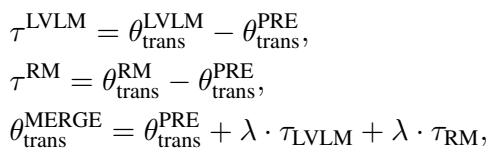
This assumes that the skills are additive and won’t cancel each other out.
Strategy C: Advanced Merging (TIES and DARE)
Sometimes, when you merge models, the parameters interfere with each other. One model might want a specific weight to be positive, while the other wants it negative. This is called interference.
To solve this, the researchers used TIES (Trimming, Electing, and Rescaling) and DARE (Drop And REscale).
- TIES: Resolves sign conflicts. It keeps only the parameter changes that agree on the direction (positive or negative) and discards the small, insignificant changes (trimming).
- DARE: Randomly drops a percentage of the delta parameters (differences from the base model) to reduce redundancy and then rescales the remaining ones to maintain the overall magnitude.

In this equation, \(f(\cdot)\) represents the filtering function of TIES or DARE, and \(d\) represents the density (how many parameters we keep).
Experiments and Results
The researchers tested their Frankenstein creations on rigorous benchmarks like VL-RewardBench, TextVQA, and MMMU-Pro. They compared the merged models against the original LVLM (Llama-3.2-Vision) and the original Text RM (Tulu-2.5-RM).
Main Results
The results were compelling. Merging the text-based reward model with the vision model consistently outperformed using either model individually.
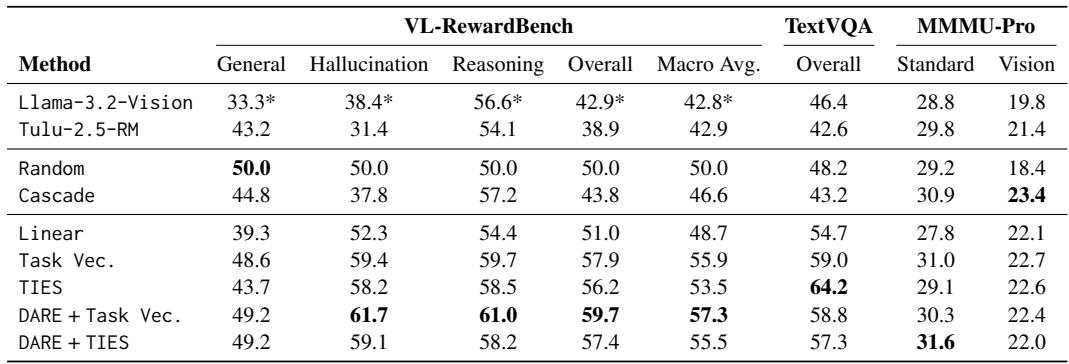
Key Takeaways from the Data:
- Baselines: The “Llama-3.2-Vision” (row 1) performs decently, but the Merged models (Rows 6-9) beat it significantly in Overall scores.
- Synergy: Look at the Overall column. The “Task Vec.” (Task Arithmetic) method achieved a score of 57.9, compared to 42.9 for the base LVLM. That is a massive jump in performance without any additional training.
- Strategy Matters: Advanced methods like DARE + Task Vec. performed exceptionally well, particularly in the “Hallucination” and “Reasoning” categories. This suggests that the model successfully retained the RM’s ability to spot hallucinations (lies) while keeping the LVLM’s ability to see.
Comparing to the Giants
Perhaps the most surprising result is how these merged models stack up against proprietary giants like GPT-4o and Gemini.
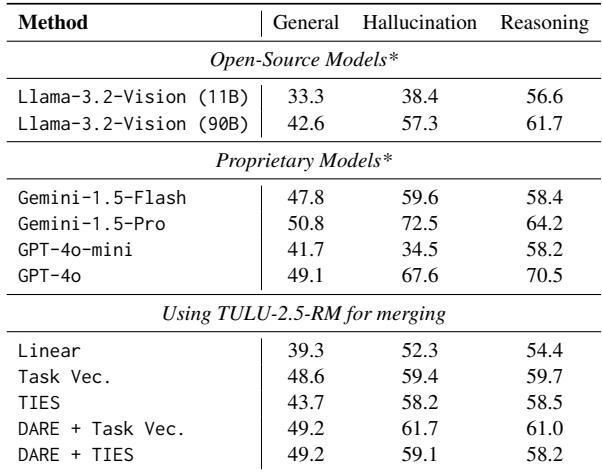
As shown above, the merged models (bottom rows) often outperform the 90B parameter version of Llama-3.2-Vision and achieve results competitive with Gemini-1.5-Pro in specific categories. This highlights the efficiency of the method: a smaller, merged model can punch well above its weight class.
Does the Vision Part Actually Work?
A skeptic might ask: “Is the model actually looking at the image, or is it just judging the text blindly?”
To test this, the authors ran an ablation study where they removed the image input.
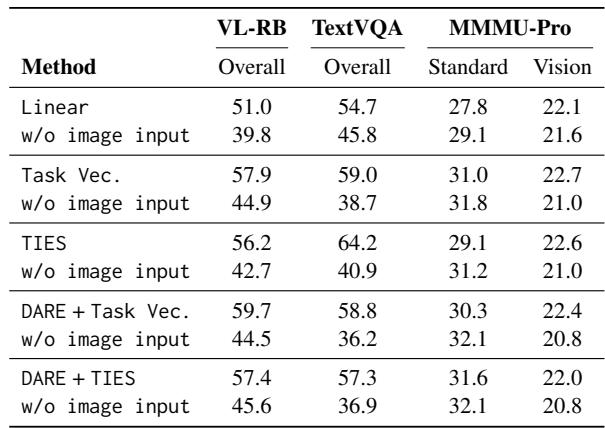
The rows labeled “w/o image input” show a significant drop in performance (e.g., Overall score dropping from 57.9 to 44.9 for Task Vec). This confirms that the Vision Encoder is active and the merged model is successfully synthesizing visual data with textual preference rules.
Qualitative Analysis: Seeing is Believing
Let’s look at a concrete example to understand why the merged model works better.
In the example below, the models are asked to evaluate two descriptions of a soccer game image.
- Response 1 is accurate.
- Response 2 hallucinates “goalposts” which are not visible in the image.
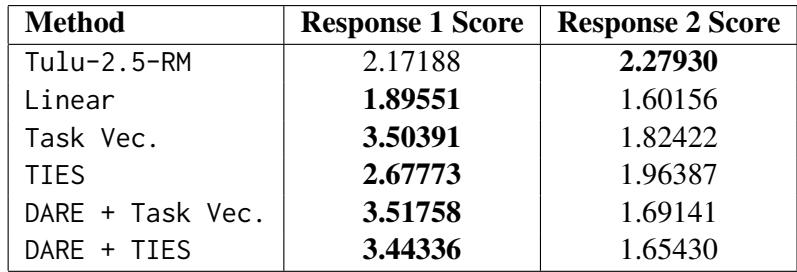
- Tulu-2.5-RM (The Text Only Model): It gave Response 2 a higher score (2.27 vs 2.17). Why? Because Response 2 is longer and mentions “goalposts,” which sounds semantically related to soccer. Without eyes, the text model falls for the hallucination.
- Task Vec / DARE (The Merged Models): These models correctly penalized Response 2 (lowering the score to ~1.6 or ~1.8) and rewarded the accurate Response 1 (scores ~3.5). The merger successfully transferred the “don’t hallucinate” preference from the text model and applied it to the visual reality seen by the vision model.
Hyperparameters: The Fine Tuning
Model merging isn’t magic; it requires tuning. The researchers analyzed how the mixing weight (\(\lambda\)) and the density (\(d\)) affected performance.
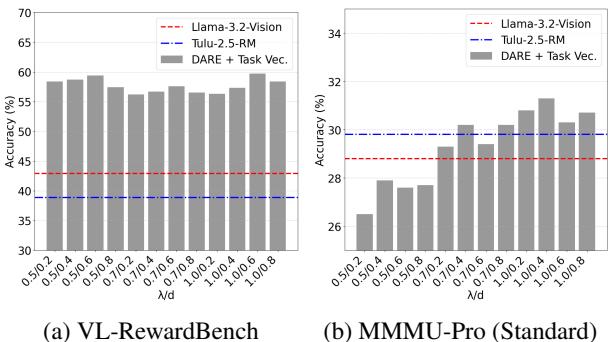
In the charts above, the gray bars represent the merged model.
- Left Chart (VL-RewardBench): The merged model outperforms the baselines (red and blue lines) across almost all hyperparameter settings.
- Right Chart (MMMU-Pro): Performance is more sensitive here. If \(\lambda\) (the contribution of the task vectors) is too low or too high, performance can dip. This indicates that finding the “sweet spot” where both visual and textual skills are balanced is crucial.
Conclusion and Implications
This paper presents a compelling argument for Model Merging as a resource-efficient alternative to training.
By taking a standard Vision-Language Model and merging it with a Text-Based Reward Model, the researchers created a Vision-Language Reward Model that:
- Outperforms its parents.
- Requires zero training (saving massive compute costs).
- Transfers complex preferences (like hallucination detection) from text to vision.
Why does this matter for students and researchers? It democratizes the creation of powerful evaluators. You don’t need a cluster of H100 GPUs to build a state-of-the-art multimodal judge; you might just need a CPU and the right merging script. It suggests that the “skills” learned by neural networks are more modular and transferable than we previously thought.
As we move toward more complex multimodal agents, the ability to Frankenstein different specialized models into a single, cohesive unit could be the key to rapid advancement. The future of AI might not just be about training bigger models, but about smarter ways of combining the ones we already have.