](https://deep-paper.org/en/paper/2502.16652/images/cover.png)
Imagine walking into a room and asking a robot, “Find the red mug near the sink.” To us, this is effortless. To a computer vision system, it requires bridging the gap between 2D visual data, 3D spatial geometry, and natural language. This is the challenge of Open-Vocabulary 3D Scene Understanding.
In recent years, 3D Gaussian Splatting (3DGS) has revolutionized how we represent 3D scenes. It offers high-quality rendering by representing scenes as millions of 3D Gaussian blobs. However, attaching semantic meaning (language) to these blobs has been a bottleneck. Existing methods rely on rendering 2D feature maps to “teach” the 3D model what it is looking at. This process is computationally expensive, slow to search, and often results in blurry or inaccurate semantic features.
In this post, we dive deep into Dr. Splat, a new research paper that proposes a method to “Doctor” these Gaussians. Dr. Splat bypasses the slow rendering process entirely, directly registering language embeddings onto 3D Gaussians and compressing them for lightning-fast search.
The Problem: The Discrepancy in Rendering
To understand why Dr. Splat is necessary, we first need to look at how current “Language-Embedded” 3DGS methods work. Typically, these methods take a pre-trained 2D vision-language model (like CLIP) and try to distill its knowledge into the 3D scene. They do this by rendering the 3D scene into 2D images, comparing those renderings to CLIP features, and using gradient descent to update the 3D parameters.
While this sounds logical, it introduces a significant problem: The Rendering Discrepancy.
When you distill features via rendering, the intermediate step distorts the data. The optimized embeddings inside the 3D Gaussians often drift away from the original, high-quality CLIP embeddings. Furthermore, searching for an object becomes a 2D image retrieval task (rendering views and looking for the object pixel-by-pixel) rather than a true 3D search.
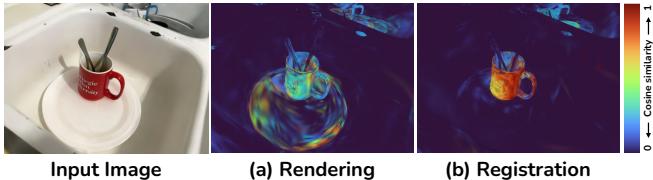
As shown in Figure 2 above, the difference is stark. On the left (a), traditional rendering-based distillation results in “blobs” of similarity that are somewhat accurate but fuzzy. On the right (b), Dr. Splat’s direct registration yields sharp, precise localization of the “cup,” specifically highlighting the handle and rim where the features are most distinct.
Background: 3D Gaussians and Language Fields
Before dissecting Dr. Splat, let’s briefly establish the mathematical foundation.
3D Gaussian Splatting (3DGS)
3DGS represents a scene as a collection of 3D Gaussians. Each Gaussian has a position, covariance (shape/rotation), opacity (\(\alpha\)), and color (\(c\)). To render an image, these Gaussians are projected onto a 2D plane and blended. The color \(\hat{\mathbf{c}}\) of a pixel is calculated as:

Here, \(T_i\) represents transmittance (how much light gets through previous Gaussians) and \(\alpha_i\) is the opacity.
Language Embedded 3DGS
To make the scene understand language, researchers replace the color vector \(c\) with a high-dimensional feature vector \(f\) (e.g., a 512-dimensional CLIP embedding). The rendering equation for a feature pixel \(\hat{\mathbf{f}}\) becomes:
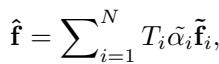
The standard approach is to optimize the 3D feature \(\tilde{\mathbf{f}}_i\) so that the rendered result \(\hat{\mathbf{f}}\) matches the CLIP features extracted from the input images. Dr. Splat argues that this optimization loop is where efficiency and accuracy go to die.
The Dr. Splat Method
The authors propose a framework that eliminates the need for per-scene optimization of language features. Instead of “learning” the features via gradient descent, Dr. Splat mechanically registers them directly onto the Gaussians and then uses Product Quantization to store them efficiently.
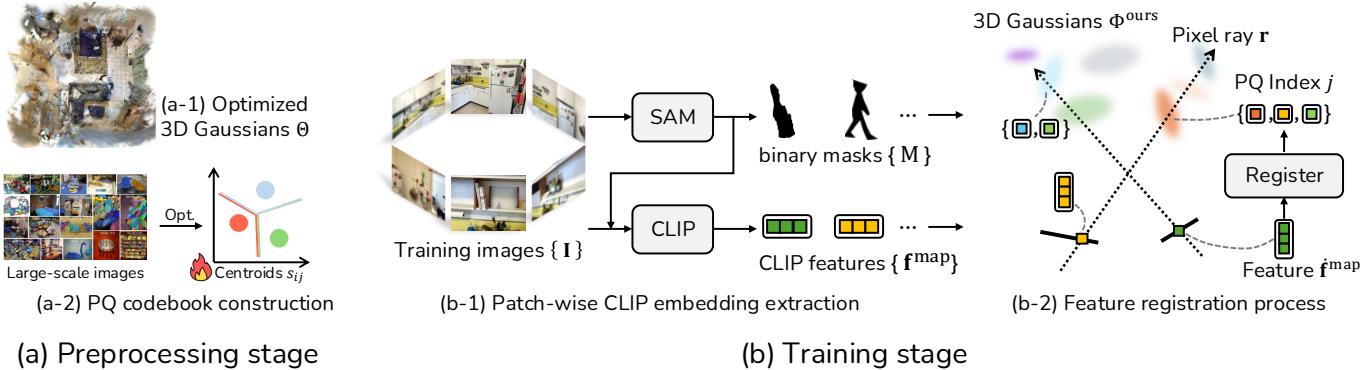
The overview above (Figure 3) outlines the two-stage pipeline:
- Preprocessing: Optimize the standard 3D Gaussians (geometry/color) and build a generic quantization codebook.
- Training: Extract CLIP embeddings from images and register them onto the Gaussians using a geometric voting scheme.
1. Direct Feature Registration
The core innovation is treating feature assignment as a geometric projection problem rather than an optimization problem.
First, the system extracts a semantic feature map \(\mathbf{F}^{\mathrm{map}}\) from the training images. This involves using Segment Anything Model (SAM) to get object masks and CLIP to get the feature vectors for those masked regions.

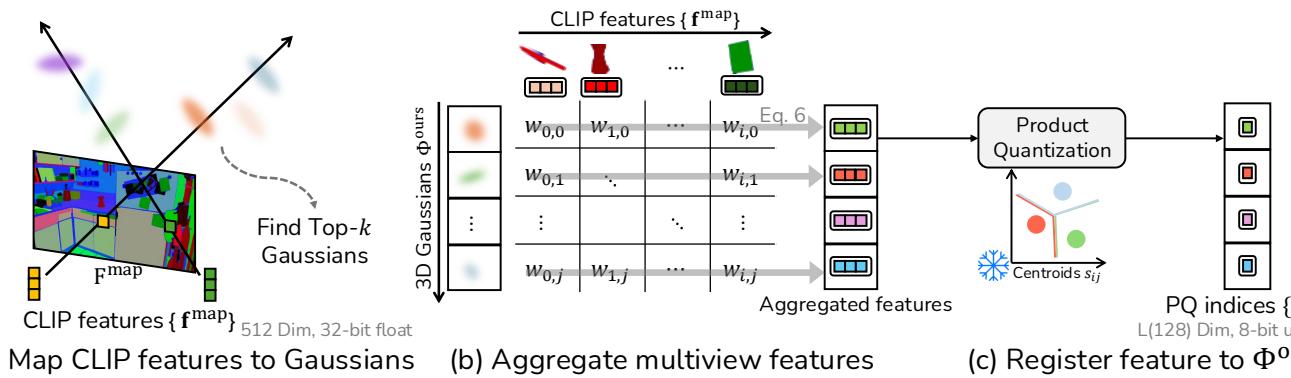
Once we have the per-pixel semantic features, we need to decide which 3D Gaussians are responsible for those pixels. The authors propose a “Top-k” strategy.
For a specific pixel in a training image, we shoot a ray into the scene. We look at the 3D Gaussians that intersect this ray. However, not every Gaussian on the ray matters—some are transparent or occluded. We calculate a weight \(w_i\) for each Gaussian based on its contribution to that pixel:

We only select the Top-k Gaussians with the highest weights along that ray. These are the “dominant” Gaussians that actually form the visible surface of the object.
Next, we aggregate these weights across all training images. If a Gaussian is visible in multiple images (views), it will accumulate weights from all of them.

Finally, the feature vector assigned to a 3D Gaussian is simply the weighted average of all the 2D CLIP features that “hit” it, normalized to unit length.

This process is illustrated beautifully below. Notice how the features from the 2D map are projected onto the “Top-k” Gaussians along the ray, effectively painting the 3D geometry with semantic meaning.
2. Product Quantization (PQ)
A major bottleneck in semantic 3D scenes is memory. A standard 3DGS scene might have millions of Gaussians. If we attach a 512-dimensional floating-point vector to each one, the memory usage explodes.
Dr. Splat solves this using Product Quantization (PQ).
PQ is a compression technique. Instead of storing the full vector, it splits the high-dimensional vector into smaller sub-vectors. For each sub-vector, it finds the closest match in a pre-computed “codebook” (a list of centroids) and stores only the index of that centroid.
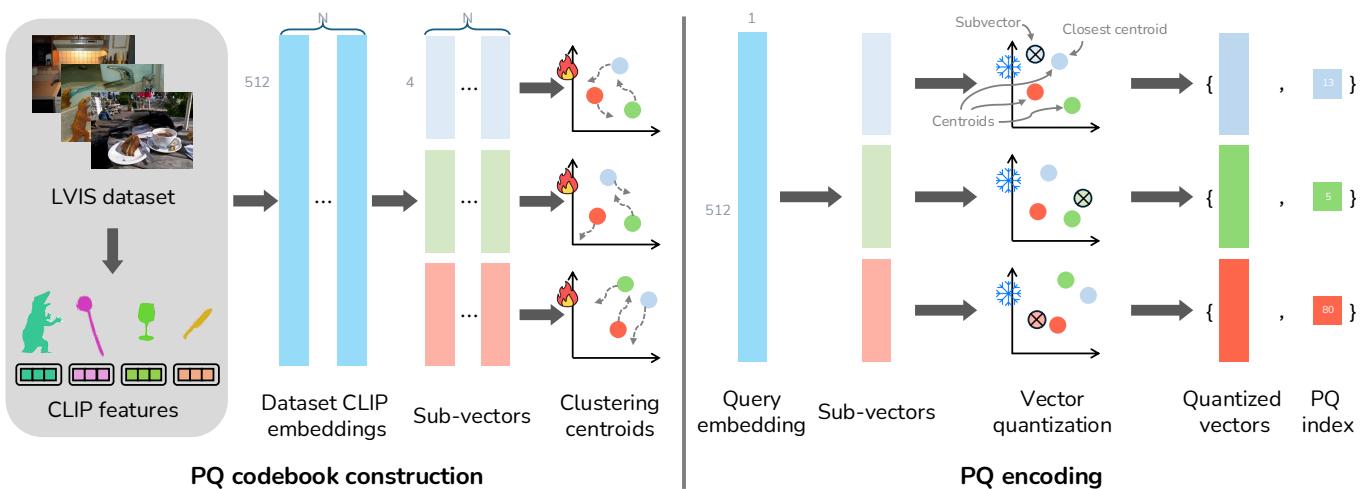
As shown in Figure S1, the 512-dimension vector is split into segments. Each segment is quantized to a centroid index (e.g., index 13, index 5).
Crucially, the authors train this PQ codebook on a massive external dataset (LVIS) once. They do not need to retrain it for every new 3D scene. This makes Dr. Splat “training-free” regarding the feature encoder.
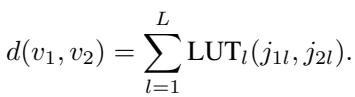
Why is this faster? When performing a search (e.g., “find the chair”), we don’t need to decompress the vectors and compute dot products. We can pre-compute a Look-Up Table (LUT) of distances between the query and the codebook centroids.

The distance calculation then becomes a simple summation of values retrieved from the table, which is computationally trivial compared to high-dimensional vector math.
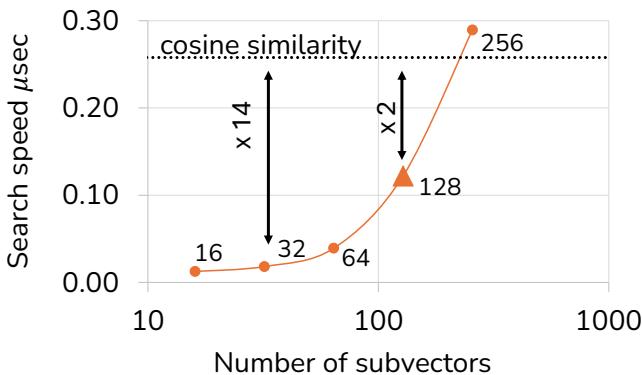
The speed gain is massive. As the graph below demonstrates, using PQ with a Look-Up Table is orders of magnitude faster than standard cosine similarity, especially as the number of sub-vectors decreases (higher compression).
A New Metric: Volume-Aware IoU
The researchers encountered a hurdle during evaluation: standard metrics for 3D localization (Intersection over Union, or IoU) are designed for point clouds. They treat every point as a uniform dot in space.
But 3D Gaussians aren’t uniform dots. Some are large and transparent; others are tiny and opaque. A large, faint Gaussian might technically overlap with a ground truth point, but visually it contributes nothing.
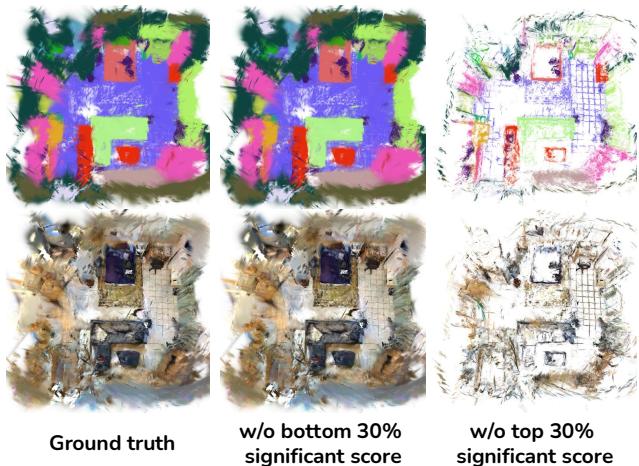
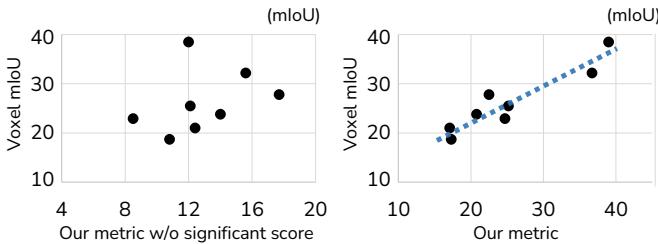
Figure 6 shows that simply removing Gaussians based on a “significant score” (volume \(\times\) opacity) drastically changes the scene’s appearance. Therefore, an evaluation metric must account for this significance.
The authors propose a Mahalanobis-distance-based label assignment and a weighted IoU metric.
First, they calculate the Mahalanobis distance between points and Gaussians to assign pseudo-ground-truth labels:

Then, they assign a semantic label to each Gaussian based on proximity to labeled point cloud data:

Finally, the IoU is calculated using weights \(\mathbf{d}\) derived from the volume and opacity of the Gaussians:
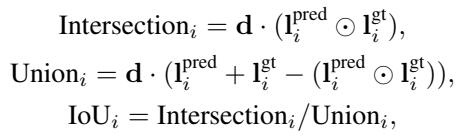
This ensures that a massive, visible Gaussian counts more towards the score than a microscopic, invisible one. The scatter plot below confirms that this new metric correlates highly with Voxel mIoU (a very accurate but slow metric), whereas unweighted metrics do not.
Experiments and Results
Dr. Splat was tested against state-of-the-art methods like LangSplat and OpenGaussian on datasets like LERF-OVS and ScanNet.
3D Object Selection
In this task, the model is given a text query (e.g., “waldo”) and must segment the object in 3D.
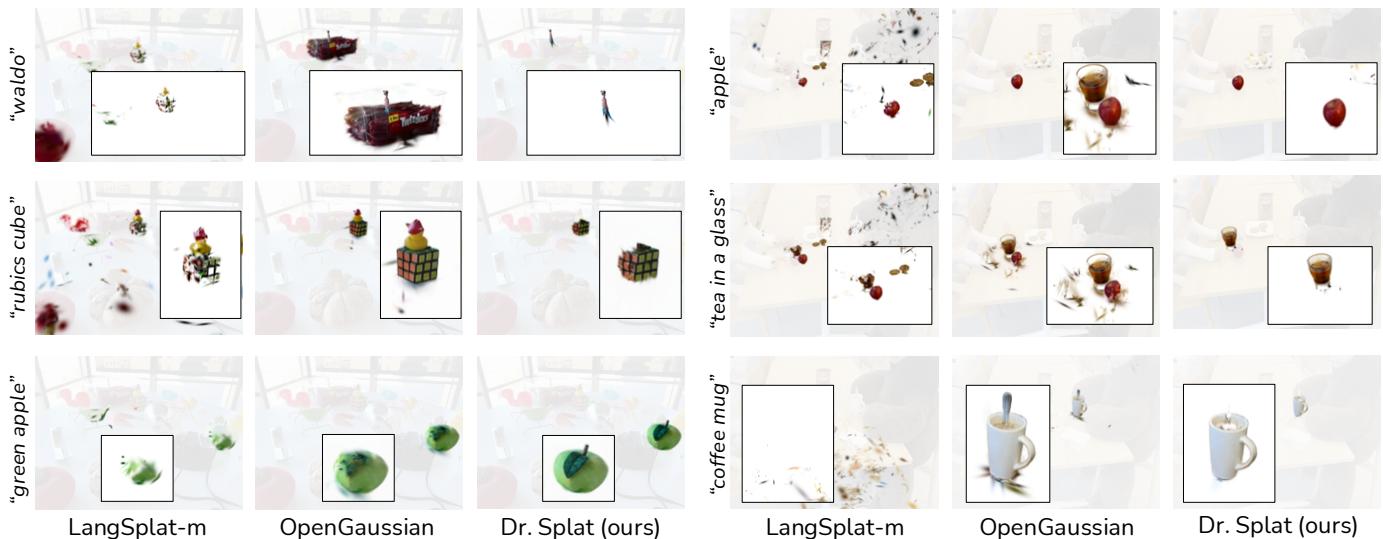
The visual results (Figure 5) are telling. LangSplat (top row) often produces scattered, noisy activations. OpenGaussian (middle) struggles with distinguishing closely positioned objects. Dr. Splat (bottom) precisely highlights the objects, even small ones like Waldo or the Rubik’s cube.
3D Object Localization
Here, the goal is to draw a bounding box around specific objects.
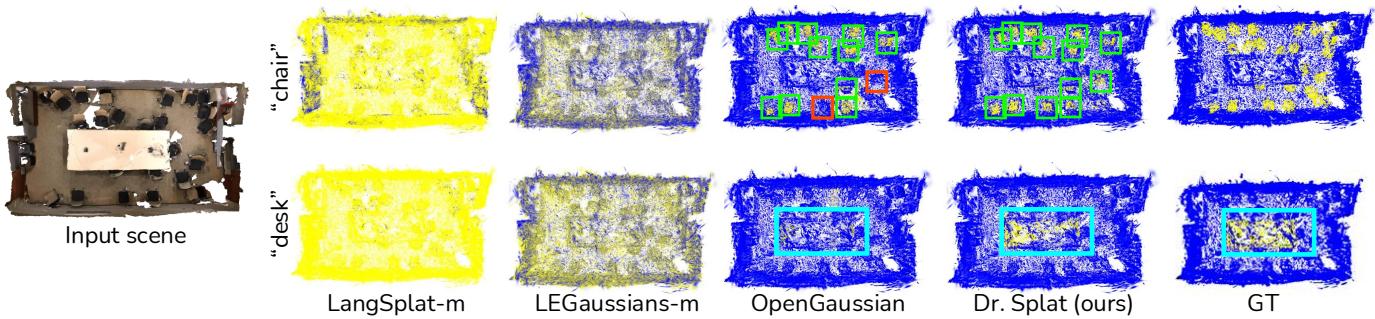
In Figure 7, notice the column for “LangSplat-m”—it fails to localize the chair almost entirely. Dr. Splat provides a clean, tight localization that aligns closely with the Ground Truth (GT).
This performance holds up even in complex scenes with multiple objects:
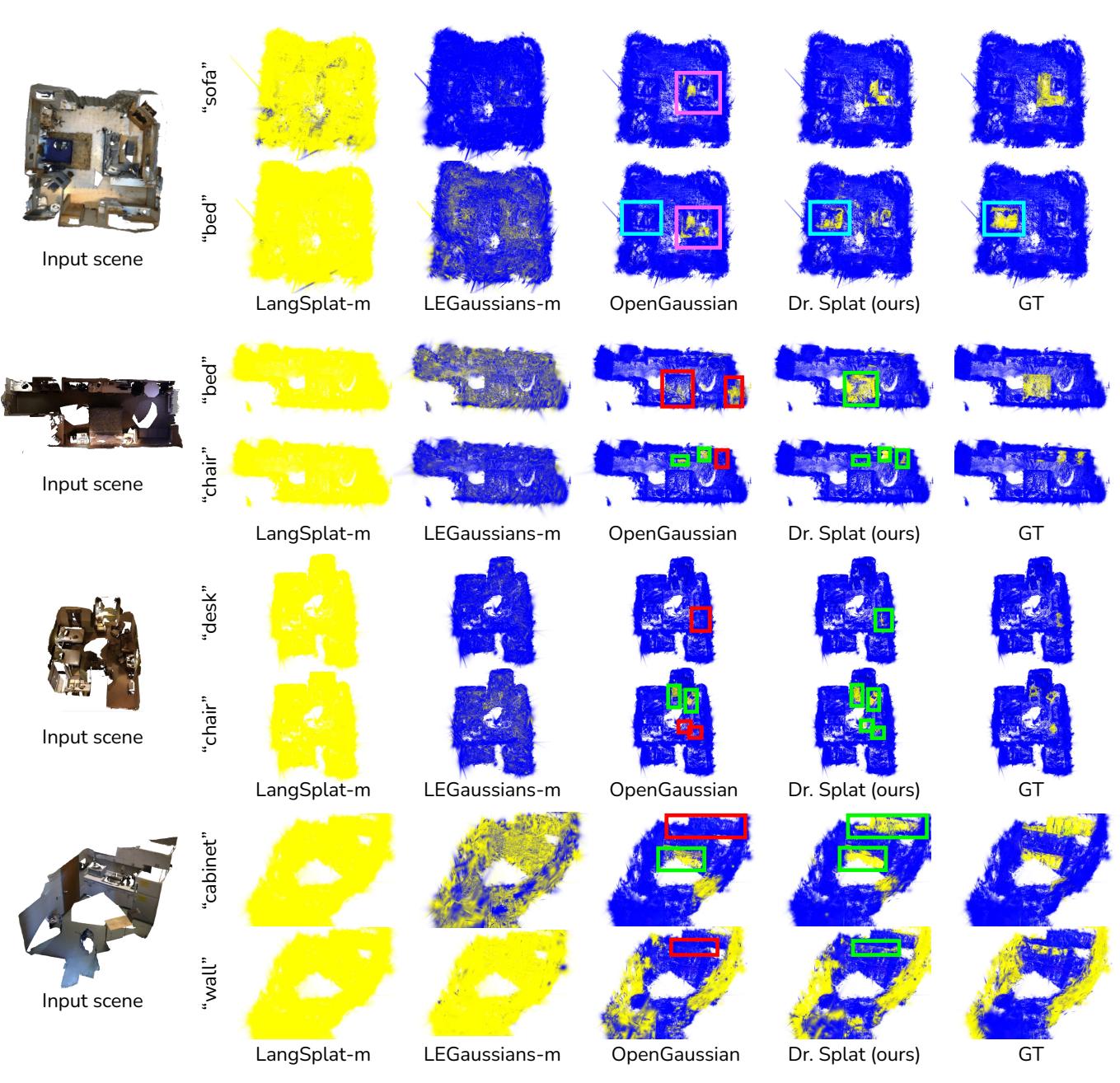
In Figure S6 above, Dr. Splat (green boxes) successfully identifies sofas and beds where other methods (red boxes) produce false positives or miss the target.
3D Semantic Segmentation
Although Dr. Splat is designed for open-vocabulary search, it can also perform full semantic segmentation (assigning a class to every part of the scene).
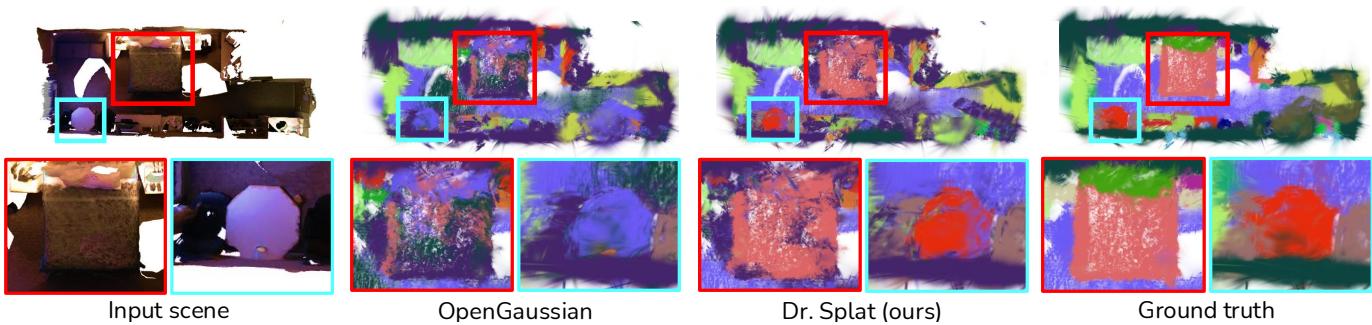
The segmentation maps (Figure 8) show that Dr. Splat achieves cleaner boundaries than OpenGaussian, particularly on the floor and furniture edges.
Ablation Studies
The authors analyzed the trade-offs in their method.
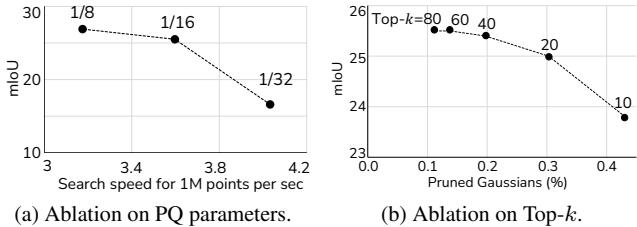
- PQ Compression: Reducing the number of sub-vectors increases speed but slightly lowers Mean IoU (mIoU).
- Top-k Gaussians: Using more Gaussians per ray improves accuracy up to a point, after which it plateaus while memory usage increases.
City-Scale and Attribute Search
One of the most impressive demonstrations is on the Waymo dataset—a large-scale city environment. Dr. Splat scales effectively to millions of Gaussians.
It can also distinguish attributes. For example, distinguishing a “green light” from a “red light” based solely on the text query.
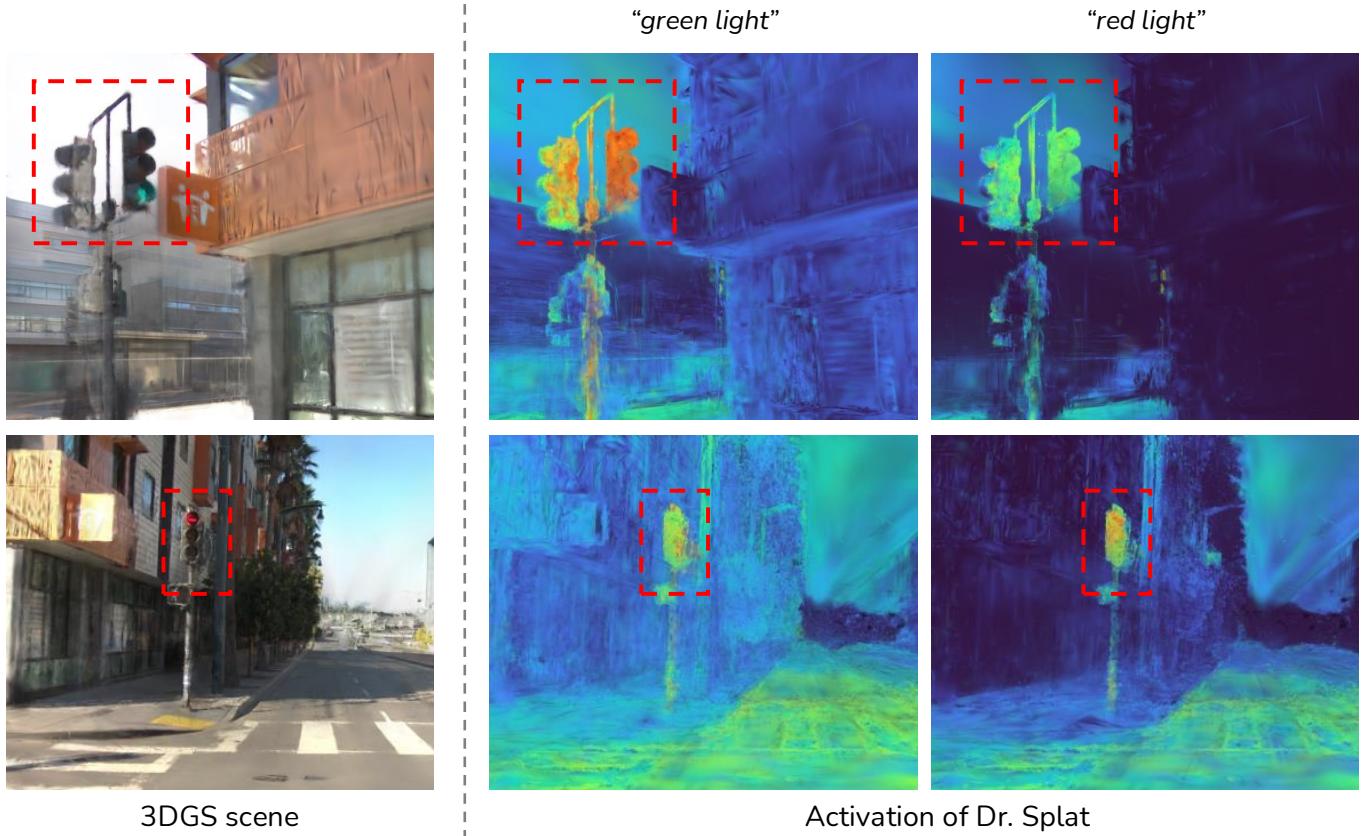
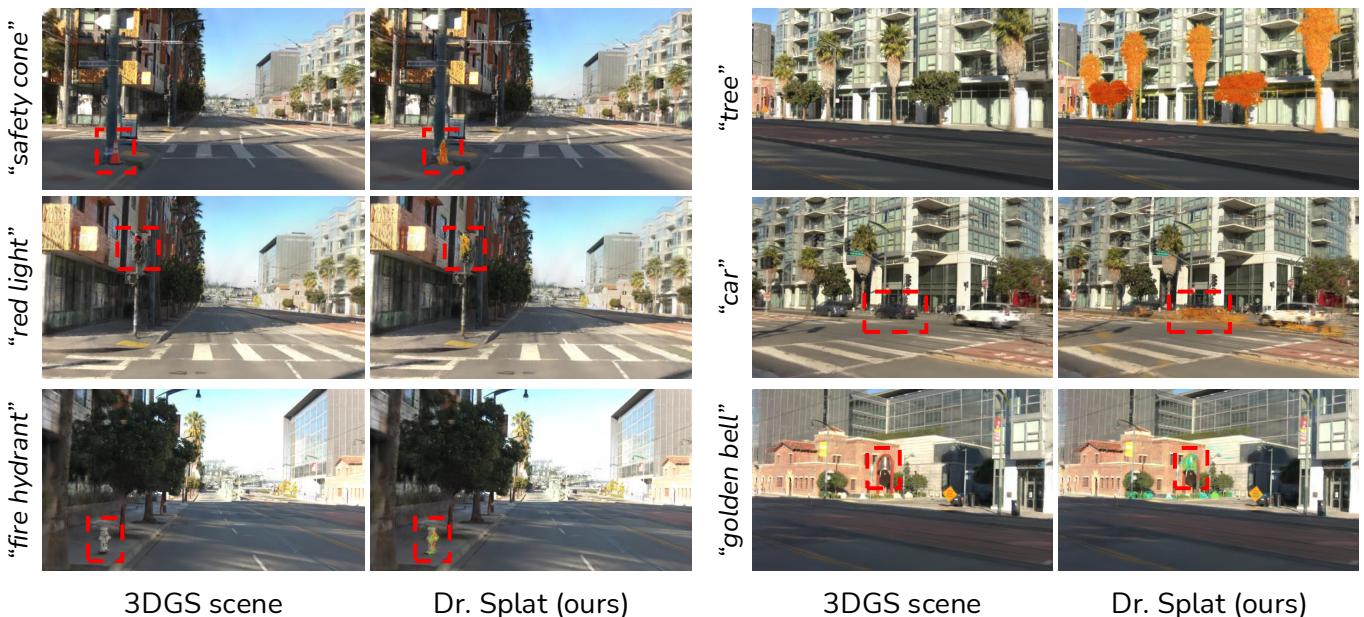
Figure S9 showcases the method’s robustness in the wild, identifying safety cones, fire hydrants, and bells in a chaotic street scene.
Conclusion
Dr. Splat represents a significant shift in how we approach semantic 3D scene understanding. By moving away from costly rendering-based distillation and embracing direct feature registration and Product Quantization, the authors achieved a system that is:
- Accurate: It preserves the fidelity of CLIP embeddings better than distillation.
- Fast: PQ enables lightning-fast 3D search without rendering.
- Efficient: It requires no per-scene training for the language features.
For students and researchers in computer vision, Dr. Splat illustrates the power of aligning 3D representations (Gaussians) directly with semantic representations (Language models), rather than trying to force them together through a 2D rendering bottleneck. As we move toward more interactive robotics and AR/VR applications, techniques like Dr. Splat will be essential for creating machines that truly understand the 3D world they inhabit.