](https://deep-paper.org/en/paper/2502.16849/images/cover.png)
In the modern era of deep learning, we often take the “pre-train then fine-tune” paradigm for granted. We train a massive model (like BERT or GPT) on a mountain of unlabeled text, and then fine-tune it on a specific task with a smaller set of labeled data. Empirically, we know this works wonders. It stabilizes training and drastically reduces the amount of labeled data required.
But why does it work? From a mathematical perspective, how does seeing unlabeled data change the geometry of the optimization landscape to make an impossible problem solvable?
In this post, we are diving deep into a recent paper by Jones-McCormick, Jagannath, and Sen (2025) titled “Provable Benefits of Unsupervised Pre-training and Transfer Learning via Single-Index Models.” This paper provides a rigorous theoretical framework demonstrating that unsupervised pre-training can reduce the sample complexity of learning from quadratic (or worse) to linear in the dimension of the data.
We will explore the “Spiked Covariance” model, visualize the optimization landscape, and uncover a surprising “trap” where random initialization is guaranteed to fail, yet pre-training succeeds effortlessly.
The Core Problem: Finding a Needle in a High-Dimensional Haystack
Supervised learning, at its simplest, is about finding a function that maps inputs to outputs. In high dimensions (where the number of input features \(d\) is large), this becomes incredibly difficult.
The authors focus on a fundamental setup: the Single-Index Model (SIM).
The Model
Imagine we are trying to learn a target vector \(v_0\) (the ground truth weights). Our data inputs \(a\) are high-dimensional vectors, and the output \(y\) is generated by:
\[y_i = f(a_i \cdot v_0) + \epsilon_i\]Here, \(f\) is a non-linear activation function (like a sigmoid or ReLU, or in this paper’s specific examples, polynomials), and \(\epsilon\) is noise. The goal of the neural network is to recover \(v_0\) by minimizing the loss between its prediction and the true \(y\).
The loss function we are trying to minimize is the standard squared loss:

This looks like a standard regression problem, but in high dimensions with a non-linear \(f\), the optimization landscape is non-convex. It is full of saddle points and local minima.
The Algorithm
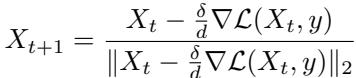
We train this model using Online Stochastic Gradient Descent (SGD) on the unit sphere (meaning we keep the length of our weight vector normalized to 1). The update rule is standard:
The central question of the paper is about Sample Complexity: How many samples \(N\) (relative to the dimension \(d\)) do we need to find \(v_0\)?
- Linear Scaling: \(N \approx d\). This is ideal.
- Quadratic Scaling: \(N \approx d^2\). This is expensive and often intractable in deep learning where \(d\) can be billions.
The Secret Weapon: Spiked Covariance
If our input features \(a\) were just white noise (isotropic Gaussian), finding \(v_0\) would be purely about brute-force search. However, real-world data isn’t white noise. It has structure.
The authors model this structure using Unlabeled Data. They assume we have access to a large set of unlabeled features that we can use for pre-training. Crucially, they assume these features follow a Spiked Covariance model.
In simple terms, the data varies more in one specific direction (the “spike” \(v\)) than in others. Mathematically, the covariance matrix of the input data looks like this:
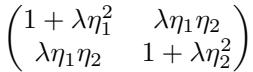
Here:
- \(I_d\) is the identity matrix (background noise).
- \(vv^T\) represents the “spike” direction.
- \(\lambda\) is the strength of the spike.
The catch? The spike \(v\) is not the same as the target \(v_0\). However, they are correlated. The alignment between the spike and the truth is given by \(\eta_1 = v \cdot v_0\).
This models a realistic scenario: the structure of the unlabeled data (the spike) gives you a hint about the downstream task (\(v_0\)), but it’s not the exact answer.
The Method: PCA Pre-training vs. Random Initialization
The paper compares two initialization strategies for SGD:
- Random Initialization: We pick a starting vector \(X_0\) uniformly at random from the sphere. In high dimensions, this vector will be nearly orthogonal to \(v_0\) (correlation \(\approx 0\)).
- Unsupervised Pre-training: We use Principal Component Analysis (PCA) on the unlabeled data to find the spike \(v\). We then use this estimated spike \(\hat{v}\) as our starting point \(X_0\).
To analyze this, the authors track the dynamics of the learning process using two variables:
- \(m_1(X)\): The correlation with the target \(v_0\) (we want this to go to 1).
- \(m_2(X)\): The correlation with the residual spike direction (orthogonal to \(v_0\)).
By projecting the high-dimensional SGD dynamics into this 2D plane \((m_1, m_2)\), we can visualize exactly why pre-training works.
Result 1: The Victory of Pre-training (Theorem 3.3)
The first major result is a positive one. If you initialize using PCA (pre-training), you start with a correlation to the target that is “good enough.”
The authors prove that if the initial correlation is within a certain “basin of attraction,” SGD will converge to the true solution \(v_0\) using only linear samples (\(N \propto d\)).
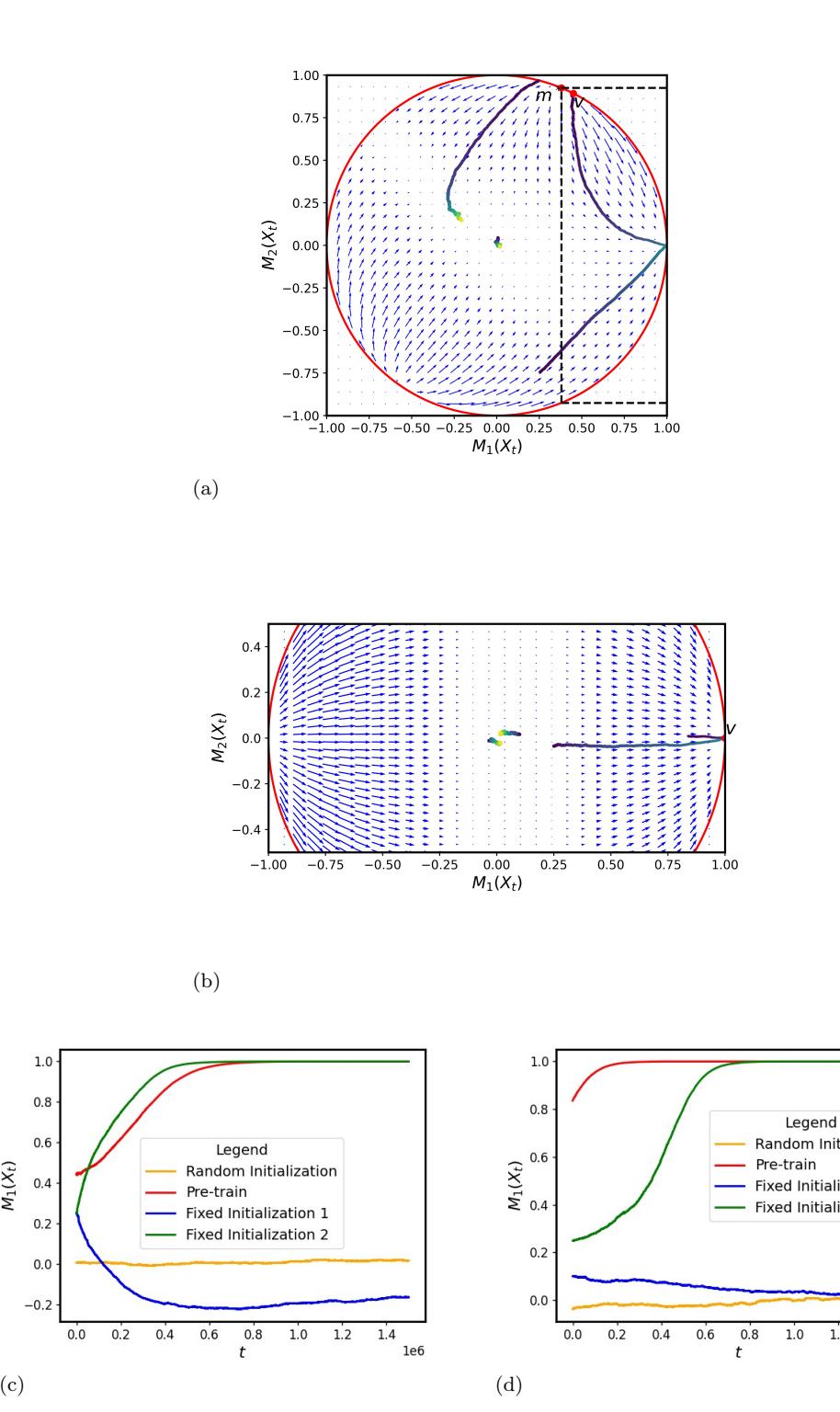
In Figure 1 (above), look at the trajectories.
- Red Line (Pre-train): Starts with non-zero correlation (thanks to the spike) and shoots straight up to \(m_1 = 1\) (perfect recovery).
- Yellow/Orange Line (Random): Stays stuck at the bottom (\(m_1 \approx 0\)).
The pre-training effectively places the optimizer on a “slide” that leads directly to the global minimum. The mathematical guarantee relies on the population gradient pointing in the right direction within a specific region:
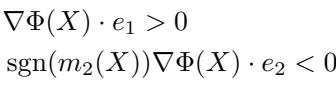
This condition ensures that if we start with high enough correlation (which PCA provides), the gradient will push us toward the solution.
Result 2: The Failure of Random Initialization (Theorem 3.4)
Conversely, what happens if we don’t pre-train?
The authors prove that for a specific class of activation functions (those with “Information Exponent” \(\ge 3\), like \(f(x) = x^3 - 3x\)), random initialization is doomed in the linear sample regime.
When initialized randomly, \(X_0\) is almost orthogonal to \(v_0\). In this region, the gradient signal is incredibly weak. The authors perform a Taylor expansion of the gradient around zero correlation:

Notice that for small correlations (\(x_1, x_2 \approx 0\)), the gradient is dominated by higher-order terms or vanishes. The “signal” is buried in the noise.
The paper establishes that to escape this flat region and find the solution from random initialization, you need at least quadratic samples (\(N \propto d^2\)). In high dimensions, the difference between \(d\) samples and \(d^2\) samples is the difference between minutes and centuries of training.
Result 3: The “Trap” (Theorem 3.5)
This is perhaps the most fascinating contribution of the paper. One might assume that having a spike in the data is always good. The authors ask: What if the spike is perfectly aligned with the target (\(v = v_0\))?
Intuitively, this should be the easiest case. The unlabeled data structure points exactly to the supervised answer.
However, the authors discover a paradox. If \(\eta_1 = 1\) (perfect alignment) and we use random initialization, SGD fails even harder.
Because of the symmetry induced by the perfect alignment, a local minimum forms at \(m_1 = 0\).

This theorem states that if you start with low correlation (random init), the probability of the correlation exceeding a small radius \(r\) goes to zero. You are trapped.
The gradient dynamics in this specific symmetric case effectively push the weights away from the solution if the initial correlation is too low, or keep them trapped near the equator of the hypersphere.
Why is this important? It highlights that “structure” in data isn’t enough. You need to leverage that structure to break symmetry before supervised training begins. Pre-training does exactly this by initializing you out of the trap.
Visualizing the Proof
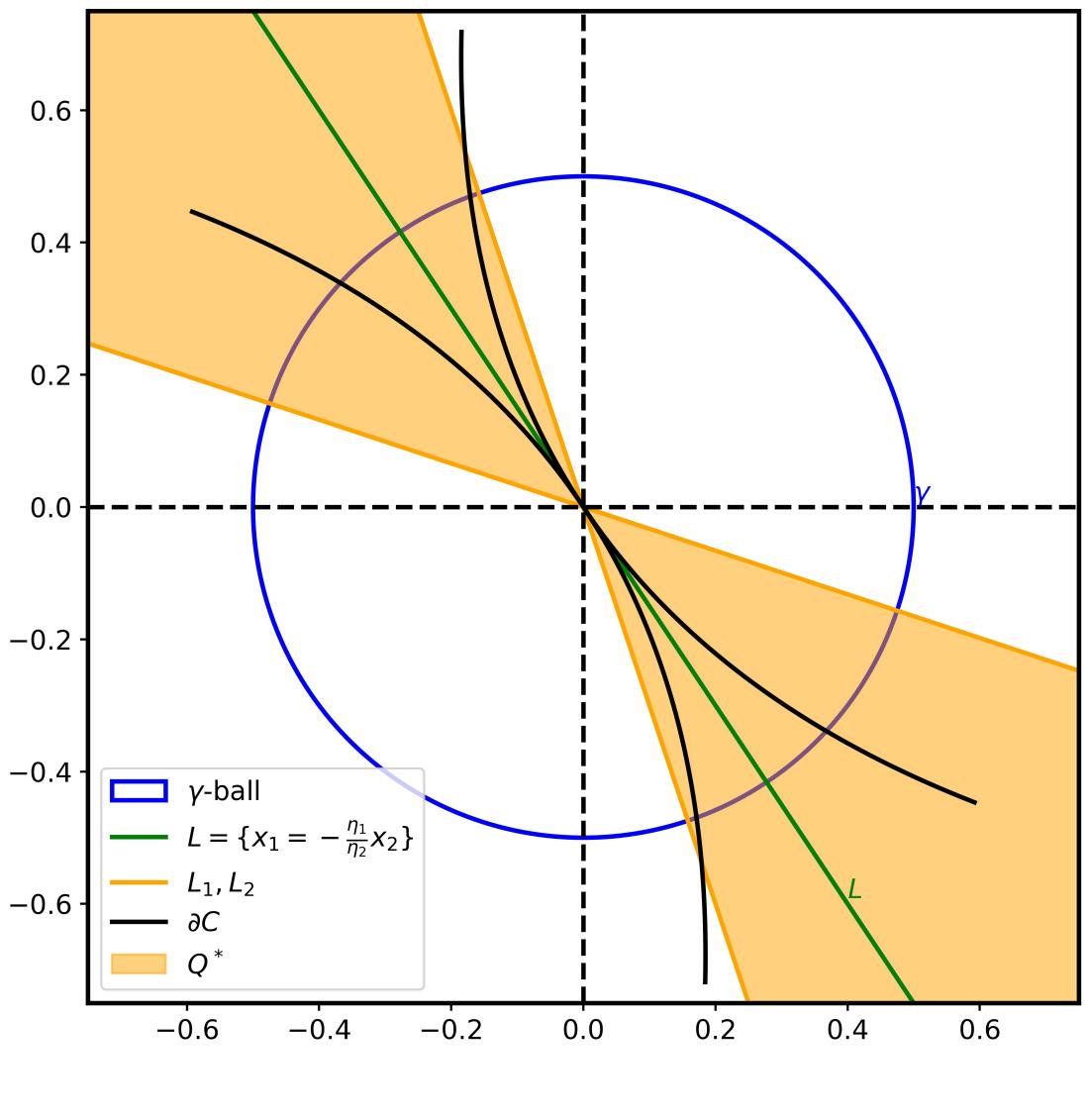
The proofs in the paper rely on “Bounding Flows.” The authors define geometric regions in the \((m_1, m_2)\) plane and prove that the SGD trajectory is confined or directed by these boundaries.
For Theorem 3.4 (the failure of random init), they define a “Zone of No Return” (Conceptually). They show that if the trajectory enters a specific quadrant \(Q_3\) or \(Q_4\) while the norm is small, it cannot generate enough signal to turn around and find the solution before running out of samples.
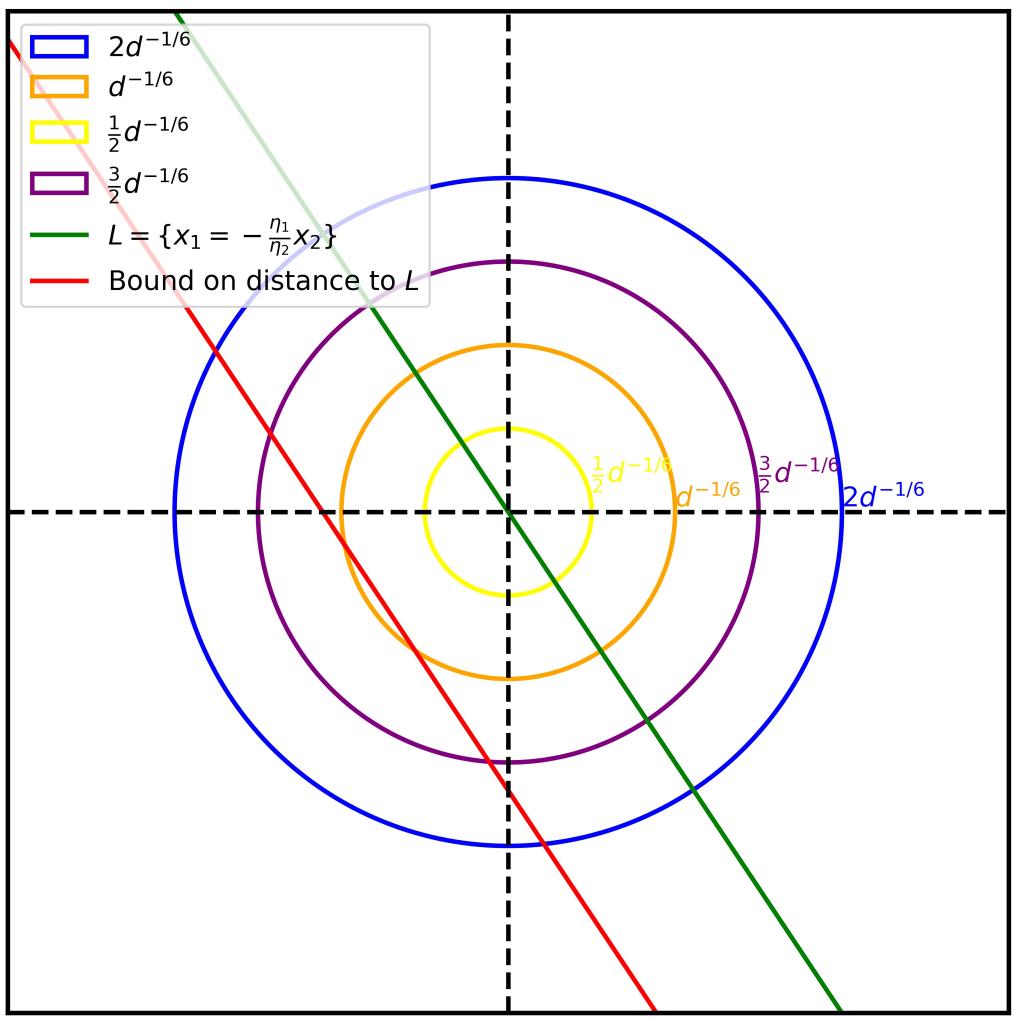
In Figure 3, the red line represents a boundary. The authors prove that the random walk of SGD (the martingale fluctuation) is not strong enough to cross these boundaries to reach the “effective” zone where gradients become useful.
They also utilize specific sets \(C\) and \(Q^*\) to bound the distance from the critical line \(L\), effectively corralling the optimization path.
The Role of Correlation Strength
An obvious question arises: How strong does the correlation between the spike (unlabeled structure) and the target (supervised task) need to be?
If the unlabeled data is unrelated to the task (\(\eta_1 \approx 0\)), pre-training shouldn’t help. The authors confirm this empirically.
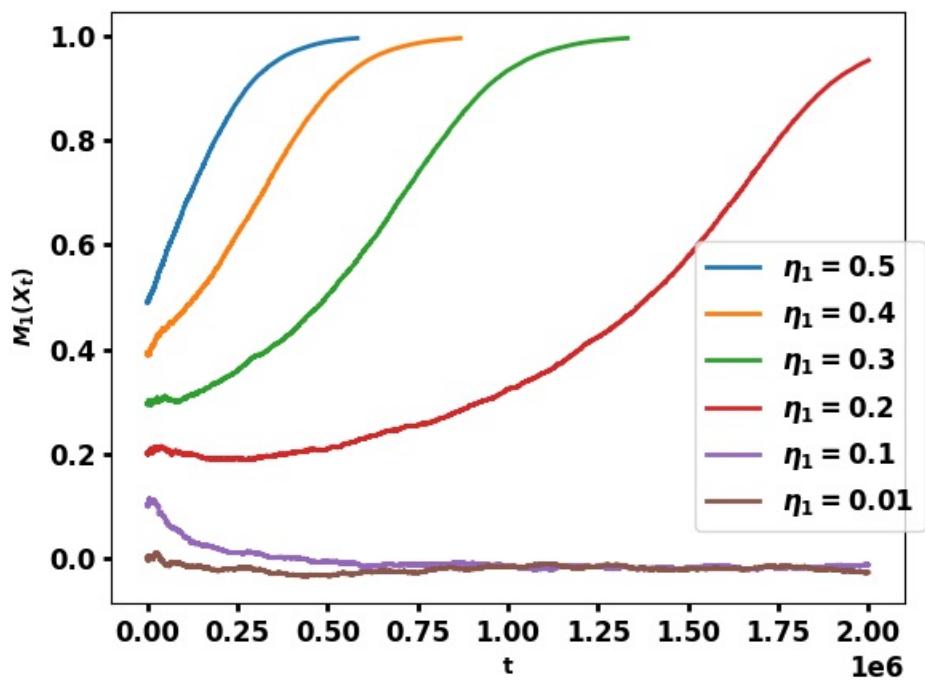
In Figure 4, we see the training trajectories for different values of \(\eta_1\) (the alignment between spike and target).
- Blue/Orange (\(\eta_1 \ge 0.4\)): PCA initialization leads to rapid convergence.
- Red/Purple (\(\eta_1 \le 0.2\)): The correlation is too weak. Even with PCA initialization, the starting point isn’t close enough to the basin of attraction, and the model fails to learn.
This theoretically validates the empirical observation in Transfer Learning: the source task (or pre-training data) must be sufficiently related to the target task to yield benefits.
Transfer Learning
The paper also briefly touches on Transfer Learning (Theorem 4.2). Here, instead of unsupervised pre-training, we assume we have a weight vector \(v^{(d)}\) from a related task.
The results are analogous: if the transferred weights have a correlation with the target that scales better than random noise ( specifically \(\eta_d = \Omega(d^{-\zeta})\) for \(\zeta < 1/2\)), the sample complexity drops significantly.
If the transferred correlation is constant (independent of dimension), we again achieve linear sample complexity, bypassing the “Information Exponent” barrier entirely.
Conclusion and Implications
This paper provides a clean, provable separation between the capabilities of random initialization and pre-training.
- Random Initialization forces the model to explore a high-dimensional sphere blindly. If the function is complex (high Information Exponent), the gradient signal is too weak, requiring massive amounts of data (\(d^2\)) to build momentum.
- Pre-training uses the covariance structure of unlabeled data to perform a “jump” in the optimization landscape. This jump lands the model in a region where gradients are strong and point toward the solution, allowing for rapid convergence with minimal labeled data (\(d\)).
- The Trap: Without pre-training, strong data structure can actually create local minima that trap the model, making learning impossible regardless of data size (in the linear regime).
For students and practitioners, this reinforces a key lesson: Optimization in deep learning is not just about the loss function; it is about the initialization. Pre-training is not just a “warm start”—it fundamentally changes the complexity class of the learning problem.