](https://deep-paper.org/en/paper/2502.18605/images/cover.png)
In the worlds of computer science, economics, and engineering, we are often obsessed with finding a state of balance. Whether it’s predicting traffic flow in a congested city, pricing options in finance, or finding a Nash equilibrium in a complex multiplayer game, the mathematical tool of choice is often the Variational Inequality (VI).
VIs are incredibly expressive. They provide a unified framework to model almost any system where agents compete for resources or optimize objectives under constraints. But there is a catch: they are notoriously difficult to solve. In computational complexity terms, finding a solution to a general VI is PPAD-hard. This means that for many real-world problems, efficient algorithms simply do not exist—or at least, we haven’t found them yet.
But what if we changed the question?
In a recent paper titled “Expected Variational Inequalities,” researchers from Carnegie Mellon, MIT, and Oxford propose a paradigm shift. Instead of hunting for a single, precise point that satisfies these rigid constraints, they introduce a relaxation: finding a distribution that satisfies the constraints in expectation.
This blog post dives into this new framework. We will explore how “Expected Variational Inequalities” (EVIs) break through the computational barriers of traditional VIs, how they connect to game theory, and why they might just be the “good enough” solution we’ve been waiting for.
The Problem with Variational Inequalities
To appreciate the solution, we first need to understand the problem. A standard Variational Inequality problem asks us to find a point \(\boldsymbol{x}\) in a constrained set \(\mathcal{X}\) (like a shape in space) such that moving anywhere else in that set doesn’t “improve” things, according to a vector field \(F\).
Mathematically, a VI asks for a point \(\boldsymbol{x} \in \mathcal{X}\) such that:

Here, \(F(\boldsymbol{x})\) could represent the gradient of a loss function, or the cost vector in a game. If you are at \(\boldsymbol{x}\), the inner product \(\langle F(\boldsymbol{x}), \boldsymbol{x}' - \boldsymbol{x} \rangle \geq 0\) essentially means there is no direction (\(\boldsymbol{x}' - \boldsymbol{x}\)) you can move towards that opposes the vector field \(F\). In optimization terms, you are at a stationary point.
While elegant, this definition is strict. Requiring this condition to hold for every possible \(\boldsymbol{x}'\) is a tall order. As the dimension of the problem grows, finding such a point becomes exponentially difficult. This intractability has stalled progress in solving large-scale equilibrium problems for decades.
Enter the “Expected” Variational Inequality
The authors propose a relaxation. Instead of asking for a single point \(\boldsymbol{x}\) that satisfies the condition against all other points, what if we looked for a probability distribution \(\mu\) over the space \(\mathcal{X}\)?
This leads to the definition of the Expected Variational Inequality (EVI). Given a set of “deviations” (functions that try to move us away from our current spot), denoted by \(\Phi\), we look for a distribution \(\mu\) such that:

Let’s break this down:
- \(\mu\) (The Solution): We are no longer outputting a single strategy or point. We are outputting a randomized strategy (a distribution).
- \(\mathbb{E}\) (Expectation): We only need the condition to hold on average.
- \(\Phi\) (The Deviations): This is the crucial lever. In the standard VI, we compare \(\boldsymbol{x}\) against every other point \(\boldsymbol{x}'\). In an EVI, we compare our current position \(\boldsymbol{x}\) against a transformed position \(\phi(\boldsymbol{x})\).
By restricting the set of allowed deviations \(\Phi\), we can make the problem easier. If \(\Phi\) includes every possible function, we are back to the hard problem. But if we limit \(\Phi\) to, say, linear maps, magic happens: the problem becomes computationally tractable.
Why This Matters: Existence and Tractability
Before discussing algorithms, we need to know if solutions even exist. One of the major contributions of this paper is proving that EVIs are “total”—meaning solutions exist under very broad conditions.
For standard VIs, existence often requires the map \(F\) to be continuous. If \(F\) is discontinuous (has jumps), a solution might not exist at all. The authors show that for EVIs, we don’t need such strict continuity.
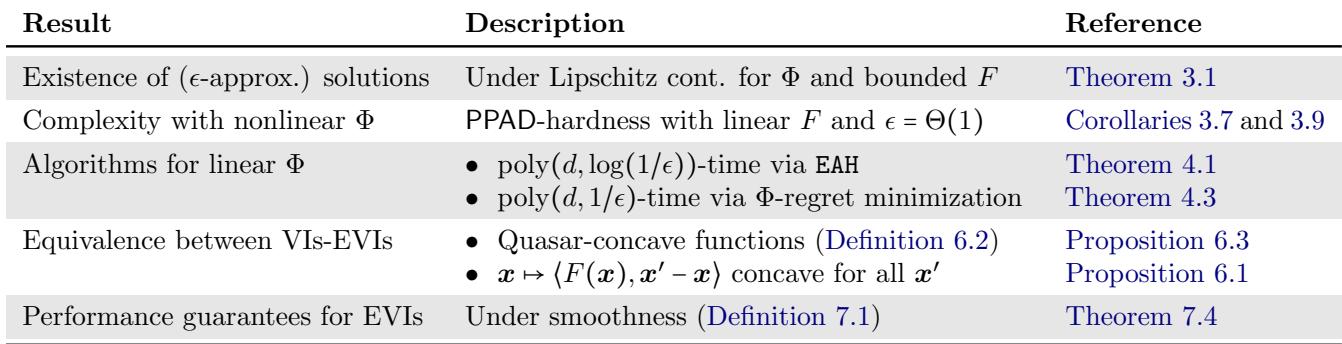
As shown in Table 1, EVIs offer a sweet spot. They guarantee existence even when \(F\) is discontinuous (provided \(\Phi\) is Lipschitz), and while they remain hard for general non-linear deviations, they unlock polynomial-time algorithms for linear deviations.
The Algorithm: Ellipsoid Against Hope
The heart of the paper’s contribution is a method to solve these problems efficiently when the set of deviations \(\Phi\) consists of linear maps (\(\Phi_{\mathsf{LIN}}\)).
The researchers utilize an algorithm with a poetic name: Ellipsoid Against Hope (EAH). Originally developed for game theory, EAH is a variation of the famous Ellipsoid method used in convex optimization.
Here is the intuition: We want to find a distribution \(\mu\) that satisfies our EVI condition. This looks like a feasibility problem:

The algorithm works by trying to solve the dual of this problem—essentially trying to prove that no such distribution exists. It constructs an ellipsoid (a multi-dimensional oval) around the potential solutions.
- It queries a “separation oracle.”
- If the oracle says “you’re outside the set,” it cuts the ellipsoid to zoom in.
- If the oracle finds a valid point (a “Good Enough Response”), we add it to our collection.
Usually, the Ellipsoid method is used to zoom in on a specific optimal point. Here, we run the ellipsoid algorithm expecting it to fail (hence “Against Hope”). When it fails to find a separating hyperplane that proves infeasibility, the “debris” left behind—the collection of points it found along the way—actually constitutes the distribution \(\mu\) we were looking for all along.
The authors prove that for linear deviations, this process runs in time polynomial in the dimension \(d\) and the logarithm of the precision \(1/\epsilon\). This is a massive improvement over the exponential time required for general VIs.
A More Practical Approach: Regret Minimization
While EAH is theoretically polynomial, it can be slow in practice. The authors also provide a more scalable alternative based on Regret Minimization.
In online learning, “regret” measures how much better you could have done if you had consistently chosen a different action. The authors define \(\Phi\)-Regret in the context of EVIs:

By minimizing this regret over time using techniques like Projected Gradient Descent, the average of the iterates converges to an EVI solution. This approach is highly parallelizable and practical for large-scale systems, though its convergence rate is polynomial in \(1/\epsilon\) (slower than EAH’s \(\log(1/\epsilon)\)).
Connecting to Game Theory
If you have a background in economics or game theory, the idea of “deviations” and “correlated distributions” might sound familiar. That’s because EVIs are a massive generalization of Correlated Equilibria (CE).
In a standard Nash Equilibrium, players play independently. In a Correlated Equilibrium, a mediator suggests strategies to players, and players follow them because it’s in their best interest.
The authors show that EVIs capture this concept perfectly. If you set the function \(F\) to be the negative gradient of the players’ utilities, an EVI solution corresponds to an equilibrium.
However, when we look at Linear Deviations (\(\Phi_{\mathsf{LIN}}\)), something fascinating appears. The set of EVI solutions is actually smaller (more refined) than the standard Correlated Equilibrium. The authors call this the Anonymous Linear Correlated Equilibrium (ALCE).
To visualize this, look at the solution space for the classic “Bach or Stravinsky” game (a coordination game where two people want to go to the same concert but prefer different ones).
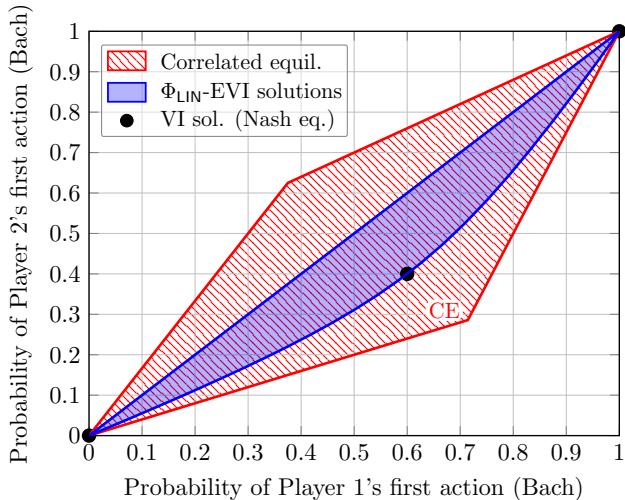
In Figure 1, the red region represents the standard Correlated Equilibria. The blue region inside represents the solutions found by the \(\Phi_{\mathsf{LIN}}\)-EVI. Notice the curved boundary of the blue region. Standard linear programming usually results in polygonal shapes (straight lines). The fact that the EVI solution set has curves suggests it captures a distinct, non-polyhedral structure of equilibrium that was previously unexplored.
This “Anonymity” comes from the fact that the linear deviation maps operate on the full joint strategy space but don’t inherently “know” the identity of the players in the same way standard game theory models do. This offers a new lens for viewing symmetric games or systems where agent identity shouldn’t define the equilibrium.
Beyond Convexity: Smoothness and Non-Concave Games
One of the most powerful aspects of EVIs is that they don’t require the underlying functions to be “nice” (concave or convex). They work well with Quasar-concavity and Smoothness.
“Smoothness” here doesn’t just mean “differentiable.” It refers to a specific condition where the function doesn’t curve too wildly relative to a global optimum.
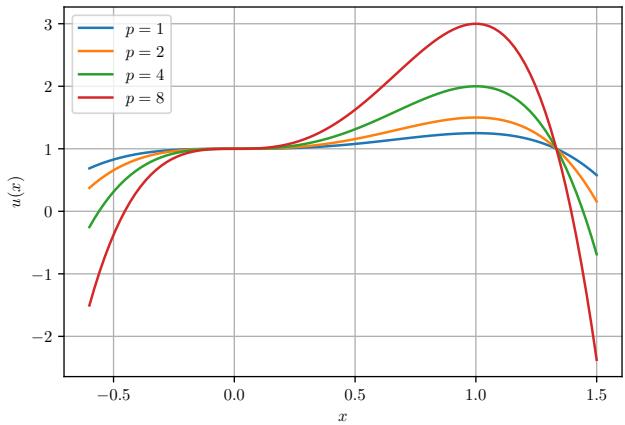
Figure 2 shows a function \(u\) that is clearly not concave (it has that dip in the middle). Standard convex optimization would get stuck in the local maximum at \(x=0\). However, this function satisfies a generalized smoothness property.
The authors prove a theorem (Theorem 7.4) stating that if an EVI problem satisfies this \((\lambda, \nu)\)-smoothness, any solution \(\mu\) guarantees a certain level of performance relative to the true global maximum.

This bound implies that even if we can’t find the perfect global maximum, the EVI distribution will yield a high objective value in expectation. This is incredibly valuable for machine learning applications involving non-convex loss landscapes, where finding the absolute minimum is hard, but finding a “good” distribution of parameters is sufficient.
Conclusion
The research paper “Expected Variational Inequalities” offers a compelling way out of the computational deadlock of equilibrium problems. By relaxing the goal from finding a “stable point” to finding a “stable distribution” robust against specific deviations, the authors:
- Guaranteed Existence: Solutions exist even for discontinuous problems.
- Achieved Tractability: Linear EVIs can be solved in polynomial time using the Ellipsoid Against Hope algorithm.
- Expanded Game Theory: They introduced ALCE, a refined equilibrium concept for multi-agent systems.
- ** bridged Optimization:** They provided performance bounds for non-convex (smooth/quasar-concave) problems.
For students and practitioners, EVIs represent a modern toolset. They remind us that in complex systems, sometimes the rigid search for a single optimal point is the enemy of the good. A well-constructed probability distribution—a strategy that holds up on average—might be the most rational solution of all.