](https://deep-paper.org/en/paper/2502.19630/images/cover.png)
Introduction
Imagine you are driving down a highway at 60 miles per hour. For a split second, you close your eyes. In that brief moment, the car in front of you slams on its brakes. That split second—where you have no visual information—is terrifying.
Now, consider an autonomous vehicle. These systems rely heavily on sensors like LiDAR and standard frame-based cameras. While sophisticated, these sensors have a fundamental limitation: they operate at a fixed frame rate, typically around 10 to 20 Hz. This means there is a gap, often up to 100 milliseconds, between every snapshot of the world. In the research community, this is known as “blind time.”
During blind time, a fast-moving vehicle can travel several meters. A pedestrian can step off a curb. Current 3D object detection algorithms essentially “guess” what happens during these gaps, often assuming constant velocity or simply waiting for the next frame. As you can imagine, this latency poses a significant safety risk.
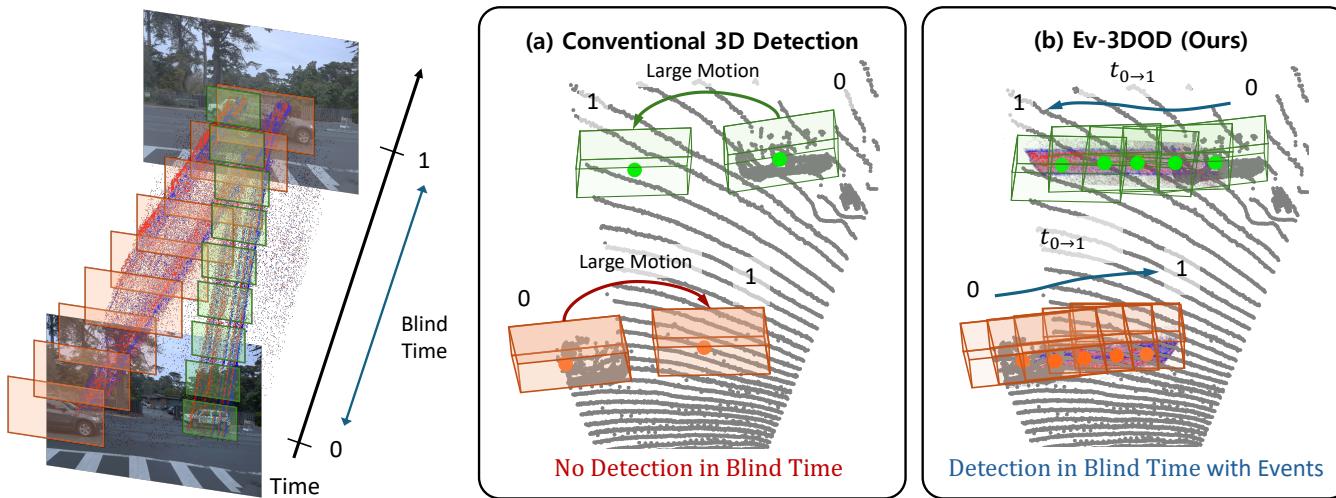
As illustrated in Figure 1, conventional methods (a) fail to detect objects during these intervals. If an object accelerates or changes direction within that \(t_{0 \rightarrow 1}\) gap, the system is flying blind.
In this post, we will dive deep into Ev-3DOD, a novel framework presented by researchers from KAIST. They propose a solution that integrates event cameras—neuromorphic sensors with microsecond resolution—into 3D object detection pipelines. By doing so, they push the boundaries of temporal resolution, allowing autonomous systems to “see” and track 3D objects continuously, even when the main sensors are waiting for their next frame.
Background: The Sensor Gap
To understand the elegance of Ev-3DOD, we first need to understand the limitations of current hardware and the unique capabilities of event cameras.
The Trade-off: Bandwidth vs. Latency
Standard sensors like LiDAR and RGB cameras capture global snapshots of a scene. While rich in detail, processing this data requires significant bandwidth and computation. To manage this, engineers cap the frame rate (e.g., 10 Hz). Increasing this frame rate significantly would overwhelm the onboard computers of a self-driving car.
Enter the Event Camera
Event cameras (or Dynamic Vision Sensors) operate differently. Instead of capturing a full image at fixed intervals, each pixel operates independently and asynchronously. A pixel reports data only when it detects a change in brightness.
- Output: A stream of “events”—tuples of \((x, y, t, p)\) representing position, time, and polarity (brightness increase or decrease).
- Latency: Sub-millisecond.
- Bandwidth: Extremely low (unless the scene changes rapidly), as static backgrounds generate no data.
The researchers realized that while LiDAR provides accurate 3D geometry at specific timestamps (active time), event cameras provide a continuous stream of motion information during the gaps (blind time). The challenge, however, is fusion. How do you combine sparse, 2D event data with dense, 3D point clouds?
Ev-3DOD: The Method
The core objective of Ev-3DOD is to predict 3D bounding boxes at any arbitrary time \(t\) within the blind interval \(0 \leq t < 1\), using only the initial sensor data at time \(0\) and the stream of events leading up to time \(t\).
Framework Overview
The architecture is split into two distinct phases to maximize efficiency: the Active Timestamp Phase and the Blind Time Motion Prediction Phase.
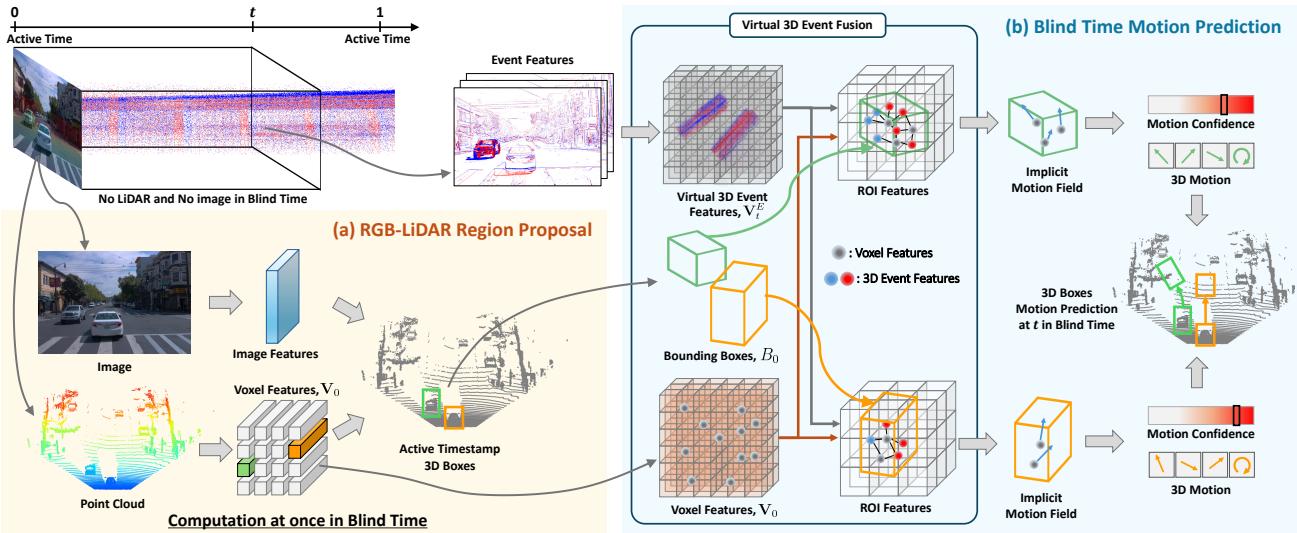
1. Active Timestamp (Figure 2a)
At \(t=0\), the system has full access to LiDAR and RGB camera data. It uses a standard Region Proposal Network (RPN)—specifically an RGB-LiDAR fusion model—to generate:
- Voxel Features (\(V_0\)): A grid representation of the 3D scene features.
- 3D Bounding Boxes (\(B_0\)): The detected objects at the start of the cycle.
- Confidence Scores (\(p_0\)): How certain the model is about each box.
This heavy computation happens only once per cycle.
2. Blind Time Prediction (Figure 2b)
This is where the innovation lies. As time progresses (\(t > 0\)), we no longer have new LiDAR or RGB data. Instead of re-running the heavy detector, the system enters a lightweight “inter-frame” mode. It takes the past voxel features (\(V_0\)) and updates the object positions using the current event stream.
The question is: How do we use 2D events to move 3D voxels?
Virtual 3D Event Fusion (V3D-EF)
The researchers introduce a module called Virtual 3D Event Fusion (V3D-EF). This module acts as a bridge between the static 3D world of LiDAR and the dynamic 2D world of event cameras.
Step 1: Aligning Voxels and Events
Event cameras lack depth information. To associate a 2D event with a 3D object, the system projects the 3D information onto the 2D event plane.
First, they identify non-empty voxels from the active timestamp. For a specific voxel \(k\), they calculate the centroid of the points inside it to get a precise 3D coordinate \(c_0^k\).
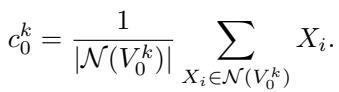
Here, \(\mathcal{N}(V_0^k)\) represents the set of points inside voxel \(k\).
Next, they project this 3D centroid onto the 2D image plane using the camera’s intrinsic and extrinsic calibration matrices. This tells the system exactly where in the 2D event stream to look for motion corresponding to that specific chunk of 3D space.
Step 2: Extracting Features
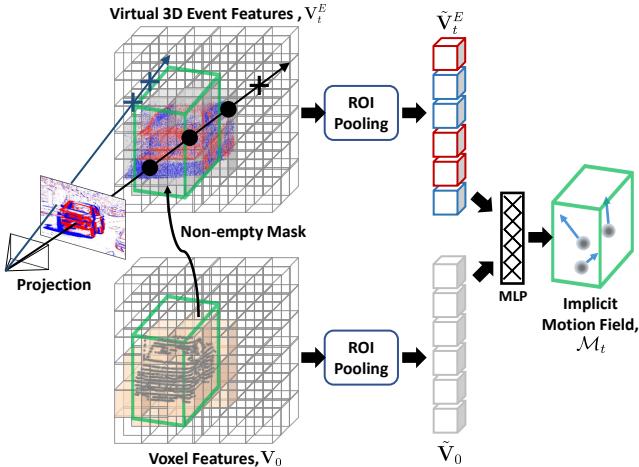
Once the system knows where the 3D voxels “live” on the 2D image plane, it samples the event features at those coordinates. This creates Virtual 3D Event Features (\(V_t^E\)). These features represent the motion that has occurred at the location of the 3D object up to time \(t\).
Step 3: The Implicit Motion Field
As shown in Figure 3, the system now possesses two sets of features for each object proposal:
- Voxel Features (\(V_0\)): Static appearance/shape info from \(t=0\).
- Virtual Event Features (\(V_t^E\)): Dynamic motion info updated to time \(t\).
These features are processed through Region of Interest (ROI) pooling (dividing the box into sub-voxels) and concatenated. They are then passed through a Multi-Layer Perceptron (MLP) to generate an Implicit Motion Field (\(M_t\)).
This field captures the motion vector \((dx, dy, dz, d\beta)\)—the shift in position and rotation—required to move the box from its original position at \(t=0\) to its new position at time \(t\).
Motion Confidence Estimator
Predicting motion in the dark (or blind time) is risky. The quality of detection relies not just on the initial detection at \(t=0\), but also on how “confident” the model is about the motion predicted by the events.
If an object makes a chaotic movement that the event stream can’t clearly resolve, the model should lower its confidence. The researchers define the final confidence score \(p_t^i\) as a product of the initial score and a new motion confidence score:
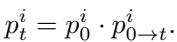
The motion confidence \(p_{0 \to t}^i\) is learned by a separate branch of the network, trained to predict the Intersection over Union (IoU) between the predicted box and the ground truth.
The Data Challenge: DSEC-3DOD
One of the biggest hurdles in event-based 3D detection is the lack of datasets. Standard datasets like Waymo or KITTI provide annotations at 10 Hz (active time). But to train and evaluate a model that works in blind time (e.g., at 100 Hz), you need ground truth labels between the frames.
The authors contributed two major datasets to the community:
- Ev-Waymo: A synthetic dataset based on Waymo, where events are simulated, allowing for perfect 100 FPS ground truth.
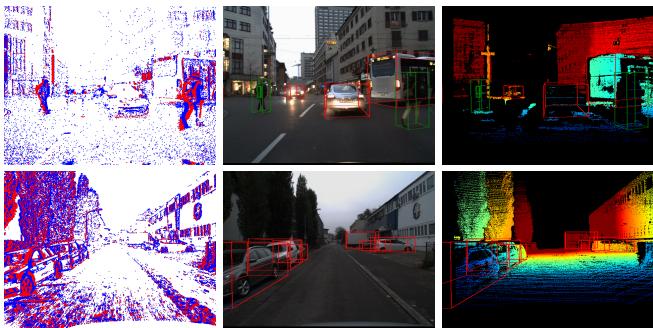
- DSEC-3DOD: The first real-world event-based 3D object detection dataset.
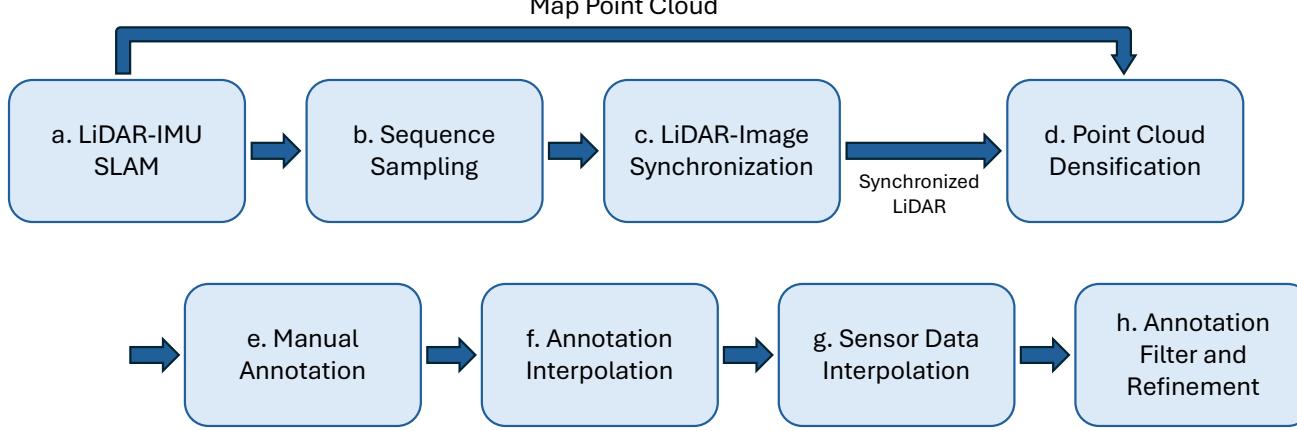
Creating DSEC-3DOD was a massive undertaking (Figure 8). Since humans cannot easily label 3D boxes at 100 FPS on empty space, the researchers used a complex pipeline involving:
- LiDAR-IMU SLAM: To get precise ego-motion.
- Interpolation: Using video frame interpolation and point cloud interpolation to generate “pseudo-data” for blind times.
- Manual Refinement: Experts adjusted the interpolated boxes based on the pseudo-data.
Experiments and Results
The researchers compared Ev-3DOD against state-of-the-art LiDAR and Multi-modal detectors. They used two evaluation protocols:
- Online: The model can only use data from the past (realistic scenario).
- Offline: The model can “cheat” by using data from the next active timestamp (\(t=1\)) to interpolate (idealistic scenario).
Quantitative Analysis
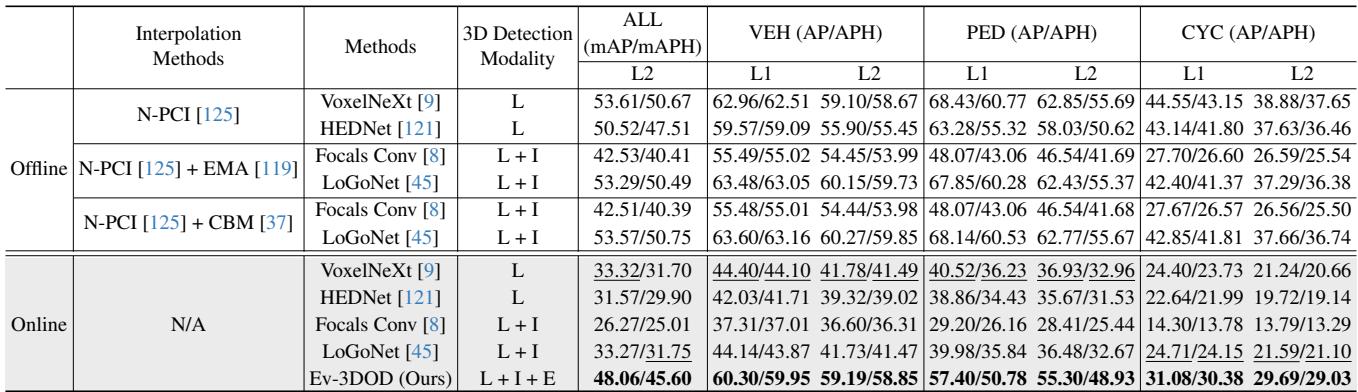
Table 1 displays the results on the Ev-Waymo dataset.
Key Takeaways from the Data:
- vs. Online Methods: Standard methods (VoxelNeXt, LoGoNet) degrade significantly in blind time because they assume the object is static or rely on simple linear motion. Ev-3DOD outperforms the best online method (LoGoNet) by a massive margin (e.g., 48.06 mAP vs. 33.27 mAP).
- vs. Offline Methods: Remarkably, Ev-3DOD performs comparably to offline methods that use future data. This suggests that the event stream provides enough information to effectively “predict the future” state of the object without actually seeing the next LiDAR frame.
Qualitative Analysis
The visual results are perhaps the most compelling evidence of the system’s robustness.
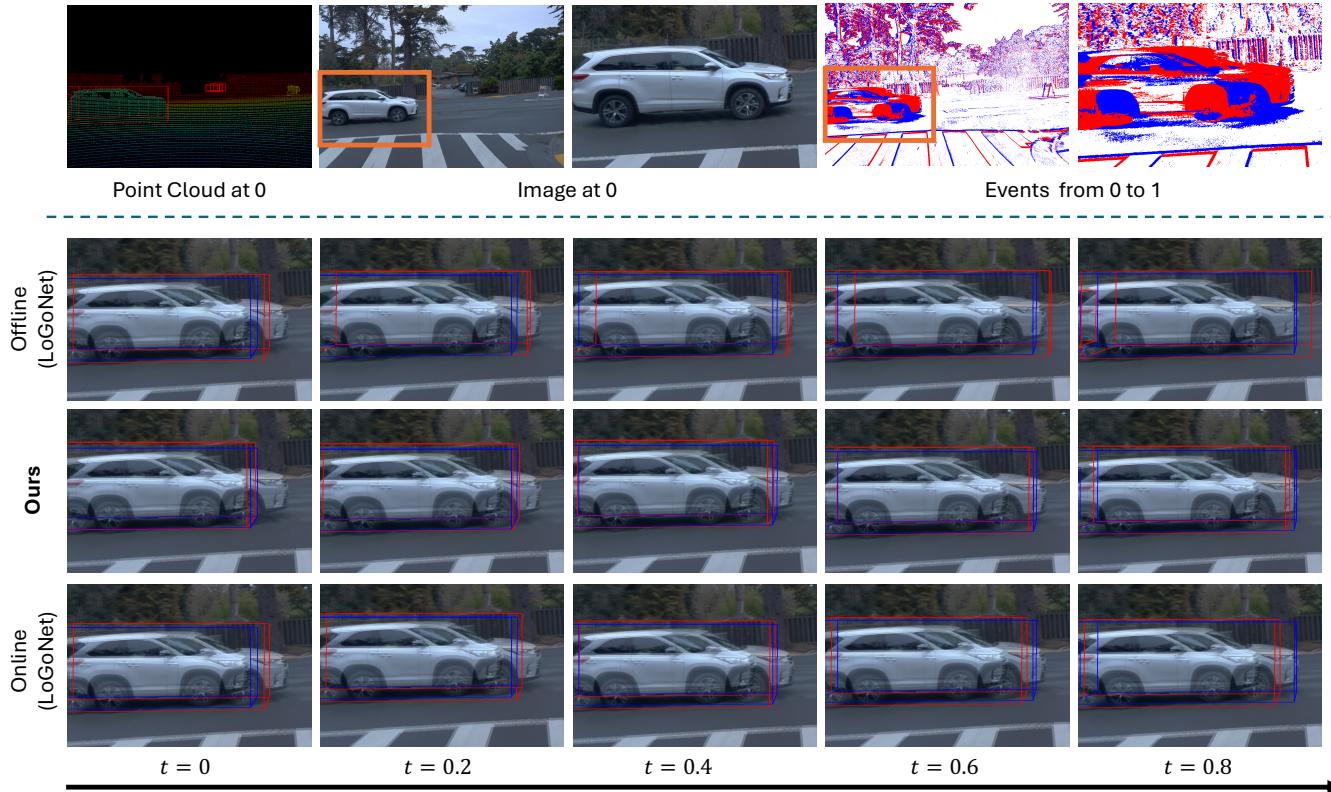
In Figure 5, we see a vehicle being tracked over time intervals \(t=0.2\) to \(t=0.8\).
- Red Box: The model’s prediction.
- Blue Box: Ground truth.
- Online Methods (Right): Notice how the red box lags behind or drifts away from the blue box as time progresses. The model has no new data to correct the position.
- Ev-3DOD (Center): The red box stays tightly aligned with the blue box, even 800ms after the last LiDAR scan. The events (white/black dots) provide the necessary cues to update the position.
Stability Over Time
How quickly does performance degrade after the last LiDAR scan? Figure 7 plots detection performance against elapsed time.
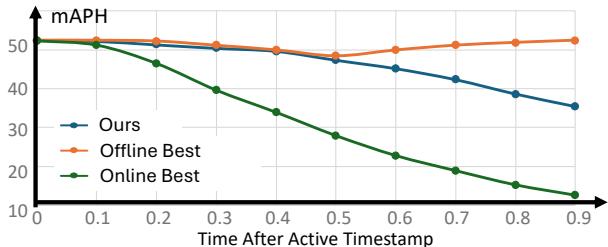
- Green Line (Online Baseline): Plummets rapidly. By the time you reach the middle of the blind time, the detection is unreliable.
- Red Line (Ev-3DOD): maintains a high curve, mimicking the behavior of the Offline (Blue) method. This proves that high-temporal-resolution events effectively fill the information gap.
Ablation Studies
The authors also validated their architectural choices. For instance, they removed the “Non-empty Mask” (which limits event projection to known voxel locations).
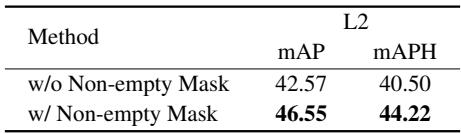
As shown in Table 4, removing this mask drops performance from 46.55 to 42.57 mAP. This confirms that guiding the event fusion with 3D structural priors (voxels) is essential to avoid noise and ambiguity.
Conclusion
The “blind time” between sensor frames has long been a vulnerability in autonomous perception systems. Ev-3DOD addresses this not by increasing the frame rate of heavy sensors, but by intelligently integrating a sensor designed for speed: the event camera.
By projecting 3D voxel information into the continuous 2D event stream (V3D-EF), the authors successfully bridged the gap between spatial precision and temporal resolution. The results show that we can track objects with “offline” accuracy in an “online” setting, significantly enhancing the safety margin for autonomous vehicles.
Furthermore, the release of DSEC-3DOD provides the research community with a benchmark to further explore this high-speed frontier. As event cameras become more accessible, techniques like Ev-3DOD will likely become standard components in the perception stack of future robots and vehicles.